Skip to content
Your son is turning 18 soon. He may communicate clearly in some settings, need help in others, and still rely on you for medical appointments, school transition planning, money management, or safe housing decisions. That's where many Texas families pause and ask a hard question: do we need guardianship, or is there a better way to protect him without taking away rights he can still use?
That question sits at the heart of guardianship for an autistic adult in Texas. Under Texas law, guardianship is a court-supervised legal relationship that can give another person authority to make certain decisions for an adult who is legally found to be incapacitated. It can involve personal decisions, financial decisions, or both. But Texas courts don't treat guardianship as the default. They treat it as a serious limit on adult rights, which means families must be ready to prove why it's necessary.
Understanding Guardianship for an Autistic Adult
Texas guardianship law appears primarily in Texas Estates Code Title 3, Subtitle G, along with related provisions in other parts of Title 3. In practical terms, guardianship allows a court to appoint someone to act for an adult who can't make some or all decisions safely and consistently, even with help.
For autistic adults, the issue is rarely simple. Some people need support with health care consent, housing choices, or public benefits, but can still express preferences, maintain relationships, and handle daily routines with structure. Others may need broader protection. Texas law is built to separate those situations instead of assuming one answer fits every family.
A guardianship may involve:
- Personal decisions such as medical care, living arrangements, and support services
- Financial matters such as managing assets or income
- Limited authority for only the areas where the adult lacks capacity
- Ongoing court oversight after appointment
Practical rule: Guardianship should solve a specific legal problem. It shouldn't be used just because a parent has always helped with daily life.
Families often start with broad fears. What happens if a hospital won't talk to me? What if my adult child signs something they don't understand? What if services break down after high school? Those concerns are real. The legal answer, though, depends on function, not diagnosis alone.
A good starting point is learning how Texas handles legal guardianship for adults with disabilities in Texas. The central theme is dignity. The court's job is to protect the adult while preserving as much independence as possible.
Assessing the Need and Eligibility
Some families come in convinced they need full guardianship. After a careful review, they may only need a limited order, or no guardianship at all. Others wait too long and run into problems with doctors, banks, or placement decisions because no legal authority is in place. The first step is an honest assessment of actual decision-making ability.
Texas courts require proof. Under Texas Estates Code § 1101.101 and related provisions, the court looks at incapacity and whether a guardian is needed at all. The legal burden is high because rights are at stake.
Statewide, courts are seeing more of these cases. In Texas fiscal year 2023, new adult guardianship filings rose by 8%, and person guardianships were up 15% over five years according to the Texas courts annual statistical report. That increase reflects what many families already feel on the ground. More parents and caregivers are trying to secure legal decision-making support for vulnerable adults.
What families should evaluate first
Don't start with labels. Start with decisions.
Ask questions like these:
- Medical understanding: Can your adult child understand the basics of treatment choices, risks, and follow-up care?
- Safety awareness: Can they recognize danger at home, online, or in relationships?
- Financial judgment: Can they manage money, benefits, and signing documents?
- Communication ability: Can they express a choice, even if they need extra time, visual tools, or supported communication?
- Consistency: Do they make the same decision over time, or are they highly vulnerable to pressure?
A diagnosis of autism doesn't automatically answer those questions. Courts want evidence tied to function.
What courts often want to see
Families help themselves by documenting supports they've already tried. That may include school transition records, therapy recommendations, benefit-management tools, or family decision supports. Emotional strain matters too. Caregivers who are carrying most of the responsibility may also need outside support for your mental well-being while working through these decisions.
A common example is a parent whose daughter can explain where she wants to live, what foods she likes, and who she trusts, but can't understand insurance forms, medication risks, or financial exploitation. That fact pattern may point toward limited authority rather than a full guardianship.
The medical side matters early. The Certificate of Medical Examination in Texas Guardianship is often where the case begins, because a guardianship petition needs documented incapacity, not just family concern.
Courts respond best when a family can show both sides of the picture: what the adult can do independently, and where specific legal help is still necessary.
Gathering Documentation and Filing the Petition
A strong case file is usually quiet and methodical. The families who struggle most often aren't careless. They're overwhelmed, rushing, or assuming the court will fill in missing facts for them. It won't.
Start with the correct probate court in the county where the proposed ward lives or where venue is otherwise proper. That might be a probate court in Harris County, a probate court in Bexar County, or the local county court handling guardianship matters in places with a different structure.
A simple visual helps families organize the early filing work:
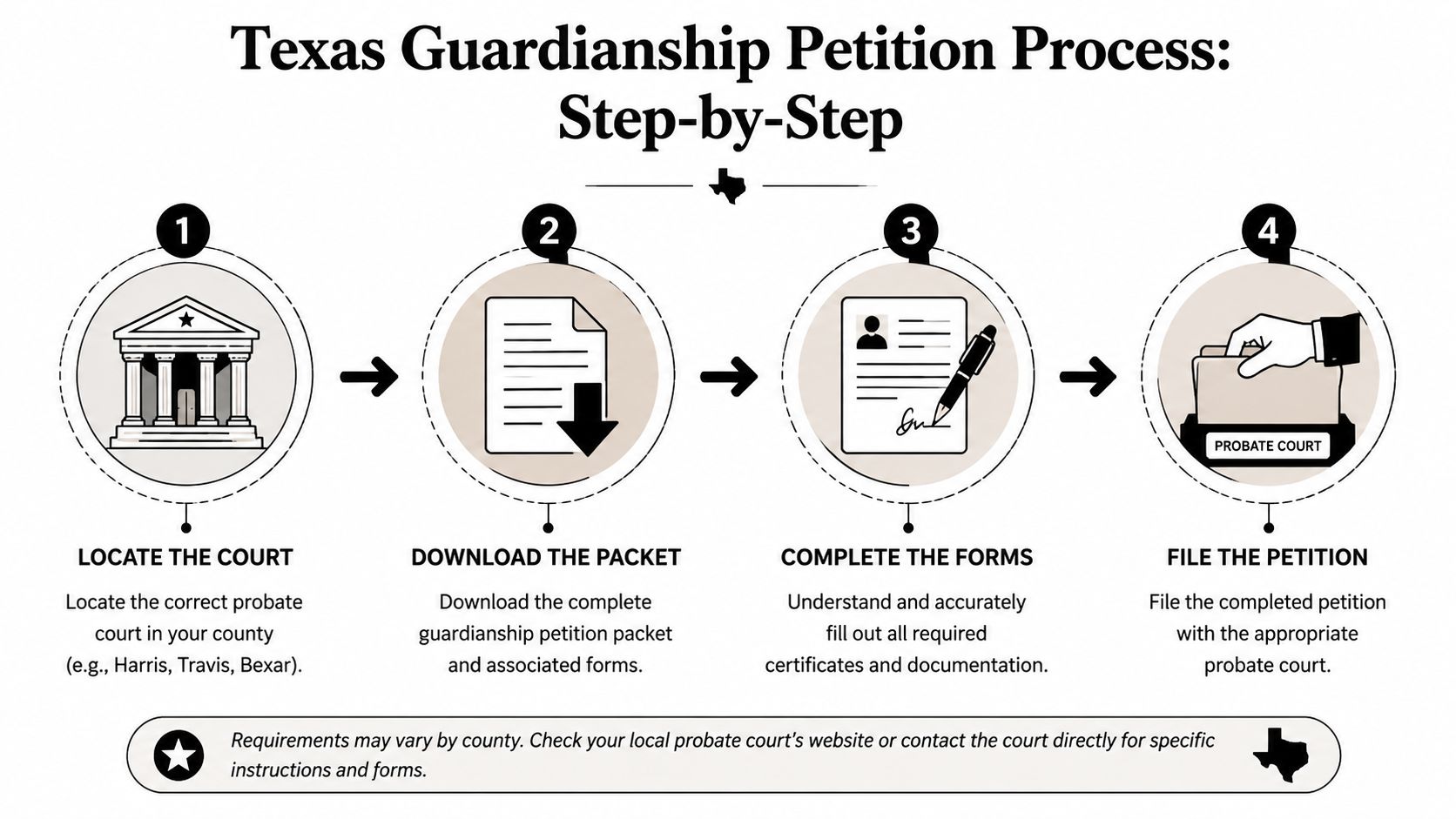
Core documents most cases need
The petition package usually includes the application itself and supporting material about the proposed ward and the proposed guardian. Courts want names, family relationships, the nature of the incapacity claim, and the powers being requested.
Pay special attention to these items:
The guardianship petition
This asks the court to appoint a guardian of the person, guardian of the estate, or both.The Physician's Certificate of Medical Examination
Texas requires a medical evaluation that addresses capacity in a legally useful way.Information about less restrictive supports
The court wants to know what was tried before seeking guardianship.Notice information for relatives and interested persons
Incomplete notice creates delay and can trigger objections.
The CME and less restrictive alternatives
Texas is explicit here. Texas law requires a Physician's CME that evaluates less restrictive alternatives before guardianship, and failure to document these supports often leads to denial, as explained in the Texas governor's guardianship guidance.
That requirement changes how families should prepare. Don't hand a doctor a blank form and hope for the best. Give the physician context. Explain what decisions are difficult to make, what supports are already in place, and whether the family is asking for full or limited authority.
Bring concrete examples to the medical appointment. “He forgets things” is weak. “He can't understand the risks of refusing seizure medication even after repeated explanation” is stronger and more useful.
The court will also appoint an Attorney Ad Litem to represent the proposed ward's interests. That attorney doesn't work for the parent. The ad litem investigates capacity, the adult's wishes, and whether guardianship is necessary at all.
Later in the filing stage, many families also benefit from a plain-language overview like How to Get Guardianship in Texas: The Process, which outlines the step-by-step court process for establishing a guardianship.
For readers who want a visual walkthrough, this short video can help frame the filing process before court appearances begin.
Practical filing tips that save time
- Match the request to the need: Ask only for powers you can justify.
- Check county rules early: Harris County Probate Court may handle scheduling and document review differently from a court in Travis County.
- Prepare for bond questions: If estate authority is requested, the court may require a bond.
- Keep a decision log: A short record of incidents, failed supports, and outside recommendations can help your lawyer and physician describe the case accurately.
Navigating Court Procedures and Hearings
After filing, the case turns from paperwork to proof. At this stage, many families feel the most stress because the process becomes public, formal, and intensely personal. A judge may hear details about your loved one's limitations, family disagreement, or private medical issues.
The legal standard matters. Under Texas Estates Code § 1101.052, the court must find by clear and convincing evidence that the proposed ward is incapacitated, that a guardianship is in the person's best interest, and that alternatives have been considered but aren't feasible. That standard is described in the Texas Estates Code guardianship provisions.
What usually happens before the hearing
The court process often includes service of notice, review of the medical certificate, and investigation by the Attorney Ad Litem. In many courts, including courts such as Harris County Probate Court, the judge expects the application to be narrow, specific, and supported by facts.
The proposed ward may be interviewed. So may caregivers, doctors, or service providers. If the adult can attend and participate, the court may want direct evidence of how the person communicates and what choices they can make.
A family should prepare for questions like:
- Why isn't a supported decision-making arrangement enough?
- Which rights should the adult keep?
- What exact risks exist if no guardian is appointed?
- Is there conflict between family members about who should serve?
Hearing day in practical terms
Some hearings are straightforward. Others become contested because a sibling objects, the adult resists the application, or the evidence is too broad and vague. In emergency situations, a family may also need to discuss temporary guardianship if immediate action is needed to protect health or safety. Those cases move quickly and still require careful proof.
A helpful way to prepare is to divide testimony into three lanes:
| Focus | What the court wants |
|---|---|
| Capacity | Specific examples of what the adult cannot do safely or legally |
| Alternatives | What supports were tried and why they did not solve the problem |
| Scope | Why the requested powers are limited to what is necessary |
The judge isn't deciding whether your loved one has autism. The judge is deciding whether the legal limits on adult rights are justified.
When disputes change the case
Guardianship disputes often arise from good intentions mixed with different views of independence. One parent may focus on safety. Another relative may believe the adult can manage with supports. Sometimes the adult strongly objects to guardianship but would accept a narrower arrangement.
That's where careful preparation matters most. Broad claims like “she can't handle adult life” usually land badly. Courts respond better to targeted evidence tied to residence, health care, contracts, benefits, or vulnerability to exploitation.
If a court grants a limited guardianship, the order should identify which decisions remain with the adult. That can include important civil rights unless the court finds incapacity in those specific areas.
Comparing Guardianship Types and Alternatives
The biggest mistake in many autism-related guardianship cases is treating the choice as all or nothing. Texas law doesn't require that. In fact, courts are directed to consider less restrictive options first.
Families dealing with guardianship for an autistic adult in Texas usually need to compare the legal tools side by side before filing anything.

The main guardianship forms
Here's the practical difference:
| Option | Typical use | Main trade-off |
|---|---|---|
| Guardianship of the person | Medical care, residence, personal decisions | Protects daily welfare but can limit autonomy |
| Guardianship of the estate | Assets, income, legal and financial management | Adds financial oversight and fiduciary duties |
| Full guardianship | Broad need across personal and financial areas | Most restrictive option |
| Limited guardianship | Specific decision gaps only | Requires careful drafting but preserves more rights |
A limited guardianship often fits better when the adult can make some choices with support but not others. That may be true for a young adult who can work, vote, or maintain friendships, yet still can't understand invasive medical treatment decisions or sign financial documents safely.
Alternatives Texas courts expect families to consider
Texas law is direct on this point. Texas courts must consider Supported Decision-Making Agreements as a less restrictive alternative before appointing guardians, per Estates Code § 1054.151, as discussed in The Arc of Texas white paper on guardianship.
A Supported Decision-Making Agreement allows an adult with disabilities to keep decision-making authority while choosing trusted supporters to help gather information, weigh options, and communicate choices. For many autistic adults, that model respects real support needs without removing adult status.
Families can learn more through this resource on supported decision-making agreements in Texas explained.
Other options may include:
- Representative payee arrangements for benefits
- Powers of attorney, when the adult has capacity to sign them
- Informal support systems with therapists, case managers, and family
- Limited guardianship orders instead of full control
A less restrictive alternative isn't a loophole. It's often the court's preferred answer when the adult can still make decisions with structured support.
A simple decision example
Consider a young man in Austin who can explain his medical symptoms, choose where he wants to spend time, and use public transportation on familiar routes. But he signs online contracts without understanding them, can't track benefits notices, and gets manipulated by acquaintances. A court may question full guardianship. It may be more open to a limited order, estate protection, or supported decision-making plus another financial safeguard.
That trade-off matters because some rights, such as voting, marriage, residence, and driving-related decisions, require close attention to the actual court findings.
Understanding Costs Duties Reporting and Planning
Families often focus so heavily on getting the order that they miss what comes after it. Guardianship doesn't end at the hearing. It begins there. Once appointed, the guardian takes on ongoing legal duties to act in the ward's best interest and follow court rules.
This visual captures the long-term framework:
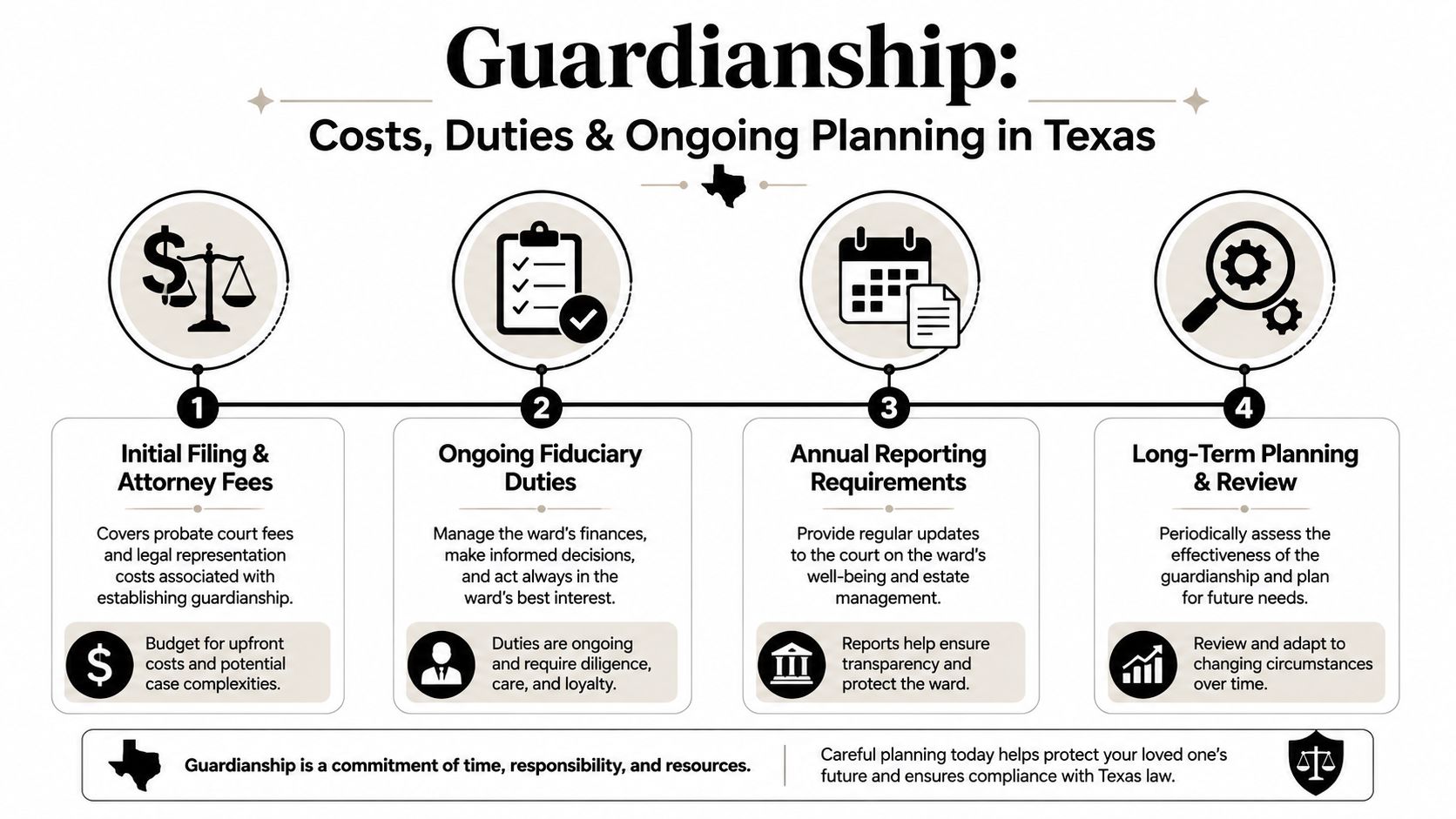
What continues after appointment
Some obligations are personal. Some are financial. All of them matter.
- Fiduciary duty: The guardian must act for the ward, not for personal convenience or family politics.
- Reporting: Courts often require regular updates, especially when property or funds are involved.
- Record keeping: Save receipts, statements, care records, and court notices.
- Periodic review: Families should reassess whether the current arrangement still fits the adult's needs.
For many households, planning also includes medical coverage, service access, and benefits coordination. If insurance changes are part of that discussion, some families also review options to enroll in Community Health Choice insurance alongside legal planning, especially when care networks and ongoing treatment access are a concern.
Planning for continuity
Texas gives families an important tool for the future. A surviving parent can name a successor guardian by will or declaration, giving families a tool for continuous long-term care under Estates Code § 1104.103, as stated in the Texas successor guardian statute.
That matters in real life. Parents age. Health changes. A sibling may move into a caregiving role. Naming a successor reduces uncertainty and can make a later transition more orderly.
Some families also pair guardianship planning with special needs trust planning in Texas when long-term financial protection and public benefits are both part of the picture.
Common Pitfalls and When to Seek Legal Help
The most common guardianship problems aren't dramatic. They're avoidable.
Families run into trouble when they file for full guardianship without evidence that narrower options were considered, submit a weak medical certificate, miss notice requirements, or ask for powers that don't match the actual need. Others forget that temporary guardianship, contested hearings, and post-appointment reporting all carry their own rules.
One practical option is working with a firm that handles guardianship applications, temporary guardianships, disputes, and ongoing compliance under the Texas Estates Code. The Law Office of Bryan Fagan, PLLC does that work in Texas probate and guardianship matters, including coordination of filings, hearings, and reporting.
Legal help is especially useful when:
- The adult objects to guardianship
- Relatives disagree about who should serve
- Emergency action may be needed
- Estate issues or benefits issues overlap with personal care concerns
If you're weighing guardianship for an autistic adult in Texas, personalized advice can make the process clearer and less stressful. Law Office of Bryan Fagan, PLLC helps Texas families evaluate alternatives, prepare guardianship filings, address disputes, and plan for long-term care with compassion and legal precision. Schedule a free consultation to discuss your family's next step.