Skip to content
You can technically file a guardianship petition yourself in Texas, but a lawyer-free guardianship is not realistic. The proposed ward must have their own attorney, and the court process requires a doctor's incapacity evaluation, personal service, notice to interested persons, an attorney ad litem, and a hearing before any appointment.
Maybe you're reading this because your mother is forgetting to pay bills, your brother can no longer safely manage his medications, or your child with a disability is turning into adulthood and you're worried about what happens next. Families often reach this point after months of doing their best informally. Then one hospital visit, one missed rent payment, or one call from a bank makes it clear that love and good intentions may not be enough.
That's when many people ask: Can you handle guardianship without a lawyer in Texas? The honest answer is that Texas law may let you file papers on your own in a narrow sense, but the system is built to protect the person at the center of the case. Because of that, the process is formal, evidence-heavy, and difficult to manage without legal help.
There's another question that matters just as much. Do you even need guardianship at all? In many Texas families, that's the better starting point. Guardianship can be necessary, especially in crisis situations or when someone cannot make safe decisions. But it is also one of the most restrictive legal tools the court can use.
A careful approach starts with the least restrictive option and moves upward only when needed. That means looking at powers of attorney, caregiver authorizations, trust planning, and other tools before asking a probate court in Harris County, Dallas County, Bexar County, or Travis County to place someone under guardianship.
Introduction A Difficult Question for Texas Families
Families rarely arrive at guardianship calmly. Most come to it after a period of confusion, fear, and exhaustion. A father starts wiring money to strangers. A grandmother leaves the stove on. A young adult with special needs turns 18, and parents learn they can no longer sign school, medical, or benefits paperwork the same way they used to.
In that moment, going to court can seem like the obvious next step. It can also seem like something you might save money on by doing yourself. That instinct is understandable. Legal help costs money, and many caregivers are already stretched thin.
But guardianship isn't just paperwork. You're asking a Texas court to give one person legal authority over another person's health, daily decisions, finances, or both. Courts treat that request seriously because it can limit the proposed ward's rights in a major way.
Practical rule: If the issue can be solved with a less restrictive legal tool, that option is often worth exploring before filing for guardianship.
That's why Texas public guidance points families toward alternatives before filing. Bexar County's guardianship guidance reflects that shift and encourages families to consider less restrictive tools first, including options such as authorization agreements for minors, medical powers of attorney, representative payees, ABLE accounts, special needs trusts, and community-administration options through Bexar County guardianship information.
What families often get wrong
Many people frame the decision as lawyer versus no lawyer. In practice, the better question is usually this:
- Is guardianship necessary
- If it is necessary, what type is needed
- If it isn't necessary, which legal tool fits the problem
- If court is unavoidable, how do you avoid costly mistakes
That shift matters. If your concern is medical decision-making, a healthcare document may solve it. If the problem is school or temporary caregiving for a minor, another tool may fit better. If the issue involves a person who cannot safely manage broad personal and financial decisions, guardianship may still be the right path.
What to do first
Before you rush to file, gather the facts:
- Write down the problems you're seeing. Focus on missed medications, unpaid bills, unsafe driving, confusion, or inability to understand basic decisions.
- List the decisions that must be made. Medical, financial, housing, school, benefits, or all of the above.
- Check whether the person can still sign legal documents. Capacity can change over time and by issue.
- Look at urgency. If there's immediate risk of harm or loss, the legal response may need to move faster.
A careful start can save your family time, conflict, and heartache.
The Legal Reality Why a Lawyer Is Always in the Room
Texas guardianship law is built around one core idea. The court's first job is to protect the proposed ward, not to make the filing process easy for the family member asking for authority.
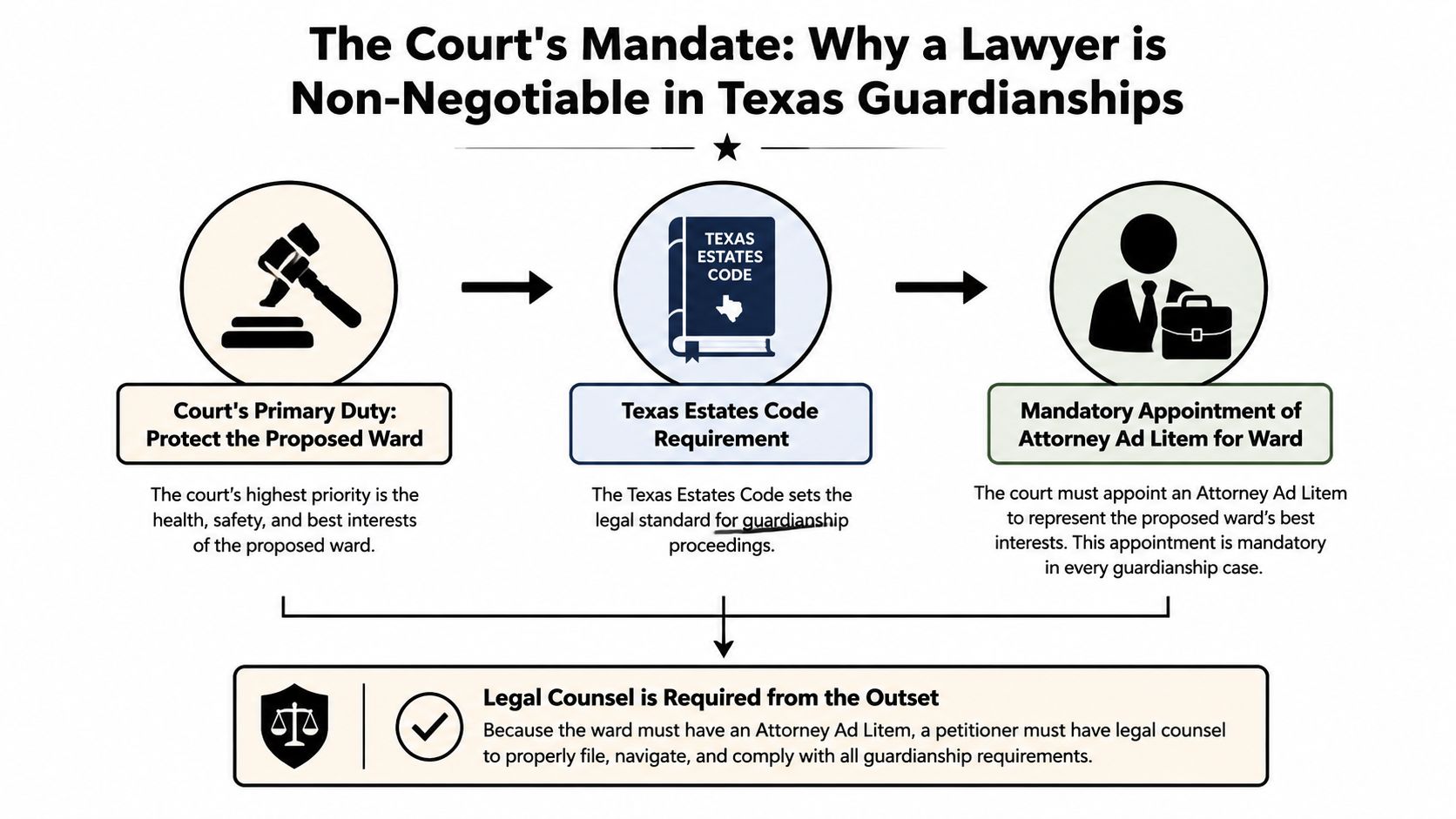
That's why the phrase “without a lawyer” can be misleading in this setting. A non-lawyer may represent themselves in a limited sense, but they can't represent another person's legal interests in a guardianship case. Texas Law Help states that you must hire an attorney because you do not have the right to represent another person in guardianship proceedings, and the proposed ward must be represented by a licensed attorney. The process also requires a doctor's incapacity evaluation, personal service on the ward, notice to interested persons, an attorney ad litem, and a hearing before appointment, as explained by Texas Law Help's guardianship overview.
Why the court inserts legal protection
A guardianship case can affect where someone lives, who handles their money, and who makes medical choices for them. Judges in probate courts, including places like Harris County Probate Court or Bexar County Probate Court, don't treat that as a family formality. They treat it as a serious legal action that may reduce someone's independence.
The court therefore appoints an attorney ad litem to protect the ward's interests. If you want a plain-language explanation of that role, The Attorney Ad Litem and Court Investigator in Texas describes the advocates a court appoints to protect the proposed ward.
What this means in real life
Even if you don't hire your own lawyer at the start, you still walk into a process where legal professionals are already involved. That includes:
- The ward's attorney: This lawyer represents the proposed ward, not you.
- The judge: The court looks for proof, procedure, and legal compliance.
- The attorney ad litem: This person examines whether the guardianship request is proper.
- Court staff and local rules: Probate courts often have county-specific practices that can trip up self-represented applicants.
You're not simply filing for permission to help. You're asking the court to change another person's legal status.
That is why families are often surprised by how formal the process feels. They may believe they are doing what's best. The court still requires them to prove it the right way.
Common Pitfalls of Filing for Guardianship Alone
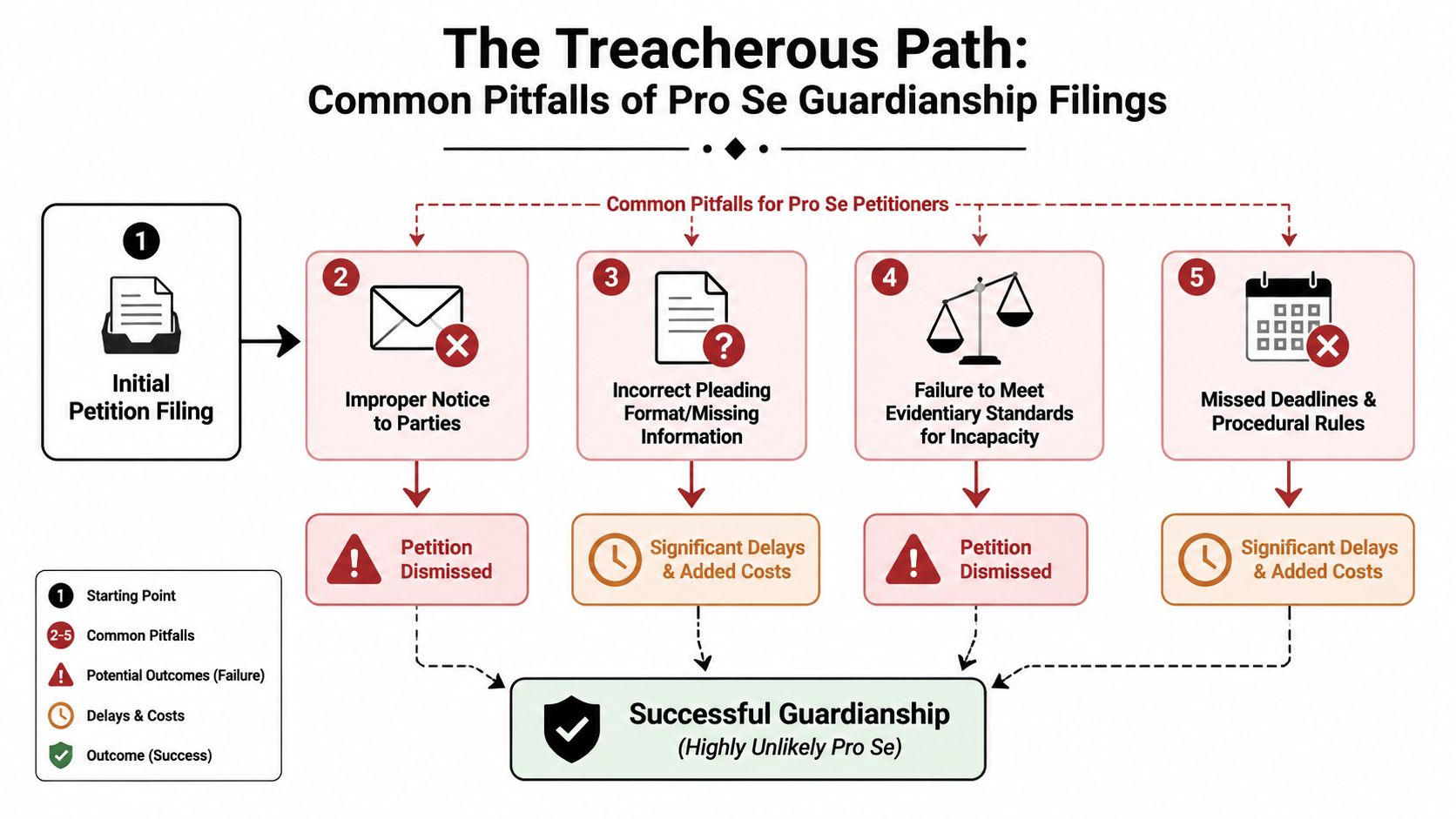
The biggest problem with self-filed guardianship cases isn't usually bad intent. It's procedural failure. Texas Estates Code requirements are detailed, and probate courts expect strict compliance.
Under the Texas Estates Code, a person isn't flatly barred from filing without an attorney, but the process carries a high risk of denial when key requirements are missed. The petition must include detailed verified facts under Section 1101.002, the physician's certificate under Section 1101.101 must be properly prepared and dated within 120 days of filing, notice rules under Section 1102.051 must be followed, and the court-appointed attorney ad litem under Section 1103.001 may challenge flaws in the filing, as outlined in Texas Estates Code guardianship provisions.
Where self-filed petitions break down
A guardianship application has to do more than say, “My loved one needs help.” It must present the right facts in the right format.
Common trouble spots include:
- The petition itself: It must be verified and include facts about incapacity, residence, and why guardianship is necessary.
- The doctor's certificate: Courts often reject letters that sound helpful but don't match what the law requires.
- Notice and service: Family members and other interested persons may need notice, and the proposed ward must be personally served.
- Hearing preparation: The judge may ask focused questions about less restrictive alternatives, living arrangements, finances, and necessity.
The physician's certificate problem
This is one of the most common points of failure. Families often bring in a doctor's note that says the person has dementia, memory loss, or disability. That may not be enough.
The certificate must do more than give a diagnosis. It must address specific deficits in decision-making capacity, such as the inability to manage finances or care for personal needs, and it must fit the statutory timing and form requirements. If it doesn't, the court may refuse to move forward.
A hard truth: A supportive doctor is not the same thing as a legally sufficient incapacity evaluation.
Notice mistakes can stop the case
Notice sounds simple until you're responsible for doing it correctly. Who must receive notice, how they receive it, and when they receive it can become a due-process issue. If notice is defective, the court may dismiss the case or delay it until the problem is fixed.
In busy probate courts, that can mean more waiting, more filing, and more stress for a family that is already dealing with a crisis.
Why forms alone don't solve it
Some families try to piece together documents from county websites, old samples, or tools designed for efficient legal document creation for lawyers. Those tools can be useful in the hands of trained professionals, but a guardianship filing still requires legal judgment about evidence, notice, and court procedure.
If you want a general overview of the filing path, this guide on how to file for guardianship in Texas can help you see the moving parts. Seeing the steps on paper often makes one thing clear. This is not a simple one-form process.
Real-World Examples What Can Go Wrong
Maria lives in Houston and cares for her father, who has worsening memory problems. He forgets to eat, gives away money over the phone, and insists that nothing is wrong. Maria decides to file for guardianship in Harris County because she thinks the facts are obvious.
She gets a letter from his doctor saying he has Alzheimer's disease and needs help. She files the paperwork herself and feels relieved. Then the problems begin. The court wants a medical evaluation that addresses decision-making deficits in the form the law expects. The attorney for her father asks whether less restrictive options were considered. At the hearing, Maria struggles to answer questions about his assets, his ability to make some choices but not others, and why a narrower option won't work.
The case doesn't collapse because Maria is careless. It stalls because guardianship requires legal proof, not just family concern.
A newly adult child with assets
David and Sarah in Dallas have a son with severe autism who just turned 19. They handled everything for him while he was a minor. Now they need authority to deal with his care and to manage money connected to a past injury settlement.
They assume the court process will be straightforward because no one in the family disagrees. But the details become harder once money enters the picture. The order must match what financial institutions expect. The family also has to show why this level of authority is necessary and what alternatives were considered.
A bank later refuses to act on paperwork the parents thought was enough. That creates a practical crisis. Bills still need to be paid, and the family has to return to court and legal counsel to correct the record.
The emotional cost families don't expect
These situations are draining for two reasons. First, the family already knows the loved one needs help. Second, the court still requires a structured legal showing that may feel cold or repetitive.
That gap can be painful. Children feel like they are proving a parent's decline in public. Parents of disabled adult children feel like they are suddenly strangers to systems they once dealt with easily.
Most families don't need false reassurance. They need a clear path that protects their loved one and holds up in the real world.
Exploring Smarter Alternatives to Guardianship
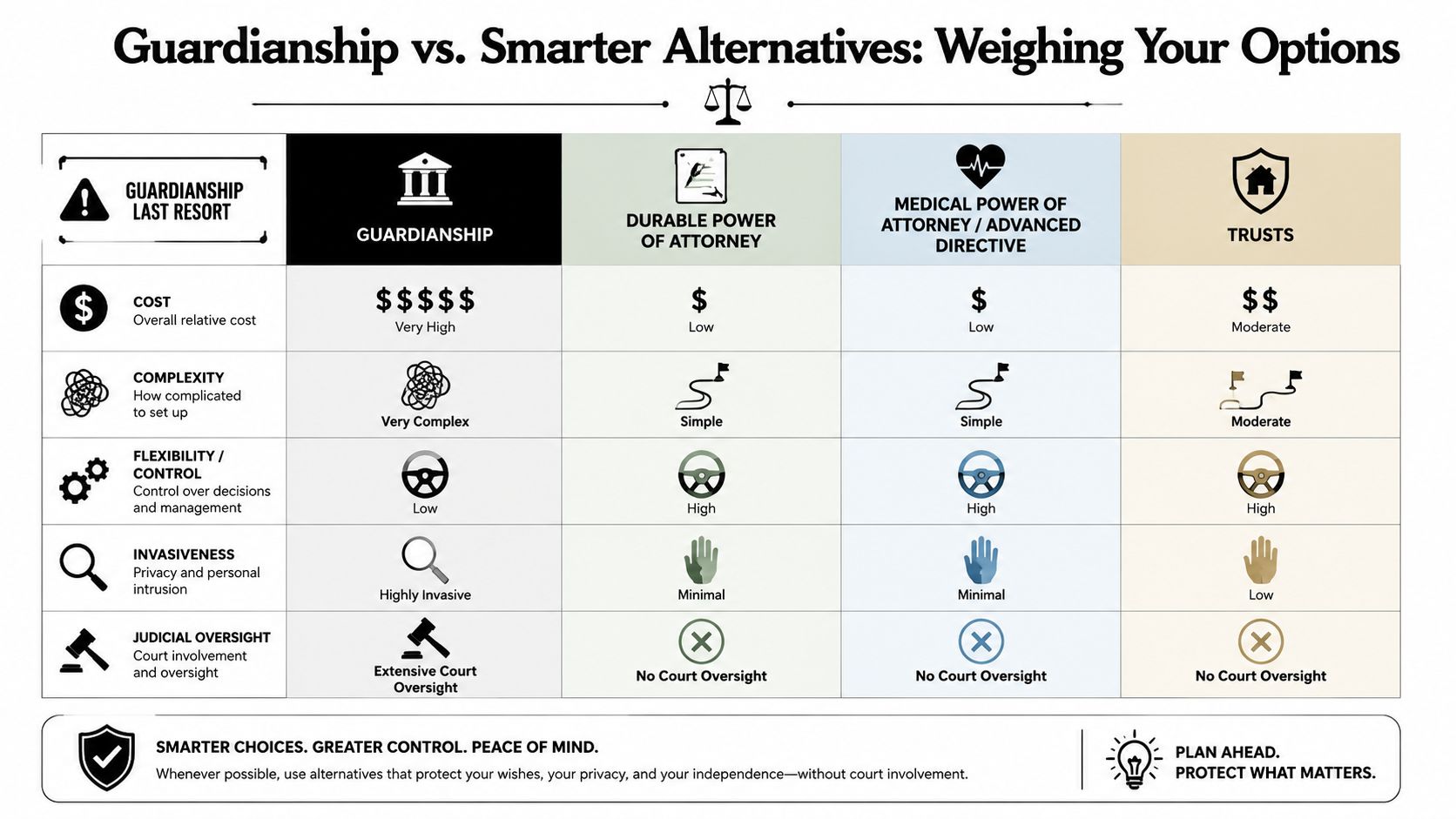
For many families, the better first question isn't “Can I file this myself?” It's “What problem am I trying to solve?” Guardianship may be necessary, but it should usually be treated as a last resort because it puts the court at the center of a person's life and can remove rights that may not need to be removed.
Texas law provides several alternatives that can sometimes solve the underlying issue without a full guardianship case. These include the Authorization Agreement for Nonparent Relative under Texas Family Code Section 34.001 and the Medical Power of Attorney under Texas Health and Safety Code Section 166.152. But these tools can fail when families draft them without legal guidance, because banks, schools, and hospitals may reject documents with weak language or missing formalities, as reflected in Texas Family Code Section 34.001 and related statutory alternatives.
A side-by-side view can make the choice clearer.
Matching the tool to the problem
| Situation | Tool that may fit | Key limitation |
|---|---|---|
| An adult still has capacity and wants help with healthcare choices | Medical Power of Attorney | It only works if the adult can validly sign it |
| An adult wants someone to handle finances | Durable Power of Attorney | Third parties may reject poor drafting or unclear authority |
| A nonparent relative is caring for a minor | Authorization Agreement for Nonparent Relative or Voluntary Caregiver | It is limited in scope and duration |
| A person receives benefits that need management | Representative payee arrangement | It does not replace broad legal authority |
| A disabled person needs asset planning | ABLE account or special needs trust | These tools address assets, not broad personal decision-making |
| A person cannot safely make major decisions and no alternative works | Guardianship | It requires court involvement and ongoing duties |
What each option actually does
A Medical Power of Attorney lets an adult choose an agent for healthcare decisions. This can be a strong option when the person understands what they are signing and wants to name someone they trust.
A Durable Power of Attorney can help with finances. But it needs careful drafting if the goal is for it to remain effective during incapacity. That's where families often run into trouble. The document may look complete, yet a bank may still question it.
An Authorization Agreement can help when a nonparent relative or voluntary caregiver needs temporary authority for a child's education or medical needs. It can be useful, but it does not create broad guardianship powers and won't solve every custody or financial issue.
Texas families also look at ABLE accounts, special needs trusts, and representative payee arrangements when the primary issue is benefits management, savings, or protected asset handling rather than broad incapacity.
Here's a helpful explainer on whether you really need guardianship in Texas and five alternatives to consider.
This video gives more context on less restrictive planning:
Why “simpler” documents still need care
Families often assume a power of attorney is just a quick form. Sometimes it works that way. Sometimes it doesn't. Hospitals, insurers, and banks may review the wording closely, especially if there is any ambiguity about authority.
If you're researching templates, resources such as an AI-powered general power of attorney can help you understand the structure of these documents. But understanding the form isn't the same as making sure it will be honored in your family's specific situation.
For broader planning, some families also pair these tools with Texas estate planning guidance so medical, financial, and disability-related decisions work together instead of colliding later.
When You Absolutely Need an Attorney
Some cases leave room to discuss alternatives. Some do not. If any of the situations below apply, legal help moves from wise to necessary.

The no-delay checklist
- Someone objects to the guardianship. If the proposed ward disagrees, or another family member contests the request, the case can quickly become evidence-heavy and emotionally charged.
- There are meaningful assets. Real estate, investment accounts, business interests, or settlement funds increase the stakes and the paperwork.
- You need emergency action. Temporary or emergency guardianship requests move fast and still require careful proof.
- Abuse, neglect, or exploitation is suspected. These cases often involve urgent facts, competing narratives, and the need for protective orders or court intervention.
- You live outside Texas. Out-of-state family members often face extra practical and procedural hurdles.
- The ward is a newly adult child with complex needs. Many parents discover that turning 18 changes legal authority overnight.
Cases that seem simple but aren't
A “friendly” family case can still be legally complicated. No one may be fighting, but the court still wants a proper record. If you are asking for guardianship of the person, guardianship of the estate, or both, the legal duties continue after the hearing.
That includes reporting, fiduciary obligations, and compliance with court orders. If the court appoints you, your work is not over. It's beginning.
If your goal is to protect your loved one without delays, the safest time to get legal help is before the filing, not after a dismissal.
Some families also need connected advice about probate or existing incapacity planning. Others need a full guardianship strategy. For that kind of review, a Texas guardianship attorney resource can help you identify what level of representation the case calls for.
If your issue overlaps with a deceased parent's estate, inherited property, or court-managed assets, legal advice may also need to include Texas probate guidance.
Your Path Forward Protecting Your Loved One with Confidence
Guardianship cases in Texas are not designed as do-it-yourself projects. That isn't because families don't care enough or work hard enough. It's because the law is trying to protect a vulnerable person while balancing safety, dignity, and due process.
For some families, the right answer is not guardianship at all. For others, guardianship is necessary, but it needs to be done carefully and correctly the first time. The key is choosing the least restrictive tool that works in real life, not just on paper.
If you're unsure whether your situation calls for a power of attorney, a trust-based plan, temporary action, or a full guardianship application, getting legal guidance early can prevent confusion later. It can also help you understand what happens after appointment, including duties to the court, compliance requirements, and when a guardianship may later be modified or terminated.
Protecting a loved one should bring clarity, not more chaos.
If your family is facing questions about guardianship, alternatives to guardianship, emergency protection, or ongoing court compliance, the Law Office of Bryan Fagan, PLLC offers free consultations to help you understand your options under Texas law. A focused conversation can help you decide whether court involvement is necessary, what documents may work instead, and what steps to take next for your loved one's safety and dignity.