Skip to content
In Texas, a formal ceremony isn't the only path to a legally recognized marriage. The state acknowledges what is known as a common law marriage—often called an "informal marriage"—which holds the same legal weight as a traditional, ceremonial marriage. This can be a source of both comfort and confusion for many families, especially when navigating major life events like separation or the loss of a partner.
At The Law Office of Bryan Fagan, we understand that these situations are emotionally challenging. Our goal is to provide clear, compassionate guidance to help you understand your rights and protect your family's future.
So, how does it work? To establish a common law marriage in Texas, a couple must meet three specific requirements at the same time:
- Agree to be married.
- Live together in Texas as a married couple.
- Present themselves to others (or "hold out") as being married.
These three elements are the bedrock of any informal marriage in the eyes of Texas law.
Demystifying Informal Marriage in Texas
It often comes as a surprise to people that a relationship without a formal wedding can have the exact same rights and responsibilities as one that started with a marriage license. This isn't a legal loophole; it's a long-standing tradition in Texas law that provides a path for couples to gain legal recognition without a ceremony.
This concept has deep roots, and Texas is one of the few states that still honors this type of union. Recognizing an informal marriage is incredibly important when it comes to things like property rights after a separation, inheritance if one partner passes away, or making critical medical decisions. You can find more details on how courts navigate these situations in our family law resources.
To make this crystal clear, let's break down the three essential pillars required for a Texas common law marriage.
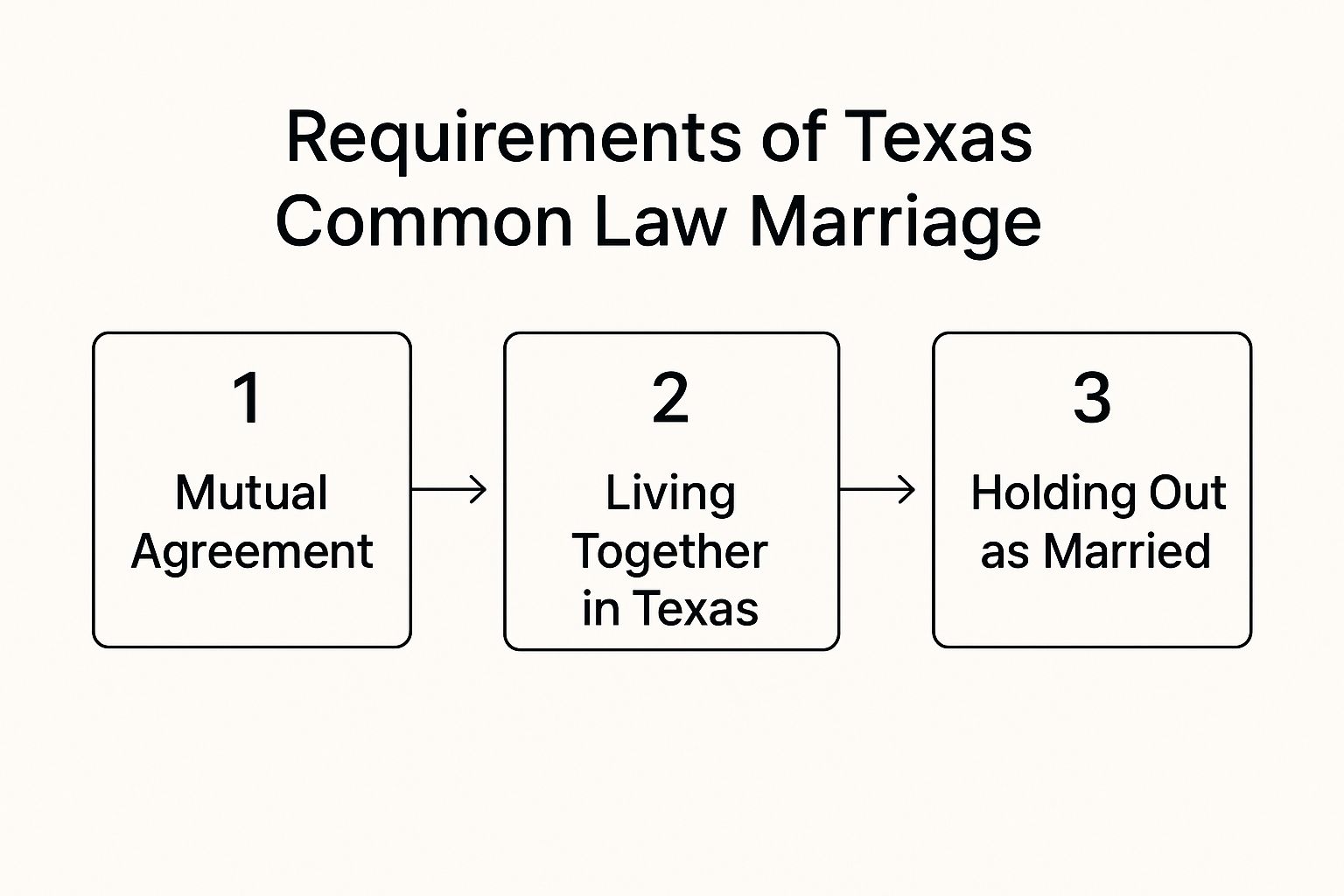
As you can see, these aren't steps you can check off over several years. The agreement, living together, and presenting as married must all happen simultaneously to form a valid marriage.
Here is a simple table to summarize these non-negotiable elements.
The Three Pillars of a Texas Common Law Marriage
| Legal Element | What It Means in Simple Terms |
|---|---|
| Agreement to be Married | Both partners must have a present and mutual intention to be married right now, not at some point in the future. |
| Living Together in Texas | The couple must cohabitate within the state of Texas, sharing a home and life as spouses. |
| Holding Out to the Public | The couple must represent themselves to the community—friends, family, businesses—as a married couple. |
Think of these as three legs of a stool; without all three firmly in place at the same time, you don't have a legally recognized marriage.
Understanding this foundation is the first step toward protecting your rights. A valid common law marriage is not a "lesser" or "unofficial" marriage—it is a real marriage in every legal sense. In the sections that follow, we'll dive deeper into each of these requirements with practical, real-world examples to help you figure out where you stand.
Meeting the Three Core Requirements for Marriage

So, how does a common law marriage actually become official in the eyes of Texas law? It boils down to meeting three specific requirements all at the same time. Think of these as the three legs of a stool—if one is missing, the whole thing falls apart.
These aren't just boxes to check off a list. A court will demand clear and convincing evidence that all three elements were present simultaneously to recognize your relationship as a legal marriage. Let's break down what the common law marriage requirements in Texas actually look like in the real world.
The Agreement to Be Married
First up is the mutual agreement to be married. This is the element that trips most people up. It's not about having an engagement or making plans to get married someday. It means that at a specific point in time, both you and your partner looked at each other and decided, "Right now, from this moment forward, we are married."
This is a present-tense agreement. It's an immediate understanding that the marriage has begun. While it can be spoken out loud, it can also be inferred from your actions, but the intent must be clear: the marriage started then and there.
A promise to get married next year is not an agreement to be married today. A Texas court will look for evidence that you both intended to be in a marriage relationship in the present, not the future.
Living Together in Texas as Spouses
Next, you have to live together in Texas after you’ve made that agreement. This is far more than just sharing an apartment to save on rent. The legal term is cohabitation, and it means you are sharing a home and building a life together as a married couple would.
There’s no magic number for how long you have to live together. A week might be enough if the other evidence is rock-solid, but even years of cohabitation won’t count if you never agreed to be married or held yourselves out as such.
A court in Harris County, for instance, would want to see that you created a genuine home life—sharing chores, splitting bills, and falling into the daily routines that define a committed, marital partnership.
Holding Yourselves Out to the Public as Married
Finally, you must have represented yourselves to others as a married couple. This is often the easiest part to prove because it usually leaves a paper trail. It simply means you acted like you were married in public and let your community believe it.
There are countless ways to show a court you were "holding out":
- Introductions: You call your partner "my husband" or "my wife" when talking to friends, family, or coworkers.
- Official Documents: You file joint tax returns, list each other as a spouse on an insurance policy, or sign a lease agreement as Mr. and Mrs.
- Shared Last Name: Using the same last name, even informally, is powerful proof.
- Community Recognition: Friends and family members can testify that they believed you were married because of how you both spoke and acted.
Crucially, all three of these pillars must be in place at the same time. You can’t agree to be married in January, move in together in June, and only start telling people you're married in December. A valid common law marriage requires the agreement, the cohabitation, and the public representation to all be happening at once.
How to Formally Prove Your Marriage Exists
You might know in your heart that you’re married, but when it comes to the law, you have to be able to prove it. This becomes incredibly important during stressful times, like a separation or after a partner passes away. Simply meeting the common law marriage requirements in Texas isn’t always enough—a court will demand clear and convincing evidence.
Trying to pull this proof together while dealing with grief or the emotional chaos of a breakup can feel impossible. Thankfully, Texas law gives you a couple of ways to formally establish your marriage and protect your rights as a spouse.
The Strongest Proof: A Declaration of Informal Marriage
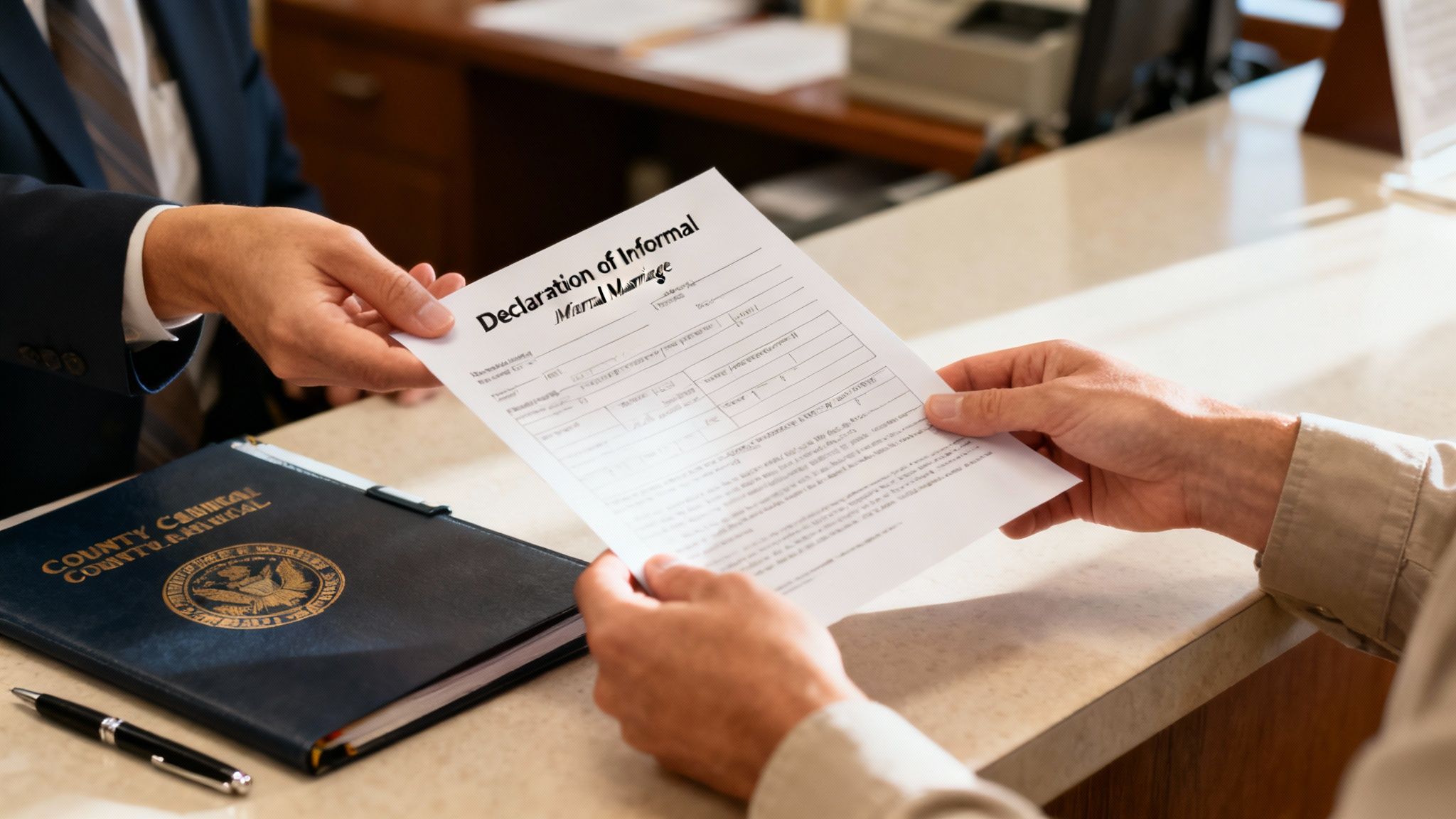
The most straightforward and powerful way to prove your marriage is by filing a "Declaration and Registration of Informal Marriage" with your county clerk. Once you and your partner sign this official document and get it filed, it serves as definitive legal proof of your marriage and, crucially, the date it began.
Think of it as a retroactive marriage certificate. The declaration doesn't create the marriage; your agreement and actions already did that. What it does is put an official stamp on it for the world to see. Filing this form at a place like the Harris County Clerk’s office can shut down any future arguments about whether the marriage was real.
Building Your Case with Supporting Evidence
What if you never filed a Declaration? You'll have to prove your marriage the hard way: by building a case with other evidence. A judge will need to see a consistent pattern of documents and testimony that shows you both acted like a married couple.
It's true that proving a common law marriage in Texas can be tricky without a formal ceremony or certificate. However, the state provides a clear legal framework for couples to make their marital status official. As legal research shows, filing the right forms with the county clerk is the best way to document your marriage's start date and create a powerful piece of evidence. You can read the full research about this legal framework.
If you find yourself in court, you'll need to gather compelling proof. Here's what that looks like:
- Financial Documents: Joint bank accounts, shared credit cards, and loan applications listing you as spouses are hard to argue with.
- Property Records: Do you have lease agreements, property deeds, or mortgage paperwork that lists you both as a married couple? That’s gold.
- Official Forms: Jointly filed tax returns ("married filing jointly") are one of the strongest indicators. Insurance policies that name each other as a "spouse" are also excellent proof.
- Witness Testimony: Don't underestimate the power of people. Statements from friends, family, and neighbors who can truthfully say you introduced yourselves and lived as a married couple can make all the difference.
Gathering this evidence isn't just a legal exercise—it's a critical step in protecting your relationship's legal status. Without it, you could lose your rights to property, inheritance, or other vital spousal benefits.
Understanding Your Rights and Responsibilities

Many people have the wrong idea about common law marriage. They think it's some kind of "marriage-lite"—a casual, unofficial version that doesn't carry much legal weight. In Texas, that couldn't be further from the truth.
Once your relationship checks the three legal boxes, it is a real marriage. Period. It carries the exact same weight, rights, and responsibilities as a ceremonial marriage that started with a walk down the aisle. Your partnership is fully recognized under the law, and that has profound implications for your family's financial security and future.
What Legal Recognition Truly Means
When your informal marriage is legally established, you gain powerful rights that protect both you and your partner. These aren't just abstract legal concepts; they have a direct impact on your life.
Here are some of the most important ones:
- Community Property: In Texas, anything you or your spouse earn or acquire during the marriage is considered community property. That means it belongs equally to both of you, regardless of whose name is on the paycheck or title.
- Inheritance Rights: If one spouse passes away without a will, the surviving common law spouse has the same inheritance rights as any other surviving spouse. This is critical for protecting their claim to the family home, savings, and other assets you built together.
- Spousal Benefits: You suddenly become eligible for all the benefits typically reserved for married couples. Think things like being added to a spouse's health insurance plan or qualifying for Social Security spousal benefits down the road.
A valid common law marriage ensures that a surviving partner isn't left financially vulnerable after a loss. It grants them the legal standing to make critical decisions and inherit the assets you built together.
Shared Responsibilities and Obligations
Of course, with rights come responsibilities. Being in a common law marriage means you have the same legal duties to each other as couples who had a formal wedding.
This includes everything from property and inheritance rights to what happens if you separate. Since Texas is a community property state that also recognizes informal marriage, the legal landscape can get complicated quickly, especially during a divorce.
This also extends to any children you have together. The law sees you both as legal parents with equal duties of support and care. If you want to learn more about what this entails, you can check out our guide on understanding parental responsibilities and custody arrangements.
Debunking Common Myths About Informal Marriages
When it comes to common law marriage, misinformation can create some serious legal and financial headaches. Believing these myths could put your family’s future on the line, so it's critical to separate the popular fiction from the legal facts.
Let's tackle some of the most persistent myths head-on.
Myth 1: The Seven-Year Rule
This is probably the most famous myth out there: live with someone for a certain number of years—usually seven—and you're automatically married. This is completely false.
Texas has no minimum time requirement for cohabitation. You could live with someone for 20 years and never be married in the eyes of the law. On the other hand, you could establish a valid informal marriage in just a few weeks if you meet all three legal requirements at the same time. The calendar is far less important than your actions and intentions.
A common law marriage is based on present intent and public representation, not the number of years you've shared a home. Focusing on a "magic number" of years is a common and costly mistake.
Myth 2: It's an Automatic Process
Right alongside the seven-year rule is the idea that an informal marriage just sort of happens on its own after you've been together for a while. It doesn’t work that way.
A common law marriage isn't passive. You and your partner must actively and intentionally meet all three common law marriage requirements in Texas at the same time. It’s a conscious choice, not something you stumble into.
Myth 3: You Don't Need a Formal Divorce
Because there was no ceremony or marriage license, many people assume they can end a common law marriage by simply moving out and calling it quits. This is a dangerous and incorrect assumption.
Once a valid informal marriage is established, it is a real marriage in every legal sense. The only way to dissolve it is through a formal, court-ordered divorce—just like any other marriage. Trying to skip this step can lead to major complications with property, debt, and future relationships.
Why an Informal Marriage Still Requires a Formal Divorce
Here's a common and costly mistake: assuming you can end a common law marriage just by walking away. Because there wasn't a formal ceremony or a marriage license, many couples think they can just separate and move on with their lives.
But in the eyes of the law, that’s not how it works. Once your relationship meets the common law marriage requirements in Texas, it is a legally binding union. It carries the exact same weight as any ceremonial marriage.
This means you can't just informally dissolve it. Your relationship has to be officially terminated through a court-ordered divorce, just like any other marriage. This is a critical step to legally separate your lives and protect your future. The process starts by filing a formal Petition for Divorce with the right court, like the Harris County District Court.
Just like a traditional divorce, the court proceedings will tackle several key issues:
- Division of Community Property: The court will divide any assets and debts you and your partner accumulated during the time you were married.
- Child Custody and Support: If you have children together, the court will issue legally enforceable orders for custody, visitation, and child support.
Going through this process can be emotionally draining, especially when you never had a formal wedding in the first place. However, getting that formal divorce decree is the only way to protect your financial interests and gain legal clarity.
For a deeper dive into this process, you can find helpful information in our comprehensive articles on divorce in Texas. A formal divorce ensures both of you can move forward independently, without any unresolved legal strings attached.
Frequently Asked Questions About Texas Common Law Marriage
When you’re navigating the ins and outs of an informal marriage, real-life events can bring up a lot of tough questions. Let’s clear up some of the most common concerns couples face about common law marriage requirements in Texas and what they mean for your future.
Deadlines and Legal Standing
How long do I have to prove our common law marriage after we separate?
This is a big one, and the clock starts ticking immediately. Texas gives you a strict two-year statute of limitations to prove your marriage after you and your partner have separated.
You must file a legal proceeding, like a divorce, within those two years. If you miss that deadline, the law automatically presumes that you were never married. Overcoming that presumption is an uphill battle and can make your case incredibly difficult to win.
Can we have a common law marriage if one of us is still married to someone else?
Absolutely not. One of the bedrock requirements for any valid marriage in Texas—ceremonial or common law—is that both people must have the legal capacity to get married.
If either you or your partner is still legally married to another person, you can't form a new marriage. The previous marriage must be officially over, whether through a divorce, an annulment, or the death of the other spouse, before you can establish a new one.
Inheritance and Property Rights
What happens if my common law spouse dies without a will?
If your spouse passes away without a will, proving your marriage becomes critical. You’ll need to demonstrate to a probate court that your common law marriage was valid according to Texas law.
Once you successfully prove it, you are recognized as the legal surviving spouse. This gives you the same powerful inheritance rights as any ceremonially married spouse under Texas intestacy laws. This often includes inheriting a large portion of your shared community property and separate property, but it all hinges on proving the marriage first. For legal professionals documenting these complex cases, tools like legal dictation software can be invaluable for maintaining accurate records.
Navigating the complexities of informal marriage requires clear, compassionate legal advice. The attorneys at the Law Office of Bryan Fagan, PLLC are here to help you understand your rights and protect your family's future. Schedule a free, no-obligation consultation with our team today to get the answers you need by visiting https://texasguardianshiplawyer.net.