Skip to content
A daughter is appointed guardian of her father's estate. Soon after, he wants to send a large check to a new friend, return home without support, and skip a medical visit she believes he needs. To him, it may feel like his daughter is taking over his life. To her, it may feel like every decision carries legal risk.
That tension is real, and it is common. In Texas, though, a disagreement between a guardian and ward is more than a painful family conflict. It is a formal court matter focused on the ward's rights, the scope of the ward's remaining decision-making ability, and whether the guardian is meeting fiduciary duties.
A guardianship works less like informal family help and more like a court-supervised job with legal rules. The guardian does not independently decide who is right. The court expects the guardian to protect the ward, respect the ward's remaining rights, and stay within the authority the judge granted.
Texas courts handle a significant number of guardianship matters each year. The Texas Judicial Branch regularly publishes probate and guardianship court statistics through its annual reporting, which helps show that these disputes are part of an ongoing court system, not a rare breakdown in one family. See the Texas Judicial Branch annual statistical reports.
That point helps many families reframe the problem.
The first question usually sounds personal: Who wins this argument? Texas law asks a narrower and more useful question. What does the law require to protect the ward while preserving as much independence as the court allows?
The Delicate Balance of Guardianship in Texas
Guardianship can help when a person can't safely manage personal or financial decisions. Under Texas Estates Code Title 3, Subtitle G, a court may appoint a guardian of the person, a guardian of the estate, or both. But appointment doesn't erase the ward's humanity, preferences, or voice.
A common example helps. An older adult under guardianship wants to buy a vehicle, send money to a relative, or change living arrangements. The guardian says no. The ward may feel controlled. The guardian may feel trapped between respecting the ward's wishes and avoiding harm. Both reactions are understandable.
Why disagreement happens even in caring families
The tension usually comes from two truths existing at once:
- The ward still has personal wishes: People under guardianship often want choice, privacy, and respect.
- The guardian has legal duties: A guardian must act within court orders and in the ward's best interest.
- The court remains involved: Guardianship in Texas is supervised, not informal.
- Rights may be limited differently in each case: Some wards lose only certain decision-making rights, not all of them.
That last point creates a lot of confusion. Many people assume guardianship means the guardian decides everything. Often, it doesn't. Texas recognizes partial limits and court supervision, which means conflict may focus on one specific issue instead of the entire relationship.
Disagreement doesn't automatically mean someone is acting badly. Sometimes it means the current guardianship order no longer fits the ward's actual needs.
Where the Estates Code fits in
The legal framework starts with the Estates Code sections governing creation, scope, court oversight, reporting, temporary guardianship, modification, and termination. Families often hear chapter numbers like Chapter 1101 for applications, Chapter 1201 for bond and qualification issues, Chapter 1163 for annual accounts in estate matters, and Chapter 1203 for reports about the ward's condition. The exact section that matters depends on the kind of dispute.
If you're facing what happens when a guardian and ward disagree in Texas, the key point is this. The court isn't there to referee feelings alone. It examines authority, evidence, and whether the current arrangement still protects the ward in the least restrictive way.
Common Reasons Guardians and Wards Disagree
Some conflicts are about money. Others are about where a person lives, who they see, or whether they receive treatment. Naming the type of dispute usually makes the next step clearer.

Personal freedom and daily life
Emotions tend to run highest in these scenarios. A ward may want to drive, live alone, date, visit certain friends, or stay in a familiar home. The guardian may believe those choices create danger.
Consider a simple example. A man under guardianship of the person wants to leave assisted living and return to an apartment by himself. His guardian worries about missed medications and falls. The conflict may sound like a family argument, but legally it becomes a question about the scope of authority, present capacity, and safety.
Money and property decisions
Financial disputes are common, especially in guardianship of the estate. A ward may want direct access to bank funds, may object to a home sale, or may believe the guardian is being too restrictive.
Texas public guidance explains that guardianship can be limited, and that guardianship of the person and guardianship of the estate are different roles, as described by Texas Law Help's guardianship overview. That distinction matters. A ward may accept help with medical needs but still object to losing control over a checking account or inheritance.
Here are situations families often recognize:
- A spending dispute: The ward wants to make a major purchase. The guardian believes it would jeopardize ongoing care.
- A property dispute: The guardian proposes selling a house. The ward sees the home as identity, not just an asset.
- An access dispute: The ward wants cash on hand. The guardian is trying to comply with reporting and accounting duties.
Medical care and treatment choices
Medical disagreements can be urgent and personal. A ward may resist medication, therapy, placement, or surgery. A guardian may rely on physicians and believe the decision is necessary.
Sometimes the core problem is communication, not defiance. The ward may understand some choices and not others. The guardian may be speaking from fear. The family may not know whether the guardianship order gives the guardian authority over that decision.
A disagreement about one medical choice doesn't always mean the whole guardianship should continue unchanged. It may mean the court needs to look more closely at which rights are truly at stake.
The Legal Standards Guiding Texas Courts
A disagreement in a guardianship case can feel personal. In court, though, the judge is asking a different question: what does Texas law require to protect the ward and hold the guardian to the duties that come with that role?

Texas probate courts use legal standards, not family dynamics, to decide these disputes. Whether the case is in Harris County, Travis County, Tarrant County, Hidalgo County, or another Texas court, the focus stays on the same core issues: the ward's rights, the guardian's authority, and whether the guardian has acted as a fiduciary.
Best interest and fiduciary duty
Texas guardianship practice was formally reshaped when the Texas Supreme Court adopted statewide standards for guardianships in Misc. Docket No. 16-9103. Those standards reinforce a point families often miss. A guardian is not merely the person in charge. A guardian is a fiduciary, which means the law requires that person to act for the ward's benefit, avoid conflicts of interest, and stay within the authority the court specifically granted.
That changes the frame of the disagreement.
The court is not deciding who sounded more reasonable in a family argument. The court is deciding whether the guardian carried out a legal duty with care, honesty, and respect for the ward's remaining rights.
A judge may ask questions like these:
- Was the guardian acting for the ward's benefit?
- Was the decision inside the limits of the court's order?
- Was the guardian influenced by a personal interest or family pressure?
- Does the current guardianship still fit the ward's present condition and needs?
Capacity is not all or nothing
This is one of the hardest parts for families to understand. Capacity works more like a dimmer switch than an on and off button. A person may need help handling investments, taxes, or property sales, yet still be able to express a clear and meaningful preference about where to live, who to see, or what daily routine feels safe.
Texas courts are supposed to keep guardianship as limited as the person's condition allows. So when a dispute arises, the judge may look closely at the specific decision being challenged, rather than assuming the guardian should control every part of the ward's life. That is why a disagreement over one issue can matter so much. It may show that the current order is too broad, unclear, or no longer a good fit.
If you want a clearer picture of how a ward can push back against an overbroad arrangement, our guide on a ward's right to ask whether they can remove or replace a guardian explains that process in more detail.
What judges often focus on in real disputes
When a case reaches a hearing, judges usually look for proof that can be tested and compared. They want records, evaluations, accountings, medical information, and testimony that connects to the ward's actual condition and the guardian's actual conduct.
| Court concern | What that often looks like in practice |
|---|---|
| The ward's present needs | Medical updates, evaluations, living situation details |
| The ward's preferences | Statements from the ward, testimony, observed wishes |
| The guardian's conduct | Reports, records, communications, compliance history |
| The least restrictive option | Whether a narrower order would still keep the ward safe |
One practical point helps families prepare. Documents usually carry more weight than assumptions, suspicions, or broad claims about what someone “has always wanted.”
Texas law does not expect a guardian to be perfect. It does require the guardian to act lawfully, faithfully, and within the court's order. That distinction matters. A hard decision can still be proper. A well-meant decision can still violate the guardian's duty if it ignores the ward's rights or goes beyond the authority the court granted.
A Ward's Right to Challenge the Guardian
A ward is not powerless in Texas. Even when a guardianship exists, the ward still has legal standing to ask the court for relief. That is one of the most important things families misunderstand.
Under the Texas Ward's Bill of Rights, a ward may ask the court to modify the guardianship, appoint a different guardian, or restore capacity and terminate the guardianship. The Texas State Law Library's guide on modifying a guardianship in Texas explains that if the ward can show improved capacity or that the current arrangement is not the least restrictive option, the court can change or end it.
What a ward can ask the court to do
A ward may challenge all or part of the arrangement. That can include:
- Modify the scope: Reduce the guardian's powers if full authority is no longer necessary.
- Replace the guardian: Ask the court to appoint someone else if the current guardian isn't acting properly.
- Terminate the guardianship: Seek restoration of rights if the ward has regained capacity or no longer needs this level of control.
- Review a specific issue: Raise a dispute about placement, spending, treatment, or access to property.
For families asking whether a ward can remove a guardian, this guide on understanding the rights of the ward in Texas gives a practical starting point.
Comparing ward rights and guardian duties
| The Ward's Right… | The Guardian's Corresponding Duty… |
|---|---|
| To be heard by the court | To respect the ward's voice and not silence objections |
| To seek modification | To comply with the current order unless the court changes it |
| To request a new guardian | To avoid self-dealing or conduct that creates removal grounds |
| To seek restoration of rights | To recognize when the ward may need less restriction, not more |
| To challenge specific decisions | To document why a decision was made and how it served the ward |
How a ward usually starts the process
The court generally needs a formal filing. In many cases, that means a petition or motion asking for modification, removal, or termination. The judge may set a hearing. The ward may also have an attorney ad litem or another lawyer involved, depending on the case.
Helpful preparation often includes:
- Written concerns: A short list of disputed decisions, dates, and why they matter
- Medical information: If improved capacity is part of the claim
- Names of witnesses: Caregivers, relatives, doctors, or facility staff
- Copies of court papers: Especially the current guardianship order
If you're a family member helping a ward, be careful not to assume the ward's goal is your goal. The court will want to know what the ward wants, not only what relatives prefer.
A Guardian's Responsibilities When Disagreement Arises
When conflict starts, a guardian's role isn't to overpower the ward. The guardian must stay inside a strict legal lane. In Texas, disagreement can signal a fiduciary-compliance issue, and the court may look closely at whether the guardian has met reporting, care, and financial duties.
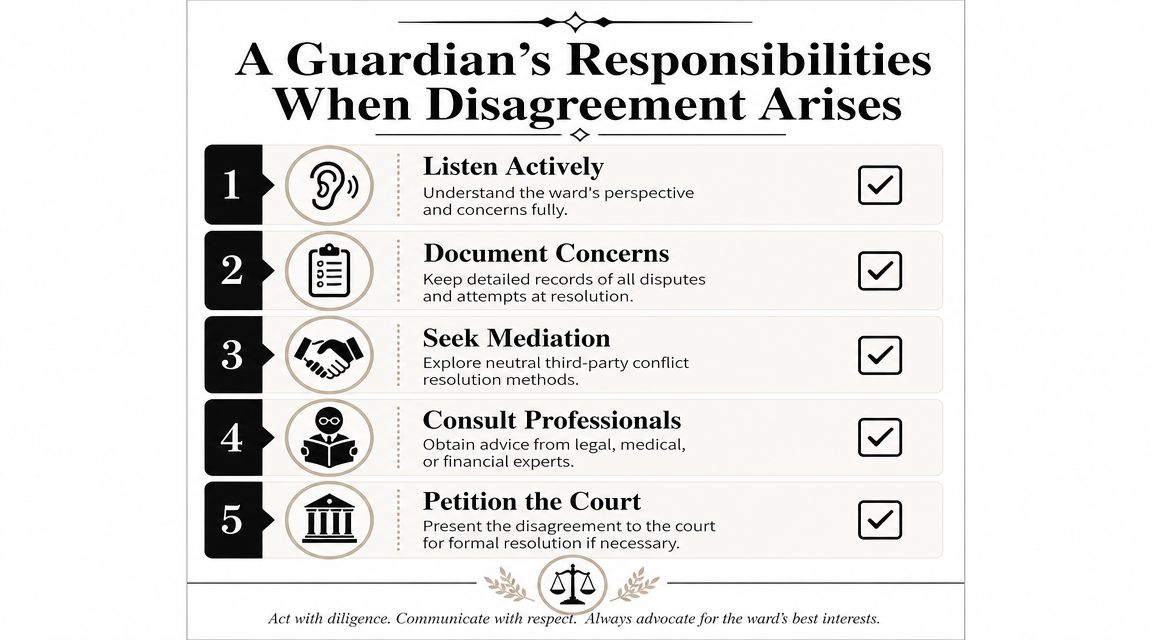
Texas law recognizes that a guardian may be removed for neglect, self-dealing, misuse of the ward's property, or failure to obey court orders. In disputed cases, bank records, receipts, and medical updates become core proof, as discussed in this overview of disputes between wards and guardians.
What good guardian conduct looks like
The strongest protection for a guardian is often calm, organized compliance.
- Keep records current: Save receipts, account statements, care notes, and major communications.
- Follow reporting rules: Annual reports and accountings aren't paperwork for paperwork's sake. They show the court what happened.
- Separate your interests from the ward's: Don't blur personal finances, convenience, or family pressure with the ward's needs.
- Ask before acting outside your authority: If the order is unclear, get legal advice or court guidance.
Guardians also need to understand medical directives and end-of-life instructions when healthcare disputes arise. Families sometimes confuse a guardianship order with a patient's treatment choices. A plain-language resource on understanding what a DNR is can help clarify one part of that conversation.
When a guardian should seek help
Sometimes the safest move is to stop treating the problem like a family disagreement and treat it like a court matter.
You may need legal guidance if:
- The ward is making repeated formal objections
- Other relatives accuse you of misuse or neglect
- A facility or physician questions your authority
- The court has requested additional filings or explanations
For a fuller overview of day-to-day and court-related obligations, this page on responsibilities of a legal guardian is useful.
A careful guardian documents first, reacts second, and remembers that every major decision may later need to be explained to a judge.
How Texas Courts Resolve Guardianship Disputes
A common turning point looks like this: a ward says, “I want to go home,” and the guardian says, “You are not safe there.” At that moment, the dispute stops being only a family argument. It becomes a legal question for the probate court. The judge's job is to decide what Texas law requires, what protects the ward's rights, and whether the guardian is meeting fiduciary duties.
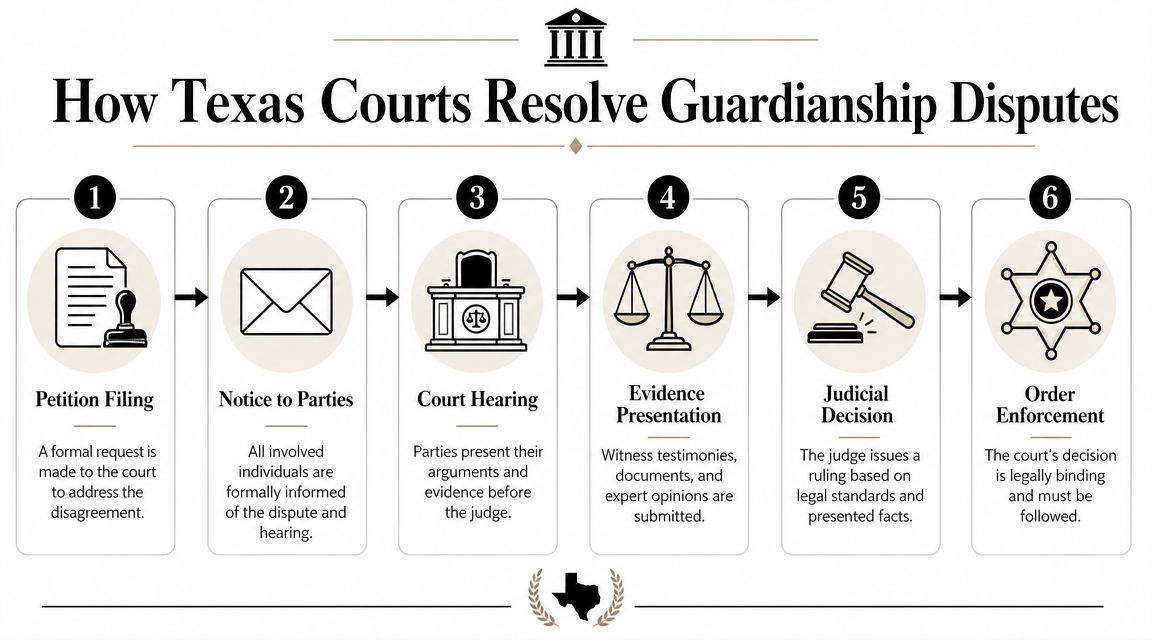
That shift matters.
Courts do not approach these cases as a contest over who sounds more upset or who has stronger opinions. They look for evidence, legal authority, and the least restrictive answer that still protects the ward. A guardianship case works a bit like a safety rail on a staircase. The rail is there to prevent harm, but it should not block the whole stairway if a narrower support will do.
In many contested cases, someone files a petition asking the probate court to act. The request may ask the court to modify the guardianship, remove the guardian, or end the guardianship altogether. Interested parties usually receive notice. If the facts are disputed, or if someone claims immediate harm, the court may set a hearing and require both sides to present evidence.
The main court tools
Texas courts have several ways to address what happens when a guardian and ward disagree in Texas.
Modification of the guardianship
If the ward needs some help but not as much as the current order allows, the court may narrow the guardian's powers. For example, the guardian may keep authority over finances but lose authority over a personal choice the ward can handle.Removal and replacement of the guardian
If the evidence shows the guardian is not acting in the ward's best interest, is misusing authority, or is failing to carry out fiduciary duties, the court can remove that person and appoint a replacement.Termination and restoration of rights
If the ward has regained capacity, or if guardianship is no longer necessary, the court can end the arrangement and restore rights to the ward.Temporary or emergency relief
In urgent situations involving immediate danger, the court can issue short-term relief under Texas temporary guardianship rules. That authority is limited and lasts only as long as the law allows.
Families often feel less anxious once they understand the sequence of a contested case. This overview of the Texas guardianship trial process and what happens at a hearing explains the courtroom side in plain language.
In broad terms, the process usually includes a filing, notice to the right people, collection of records and testimony, a hearing before the judge, and a written order that controls unless the court later changes it.
Here is a helpful video overview to pair with that process:
Least restrictive alternatives matter
One of the most important ideas in a Texas guardianship dispute is the least restrictive alternative. Judges often ask a practical question: does this person need full guardianship, or would a narrower arrangement protect the ward while preserving more independence?
That question can change the outcome. A disagreement over money management may point to a limited guardianship rather than full control over personal decisions. A conflict about medical care may require closer review of the existing order, medical evidence, and the ward's present abilities. In some cases, supported decision-making or another less restrictive option may fit better than broad guardianship, as discussed in this Texas guardianship dispute overview.
What helps the court decide
Judges are trying to solve a legal problem with real-world facts. Clear proof matters more than broad accusations.
Helpful evidence often includes:
- Current medical records that speak to capacity and safety
- Financial records if the dispute involves spending, access, or missing funds
- Care facility records about behavior, placement, or daily needs
- Prior court orders showing the guardian's actual authority
- Specific examples of what happened, when it happened, and who was present
The strongest presentation is usually the simplest one. Dates, documents, and firsthand testimony carry more weight than a long retelling of old family grievances.
What families should expect after the hearing
After the hearing, the judge may leave the guardianship in place, narrow it, replace the guardian, order added protections, or end the case if guardianship is no longer needed. The written order matters because it defines what each person can and cannot do next.
That is why precision matters after court. If the order changes living arrangements, medical authority, spending limits, or reporting duties, everyone involved needs to follow the new terms exactly. Confusion after a hearing can create a second dispute, even when the first one has been decided.
Sometimes a guardianship dispute also touches related probate or planning issues, especially when the case involves property, inheritances, or older legal documents. In those situations, families often need advice that connects the guardianship order to the rest of the legal picture, rather than treating each issue as separate.
Navigating Your Next Steps with a Guardianship Attorney
A disagreement between a guardian and ward can feel personal, but Texas law treats it as something more precise. The court looks at rights, duties, current capacity, evidence, and whether the arrangement remains the least restrictive option. That's why these cases can change quickly once records, medical opinions, and court filings come into play.
You should consider speaking with a lawyer if you're a ward who feels ignored, a guardian facing accusations, or a family member who believes a loved one is not being protected. Legal help also matters when there's an emergency, a dispute over placement, a concern about missing money, or a question about whether guardianship should be reduced or ended.
The Estates Code gives families a framework, but real cases are rarely simple. The facts may involve aging, disability, mental health, blended families, long-distance relatives, or property issues. In counties like Harris, Dallas, Tarrant, and Travis, local probate practice can also affect how a case moves.
One option is working with a Texas firm that handles guardianship establishment, contested matters, temporary guardianships, reporting compliance, and related probate filings. The Law Office of Bryan Fagan, PLLC represents clients in those matters and offers guidance for families trying to decide whether to seek, challenge, modify, or terminate a guardianship.
If you're unsure what to do next, don't wait for the situation to get harder. Early advice often helps families protect both safety and dignity.
If you're dealing with a guardianship dispute in Texas, Law Office of Bryan Fagan, PLLC can help you understand your options and the next legal step. Whether you're a ward, a guardian, or a concerned family member, you can schedule a free consultation to get guidance specific to your situation.