Skip to content
Deciding to file for guardianship is a profound, often heart-wrenching step, and it's completely normal to feel overwhelmed. You're faced with the reality of telling a court that your loved one can no longer make safe decisions for themselves—a step that should only ever be taken when it's truly the last resort. At The Law Office of Bryan Fagan, our mission is to guide Texas families through this challenging process with clarity and care.
Is Guardianship the Right Path for Your Family?

Before you even think about filing paperwork, the most crucial first step is to honestly assess if guardianship is the only solution. This decision carries immense emotional and financial weight, so understanding the high legal bar and the available alternatives is your first act of responsible caregiving.
Texas courts don't take this lightly. Guardianship involves removing a person's fundamental rights to self-determination, so it is always viewed as a final option, not a first step. The entire process is designed to protect those who are truly unable to protect themselves.
The entire case will hinge on proving "incapacity." The court needs to see clear and convincing evidence that an adult, due to a physical or mental condition, is substantially unable to provide for their own food, clothing, or shelter, care for their own health, or manage their financial affairs.
Understanding Incapacity in Texas
Under Title 3, Subtitle G of the Texas Estates Code, a judge in a Harris County Probate Court isn't going to grant guardianship just because a parent is making a few questionable financial choices. They are looking for a consistent, provable pattern of inability to handle essential life tasks.
Think about these common scenarios where guardianship becomes a critical conversation:
- Progressive Dementia: An aging parent with Alzheimer's starts wandering from home, forgets to pay the mortgage or utility bills, and can no longer manage their medications safely.
- Sudden Medical Crisis: A sibling suffers a traumatic brain injury in a car accident, leaving them unable to communicate their wishes about medical care or access their bank accounts to pay for rent.
- Developmental Disability: An adult child with a severe developmental disability lacks the capacity to manage their finances or make complex healthcare decisions independently, requiring a parent to continue their role as a legal decision-maker.
When considering if guardianship is the right path, it's crucial to understand the legal framework surrounding the protection of individuals deemed 'vulnerable adults,' a primary focus of guardianship for vulnerable adults.
Are There Less Restrictive Options?
Because guardianship is such a drastic measure, Texas law requires you to explore all less restrictive alternatives first. Is it possible that the situation could be managed with other legal tools, perhaps from a well-drafted estate plan?
For example:
- A Durable Power of Attorney could allow a trusted agent to handle finances.
- A Medical Power of Attorney can designate someone to make healthcare decisions.
- A Supported Decision-Making Agreement allows an individual with disabilities to get help from trusted advisors without giving up their rights.
Weighing the pros and cons of these options is a crucial step. You can explore a detailed comparison in our article on the pros and cons of guardianship in Texas. This path is not one you have to walk alone. The Law Office of Bryan Fagan is here to help you assess your unique situation with clarity and care.
The demand for these services reflects broader demographic shifts. For example, U.S. states like Florida and California, with large populations aged 65 and older, experience substantial demand for elder law services that include guardianship filings. Learn more about these market trends and their drivers.
If, after considering all the alternatives, you believe guardianship is the only way to truly protect your loved one, we are ready to guide you. Schedule a free consultation with our team to discuss your family's needs and receive personalized guidance.
Gathering Your Documents and Filing the Application
Once you’ve made the difficult decision that guardianship is the right path, the process shifts from emotional deliberation to practical action. This stage is all about meticulous preparation and organization.
Filing for guardianship in Texas isn't as simple as filling out a form. You're essentially building a clear, compelling case for the court, showing exactly why this significant legal step is necessary. Approaching this with a keen eye for detail will save you headaches, prevent costly delays, and lower your stress levels. Think of it as assembling a complete story for the judge, where each document is a crucial piece of evidence.
The Cornerstone of Your Application: The CME
The single most critical document you'll need is the Certificate of Medical Examination (CME). This isn't just any doctor's note; it's a specific, sworn statement from a physician licensed in Texas. Critically, this doctor must have examined the proposed ward within the last 120 days.
This letter has to get specific. It needs to detail the nature, degree, and severity of your loved one's incapacity. The CME gives the court an unbiased, professional assessment that directly speaks to the legal standards in the Texas Estates Code. A vague or incomplete CME is one of the most common reasons guardianship applications get bogged down in delays.
For instance, a CME for a mother with advanced dementia shouldn't just state the diagnosis. It needs to connect the dots for the judge, describing her inability to manage finances, remember to take life-sustaining medication, or make safe decisions about her daily care. The letter must directly link these behaviors to her medical condition.
Assembling the Application Packet
The formal request you make to the court is the Application for Appointment of Permanent Guardian. This is the core legal document where you'll provide detailed information about yourself (the applicant), your loved one (the proposed ward), and the specific reasons guardianship is needed.
Here’s what you’ll need to pull together:
- Applicant Information: Your full name, address, relationship to the proposed ward, and a statement confirming you aren't disqualified from serving as a guardian. It's a good idea to review the full legal requirements for becoming a guardian in Texas to be sure.
- Proposed Ward’s Information: Their full name, date of birth, current address, and detailed information about their next of kin.
- Reasons for Guardianship: A clear, concise statement explaining why your loved one is incapacitated and why guardianship is the only way to protect their health or financial well-being.
- Criminal History Background Check: You will have to submit to a background check to confirm you're eligible to serve.
A common trip-up is providing incomplete information about family members. The court is legally required to notify all interested parties, so be thorough. Listing all spouses, children, parents, and siblings of the proposed ward from the start will save you from procedural delays down the road.
As you get your paperwork in order, a comprehensive guide on how to get legal guardianship of a parent can be a fantastic resource for understanding the bigger picture.
Before you file, it's wise to create a checklist of all the documents you'll need. This simple step can prevent the frustration of having your application rejected for being incomplete.
Key Documents for Your Texas Guardianship Application
Here’s a quick-reference table of the essential information and paperwork you'll need to gather.
| Document or Information Needed | Purpose and Key Details | Where to Obtain It |
|---|---|---|
| Certificate of Medical Exam (CME) | Provides medical proof of incapacity. Must be from a Texas physician and dated within 120 days of filing. | The proposed ward's physician. Ensure they use the state-required form. |
| Application for Appointment | The main legal document that formally requests the guardianship from the court. | Your attorney, or from the county court's website. |
| Applicant's Personal Info | Full legal name, address, Social Security Number, and date of birth. | Your personal records. |
| Proposed Ward's Personal Info | Full legal name, address, date of birth, and Social Security Number. | Family records, birth certificate, or other official documents. |
| List of Next of Kin | Names and addresses of all immediate family members who must be notified. | Family records, address books, or by contacting relatives directly. |
| Criminal History Information | Required for your mandatory background check. | You will fill out a form authorizing the court to run the check. |
| Description of Ward's Estate | A general list and estimated value of the proposed ward's assets and property. | Financial statements, property deeds, bank account records. |
Having these items organized and ready will make the filing process much smoother.
Filing with the Correct Texas Court
Once your application packet is complete, the next step is to file it with the proper court. In Texas, guardianship cases are generally handled by statutory probate courts, county courts at law, or district courts.
The right place to file—what lawyers call "venue"—is the county where your loved one resides.
So, if your mother lives in Fort Worth, you would file the application with a Tarrant County Probate Court. If she lives in the Austin area, you would file with the Travis County Probate Court.
Be prepared for filing fees. These vary by county but typically fall in the $300 to $500 range. These fees cover the court's administrative costs for opening a new case. Filing your application correctly is the first official step on the legal path to protecting your loved one. A complete and accurate submission truly sets the stage for a smoother court process ahead.
Navigating the Texas Guardianship Court Process
Once you’ve officially filed your application, the legal gears start turning. For many families, this is where things can feel a bit intimidating—you're suddenly dealing with court-appointed professionals, legal notices, and the prospect of a formal hearing. But if you know what to expect, you can walk into the process with confidence and clarity.
It helps to remember that the court's main goal isn't to put up roadblocks. It's to make absolutely sure that your loved one's rights are protected every step of the way. The judge, the attorneys, and the investigators are all there to figure out what's in the best interest of the person you're trying to help.
The Key Players in Your Case
Right after you file, the court will appoint at least two independent people to look into the situation. These are neutral parties, and their job is to give the judge a clear, unbiased picture. You should expect to hear from them pretty quickly.
First is the Court Investigator. This person is tasked with a completely impartial evaluation. They'll likely want to visit your loved one, interview you and other family members, and get a feel for the living conditions. They write a confidential report for the judge that gives a crucial snapshot of the circumstances.
The court will also appoint an Attorney ad Litem. Think of this person as your loved one's personal lawyer. Their only client is the proposed ward, and their duty is to fiercely defend their rights and wishes, as laid out in the Texas Estates Code, Title 3, Subtitle G. This attorney will meet privately with your loved one to explain what's happening and will advocate for what they want—even if that means fighting against the guardianship.
It's absolutely vital to cooperate fully and honestly with both the investigator and the Attorney ad Litem. Being transparent helps them do their jobs right and, frankly, makes the whole process go a lot smoother for everyone.
It's worth noting that courts handling these cases are often incredibly busy. For example, in a recent month, a major jurisdiction like King County, Washington, saw 3,862 civil cases filed, which includes matters like guardianship. That's a lot of families seeking court intervention. You can explore more on these court statistics and trends.
The Formal Notice Process
Before any hearing can happen, Texas law requires that all "interested parties" get formal notice. This legal notification is called a "citation," and it's a step that cannot be skipped. The whole point is to give family members a fair chance to show up in court, either to support the guardianship or to contest it.
So, who gets notified?
- The proposed ward themselves.
- Their spouse, parents, and any children.
- The person or facility that has custody or care of them.
- Anyone they might have named as an agent in a power of attorney.
This notice has to be delivered in person by a sheriff, constable, or a private process server. It’s called "personal service," and it guarantees that everyone has had a chance to be heard before a judge makes a life-altering decision.
This visual shows a simplified flow for getting started with the guardianship filing process: collecting documents, completing forms, and filing with the court.
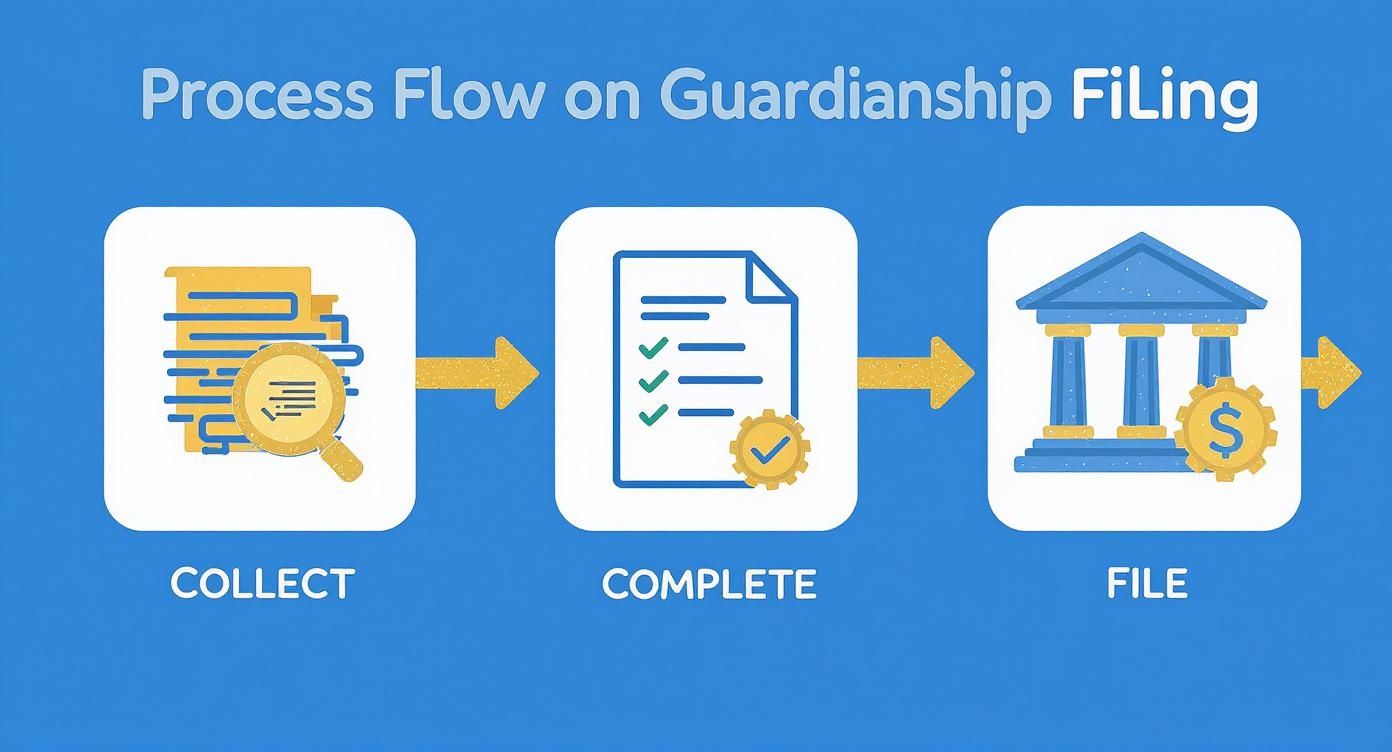
This infographic highlights that the journey begins with diligent preparation before you ever enter the courthouse, setting the foundation for the court process that follows.
Preparing for the Guardianship Hearing
The hearing is your moment to make your case directly to the judge. Whether you're in a Harris County Probate Court or a courtroom in a smaller county, your testimony is the foundation of the judge's ruling. Your objective is to show, with clear and convincing proof, that your loved one is incapacitated and that you are the right person to be their guardian.
Here’s what you need to be ready to talk about:
- Your Relationship: Explain who you are to the proposed ward and why you are the most suitable person for this role.
- Evidence of Incapacity: This is the heart of your case. You can't just say, "Mom is confused." You need specific, real-world examples of how she's unable to manage her health, safety, or finances.
- The Need for Guardianship: You have to prove why less restrictive options, like a power of attorney, just aren't working or aren't enough to protect them.
For instance, instead of saying, "Dad can't handle his money," you need to provide concrete facts. "My father has received three eviction notices in the last four months because he forgets to pay rent. Last week, he gave a stranger $2,000 for a fake lottery prize. We've also found multiple unusual withdrawals from his bank account that he can't explain." That's the kind of detail a judge needs.
The judge will ask you questions. The Attorney ad Litem will ask you questions. The key is to stay calm, speak clearly, and be respectful. You need to come across as a capable, caring, and responsible advocate for your loved one. Once all the evidence is presented, the judge will make a decision.
Facing a court hearing is a major step, both emotionally and financially. The process is designed to be thorough because the stakes are so high. At The Law Office of Bryan Fagan, we stand beside you through every single step, from getting the application filed to representing you at the final hearing. Schedule a free consultation today to get compassionate support tailored to your family's unique situation.
Your Duties After a Guardian Appointment

The moment the judge signs the order appointing you as guardian, you might feel a huge wave of relief. The hearing is over, and you finally have the legal authority to protect your loved one. But this milestone isn’t the finish line—it’s actually the starting line for your official responsibilities.
Your role as a guardian comes with a fiduciary duty, which is the highest standard of care recognized by the law. Simply put, you must always act in the ward's best interest, managing their life and finances with absolute diligence and integrity. The court doesn't just hand over the reins and walk away; it will continue to oversee your actions to make sure you're meeting these critical obligations.
Immediate Steps to Take After Your Appointment
In the first month or two, you’ll need to tackle several administrative tasks to formalize your role. These aren't optional suggestions; they are non-negotiable steps required by Texas law, and getting them done promptly is crucial.
First, you have to take an oath of guardianship. This is a formal, sworn statement you file with the court, promising to faithfully carry out all your duties. Think of it as your official pledge to both the court and the person you're protecting.
Next, the judge will likely require you to post a bond. This works like an insurance policy, protecting the ward's assets from any potential mismanagement on your part. The bond amount is usually based on the value of the ward's liquid assets and has to be secured from a surety company.
Once the oath is taken and the bond is filed, the court clerk will issue your "Letters of Guardianship." This document is your golden ticket—the official proof of your legal authority. You’ll need to show certified copies of these letters to banks, doctors, and anyone else who needs confirmation that you can make decisions for the ward.
Getting these initial duties squared away sets the legal foundation for everything that follows. Keeping organized records from day one will make your life infinitely easier down the road.
Ongoing Management and Reporting Duties
Being a guardian is an active, long-term commitment. It demands careful management and completely transparent reporting to the court. Your responsibilities generally fall into two buckets: managing the ward’s personal life and overseeing their financial estate.
As guardian of the person, you're in charge of decisions about their daily life, including:
- Healthcare: Choosing doctors and consenting to medical treatments.
- Living Arrangements: Deciding where the ward will live—whether it's at home, with family, or in a dedicated care facility.
- Personal Needs: Making choices that support their overall well-being, from social activities to personal care.
As guardian of the estate, you must manage the ward’s finances with meticulous care. This means collecting their income, paying bills, and protecting their assets. You are legally required to keep detailed records of every single transaction—no exceptions.
Initial vs Ongoing Guardian Duties in Texas
It's helpful to see a breakdown of the one-time tasks you'll handle right away versus the recurring duties you'll manage for as long as the guardianship lasts. This table clarifies the difference.
| Duty Category | Initial Post-Appointment Tasks (First 60-90 Days) | Ongoing Annual Responsibilities |
|---|---|---|
| Legal Formalities | Take and file the Oath of Guardianship with the court. | Renew the bond annually if one was required. |
| Financial Setup | Obtain Letters of Guardianship. Post a bond if ordered. | File an Annual Accounting detailing all income and expenses. |
| Asset Management | Open a separate, designated guardianship bank account. File an Inventory, Appraisement, and List of Claims detailing all of the ward’s assets. | Manage and invest assets prudently according to Texas law. Pay all of the ward's bills and taxes. |
| Personal Care | Notify all relevant parties (banks, Social Security Administration, doctors) of your appointment. | File an Annual Report on the Condition and Well-Being of the Ward. Make ongoing healthcare and personal care decisions. |
As you can see, the work doesn't stop after the initial setup.
Your most important ongoing duties are filing those annual reports. The Annual Report on the Condition and Well-Being of the Ward gives the court an update on their health, living situation, and general welfare. The Annual Accounting is an exhaustive financial report showing every dollar that came in and went out of the ward's estate over the year.
Failing to file these reports on time can lead to serious consequences, including being removed as guardian and facing financial penalties. While these responsibilities might seem daunting, they exist for one reason: to protect the ward. At The Law Office of Bryan Fagan, we can help you create systems to stay organized and ensure you remain compliant with all court requirements. Schedule a free consultation to discuss your duties and get the support you need.
Exploring Alternatives to Guardianship in Texas

Here's something the courts in Texas want you to know: guardianship is a big deal. It involves removing a person’s fundamental civil rights, so the law is crystal clear that it should only be used as a last resort.
Before you even start down the path of filing for guardianship, the court will expect you to have seriously considered all less restrictive options. These tools can often provide the support a loved one needs without the cost, emotional toll, and permanence of a court order.
Think of these alternatives as proactive solutions. They empower people to make their own choices with help, rather than having those choices taken away entirely.
Powerful Legal Tools for Financial Decisions
One of the most effective and common alternatives to a guardianship of the estate is a Durable Power of Attorney. This is a legal document where someone (the "principal") appoints a trusted person (the "agent") to handle their financial affairs.
The key word here is "durable." This means the agent's authority doesn't stop if the principal later becomes incapacitated. For instance, if a father in Bexar County signs a durable power of attorney naming his daughter as his agent, she can keep paying his bills and managing his investments if he later develops dementia. That single document can often eliminate the need for any court involvement in his finances.
Empowering Choices in Healthcare
In the same vein, a Medical Power of Attorney lets an individual designate an agent to make healthcare decisions for them if they can't. This is absolutely crucial for making sure a person’s medical wishes are honored.
Imagine a woman in Dallas suffers a sudden stroke and can't communicate. Because she had a Medical Power of Attorney, her husband has the immediate authority to speak with doctors and consent to treatment. This avoids a frantic, stressful emergency guardianship proceeding.
When created while a person still has capacity, these power of attorney documents form the cornerstone of a plan that respects autonomy while providing a safety net. They keep private family matters out of the public court system and in the hands of trusted loved ones.
It's interesting to see how this plays out even with minors. Nationwide, from 2017 to 2021, while about 3.7 million children lived with caregivers who weren't their parents, only about 4% of those situations led to formal guardianship petitions. Many families find ways to manage with informal arrangements or other legal tools.
Collaborative Approaches to Decision-Making
A newer and increasingly popular alternative in Texas is the Supported Decision-Making Agreement. This tool is a fantastic option for adults with intellectual or developmental disabilities who can make their own decisions but just need some help understanding the options.
With this agreement, a person can formally name trusted advisors—family, friends, or professionals—to help them gather information, weigh pros and cons, and communicate their choices. The most important part? The final decision always remains with the individual. This preserves their independence while providing a structured, supportive framework.
Exploring all the alternatives to guardianship in Texas can open your family up to options that are a much better fit for your unique situation.
Choosing the right path requires a careful, compassionate look at what your loved one truly needs and is capable of. We can help you understand these powerful alternatives and find the most supportive, least intrusive solution for your family.
Answering Your Top Questions About the Guardianship Process
Going through the guardianship process brings up a lot of questions. It's totally normal to feel a mix of determination and uncertainty as you think about the practical and emotional road ahead.
We've been through this with countless Texas families, and we’ve heard it all. To give you some peace of mind, we've put together answers to the most common concerns we hear. Think of this as a head start on getting the clarity you need to make the best decisions for your loved one.
How Much Does Guardianship Really Cost?
This is almost always the first question families ask, and for good reason. The financial side of things can feel overwhelming, so let's break down exactly what you can expect.
There’s no single price tag for guardianship in Texas because the total cost is a mix of several different fees. Here’s what you’re typically looking at:
- Attorney's Fees: This is usually the biggest piece of the puzzle. Your attorney is doing a lot of heavy lifting—preparing and filing the application, dealing with the court, and representing you at the hearing.
- Court Costs: Just to file the application, the court charges a fee. This varies by county but usually lands in the few hundred dollar range.
- Attorney ad Litem Fees: The court will appoint an independent attorney to represent your loved one’s interests. Their job is to ensure everything is fair, and their fees are typically paid from the proposed ward’s estate.
- Bond Premiums: If your loved one has assets, the court will likely require you to get a bond. It's like an insurance policy to protect their money, and you'll pay an annual premium to a surety company for it.
- Other Professional Fees: Don't forget the smaller costs, like the physician’s exam to confirm incapacity and any fees from a court investigator who assesses the situation.
In most cases, these costs are paid directly from the proposed ward's estate. But if the estate doesn't have the funds, the person applying for the guardianship may need to front the expenses.
What Happens if Someone Fights the Guardianship?
Things can get complicated—and fast—when a family member or another interested person disagrees with the guardianship application. When this happens, it’s called a contested guardianship, and it basically turns the entire process into a lawsuit.
A contest can pop up for a few common reasons:
- Someone might argue that the proposed ward is not legally incapacitated and can still make their own decisions.
- Another person might object to who is applying to be the guardian, believing they aren't the right fit.
- There could be a genuine disagreement over whether guardianship is truly the least restrictive option available.
When a guardianship is contested, the court sets a formal hearing. Both sides get to present evidence, call witnesses to testify, and make their case. Imagine a scenario where one adult child files for guardianship of their aging mother, but a sibling objects, insisting their mom’s power of attorney is all that’s needed. A judge in a Harris County Probate Court will hear both arguments and make a final decision based on the facts.
No matter how heated a contest gets, the court’s focus never changes: its number one job is to determine what is in the best interest of the proposed ward. These disputes can be incredibly draining, both emotionally and financially, which makes having an experienced attorney in your corner absolutely essential.
Guardian of the Person vs. Guardian of the Estate: What's the Difference?
A lot of people don’t realize that guardianship isn't a one-size-fits-all role. As defined in Title 3 of the Texas Estates Code, it can actually be split into two very distinct jobs. Knowing the difference is critical so you can ask the court for the specific authority your loved one actually needs.
A Guardian of the Person is in charge of the ward’s physical and personal well-being. This person makes decisions about things like:
- Where the ward lives
- What kind of medical care they get
- Their day-to-day personal needs, like food, clothing, and social life
On the flip side, a Guardian of the Estate manages the ward’s financial world. Their duties are all about the money and property:
- Collecting social security or pension checks and paying bills
- Managing bank accounts, stocks, and other investments
- Protecting real estate and other property, and filing the required annual accountings with the court
Sometimes, the court appoints one person to handle both roles. In other situations, it might appoint two different people. For example, a family member might be named guardian of the person, while a bank or a professional fiduciary is appointed guardian of the estate. This separation can add an extra layer of protection for the ward’s assets.
The journey of filing for guardianship is filled with legal complexities and emotional decisions. At The Law Office of Bryan Fagan, PLLC, we are dedicated to providing the compassionate and knowledgeable guidance Texas families need. We can help you understand your options, navigate the court system, and ensure your loved one is protected. Schedule a free consultation today to discuss your family's unique situation. You can learn more about our services at https://texasguardianshiplawyer.net.