Skip to content
When an aging parent starts missing medication, forgetting bills, or trusting the wrong person with money, families often split fast. One daughter says, “Mom needs help now.” A son says, “She's still capable.” Another relative insists the core issue is who wants control, not what Mom needs.
That's the point where many people start searching for how judges evaluate family conflict in guardianship cases. In Texas, the answer is more reassuring, and more demanding, than most families expect. A probate judge in Harris County, Dallas County, Tarrant County, or Bexar County isn't there to referee old family resentments. The court's job is to protect the proposed ward while limiting any loss of rights to what the law supports.
Guardianship fights feel personal because they are personal. They also drain time, money, and trust. If children are watching adults battle over a grandparent's care, the emotional strain can spill across generations. Families dealing with that kind of tension sometimes benefit from outside guidance on communication and stability, including these strategies for children of divorce, because the same loyalty conflicts often appear when adults split into camps.
A Texas judge will filter out most of the noise and focus on proof. That means medical evidence, functional evidence, legal standards, and the practical question of what arrangement protects the person with the least restriction. If several relatives want the role, the court still won't pick a winner based on passion or volume. It will look at legal fitness, conflict, and the ward's needs. Families facing competing applications often start by reviewing how Texas courts decide when multiple people want guardianship.
When Family Disagrees on Guardianship What Does a Judge Do
A judge starts from a simple premise. The case is about the proposed ward, not the family argument.
That sounds obvious, but in court it changes everything. A sibling may come in angry about years of unfair treatment. Another may want to revisit who helped more, who lived closer, or who paid what. The judge usually sees those facts as background unless they help answer a legal question about capacity, safety, finances, or suitability.
The judge is a fact-finder, not a family counselor
In a typical dispute, one child files for guardianship after a hospitalization. Another objects and says less help is needed. A third says the first child only filed to control the parent's money. All three may be partly sincere. All three may also carry old grievances into the courtroom.
The judge's role is narrower than many families expect:
- Decide whether the person is incapacitated under Texas law
- Decide whether guardianship is necessary
- Decide what type of authority, if any, should be granted
- Decide who, if anyone, is suitable to serve
The court won't reward the relative who tells the saddest story. It won't punish a family member just because other relatives dislike them. It won't assume the closest child is the best guardian.
Family conflict matters only when it helps prove something legally relevant.
What families often misunderstand
Many people think the hearing will turn on who sounds more caring. It usually doesn't. Judges want evidence that can be tested. They want records, evaluations, witness testimony with firsthand knowledge, and facts tied to the proposed ward's actual functioning.
This is one reason emotions can run high after a hearing. A family may feel the court “ignored” years of tension. In reality, the judge probably heard it and then set it aside because it didn't answer the legal questions in front of the court.
That approach can feel cold. It's also one of the main protections built into Texas guardianship law.
The Two-Part Test Judges Must Apply
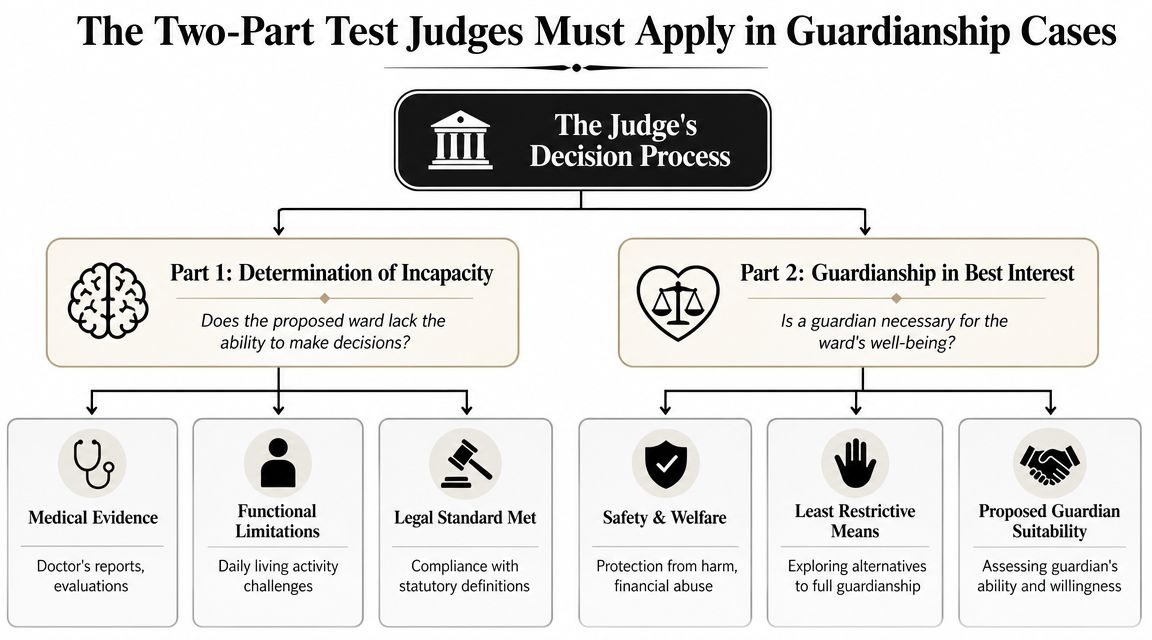
Texas guardianship cases follow a sequence. Step one is incapacity. Step two is suitability and best interest. If the first step fails, the second one doesn't matter.
A useful way to think about it is a locked door with two keys. The family must first address the question of capacity. Only then does the court move to who should serve and what powers should be granted.
Part one is proving incapacity
Under Texas practice, incapacity must be proven by clear and convincing evidence, supported by a physician's capacity evaluation, and the court does not merely accept family opinion in place of that proof, as discussed in Texas guardianship litigation guidance.
For families, that means a few practical things:
- Your belief isn't enough. Even if everyone in the family agrees, the court still needs proper evidence.
- A doctor's paperwork matters. The medical evaluation gives the court a structured basis to assess ability.
- Function matters as much as diagnosis. A label alone does not answer whether the person can manage personal or financial decisions.
Texas Estates Code Title 3, Subtitle G governs much of this process. In practice, the court wants proof tied to daily consequences. Can the person understand medical choices? Pay bills? Resist exploitation? Manage medications? Recognize risk?
Part two is deciding whether a guardian should serve
If incapacity is established, the court then looks at the proposed guardian. Many family fights often arise at this stage. A relative may sincerely love the proposed ward and still be a poor candidate to serve.
The court commonly looks at:
| Issue | Why the judge cares |
|---|---|
| Relationship to the proposed ward | Past involvement often shows reliability or lack of it |
| Financial stability | Guardians handle fiduciary duties and may manage assets |
| Conflicts of interest | Personal gain can distort decision-making |
| Ability to follow court rules | Guardians must report, account, and comply with orders |
A close relative can be bypassed if the court sees a real conflict or a practical inability to perform fiduciary duties. That surprises families all the time.
Practical rule: Don't argue only that you love your parent more. Show that you can carry out court-supervised duties cleanly, consistently, and without conflict.
Texas procedure families should expect
In many Texas counties, including busy probate courts in Houston and Dallas, the process often includes filings, service, medical evidence, representation for the proposed ward, and a hearing. Depending on the facts, the court may also address temporary or emergency relief if immediate harm is alleged.
Families should also know the hearing isn't the end of the responsibility. If a guardian is appointed, Texas law imposes continuing duties. Those can include qualification, possible bond requirements, inventories, accountings, annual reports, and strict fiduciary obligations under Title 3, Subtitle G.
What Proof Carries the Most Weight in Court
When families ask what really persuades a judge, the short answer is this. Independent evidence beats interested testimony. The more objective the proof, the more useful it usually is.
This doesn't mean family testimony is worthless. It means judges know relatives may be biased, even when they're telling the truth. In contested cases, courts compare competing stories against layered proof. The modern process described in this discussion of contested guardianship hearings involves court-appointed professionals, records, and testimony that can be tested, and it notes that legal professionals are often reluctant to endorse full guardianship unless the evidence clearly supports it.
A quick visual helps show the usual hierarchy.

The evidence judges trust first
In most contested hearings, the strongest proof comes from neutral or professional sources.
Medical and expert evaluations
These give the court a direct opinion on capacity and functioning. A physician's evaluation often anchors the case.Court-appointed investigator or similar neutral input
Courts value independent eyes on the situation, especially where families accuse each other of manipulation.Records that show day-to-day function
Medical records, financial records, care notes, and similar documents often tell a cleaner story than argument alone.
Here's a short video overview that can help families understand how these issues appear in practice.
What helps but often needs support
Other proof can matter a great deal, but it usually becomes persuasive when it lines up with stronger evidence.
- Neutral caregiver testimony can be powerful because the witness usually has firsthand observations and less personal stake.
- The proposed ward's own statements may carry real weight if the person can express preferences and understanding.
- Photos, calendars, texts, and informal notes can support a timeline, but they rarely carry a case by themselves.
Family members should frame testimony around specifics. “Dad forgot my birthday” is usually noise. “Dad signed the same check three times in one week and couldn't explain where the money was going” is more useful because it points to function.
What usually hurts your credibility
Judges tend to tune out testimony that sounds like a sibling rivalry dressed up as legal argument.
Common examples include:
- Character attacks without records
- Old grievances unrelated to current capacity
- Broad claims of theft or abuse without documents
- Statements about what the parent “would have wanted” when no one can tie that claim to present legal issues
Families preparing proof often benefit from a focused review of what evidence actually matters in Texas guardianship contests.
Bring proof that answers a judicial question. Leave out proof that only proves your family has been fighting for years.
Is Full Guardianship Always the Answer
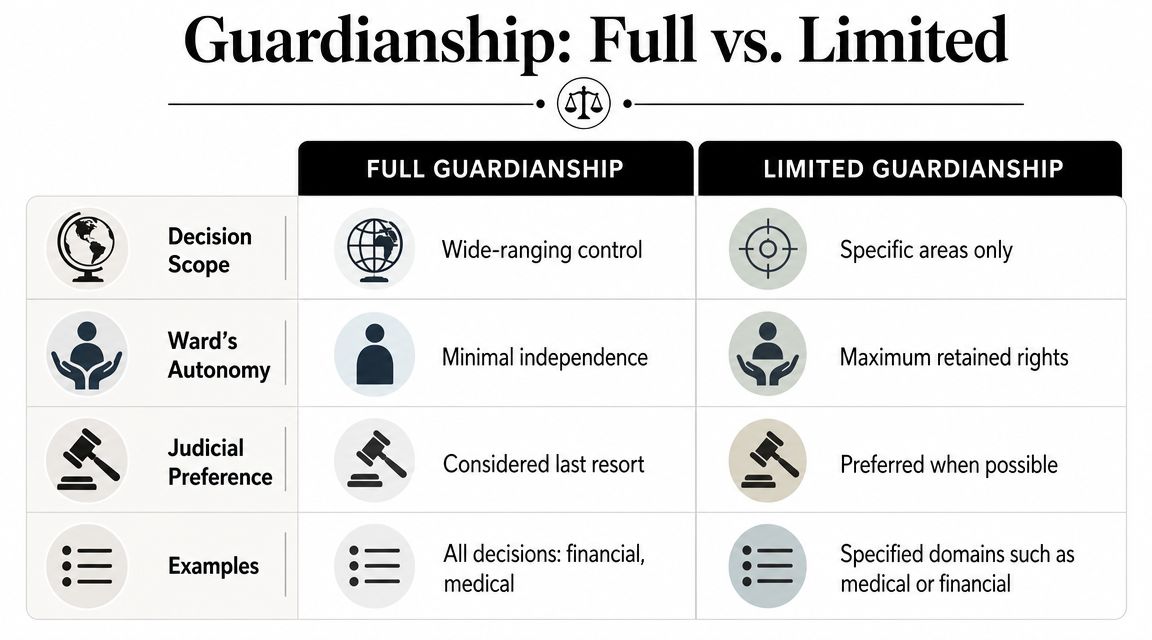
Usually, no. In many cases, the actual dispute isn't whether help is needed. It's how much help the law should authorize.
That question matters because guardianship takes rights away. Texas courts are supposed to be careful with that power. Under Title 3, Subtitle G of the Texas Estates Code, the court must consider whether a less restrictive option can meet the person's needs before imposing broad control.
Why judges look for narrower solutions
Modern court practice has moved toward less-restrictive decision-making. A 2024 National Center for State Courts report on guardianship monitoring reflects that broader approach by emphasizing structured case data and distinguishing full from limited guardianship so courts can better review what powers were granted and whether narrower arrangements protect autonomy.
For a Texas family, that often means the judge asks questions like these:
- Does the person need help with money, but not personal decisions?
- Is there already a valid power of attorney?
- Could a supported decision-making agreement work?
- Is a temporary guardianship needed because of an emergency, or is the request broader than the facts justify?
Common alternatives families should discuss early
A full guardianship may be unnecessary if another legal tool can address the immediate risk.
| Option | When it may help |
|---|---|
| Durable power of attorney | Financial help if the person still has capacity to sign |
| Medical power of attorney | Health care decisions through an agent |
| Supported decision-making agreement | Assistance without stripping rights |
| Limited guardianship | Court-supervised help only in specific areas |
| Temporary guardianship | Short-term protection during a true urgent situation |
This is often where compromise becomes possible. One sibling may fear total control by another. The court may instead consider a limited arrangement that protects assets or medical care while preserving as many rights as possible.
What works and what doesn't
What works is a narrow request tied to actual need. What doesn't work is asking for the widest power available because the family doesn't trust each other.
If your concern is unpaid bills, say that and prove that. If the problem is unsafe discharge planning after a hospital stay, address that. Families lose credibility when they ask for full guardianship but only prove a limited problem.
How Your Family's History Can Help or Hurt Your Case
Family history doesn't control a guardianship case, but it can shape how a judge views motive, reliability, and risk. Judges know families are messy. They also know patterns matter.
A caregiving history often matters
Take two adult children. One has been taking the parent to appointments, managing prescriptions, speaking with doctors, and dealing with insurance for a long time. The other appears only after a bank account issue or a dispute over a house.
That doesn't automatically disqualify the second child. It does raise questions. The judge may reasonably ask why the involvement started late and whether the request is driven by concern, control, or money.
A caregiving record can help because it shows practical knowledge. The caregiver often knows medications, routines, safety issues, and providers. Those details make testimony more concrete.
Financial conduct can become a major issue
Now consider a different example. A son wants appointment as guardian of the estate. The evidence shows he regularly borrowed money from the parent, had access to cards or accounts, or was involved in related litigation about property.
Even if he's a close relative, that history can hurt badly. Courts in Texas scrutinize conflicts because the guardian must act as a fiduciary. If the proposed guardian may personally benefit from estate decisions, the judge may question whether the ward's interests can stay separate from family disputes.
The court pays attention to conduct, not just titles. “I'm the oldest child” carries less weight than “I handled her care responsibly and transparently.”
Family facts that often become legally relevant
Judges usually care less about personality clashes and more about facts like these:
- Who has provided care
- Who has access to money or property
- Whether anyone isolated the proposed ward
- Whether a relative has a history of making requests for money
- Whether someone ignored medical needs or failed to follow through
- Whether multiple relatives can co-exist or whether conflict will cripple decision-making
A long-estranged relative isn't doomed. A longtime caregiver isn't guaranteed appointment. But each person's history gets translated into the legal issues the court must decide. Suitability is not abstract. It grows out of behavior.
Preparing for a Contested Guardianship Hearing
The hearing often arrives after months of arguments, sleepless nights, and pressure from every direction. Then everyone walks into court carrying the same mistaken assumption. If the judge hears how ugly the family conflict has become, the right answer will be obvious.
That is not how these hearings are decided.
A probate judge is listening for proof that survives conflict. The court sorts evidence into two buckets. One bucket shows functional limits, risk, and the least restrictive way to protect the proposed ward. The other bucket is family noise. If you are preparing for a contested hearing, the work is to keep feeding the first bucket.
Build a record the court can trust
Start with a timeline. Dates matter. So do sequences. A judge is more likely to rely on a witness who can place events in order and connect them to a real problem than on a relative who gives broad conclusions.
Include specific events such as hospitalizations, missed medications, wandering, unpaid bills, unsafe driving, repeated scams, account changes, sudden transfers, or failed follow-up after discharge. Then match those events to documents where possible.
The difference is usually obvious:
- Useful: “On March 4, Dad missed his cardiology appointment after forgetting it and getting lost on the way to the office.”
- Weak: “Dad is stubborn and impossible.”
Bring records that answer the legal questions in dispute. Depending on the case, that may include medical records, medication lists, facility notes, bank statements, care invoices, discharge paperwork, text messages, or emails showing who was informed and what happened next.
Prepare testimony that helps the judge decide something
In a contested case, relatives often overestimate how much a judge cares about blame. The court cares more about whether a witness can give direct observations tied to capacity, safety, or property management.
That changes how testimony should sound.
| Stronger testimony | Weaker testimony |
|---|---|
| “She gave her debit card number to strangers twice in one month.” | “She has terrible judgment.” |
| “He cannot explain his medications or take them on schedule without help.” | “My sister exaggerates everything.” |
| “A limited guardianship over finances would address the missed bills and withdrawals.” | “I should be appointed because I'm the one who cares.” |
Judges hear anger every week. They slow down for specifics.
Expect scrutiny from the attorney ad litem and from experts
In Texas guardianship cases, the proposed ward has independent representation. The attorney ad litem is not there to make the family comfortable. That lawyer will test whether a guardianship is necessary, whether the requested powers go too far, and whether the evidence supports what the applicant is asking the court to do.
Families should also be ready for close questions about medical proof, day-to-day function, and available alternatives. In cases with sharp disagreements about capacity, diagnosis, or practical ability, expert testimony can make the difference between a vague concern and a finding the court is willing to enter. If that issue is coming, review how expert testimony works in a Texas guardianship hearing.
Practical steps before the hearing
Preparation usually comes down to discipline.
- Meet with counsel early so filing deadlines, service, physician documentation, and hearing requirements are handled correctly under Texas Estates Code procedures.
- Organize exhibits by issue such as medical proof, finances, safety incidents, and care history, instead of arriving with an unsorted stack of papers.
- Use neutral witnesses where possible including caregivers, social workers, facility staff, or treating providers with direct observations.
- Prepare for cross-examination because the other side will test your memory, motives, and consistency.
- Offer a workable plan for care, decision-making, and reporting duties if the court appoints a guardian.
- Address alternatives openly if limited guardianship, a management trust, supported decision-making, or another narrower option may solve part of the problem.
One more point matters. Do not overask. If the proof supports help with finances but not total control over every personal decision, asking for full guardianship can hurt credibility. Judges notice when a family member is trying to solve a long-running family conflict through a guardianship order.
Good hearing preparation is not about telling the longest story. It is about giving the court reliable proof, in a clean format, tied to the exact findings the law requires.
Common Questions About Guardianship Conflicts in Texas
What if the judge thinks no one in the family is suitable
That can happen. If the court finds serious conflict, financial concerns, or other disqualifying problems, it may appoint a neutral third party instead of a relative. Families are often surprised by this, but judges will do it if they believe it better protects the ward.
Can a judge order mediation
In some disputed probate matters, courts may encourage or direct mediation depending on the county and the case posture. Mediation can help narrow disputes about scope, care plans, or who should serve. But it won't erase the court's duty to protect the proposed ward's rights.
How much weight does the proposed ward's opinion carry
It depends on the person's ability to understand and communicate meaningful preferences. A judge will listen carefully if the proposed ward can explain wishes and demonstrate functional ability. The person's opinion is important, but it isn't the only factor.
What if there is an emergency
Texas law allows temporary or emergency-type relief in appropriate circumstances. If there is a real risk of immediate harm to health, safety, or property, the court can move faster than it would in a routine case. Families should be ready to show exactly why the situation is urgent.
Can a guardianship be limited or later changed
Yes. Courts can tailor authority to specific needs, and existing arrangements can sometimes be modified or terminated if circumstances change. Guardians must also comply with continuing court supervision, and failure to do so can create later problems.
What should a family do right now if conflict is building
Start documenting facts, preserve records, stop arguing over text if it isn't helping, and get legal advice early. Guardianship cases get harder when families wait until a medical crisis, suspicious transfer, or hearing date to organize the evidence.
If your family is facing a guardianship dispute in Texas, a focused legal strategy can make the process clearer and less damaging. The Law Office of Bryan Fagan, PLLC helps families evaluate incapacity issues, prepare evidence, address temporary and contested guardianships, and manage ongoing duties under the Texas Estates Code. Schedule a free consultation to get guidance customized to your county, your family dynamic, and your loved one's specific needs.