Skip to content
Your mother has started repeating the same stories. Last month, she paid the electric bill twice and missed the mortgage payment. The bank teller won't talk to you because your name isn't on the account. Her doctor says she needs help keeping up with medications, but she still insists she's “fine.”
That's the moment many Texas families begin searching for answers. They aren't trying to take over a loved one's life. They're trying to prevent a crisis, protect dignity, and make sure the right person can step in legally when help is needed.
The hard part is that families often hear two terms at once: power of attorney and guardianship. They sound similar, but they solve very different problems. One is usually a private planning tool. The other is a court case. One works best before incapacity becomes severe. The other exists for situations where the court must intervene.
If you're weighing Power of Attorney vs Guardianship in Texas: Which Is Better?, the answer usually depends on timing, capacity, family dynamics, and whether a less restrictive option can still work. In real life, the most important question often isn't which tool is “better” in the abstract. It's which tool protects your loved one without taking away more rights than necessary.
Navigating a Loved One's Changing Needs
Families usually don't arrive at this decision all at once. It happens in pieces.
A daughter in Houston notices her father can still carry on a warm conversation, but he forgets to open mail and sends money to suspicious callers. A son in Dallas learns his mother signed forms at a rehab facility without understanding them. Siblings in Harris County argue over whether Dad just needs help with paperwork or whether he can no longer make safe decisions at all.
Those situations feel personal, but the legal problem is often the same. Someone you love may need help with money, medical decisions, living arrangements, or daily safety. The law requires a different response depending on whether that person still has enough capacity to choose help voluntarily.
The family's real question
Few individuals ask, “What legal instrument applies here?” Instead, they pose a more human question:
How do we help without humiliating them, starting a family fight, or making the situation worse?
That's the right question. A rushed move toward guardianship can be more restrictive than necessary. Waiting too long can leave bills unpaid, medical care delayed, or assets exposed to misuse.
What families often struggle with first
- Respecting independence: Your loved one may need support in some areas but not all of them.
- Figuring out capacity: Memory loss doesn't automatically mean incapacity, and capacity can change from day to day.
- Handling resistance: A parent may reject help even when the warning signs are obvious to everyone else.
- Managing conflict: One sibling may push for court action while another insists a signed document should be enough.
In practice, the decision is rarely clean. There's often a messy middle where an existing power of attorney may be incomplete, unsupported, or starting to fail. That's where families need clear legal judgment, not just a checklist.
Defining Your Two Main Legal Tools in Texas
Under Texas law, the two main tools are Power of Attorney and Guardianship. They are not interchangeable.
A Power of Attorney, often called a POA, is a document a person signs while they still have legal capacity. The person signing it is the principal. The person receiving authority is the agent. A POA can give authority over finances, business matters, property, or healthcare, depending on the document.
A Medical Power of Attorney allows an agent to make healthcare decisions in the situations covered by the form. A Durable Power of Attorney is commonly used for financial matters and is meant to remain effective even if incapacity later occurs. Texas families looking at healthcare planning often start with a Texas medical power of attorney guide.
What guardianship means
Guardianship is different because it is created by a court, not by private signature. Texas Estates Code Title 3, Subtitle G governs guardianship matters, and Chapter 1104 addresses the appointment of guardians. A court may appoint a guardian of the person, a guardian of the estate, or both.
- Guardian of the person: Handles personal decisions such as residence, care, and medical needs.
- Guardian of the estate: Handles financial matters, assets, and property under court supervision.
A power of attorney is usually a voluntary plan made before incapacity. Guardianship is a court-ordered remedy used after incapacity is already present, with filing requirements, proof, a hearing, and ongoing judicial supervision, as noted in this Texas guardianship discussion.
Why capacity matters so much
Capacity is the dividing line. If your loved one still understands what they are signing and who they are authorizing, a POA may work well. If they no longer have that understanding, a new POA may not be valid, and the family may need to consider guardianship instead.
This is why timing matters so much. A family that acts early often has more options. A family that waits until the crisis point may find that private documents are no longer available and court intervention is the only workable path.
A Detailed Comparison of Power of Attorney and Guardianship
When families compare these two tools, they usually care about the same core issues: control, speed, privacy, oversight, and what happens if something goes wrong.
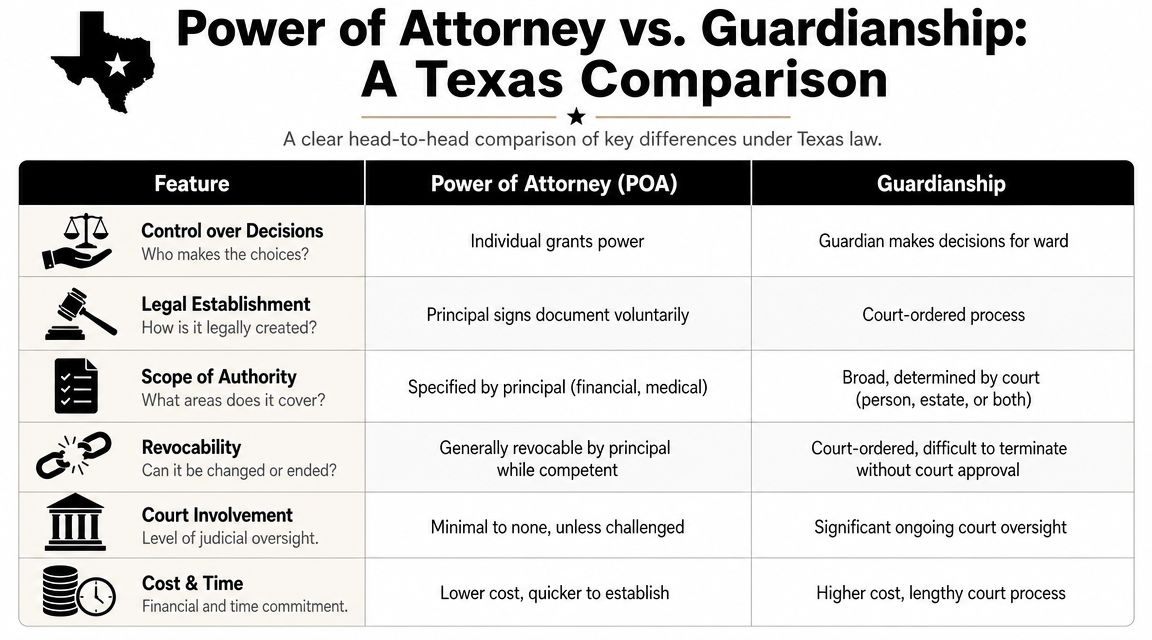
Power of Attorney vs. Guardianship at a Glance
| Feature | Power of Attorney (POA) | Guardianship |
|---|---|---|
| Control over decisions | The principal chooses the agent and grants authority | The court appoints a guardian and defines authority |
| Legal establishment | Signed voluntarily as a private document | Created through a court proceeding |
| Scope of authority | Can be tailored for financial, medical, or limited needs | Can cover the person, estate, or both, based on court order |
| Revocability | Generally revocable by the principal while competent | Usually requires court action to modify or end |
| Court involvement | Minimal unless challenged | Significant court oversight from start to finish |
| Privacy | More private | More public because it runs through court |
| Time and friction | Usually faster and simpler to put in place | More formal, slower, and supervision-heavy |
The practical difference becomes very clear when families step into probate court. In counties such as Harris County or Dallas County, a guardianship case is not just paperwork. It means filings, service, hearings, medical evidence, and ongoing compliance after appointment.
The biggest trade-offs
A POA gives the family flexibility. If your father still has capacity, he can choose who will help him, limit that help to certain tasks, and avoid routine court monitoring. That often preserves dignity and reduces conflict.
Guardianship offers stronger outside oversight. That can be necessary when a person is vulnerable, the family is fighting, or no one trusts the existing agent to act properly.
Practical rule: If your loved one can still make an informed choice, a carefully drafted POA is usually the less intrusive path. If they can’t, the court may need to decide who should act and under what limits.
Texas guidance describes guardianship of the estate as a high-supervision financial control system. The guardian operates under court supervision, and the process generally involves petitioning a probate court, proving incapacity, medical evaluation, notice to interested parties, a hearing, and ongoing reporting or accounting duties. A POA, by contrast, can be executed privately and customized without routine court monitoring, making it lower-friction while capacity still exists, according to this Texas comparison of POA and guardianship.
Here is a short video that helps frame the difference in a practical way:
What works, and what doesn’t
A POA works well when:
- The document is signed early: Waiting too long can destroy the option.
- The authority is clear: Broad confusion invites disputes with banks, hospitals, or relatives.
- The agent is trustworthy: The document is only as safe as the person using it.
Guardianship works well when:
- The family needs enforceable authority: Third parties usually recognize a court order more readily than a disputed POA.
- There is a need for supervision: Court monitoring can help protect assets and reduce abuse risks.
- The situation is already in crisis: If incapacity is established, the court process may be unavoidable.
What doesn’t work is pretending these tools carry the same weight. They don’t. A POA is a private delegation. Guardianship is a public legal status backed by court authority.
Common Scenarios Where a Power of Attorney Is the Best Choice
A power of attorney is often the right answer when the person still understands what they are doing and wants help, not replacement.
One common example is the aging parent who is still sharp enough to make decisions but tired of handling every detail. She may want her daughter to help with online banking, insurance calls, and routine paperwork while keeping control over major choices. A durable financial POA can fit that situation well because it supports the parent without putting her under court control.
Medical planning before a health event
Another strong use case is medical planning before surgery or treatment. A man scheduled for a serious procedure may want his wife to speak with doctors and make healthcare decisions if he cannot communicate for a period of time. That’s exactly the kind of situation where a medical POA can be practical, dignified, and efficient.
Estate planning for couples and families
Married couples often include POAs in broader estate planning. They want someone they trust to step in if one spouse becomes ill, travels unexpectedly, or begins to decline cognitively. That kind of planning works because it is intentional. The principal chooses the helper in advance rather than leaving the family to sort it out in probate court later.
A good POA doesn’t take rights away. It creates a plan for who may act if help is needed.
Why POA is often the better first step
Families usually prefer POA when the goal is support rather than control.
- It preserves choice: The principal names the agent.
- It can be narrow or broad: Some people need help only with finances. Others want only medical coverage.
- It avoids routine hearings: That can reduce stress for the whole family.
- It can reduce public exposure: Private documents usually keep sensitive family issues out of court.
The catch is simple. It only works if it is done while capacity still exists and if the document is drafted clearly enough for real-world use. Families often regret waiting until “things get worse,” because by then the person may no longer be able to sign a valid document at all.
When Guardianship Becomes the Only Necessary Option

Some cases have already moved past private planning. The parent never signed a POA. The existing document is too limited. The agent is misusing funds. A facility refuses to accept the paperwork. A loved one’s condition has deteriorated to the point that informed consent is no longer possible.
That’s when guardianship stops being theoretical and becomes necessary.
Common trigger points
Texas families often reach this point after a clear breakdown:
- Advanced cognitive decline: The person can’t understand decisions or protect themselves consistently.
- Sudden incapacity: A stroke, accident, or medical emergency leaves no time to create new documents.
- Agent misconduct: The person named in the POA is acting against the principal’s interests.
- Institutional refusal: A bank, care facility, or other institution rejects the POA or says its authority is unclear.
- Family conflict: Relatives accuse one another of manipulation, isolation, or financial abuse.
Texas materials also recognize an important nuance. Guardianship can override a POA, but only in certain circumstances. In some situations, part of the POA may still remain effective even after a guardianship is created. The practical issue is what failed badly enough for the court to step in. That may involve incapacity, agent misconduct, bank refusal, unclear authority, or a limited guardianship designed for a specific problem, as discussed in this explanation of moving from POA to guardianship in Texas.
What the court process usually involves
A Texas guardianship case under Texas Estates Code Title 3, Subtitle G is formal. Families should expect:
- A filed application in the proper court, often a probate court.
- Personal service and notice to the proposed ward and other interested persons.
- Evidence of incapacity, often including medical support.
- A hearing where the judge decides whether guardianship is necessary and, if so, how broad it should be.
- Post-appointment duties such as bond issues, reporting, and compliance for the guardian.
In counties like Harris County Probate Court, these cases can feel emotionally heavy because the court is deciding whether someone’s legal rights should be restricted. That’s why the evidence and procedure matter so much.
Guardianship is not a stronger version of a POA. It is a different remedy for a different problem.
Temporary and emergency guardianship
Sometimes a family can’t wait for the full process to unfold. If there is an urgent threat to health, safety, or property, the court may be asked to consider temporary relief. That can be critical when immediate decisions must be made and no reliable legal authority exists.
Temporary solutions can help stabilize a crisis, but they do not erase the need for careful preparation. Families still need records, medical information, witness details, and a clear explanation of why less restrictive options won’t protect the person right now.
Exploring Less Restrictive Alternatives in Texas
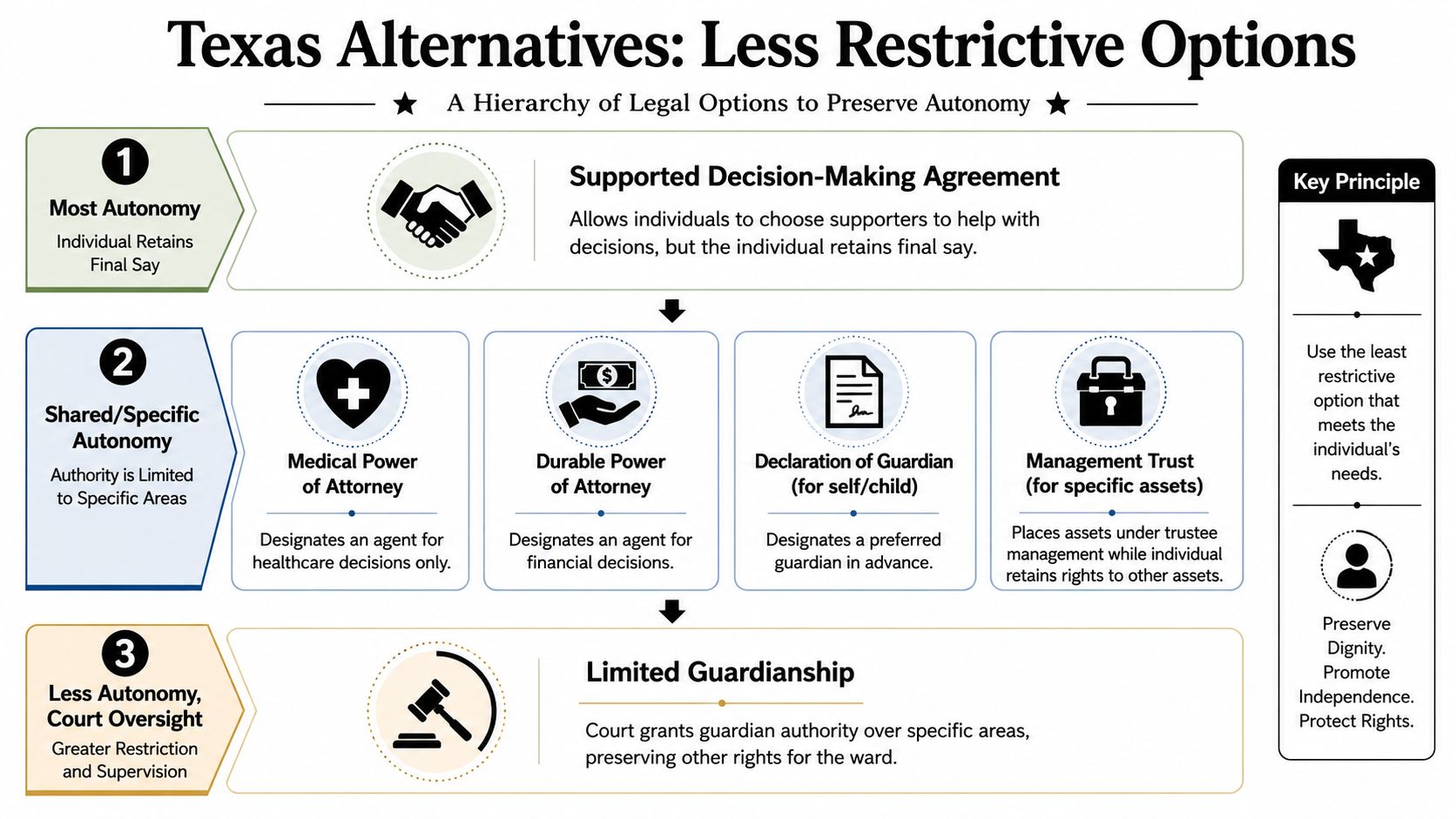
The choice is not always “sign a POA or file for full guardianship.” Texas law puts real weight on alternatives that preserve more independence.
That matters most in the messy middle. A loved one may struggle with some decisions but still understand others. Capacity may rise and fall. The problem may be family conflict rather than complete inability. In those cases, a full guardianship can remove more rights than the situation requires.
Texas guidance stresses that alternatives to guardianship should be considered, and that a durable power of attorney can prevent guardianship in some cases. The focus should be on preserving as much decision-making authority as possible while still protecting the person, including through supported decision-making and narrowly designed limited guardianships, as explained by Texas Law Help on guardianship alternatives.
Supported decision-making
A Supported Decision-Making Agreement can be a strong option for adults who can make decisions if they receive help understanding information, weighing choices, or communicating with providers.
Families often do well with this option when the loved one can still say what they want, but needs a trusted supporter to help with:
- Medical discussions
- School or service planning
- Benefit or paperwork review
- Communication with banks or agencies
Readers wanting a practical overview can review this guide to supported decision-making in Texas.
Limited guardianship and other targeted tools
A limited guardianship may fit when the court needs to step in, but only for certain decisions. For example, the court may restrict authority to medical decisions or certain estate issues instead of removing broad rights across every area of life.
Other targeted planning tools may also help, depending on the problem:
- Medical POA: Useful when the main concern is healthcare.
- Durable POA: Useful when finances and property management are the issue.
- Declaration of guardian: Helps express future preferences.
- Trust-based management: May help with specific assets without broad court intervention.
The best plan is usually the least restrictive one that still keeps the person safe.
In such situations, legal advice becomes especially valuable. The family may not need “more authority.” It may need the right amount of authority, in the right place, with the fewest rights lost.
Your Family’s Practical Next Steps
A lot of families reach this point after something has already gone wrong. The bank refused to honor the POA. A sibling is accusing the agent of misuse. A parent who signed documents years ago now cannot explain what they want. At that stage, delay usually makes the problem harder and more expensive to fix.
Start by getting clear about the problem in front of you. Is the current POA still usable? Is the agent doing the job properly? Does your loved one still have enough capacity to update documents, or has the situation crossed into territory where court involvement may be the safer option?
A practical checklist
-
Assess current capacity.
Focus on present ability, not old assumptions. Your loved one may still be able to choose a helper for one task but not manage broader financial or medical decisions. That distinction often determines whether a new POA is still possible or whether the family needs to prepare for guardianship. -
Gather the documents before opinions harden.
Collect existing POAs, medical directives, wills, trusts, recent medical records, bank notices, and any correspondence showing rejected authority or suspected misuse. If conflict is building, preserve texts, emails, and a timeline of incidents. Those details matter. -
Identify the core points of agreement and disagreement.
Some families are not fighting about care. They are fighting about control, money, or mistrust built up over years. Separate those issues early. Also ask whether your loved one can still participate meaningfully in the discussion, because their voice should remain central as long as possible. -
Test whether the current POA is failing, and why.
A POA can fail for different reasons. The document may be too old, too vague, improperly executed, rejected by a financial institution, or abused by the named agent. Each problem points to a different response. Sometimes the fix is a new document. Sometimes it is revocation, an accounting demand, or immediate court action. -
Compare the middle-ground options before filing.
Families often assume the next step after a weak POA is full guardianship. That is not always true. A limited guardianship, supported decision-making arrangement, updated medical documents, or a trust-based solution may solve the actual problem without removing broader rights than necessary. -
Prepare for guardianship like a court case, because it is one.
If guardianship appears likely, begin preparing for medical evidence, required notices, attorney appointments, the hearing, and the ongoing reporting duties that come after appointment. The filing fee is only part of the cost. Time off work, family conflict, and long-term court supervision are part of the equation too. -
Get legal advice tied to your county and your facts.
Texas law sets the framework, but outcomes also depend on the document language, the medical evidence, the family dynamic, and local court practice. A Texas guardianship attorney can help your family decide whether to repair a failing plan, use a narrower alternative, or move quickly toward guardianship before more damage is done.
The right next step depends on your loved one’s condition today. It also depends on whether the family needs cooperation, enforcement, or protection. Families in Houston, Dallas, Austin, San Antonio, and surrounding counties often need advice that is both legally precise and realistic about cost, timing, and what court involvement will require.