Skip to content
A lot of families reach this point after months, sometimes years, of trying everything else first. A daughter is calling the bank because her father is forgetting bills and giving money away. A spouse is arguing with a hospital that says, incorrectly, “We need guardianship before we can talk to you.” A parent of an adult child with disabilities is realizing that turning eighteen changed the legal situation overnight.
When guardianship becomes part of the conversation, most families feel two things at once. Relief that there may be a way to protect someone they love, and grief because they know guardianship can take away important rights. That tension is normal.
In Texas, guardianship is not meant to be the first answer. It is the hardest answer. But there are times when it is also the only workable one. When that happens, families need clear information, steady guidance, and a plan that protects dignity as much as safety.
Understanding When Guardianship Is a Last Resort
Texas courts start from a simple idea. Adults should keep as much independence as possible for as long as possible. Texas treats guardianship as a last resort and requires courts to consider less restrictive alternatives before appointing a guardian. State reforms formalized in 2017 reinforced that approach, and families often must show not only incapacity, but also why tools like supported decision-making or powers of attorney are not enough, because guardianship removes rights and privileges from the proposed ward, as explained by Texas Law Help's guardianship overview.

That legal standard matters in real life. If your loved one is making risky choices but still understands the consequences and can direct help, the court may decide guardianship is too restrictive. If your loved one cannot manage basic personal safety, medical decisions, or finances, and no narrower option will protect them, the court may see guardianship differently.
What incapacity usually means in practice
Families often get confused here. Incapacity is not the same as aging, a diagnosis, stubbornness, or family conflict.
A person can be forgetful and still legally capable. A person can be physically frail and still able to make sound decisions. And a person can make choices you disagree with without being legally incapacitated.
Texas guardianship law under Title 3, Subtitle G of the Texas Estates Code focuses on whether the person can manage personal needs, health, safety, or property. The court is looking for proof, not guesswork.
Practical rule: Guardianship is usually about inability, not inconvenience. The question is not “Is this hard for the family?” The question is “Can this person protect themselves and manage what the law expects them to manage?”
The why now question
The hardest cases often turn on timing. Families say, “We've managed until now, but something changed.”
That change may look like this:
- Medical refusal with serious risk: Your mother no longer understands why she needs treatment and refuses care that she cannot meaningfully evaluate.
- Financial exposure: Your brother is being manipulated, can't track bills, and cannot stop the loss on his own.
- Unsafe living conditions: Your loved one can no longer maintain housing, hygiene, medication, or nutrition without decision-making help.
- No valid legal documents: There is no usable power of attorney, or the person can no longer sign one.
If you're still trying to sort out whether the court will view guardianship as necessary, this guide on alternatives to consider before guardianship in Texas can help you frame the issue the same way a Texas probate court will.
Why Powers of Attorney and Other Tools May Not Be Enough
Most families ask about a power of attorney first, and that's often the right instinct. A durable power of attorney, medical directive, supported decision-making agreement, representative payee arrangement, or trust can solve many problems without taking away broad legal rights.
But these tools only work when they match the problem.
Where alternatives break down
A power of attorney is useful only if it was signed while the person had enough capacity to understand what they were signing. If your loved one already lacks that capacity, a new POA usually isn't available.
A medical directive helps with health decisions, but it doesn't solve every financial problem. A supported decision-making agreement can be an excellent option when a person can still make decisions with help, but it won't fix a situation where the person cannot understand the choices at all.
Another major problem is misuse. A document can exist on paper and still fail in practice if the named agent is abusing authority, refusing to act, or unable to handle the job responsibly.
Texas families also run into institutions that wrongly insist on guardianship. As noted in Grogan Law's discussion of power of attorney vs guardianship in Texas, supported decision-making agreements have been legally recognized in Texas since 2015, yet banks, hospitals, and schools don't always understand how to work with them.
If a bank or hospital says “you need guardianship,” ask a follow-up question. “What exact document or authority do you need for this specific action?” Sometimes the answer is narrower than the institution first claimed.
Guardianship vs alternatives in Texas
| Feature | Durable Power of Attorney | Medical Directive | Supported Decision-Making | Guardianship |
|---|---|---|---|---|
| How it starts | Signed voluntarily by the principal | Signed voluntarily by the patient | Signed voluntarily by the adult | Created by court order |
| Capacity needed at signing | Yes | Yes | Yes | No consent required if incapacity is proven |
| Court oversight | No | No | No | Yes |
| Can it help with finances | Often, yes | No | Sometimes, indirectly | Yes, if estate authority is granted |
| Can it help with medical decisions | Sometimes, depending on the document | Yes | Sometimes, as support rather than substitute decision-making | Yes, if person authority is granted |
| Best fit | Advance planning | Specific healthcare planning | Adults who can decide with support | Situations where less restrictive tools failed or can't work |
Real-world tipping points
A few examples make this clearer.
Example one: An elderly father signed a durable power of attorney years ago. His daughter discovers the named agent has been draining accounts. The document exists, but it is no longer protecting him. Court oversight may now be necessary.
Example two: An adult son with developmental limitations understands daily routines but cannot manage a settlement fund or deal with complex financial decisions. A limited guardianship of the estate may be more appropriate than trying to stretch a simpler document beyond its purpose.
Example three: A hospital refuses to discuss discharge planning with a family member. Before filing for guardianship, the family should ask whether a medical power of attorney, HIPAA release, or supported decision-making agreement will satisfy the hospital's concern. Guardianship may still become necessary, but not every institutional roadblock justifies it.
For a side-by-side look at when one option fits better than the other, see power of attorney vs guardianship in Texas.
The Texas Guardianship Process from Filing to Hearing
A lot of families reach this stage after months of trying everything else first. The power of attorney was ignored. The hospital wanted someone with legal authority. The bank froze access. The person at the center of the case could no longer understand what they were signing, or could not protect themselves from harm. When that happens, the question changes from "Can we avoid court?" to "How do we protect them the right way?"
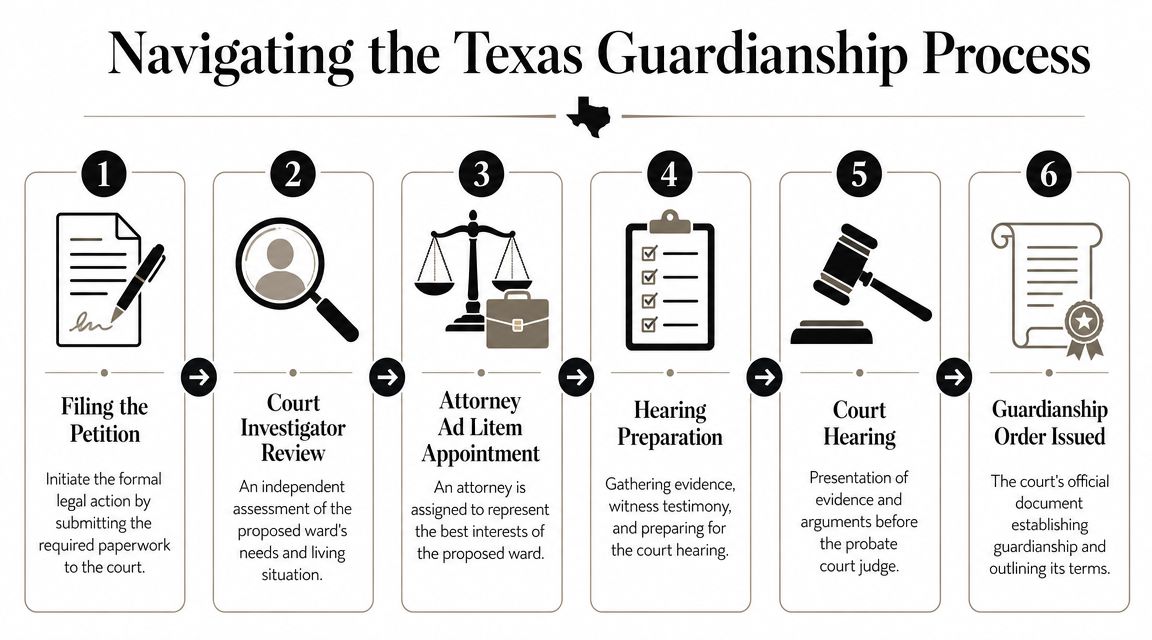
Texas treats guardianship as a serious transfer of rights, so the process is formal on purpose. For an adult guardianship, Texas law generally requires a licensed attorney to file the case, medical evidence addressing incapacity, personal service on the proposed ward, notice to certain interested persons, appointment of an attorney ad litem, and a court hearing. You will see these requirements in practice under Title 3, Subtitle G of the Texas Estates Code.
What the filing stage usually looks like
The case begins with an application filed in the proper probate court or county court handling guardianship matters. The application tells the court who needs protection, what authority is being requested, and why less restrictive options are no longer enough. That last part matters. Judges in Texas do not want families to use guardianship as a shortcut when a narrower tool would work.
In plain English, the filing needs to answer two hard questions. Why now? What failed?
A strong application often includes concrete examples. The proposed ward wandered from home and could not find the way back. Bills went unpaid despite available income. A caregiver exploited an existing power of attorney. A facility refused discharge planning because no valid decision-maker could act. Facts like these help the court see the tipping point.
Medical evidence is usually central. In many adult cases, the court will expect a Physician's Certificate of Medical Examination or other legally sufficient medical proof addressing the person's condition, functional limits, and ability to make decisions. Families are often surprised by how specific this needs to be. A diagnosis alone is usually not enough. The court wants to know how the condition affects actual decision-making.
If there is a disputed injury, a complicated diagnosis, or conflicting opinions about capacity, reading about medical experts in personal injury cases can help explain why courts give so much weight to clear, qualified medical testimony.
What happens after filing
After the application is filed, the proposed ward must be personally served with citation. That step can feel harsh to families, especially when they are trying to help. But it serves the same purpose as notice in any case involving important rights. The person has a right to know that someone is asking the court to limit their legal authority.
The court also appoints an attorney ad litem for the proposed ward. This lawyer does not represent the applicant or the family as a group. The ad litem's job is to represent the proposed ward in the case, investigate the facts, and help the court test whether guardianship is necessary and, if it is, how limited it should be.
That investigation often changes the tone of the case.
Families sometimes expect a simple paperwork review. Instead, the court process works more like a safety check. The judge is not only asking whether help is needed. The judge is also asking whether the requested authority is too broad, whether someone else is better suited to serve, and whether the person's remaining rights can be preserved.
A typical sequence looks like this:
- Attorney review and case planning: Counsel confirms the problem, reviews failed alternatives, and identifies whether the request involves the person, the estate, or both.
- Application filed with the court: The pleading must give the court a legally sufficient reason for guardianship and identify the requested powers.
- Medical evidence prepared: The physician or other qualified professional provides the required capacity evidence in the form the court will accept.
- Service and notice completed: The proposed ward is personally served, and required notices go to family members and other interested persons.
- Attorney ad litem investigation: The ad litem meets with the proposed ward, reviews records, and may contact relatives or providers.
- Hearing before the judge: The court decides whether the legal standard has been met and, if so, what authority to grant.
A short video can also make the flow easier to understand before a hearing date arrives.
The hearing is where the court decides whether another adult should receive legal authority over the person or property of the proposed ward. That is why the process is evidence-heavy and closely supervised.
Practical steps before court
Good preparation helps families avoid two common problems. The first is filing too early, before they can show why other options failed. The second is filing with too little detail, which leaves the court guessing about the actual risk.
Before the hearing, organize the case like you would organize a timeline for a doctor. Dates, incidents, records, and names matter.
- Medical records and provider contacts: Keep current records together, along with the names of the doctors who can explain the person's limitations.
- A written timeline of recent events: Include falls, missed medications, unsafe driving, scams, financial losses, elopement, or refusal of needed care.
- Copies of alternatives already attempted: Bring powers of attorney, directives, supported decision-making agreements, trust documents, or revocations if those tools failed or were abused.
- Proof of institutional refusals: If a bank, hospital, rehab facility, or insurer blocked action, write down who said what, when, and why. Sometimes the institution is wrong about needing guardianship, and sometimes that refusal helps show why court authority is now necessary.
- A practical care plan: Be ready to explain where the person will live, who will help with care, how bills will be paid, and what oversight will exist.
Families should also prepare for emotion in the courtroom. Guardianship cases often involve grief, guilt, and disagreement. The legal question is narrower. Can the court, based on the evidence, find that this person needs a guardian and that no less restrictive option will protect them right now?
That focus helps.
Choosing the Right Type of Guardianship for Your Loved One
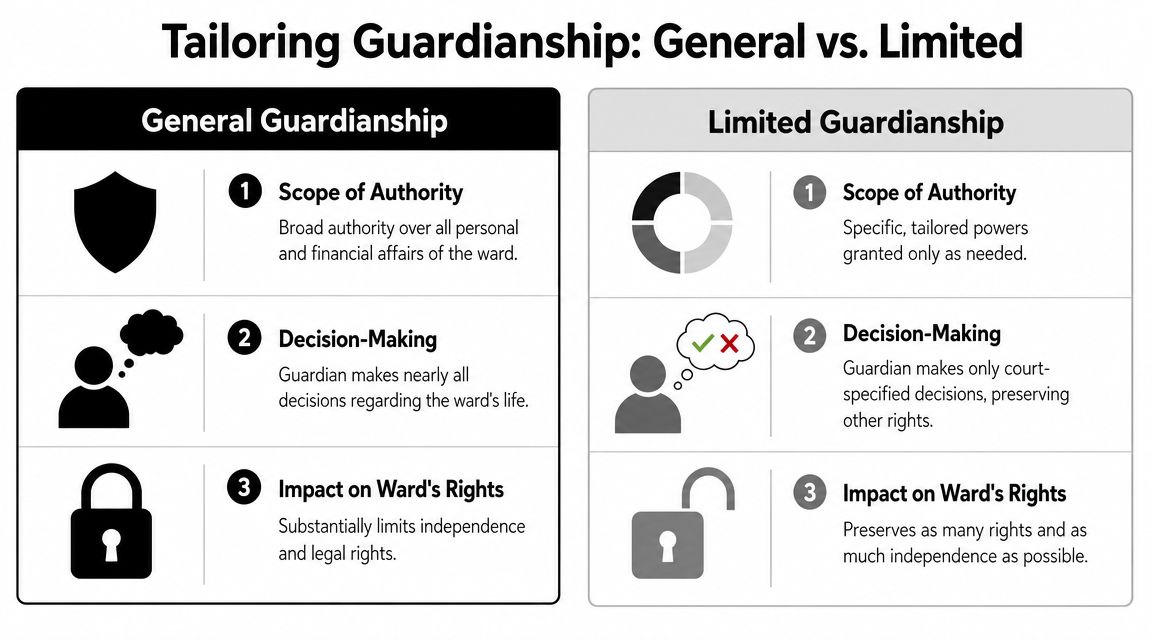
Guardianship isn't one giant switch that turns all rights off. Texas courts can tailor the order to the actual need. That matters because the goal is protection, not unnecessary control.
Person, estate, or both
A guardian of the person handles decisions about care, housing, medical treatment, and day-to-day well-being. This is often the focus when the main concern is safety, supervision, or healthcare.
A guardian of the estate handles money, property, benefits, and other financial matters. This becomes important when a loved one has assets, settlement funds, income, or bills they cannot safely manage.
Some families need both. Others need only one.
Why limited guardianship matters
Texas courts generally prefer the least restrictive arrangement that will still protect the person. Under Title 3, Subtitle G of the Texas Estates Code, that often means looking closely at what the person can still do for themselves.
A limited order may allow the ward to keep decision-making power in some areas while giving the guardian authority only where help is needed.
Consider these examples:
- Health care help only: A woman can manage spending money and daily choices, but she cannot understand complex medical treatment options. Guardianship of the person may be limited to health-related decisions.
- Financial help only: A young adult can decide where to live and what care he wants, but he cannot manage a bank account or a legal settlement. Guardianship of the estate may be the better fit.
- Narrow authority for a narrow risk: A person may need help consenting to services or handling benefits, but not broad control over every part of life.
A careful guardianship order should answer one question well: “What specific authority is necessary to keep this person safe and stable?”
Questions to ask before requesting scope
When families rush into court, they sometimes ask for more authority than they need. That can create avoidable conflict.
Ask yourself:
- What decisions is my loved one still making safely?
- Where has actual harm happened, or where is harm likely soon?
- Does the court need to protect the person, the estate, or both?
- Could a limited order solve the problem without removing more rights than necessary?
These questions often shape a stronger, more respectful case.
Handling Emergency Situations and Family Disputes
Some cases don't arrive neatly. They arrive in crisis.
A son learns his mother is wandering from home, refusing medication, and signing papers she doesn't understand. A niece discovers an uncle's accounts are being emptied while relatives argue over who should step in. These are the moments when waiting may create real danger.
When temporary guardianship may be necessary
Texas law allows temporary guardianship for no more than 60 days in ordinary cases, with a limited exception allowing up to nine months if the application is contested and the court still finds guardianship necessary, as explained in this overview of the temporary guardianship process in Texas.
That short timeline is important. Temporary guardianship is not supposed to become a quiet shortcut around the full process. It is designed to stabilize an emergency while the court considers longer-term relief.
A temporary case may be appropriate when:
- Immediate medical danger exists: A person cannot consent to necessary care and delay could lead to serious harm.
- Assets are at immediate risk: Someone is draining funds, coercing transfers, or exploiting the proposed ward.
- Living conditions are unsafe: The person is exposed to neglect, abandonment, or dangerous housing conditions.
What family disputes usually look like
Contested guardianship cases are rarely just legal fights. They are often years of family tension concentrated into one hearing.
One sibling may say, “Dad needs help now.” Another may say, “He's still capable, and you just want control.” Sometimes the disagreement is about need. Sometimes it is about who should serve. Sometimes it is both.
The court's job is not to reward the loudest relative. The court focuses on the proposed ward's welfare, the evidence of incapacity, and the least restrictive solution available.
In a contested case, judges pay close attention to conduct. Families who stay organized, respectful, and fact-focused usually help their case more than families who turn the hearing into a personal feud.
If you're facing a fast-moving crisis, this guide on how to get emergency guardianship fast in Texas can help you understand what to gather and what the court will expect.
A Guardian's Duties and Responsibilities After the Hearing
The court order is not the finish line. It is the start of ongoing fiduciary responsibility.
Once appointed, a guardian must act in the ward's best interest and remain accountable to the probate court. That means keeping records, following the court's limits, and staying current with filing deadlines.

What the court expects after appointment
Texas guidance states that a guardian of the person must file an Annual Report, and a guardian of the estate must file an Annual Accounting. Letters of Guardianship also expire after 16 months, which means the guardian must stay in compliance, obtain replacement letters, and continue meeting court requirements, as described by Hammerle Finley Law Firm's guardianship compliance overview.
That system exists for a reason. Guardianship gives one person legal authority over another person's care or property, so the court keeps watching.
Daily duties that matter most
The exact job depends on the type of guardianship, but common responsibilities include:
- Protecting the ward's well-being: Arrange housing, medical care, and support services that fit the court order.
- Managing funds carefully: Pay bills, preserve records, and avoid mixing the ward's money with anyone else's money.
- Following court limits: Ask for approval when required, especially for major decisions involving property or other significant changes.
- Tracking deadlines: Missed reports can create legal problems and may affect the guardian's authority.
A good practical habit is to keep one dedicated file, digital or paper, for every court notice, receipt, bank statement, medical update, and communication related to the ward.
Can guardianship end or change
Yes. Guardianship can be modified or terminated if the facts change. If a ward regains capacity in some area, or if a less restrictive arrangement later becomes workable, the court can revisit the order under the Estates Code.
That possibility matters. Even when guardianship is necessary now, the law still recognizes that the right amount of authority may change over time.
Your Next Step Protecting Your Loved One
Choosing guardianship usually means your family has already tried patience, teamwork, and smaller legal tools. By the time you are here, the question often isn't whether guardianship feels uncomfortable. It does. The question is whether anything else will protect your loved one in time.
When guardianship is the only option in Texas, clarity matters. You need to know what problem the court must solve, what alternatives have failed, what evidence will support the case, and what responsibilities come after appointment. You also need to move with care, because this process affects rights, dignity, family relationships, and long-term care planning.
Related planning often overlaps with other legal areas too. A guardianship case may connect with guardianship matters, probate guidance, or estate planning resources, depending on your loved one's needs and assets.
If you're worried that a parent, spouse, adult child, or minor may need protection, get legal advice early. Early advice can help you avoid an unnecessary filing, or build a stronger case when a filing can't be avoided.
The attorneys at Law Office of Bryan Fagan, PLLC help Texas families evaluate whether guardianship is necessary, prepare for probate court, handle emergency filings, and stay compliant after appointment. If you need guidance specific to your family's situation, schedule a free consultation to discuss the safest and least restrictive path forward.