Skip to content
When you make the courageous decision to pursue guardianship for a loved one, you are stepping into a legal process where every detail matters. We understand this journey is often filled with emotional and financial challenges. In Texas, one of the first and most critical steps is called “notice.” This is the formal, legal way of informing everyone involved that a guardianship case has been filed.
This isn’t just about filling out forms; it’s a fundamental legal right that protects the person at the center of the case. Think of it as the bedrock of a fair and transparent process, ensuring your loved one’s voice is heard and their rights are protected.
Why Notice Is the Foundation of Texas Guardianship Law
Imagine a legal notice as the official invitation to a very serious meeting—one where a person’s fundamental rights are on the table. Before any Texas judge can appoint a guardian, the law, specifically Title 3 of the Texas Estates Code, demands that certain people be formally notified. This rule is there to protect the proposed ward (the person who may need a guardian) and ensure the entire process is handled justly.
We know how much is at stake. A simple mistake in who you notify or how you do it could lead a judge in a Harris County Probate Court to dismiss your application entirely. That means you’re back to square one, facing frustrating delays, more legal fees, and prolonged uncertainty for your family.
The Purpose Behind the Paperwork: Upholding Due Process
At its core, the notice requirement is all about upholding a constitutional principle called "due process." In plain English, it means everyone gets a fair opportunity to be heard before their rights are changed.
In a guardianship context, proper notice ensures that:
- The proposed ward is fully aware that someone is asking a court for the power to make decisions on their behalf.
- Family members and other key individuals have the chance to support, contest, or provide information about the guardianship.
- The court has a complete picture from all relevant parties before making a life-altering decision.
Notice prevents a guardianship from happening in the shadows. It guarantees the person whose freedoms are at stake, along with their closest relatives, can have a voice in the courtroom. You can get a clearer picture of the initial steps by reading our detailed guide on how to file for guardianship in Texas.
At The Law Office of Bryan Fagan, we know that legal rules can feel overwhelming, especially when your family is already under stress. Our mission is to cut through the complexity and provide clear, compassionate guidance. We want to empower you with understanding and direction, so you feel confident in the court system, not intimidated by it.
This section is just the starting point. Next, we’ll break down exactly who needs to be notified, the specific methods you must use, and the strict deadlines you have to meet. Understanding these foundational rules is the first step toward a successful outcome.
If you are considering guardianship, you don’t have to navigate these complex requirements on your own. The stakes are simply too high. Contact The Law Office of Bryan Fagan today for a free consultation to talk about your family’s situation and make sure every step is handled with the care and precision it deserves.
Who to Notify and How to Do It Correctly
Figuring out exactly who needs to be told about a guardianship filing can feel like untangling a knotted rope. Thankfully, the Texas Estates Code lays out a clear path. The whole point of these rules is to make sure the people most affected by the guardianship have a chance to be heard and that the judge has the full picture before making a decision.
The law sorts people into different groups, and each group has its own specific rules for how they must be notified. Let’s break it all down into simple, manageable steps.
The Proposed Ward Must Be Personally Served
The most important person to notify is, without a doubt, your loved one—the person the guardianship is for, known as the proposed ward. Texas law is very strict about this. It requires something called personal service of citation.
This isn't as simple as dropping a letter in the mail.
Personal service means an officer of the court, like a constable or a private process server, must physically hand-deliver a copy of the guardianship application and a legal notice (the citation) directly to the proposed ward. This formal delivery is the court's way of guaranteeing they are officially aware of a case that directly impacts their rights.
This process ensures that the legal filing is connected to a fair outcome through proper notification.
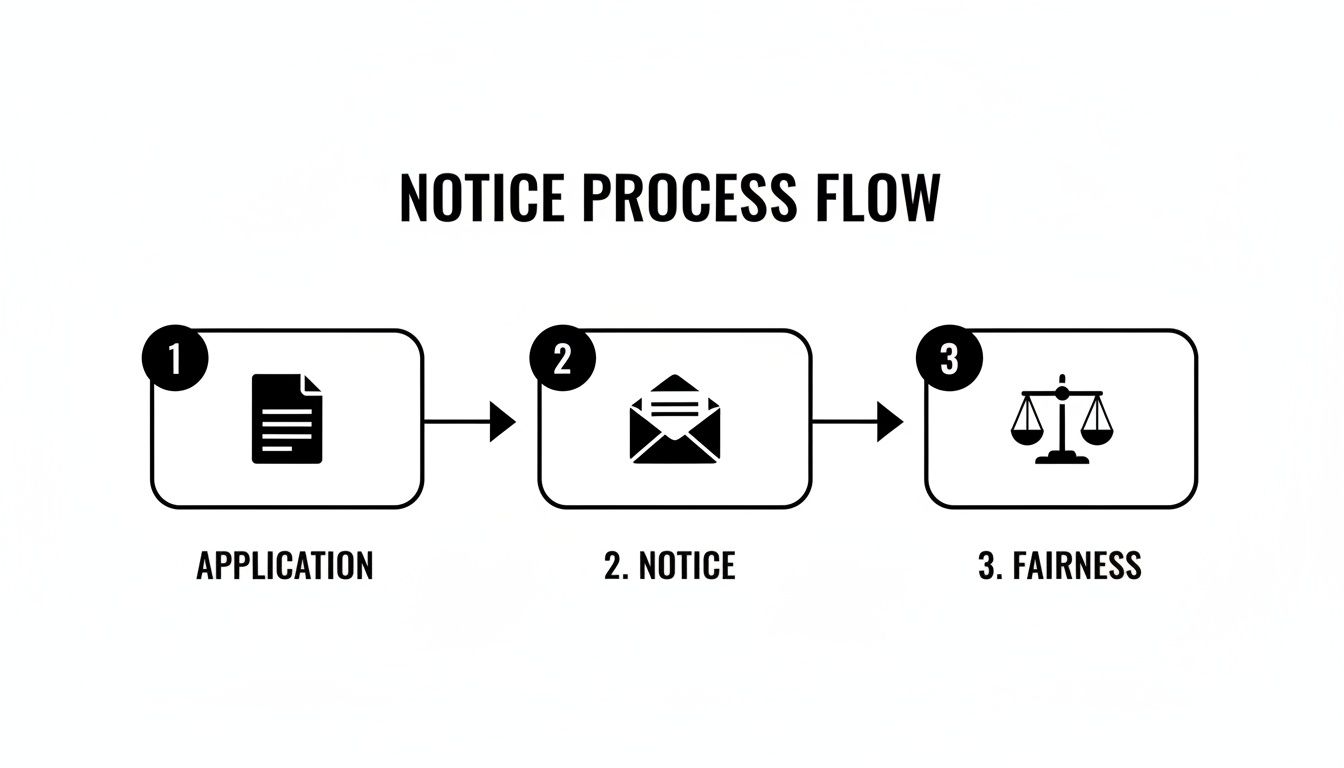
As you can see, proper notice is the critical middle step that connects the legal action to a just result.
Notifying Close Family and Other Key Parties
Beyond the proposed ward, a specific list of family members and other interested people must also get notice. The way you notify them is usually different from the personal service required for the ward.
Let's use a hypothetical scenario. Imagine a family in Harris County is filing for guardianship for their father, who has advanced dementia. The adult children filed the application. Here’s a list of who else they must legally inform:
- The Proposed Ward’s Spouse: If their father is married, his wife must be notified.
- The Proposed Ward’s Parents: If their father’s parents are still living, they must be notified.
- The Proposed Ward’s Adult Children: Every one of their father’s other adult children needs to receive notice.
- Current Caregivers: Anyone who lives with their father or provides significant, ongoing care must be informed.
- Facility Administrators: If their father is in a nursing home or assisted living facility, the administrator needs to get notice.
For these individuals, notice is typically sent via certified mail with a return receipt requested. This creates a paper trail proving the documents were sent and, hopefully, received—which is absolutely crucial for showing the court you’ve followed the rules to the letter.
The guiding principle here is transparency. Guardianship decisions are never made in a vacuum. The law is designed to ensure family members and caregivers have the opportunity to participate, whether it's to offer their support or to voice any concerns.
Following the Legal Requirements: A Practical Checklist
The Texas Estates Code § 1051.103 is the statute that dictates who gets notice. Missing even one person on that list can put the entire case at risk. In Texas, the notice requirements are strict, and hearings cannot proceed until at least 10 days have passed after service is complete.
Getting this wrong is more common than you'd think. While specific data varies, a significant percentage of guardianship applications face dismissal or delays due to defective notice. You can learn more about guardianship filing deadlines and their impact.
To stay on track, a simple checklist can be a lifesaver:
- Identify All Required Parties: Make a complete list of every person and facility that needs notice according to the Texas Estates Code. Don't guess.
- Serve the Proposed Ward Personally: Arrange for a constable or a professional process server to handle the in-person delivery of the citation.
- Mail Notices to Other Parties: Send copies of the application by certified mail, return receipt requested, to all other relatives and individuals on your list.
- File Proof with the Court: Once the process server gives you their "return of service" and you start getting back the green certified mail cards, file them with the court clerk. This is your proof that everyone was notified.
The notice requirements for guardianship in Texas are detailed for a very good reason—they protect your loved one and ensure the process is fair for everyone involved. If you’re feeling overwhelmed by these steps, The Law Office of Bryan Fagan is here to help. Schedule a free consultation with our team, and let us handle the legal complexities so you can focus on what matters most: your family.
Understanding Critical Guardianship Timelines

In Texas guardianship proceedings, timing isn’t just important—it’s everything. The law lays out a series of strict deadlines meant to protect the rights of the proposed ward and ensure the process is fair. While these timelines can feel rigid, understanding them helps your family stay on track, avoiding costly delays and unnecessary stress.
The most critical deadline is the one that kicks in right after the citation is personally served on your loved one. Once that formal delivery happens, a legal clock starts ticking.
The Mandatory 10-Day Waiting Period
Under Title 3 of the Texas Estates Code, a judge cannot hold a hearing on a guardianship application until at least 10 days have passed since the proposed ward was personally served with the legal papers. This is often called the "10-day rule," and it's a non-negotiable part of standard guardianship cases. This waiting period is a crucial safeguard, giving the proposed ward and their court-appointed attorney (the Attorney Ad Litem) time to review the application, talk about the situation, and prepare for the hearing.
Think of it as a mandatory pause button. It ensures that no one is rushed into court without a fair chance to understand what’s happening and respond.
Let's look at a simple calendar example to see how this plays out in a real-world case.
- Day 1 (Monday, May 5th): A process server personally serves your father with the guardianship application and citation in Bexar County.
- Day 11 (Friday, May 16th): This is the earliest possible day a judge could hear the case. The 10-day period has now passed.
This timeline shows that while the wait can feel long, it’s a predictable part of the process. With careful planning, your attorney can schedule the hearing accordingly, ensuring no time is wasted.
Filing Proof of Service and Other Deadlines
The work isn’t done once the notices are sent. The court needs official proof that you followed all the notice requirements for guardianship in Texas. This is done by filing specific documents with the court clerk.
When the process server serves the proposed ward, they will complete a document called a Return of Service. This is a sworn statement detailing when, where, and how they delivered the papers. For other relatives notified by certified mail, you'll get green signature cards back in the mail as proof of delivery.
These documents—the Return of Service and the signed certified mail receipts—must be filed with the court clerk. They are the official record that proves everyone was properly notified. Without this proof on file, the judge cannot proceed with the hearing.
Missing these deadlines or failing to file your proof of service has real-world consequences. A judge in any Texas court, from Tarrant to Travis County, will simply reschedule the hearing, forcing you to wait even longer. This not only prolongs the uncertainty for your loved one but also drives up legal fees and adds to your family's emotional burden.
These timelines are strict for a reason, but they are entirely manageable with proactive legal guidance. We can help you navigate these critical dates and ensure every step is completed correctly and on time. To discuss your family’s specific needs and create a clear path forward, contact The Law Office of Bryan Fagan for a free consultation today.
The Role of the Attorney Ad Litem

After you file a guardianship application, the court doesn’t just take your word for it. A judge will immediately appoint a special, independent attorney whose only client is the person you’re seeking to protect—the proposed ward. This lawyer is called an Attorney Ad Litem, or AAL for short.
It’s natural to feel a little apprehensive about another attorney getting involved. But understanding their role is key. The AAL isn’t there to fight your family or oppose the guardianship. Think of them as the eyes and ears of the court, dedicated exclusively to protecting your loved one’s rights and ensuring their voice is heard.
The AAL’s Investigation and Duties
The Attorney Ad Litem has a very specific job: conduct a thorough, unbiased investigation. Their first and most important step is to meet privately with your loved one. During this meeting, they'll explain what a guardianship means in simple terms and, most importantly, give your family member a chance to express their own wishes and feelings about it.
As part of their investigation, the AAL is required to:
- Interview All Parties: The AAL will speak with you, other family members, and caregivers to get a complete 360-degree view of the situation.
- Review Medical Records: They'll carefully examine the doctor’s letter and any other medical evidence you've provided to understand the clinical basis for the alleged incapacity.
- Verify Notice: This is a huge part of their job. The AAL must confirm that all notice requirements for guardianship in Texas were followed to the letter. They check that the proposed ward was properly served and that every required relative was notified on time.
This meticulous review ensures the entire case is built on a solid legal foundation before it ever gets in front of the judge. It's worth noting this role is different from a Guardian Ad Litem, which you can read our guide on the duties of a Guardian Ad Litem to understand better.
Why This Role Matters So Much
The Attorney Ad Litem acts as a critical check and balance in the system. They make sure that, in the rush to provide protection, no one's fundamental rights get steamrolled. Their final report to the court, which lays out their findings and makes a recommendation, carries a lot of weight with the judge.
The AAL’s purpose is to ensure the proposed ward’s voice is heard, even if they can no longer speak clearly for themselves. This commitment to due process protects your loved one and gives your family confidence that the outcome will be just and fair.
The AAL must complete specialized training to even qualify for this role. Their work is pivotal. Data from counties like Fort Bend and Montgomery shows the vast majority of hearings only move forward after the mandatory 10-day citation period is met—a deadline the AAL is responsible for confirming. You can explore more about these guardianship responsibilities and statistics.
Here at The Law Office of Bryan Fagan, we view the Attorney Ad Litem as an essential part of the process. We work with them, not against them, by providing all the information they need to do their job right. This cooperative spirit helps streamline the case, minimize conflict, and keep the focus exactly where it should be: on your loved one’s well-being.
If you have questions about the Attorney Ad Litem or any other step in the guardianship process, our team is here to bring you clarity. Schedule a free consultation today to get the answers you need.
Navigating Emergency Guardianships and Waivers
While the standard guardianship process has deliberate, built-in timelines, some situations are simply too urgent to wait. Your loved one might be facing immediate physical harm or be the target of a financial predator who is quickly draining their life savings.
For these crises, Texas law provides important exceptions to the standard notice rules, allowing a court to step in quickly. The two main tools for this are Temporary Guardianships and Waivers of Service.
When Is a Temporary Guardianship Necessary?
A Temporary Guardianship is a fast-tracked, short-term measure designed for true emergencies. To convince a judge to grant one, you have to provide solid proof of "imminent danger." This means showing that your loved one is at immediate risk of serious physical harm or that their estate is about to be wasted or stolen if a guardian isn't appointed right away. It's a high bar to clear.
For instance, if an elderly parent with dementia has a new "friend" who is siphoning money from their bank accounts, that could be considered an imminent danger. The same goes for a person who, due to a mental health crisis, is refusing life-saving medical treatment.
Even in these urgent scenarios, notice isn't completely thrown out the window. The hearing can happen in a matter of days rather than weeks, but the court still insists that the proposed ward and their Attorney Ad Litem get notified, even if it's on a very compressed timeline. For a deeper look, check out our guide on how to get a temporary guardianship without standard notice in Texas.
Using Waivers of Service to Speed Things Up
Another tool that can help move a guardianship case along more quickly is a Waiver of Service. This is a legal document that certain family members can sign to tell the court they agree to give up their right to be formally served with notice.
A waiver streamlines the process by removing the need to wait for formal service and mail delivery. It’s a sign of family consensus that can help a case proceed more smoothly and quickly.
By signing a waiver, they're effectively saying, "I'm aware of the case, I don't need a process server to hand me papers, and I consent to the court moving forward."
However, the law is very specific about who can and cannot sign a waiver:
- Family Members Can Sign: A spouse, adult children, or parents can often sign a waiver if they're on board with the guardianship. This is a common strategy when the family is united and wants to avoid unnecessary delays.
- The Proposed Ward CANNOT Sign: This is a critical point. The Texas Estates Code strictly forbids the proposed ward from signing a waiver. Their right to be personally served is absolute and cannot be given up.
Deciding whether to take the standard path, pursue an emergency guardianship, or use waivers really depends on the unique facts of your family's situation. With so much on the line, making the right call requires a careful legal analysis.
At The Law Office of Bryan Fagan, we can help you assess the urgency of your circumstances and decide on the most appropriate path forward. Schedule a free consultation today, and let us help you protect your loved one with clarity and care.
Your Notice Duties After a Guardian Is Appointed
Walking out of the courthouse with a signed order appointing you as guardian might feel like the finish line, but it's really the starting gun for your new responsibilities. While the initial notice requirements for guardianship in Texas are behind you, a whole new set of duties kicks in immediately.
Your role now shifts to active management, transparency, and ongoing communication, all governed by the Texas Estates Code. The court has placed immense trust in you, and these rules are the system's way of ensuring accountability. Ignoring these post-appointment duties can land you in serious legal trouble, including being removed as guardian.
Initial Tasks and Notifying Creditors
The first month after your appointment is a whirlwind of deadlines. Your immediate task is to formally accept your role. This means you have 20 days from the date you're appointed to file a sworn oath with the court, promising to faithfully perform your duties. You'll also need to post a bond, which acts like an insurance policy to protect the ward's assets.
Once that's done, your attention must pivot to the ward’s financial picture, specifically their debts. You have a legal obligation to let creditors know about the guardianship.
-
Notice to Unsecured Creditors: You have one month after receiving your official Letters of Guardianship to publish a general notice in a local newspaper. This informs anyone the ward might owe money to—like credit card companies or medical providers—that a guardianship has been established and they need to file a claim with the estate.
-
Notice to Secured Creditors: For debts tied to collateral, like a home mortgage or a car loan, the timeline is a bit longer. You must send specific, direct notice to these creditors within four months of your appointment.
These aren't just suggestions; they are firm deadlines set by law. Failure to comply can lead to serious complications. For a deeper dive into these duties, you can learn more about guardianship requirements from Texas Law Help.
Ongoing Notice for Major Life Events
Beyond the initial flurry of activity, your duty to provide notice is ongoing. The law recognizes that even with a guardian in place, close family members still have a right to know about significant events affecting their loved one.
A guardian’s role is one of active management, not silent control. The law builds in checkpoints to ensure you are communicating key information, which protects both the ward and you.
You'll need to provide notice to the court and other parties for major life changes, including:
- Change of Residence: If you need to move the ward to a new home, whether it's to another house, an assisted living facility, or a nursing home, you must notify the court and often other interested parties.
- Hospitalization or Serious Illness: While this might not always require a formal legal filing, keeping close family members informed about major health developments is a fundamental part of a guardian’s role.
- End-of-Life Decisions: In the unfortunate event you must make significant medical decisions near the end of the ward's life, the law may require you to provide notice to certain individuals.
Successfully managing a guardianship is all about staying organized, being proactive, and communicating clearly. These ongoing notice requirements are a core part of that responsibility, ensuring you always act with the transparency and integrity the role demands.
If the ongoing responsibilities of a guardian feel daunting, you don't have to manage them alone. The Law Office of Bryan Fagan provides ongoing support to Texas families, helping you stay compliant and confident. Schedule a free consultation to discuss how we can assist you long after the initial hearing is over.
Common Questions About Guardianship Notice
The Texas guardianship process is layered with specific rules, and it’s completely normal to have questions—especially when it comes to who needs to be notified and how. We've seen firsthand how confusing the notice requirements can be for families.
Let’s walk through some of the most common scenarios our clients face. Getting clear on these points can help demystify the notice requirements for guardianship in Texas and give you the confidence to move forward.
What If We Cannot Find a Family Member to Serve Notice?
This happens more often than you might think. If you’ve made every reasonable effort to locate a required relative and have come up empty, your case isn’t dead in the water.
Your attorney can file a motion with the court, such as a Harris County Probate Court, explaining the situation. You’ll ask for permission to use an alternative method of notice, such as posting it at the courthouse or publishing it in a local newspaper. The key is proving you conducted a "diligent search." You must be able to show the judge every call, email, and letter you sent. Meticulous documentation is your best friend here; it prevents major delays.
Does the Proposed Ward Have to Accept the Papers?
No, they don't. A person can't halt a guardianship proceeding simply by refusing to take the paperwork from a process server. The law anticipates this.
If the proposed ward refuses to accept the papers, the server can complete the service by being in their presence, identifying them, and leaving the citation in a conspicuous place nearby. The server then files a sworn statement, the "return of service," with the court, detailing what happened. This ensures the process moves forward while still respecting the rules.
Can We Shorten the 10-Day Waiting Period?
For a standard guardianship, that 10-day waiting period after the proposed ward is served is non-negotiable. It's a critical safeguard built into the Texas Estates Code.
This period gives the proposed ward and their court-appointed Attorney Ad Litem the necessary time to review the application, understand what’s happening, and prepare for the hearing.
The only exception is a true Temporary Guardianship, where you must prove to the court that the proposed ward faces an imminent risk of substantial harm. Trying to rush a standard guardianship will almost always lead to frustrating postponements.
Do I Have to Notify Estranged Relatives or Those Living Abroad?
Yes, absolutely. The law is very clear on this. You are required to notify all legally specified relatives, regardless of your personal relationship or where they happen to live.
Estrangement doesn't erase a person's legal right to be informed about a proceeding involving a family member. For relatives living out-of-state or overseas, notice has to be sent using a trackable method like certified mail. Failing to notify a required person is a critical mistake that can put the entire guardianship in jeopardy. It’s essential to list every relative and their last known address in your application to stay in full compliance.
Navigating the detailed notice requirements is one of the most important parts of a successful guardianship case. You don't have to face it alone. The experienced team at The Law Office of Bryan Fagan, PLLC is dedicated to guiding Texas families through every aspect of Guardianship Law, Probate, and Estate Planning with clarity and compassion. Schedule a free consultation today to get personalized guidance for your family’s unique situation.