Skip to content
When your family decides to establish a Guardianship in Texas, you'll encounter a term that might sound like intimidating legal jargon: "service of citation." We understand this can feel complex, but this step is actually a compassionate and crucial part of the process, ensuring the entire proceeding is handled fairly and legally for your loved one.
Think of it as the official, required notice that lets everyone involved know a guardianship case has been opened to protect someone you care about.
Why Proper Citation Is Key in Texas Guardianship Cases

The legal road to becoming a guardian is paved with very specific, non-negotiable rules. These rules, found in the Texas Estates Code, are designed to protect the rights of the person who may need help—the "proposed ward." Proper service of citation is the bedrock of this entire legal foundation.
This isn’t just a piece of procedural red tape; it's a constitutional requirement and a fundamental act of care. It’s what guarantees that the proposed ward and their closest family members have a chance to have their voices heard, a right we deeply respect.
Getting this right from the very beginning leads to a much smoother, less contentious journey for everyone, reducing the emotional and financial strain on your family.
The Purpose Behind the Paperwork
Let's picture a family in Harris County who are deeply concerned about their aging mother. Her memory is slipping, and she's having more and more trouble managing her bills and appointments. If they decide to pursue guardianship, their first legal obligation is to give her, and other specific relatives, formal notice.
This notice, the citation, is a legal document that serves several vital purposes:
- Upholds Due Process: It protects the proposed ward’s basic constitutional right to be informed that a court is considering appointing a guardian to manage their affairs. This is a core principle of our justice system.
- Notifies Interested Parties: It officially alerts close family members, like a spouse or adult children, giving them the opportunity to participate in, support, or even contest the guardianship. This promotes transparency and family involvement.
- Establishes Court Authority: Correct service gives the probate court the legal power (jurisdiction) to hear the case and make a binding decision.
If service isn't handled correctly, any orders the judge makes can be challenged and potentially thrown out. This forces you to start the whole process from scratch, causing major delays, extra costs, and a lot of unnecessary emotional stress for your family.
We understand this is an emotional time. The procedures can seem overwhelming, but each step is there to protect your loved one. Our goal is to demystify this process, offering a clear path forward for Texas families navigating Guardianship law.
In many cases, the need for guardianship arises from difficult situations, like when you're trying to figure out what to do when aging parents refuse help. That resource offers practical advice for a common scenario that often precedes a guardianship filing.
If you are facing the difficult decision to pursue a guardianship, you don't have to navigate it alone. The compassionate team at The Law Office of Bryan Fagan is here to guide you through every requirement, including the critical service of citation guardianship texas rules. Schedule a free consultation with us today to discuss your family's unique situation and ensure you’re taking the right steps from the start.
Identifying Who Must Receive a Citation in Texas

When you begin a guardianship case, it's easy to get caught up in the big picture—protecting your loved one. But one of the first procedural steps is also one of the most unforgiving: figuring out who needs to be legally notified. Get this wrong, and your case can screech to a halt before it even gets going.
The Texas Estates Code is incredibly specific about this, and for good reason. The law views this notification, called "service of citation," as a fundamental right. It ensures that everyone with a direct legal interest in the proposed ward's life gets a seat at the table and a chance to speak to the court.
You have to remember, the state's guardianship system is massive. A 2016 report revealed it was already overseeing 54,693 active guardianships managing assets estimated at $5 billion. With stakes that high, the rules for service of citation in guardianship Texas proceedings have to be strict. You can see the full scope of the system in the report from the Texas Office of Court Administration.
The Mandatory List for Personal Service
The law doesn’t want you to guess. The Texas Estates Code (specifically Title 3, Subtitle G) spells out exactly who must receive the citation through personal service, where a sheriff, constable, or private process server physically hands them the documents.
Here’s the list of people who absolutely must be personally served:
- The Proposed Ward: If the person you're seeking to protect is 12 years of age or older, they get served. This is non-negotiable, even if they have a severe cognitive impairment and may not understand the document. It’s about respecting their right to be notified.
- Parents of the Proposed Ward: When the case involves a minor, both parents must be served. It doesn't matter if they're divorced, estranged, or one has been out of the picture for years.
- The Spouse of the Proposed Ward: If the proposed ward is married, their spouse has a legal right to be formally notified.
- Any Court-Appointed Conservator: If a court has already given someone legal authority over the proposed ward’s affairs (like in a prior divorce decree or lawsuit), that person must be served, too.
Key Takeaway: This list isn't a suggestion. A judge in any Texas probate court, like the Harris County Probate Court, will meticulously review the "return of service" paperwork. If they can't confirm everyone on this list was properly served, the hearing simply won't happen.
A Real-World Scenario: Guardianship for a Minor
Let's put this into practice. Imagine a 14-year-old boy in Texas is awarded a large settlement after a car accident. He can't legally manage the money himself, so his grandmother, who has raised him since he was a toddler, steps up to file for a guardianship of the estate.
Here’s the catch. Even though the grandmother has been his sole caregiver, the law still demands that both of the child's legal parents be personally served with the citation. It makes no difference if the father lives out-of-state and hasn't seen the boy in a decade. The court will require proof of a diligent, good-faith effort to locate and serve him, honoring his parental rights to be part of a case involving his child.
You can learn more about the initial steps of this process in our guide on filing a guardianship petition in Texas.
Navigating the Process of Issuing and Serving Citations
Once you’ve filed your guardianship application with the court, say in a place like Dallas County Probate Court, the formal legal machinery starts turning. This is when the court officially recognizes your petition and begins the critical process of notifying everyone involved. For many families, this step can feel intimidating, but understanding how a citation is issued and served can take a lot of the anxiety out of it.
The process starts when the county clerk takes your application and formally “issues” a citation. This isn’t just a letter; it’s a legal document with very specific information.
The citation will state that a guardianship case has been filed, identify the proposed ward, name you as the applicant, and list who you’ve asked the court to appoint as guardian. This document is the official starting gun for the service of citation guardianship Texas process.
The Standard Methods of Serving a Citation
After the clerk issues the citation, the next job is to get it into the right hands. The Texas Estates Code is very clear about the approved methods for this. The whole point is to make sure notice is delivered in a way that can be legally proven later.
Here’s a look at the common methods a court will recognize.
Methods of Service in Texas Guardianship
The method of service depends on who needs to be notified. Getting this right is a non-negotiable part of the process. Below is a quick comparison of the primary methods used in Texas guardianship cases.
| Service Method | Who Performs It | Primary Use Case | Key Consideration |
|---|---|---|---|
| Personal Service | Sheriff, Constable, or Private Process Server | Required for the proposed ward and other key parties. | This is the most formal and preferred method, providing direct, in-person delivery. |
| Service by Mail | County Clerk | Certain interested parties, like family members. | Uses certified or registered mail with a return receipt to create a paper trail of delivery. |
| Substituted Service | Varies (as ordered by the court) | When personal service fails after documented attempts. | Requires a judge's permission and could involve leaving papers with someone over 16 at the location. |
Personal service is the gold standard and is absolutely required for the most important person in the case: the proposed ward. It involves a neutral third party—like a sheriff or certified private process server—physically handing the citation and a copy of your application to the person. This ensures there's no question they received it.
For some other parties, service by mail is sufficient. This is usually done via registered or certified mail with a return receipt requested, which creates that crucial paper trail. If repeated, documented attempts to serve someone in person just aren't working, your attorney can ask the judge for permission to use an alternative, or "substituted," method.
The rules here are strict for a reason. To dig deeper into the specific legal language, you can review the Texas Estates Code section 1051.103.
Who Is Authorized to Serve the Citation
A question we get all the time is, "Can I just hand the papers to my relative myself to save some time and money?" The answer is a firm no.
In Texas, anyone who is a party to the case (that includes you, the applicant) is strictly forbidden from serving the citation. This rule is in place to guarantee impartiality and prevent any future claims that the service was improper or done under pressure.
Service must be handled by one of these authorized individuals:
- A County Sheriff or Constable
- A Certified Private Process Server
These professionals understand the legal requirements of service. More importantly, they are the ones who provide the official "Return of Service" document that you absolutely must file with the court.
A Word of Caution: The Return of Service is the official proof the court demands to see that its rules were followed. Without this properly completed and filed document, the judge cannot move forward with your guardianship hearing. It confirms who was served, when, where, and how it was done.
Understanding the Critical Timelines
Patience is a key part of any legal process, and guardianships are no different. The law intentionally builds in waiting periods to protect the rights of everyone involved.
Once the citation has been successfully served on all required parties, a mandatory waiting period kicks in. The court is legally prohibited from holding a hearing on your application until the first Monday after the 10-day period following the completion of service has passed.
For instance, if the final person was served on a Tuesday, the 10-day clock starts ticking. The earliest the court could hear your case would be the second Monday after that service date. This buffer gives everyone who was notified time to process the information, hire a lawyer if they wish, and prepare to appear in court. These timelines are critical, and you can learn more about the specific notice requirements for guardianship in Texas in our related article.
At The Law Office of Bryan Fagan, we handle these procedural details so you can stay focused on your family. If you have questions about serving a citation or are ready to start the guardianship process, contact us for a free consultation.
Common Mistakes in Service of Citation to Avoid
After handling countless guardianship cases in Texas probate courts, we’ve seen firsthand how small, seemingly innocent mistakes during the service of citation can bring a case to a screeching halt. These errors don't just cause delays; they add a layer of emotional and financial strain to an already difficult time. The rules for service of citation in a guardianship are strict for a reason, but knowing the common pitfalls can make the process much smoother for your family.
At its core, the process is straightforward: you file your application, the clerk issues the formal notice (the citation), and then an authorized person serves the documents.
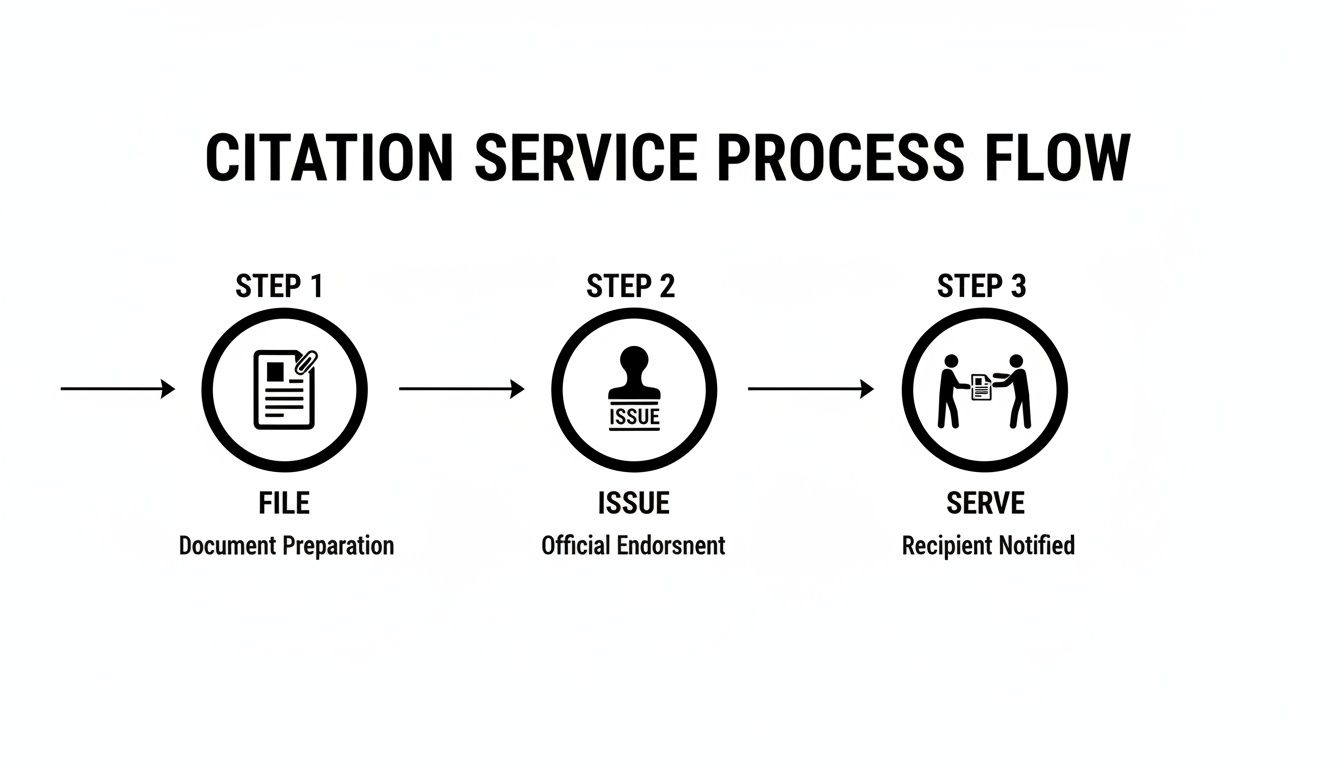
A misstep at any of these points can stop your case dead in its tracks. Let's walk through the mistakes we see most often.
Overlooking Required Parties
One of the most frequent and critical errors is failing to identify and serve every single person required by the Texas Estates Code. It's easy to assume you don't need to notify an estranged parent or a sibling you haven't spoken to in a decade. That assumption is a mistake.
The law is clear: you must serve all statutorily required parties. If you can’t locate someone, you can’t just move on. You have to formally document your "diligent search" efforts in a sworn affidavit to prove to the judge you did everything possible to find them.
Choosing the Wrong Service Method
Not all service methods are interchangeable. You can't just drop the citation in the mail when the law specifically requires personal service. For the proposed ward and certain other key individuals, personal service is the gold standard and often non-negotiable.
Using the wrong method guarantees the judge will declare the service invalid. This forces you to start the process all over again for that person, wasting precious time and money. Always double-check the legally required method for each individual you need to notify.
A Real-World Scenario: The Wrong Address
We once worked on a case where a man living in California needed to establish guardianship for his elderly father in Austin. His father had another son in Houston, but the brothers were not on speaking terms.
The California brother, trying to manage everything remotely, gave the process server an old address for his Houston sibling. After three failed attempts, the return of service came back stating the brother could not be served.
When we got to the hearing in Travis County Probate Court, the judge saw the incomplete service and immediately put the brakes on the entire proceeding. No guardianship could be granted until the Houston brother was properly notified. The case was delayed for weeks, and the client had to pay for a second round of service—all while his father’s health situation remained in limbo.
The Ripple Effect of Incomplete Paperwork
Initial mistakes in a guardianship case can create problems that ripple through the entire process. Research has highlighted a troubling pattern of compliance issues in Texas guardianships. One study found that only 32% of required Inventory, Appraisement, and List of Claims reports were filed, and a mere 28% of first annual reports were submitted. These issues often stem from foundational errors, like improper service, that derail a case from the very beginning.
This is precisely why the law is so meticulous. For example, when a proposed ward is personally served, the citation must include a specific statement of their rights as outlined in Texas Estates Code Section 1051.252. Leaving that statement out can invalidate the entire service.
Professional Insight: A judge's primary duty is to protect the rights of the proposed ward. Any procedural error, no matter how small, that undermines those rights will bring your case to a halt. The court isn't trying to be difficult; it's ensuring the process is legally sound and fundamentally fair to everyone involved.
Forgetting to File the Proof of Service
Serving the citation correctly is only half the job. The final, essential step is filing the "Return of Service" with the court clerk. This document, filled out and signed by the sheriff or process server, is the official proof the court needs to see that service was completed according to law.
Failing to file the Return is like running a marathon and stopping one foot short of the finish line. Without it, the court has no evidence that service happened, and the hearing cannot move forward. These rules can sometimes differ in highly specific situations, such as when seeking a temporary guardianship without notice in Texas, but for most cases, it's a mandatory final step.
Trying to navigate these complex rules while carrying the emotional weight of a loved one’s needs is a significant burden. Our team at The Law Office of Bryan Fagan is here to manage these procedural details with the precision they demand, letting you focus on what matters most—your family. If you're worried about making a mistake or just need guidance, schedule a free consultation with us today.
What Happens After the Citation Is Served
So, the citation has been served. It’s a huge step in the guardianship process, but the work isn’t over. For many families, this is where a new wave of questions and anxieties can set in. Now that everyone has been officially notified, what comes next?
Let's walk through what you can expect between the moment of service and the final court hearing. Knowing the roadmap can bring a sense of clarity and control during what is often a very uncertain time.
The first thing you’ll be waiting for is a document called the Return of Service. This isn't just a simple delivery confirmation. It's a sworn statement, filled out and signed by the sheriff, constable, or private process server who delivered the notice. This document is your official proof, which you'll file with the court, showing that the service of citation for the guardianship in Texas was done correctly and by the book.
The Waiting Game and The Court’s Independent Review
Once the Return of Service has been filed for every person who needed to be notified, a mandatory waiting period kicks in. The Texas Estates Code is very specific here: the court can't hold a hearing until the first Monday that falls at least 10 days after service is complete.
This isn't just dead time. This pause is built into the system for a crucial reason. It gives your loved one and other interested family members a chance to absorb the news, talk to a lawyer if they choose, and figure out how they want to respond.
While you're waiting, the court is actively working. A judge will make two very important appointments to get an independent view of the situation.
- Attorney Ad Litem: The court will appoint an independent lawyer whose sole job is to represent the proposed ward. This attorney, called an "attorney ad litem," advocates fiercely for your loved one's wishes, rights, and best interests—and nobody else's.
- Court Investigator: The judge also assigns a neutral court investigator. This person acts as the court's fact-finder, interviewing you, the proposed ward, and sometimes other family members or doctors to give the judge an unbiased report of the circumstances.
These appointments are standard operating procedure in probate courts across Texas, like those in Bexar County, and are designed to give the judge a full picture before making any decisions.
Key Insight: The roles of the attorney ad litem and court investigator are fundamental to a fair guardianship process. They act as the eyes and ears of the court, ensuring that any decision made is truly based on the needs and well-being of your loved one, not just on the information you provide.
The Critical Role of the Attorney Ad Litem
Of all the players in a guardianship case, the attorney ad litem is one of the most important. Their first step is to meet privately with your loved one. They will explain, in terms the person can understand, what a guardianship means, what rights they might lose, and how the court process works.
After this meeting, the ad litem will report back to the judge, providing answers to critical questions:
- Does the proposed ward seem to understand the guardianship proceeding?
- Do they agree with it, or do they object to it?
- Do they feel the person applying to be guardian is the right choice?
- Could a less restrictive alternative, like a supported decision-making agreement or a durable power of attorney, be a better fit?
The judge takes this attorney’s assessment very seriously. Their involvement ensures your loved one's voice is heard loud and clear, even if they can't physically be in the courtroom to speak for themselves. Successfully navigating these interactions is a key part of reaching a positive Probate or guardianship outcome.
Getting Ready for the Final Hearing
As the waiting period ends and the court-appointed professionals finish their reports, your case will be scheduled for a final hearing. This is your day in court—the moment you will go before the judge and present your case.
You’ll need to prove with "clear and convincing evidence" that your loved one can no longer manage their own affairs and that appointing you as their guardian is in their best interest. The reports from the attorney ad litem and court investigator will also be submitted as evidence for the judge to consider.
This time after service is all about careful preparation. It's when you and your attorney will be busy gathering medical records, organizing financial statements, and preparing your testimony. Understanding what to expect removes a lot of the mystery from the process and helps you walk into that final hearing with confidence. For those also thinking about the bigger picture, exploring Estate Planning can provide helpful long-term context.
It's completely normal to feel overwhelmed by these next steps. The team at The Law Office of Bryan Fagan is here to offer the personalized guidance you need. Schedule a free consultation with us to make sure you are fully prepared for your hearing and confident in the path ahead.
Common Questions About Texas Guardianship Citation
When families begin the guardianship process, the legal formalities can feel overwhelming. The rules around "service of citation"—the official way you notify people about the case—often bring up a lot of questions. We've heard them all. Here are some of the most common ones we encounter, with straightforward answers from our experience.
What if I Can’t Find a Relative Who Needs to Be Served?
This happens more often than you might think. You can't just move forward and skip someone the law says must be notified, even if you haven't spoken to them in years. It's a legal roadblock, but one we know how to navigate.
If you’ve genuinely done everything you can to find a required family member and come up empty, your attorney will need to file a sworn statement with the court. This is called an Affidavit of Diligent Search, and it lists every single attempt made to locate the person.
Once the judge reviews this affidavit and is satisfied with your efforts, they can authorize an alternative way to serve notice. This usually involves:
- Service by Posting: The citation is physically tacked to the courthouse door in the county where you filed, like the Harris County Civil Courthouse.
- Service by Publication: The notice is printed in a local newspaper.
This ensures your case can proceed while still meeting your legal duty to provide notice.
Does the Proposed Ward Have to Be Served if They Have Severe Dementia?
Yes, absolutely. The Texas Estates Code is crystal clear on this point. If the proposed ward is 12 years of age or older, they must be personally served with the citation, no matter their mental or physical state.
This isn't about whether they'll comprehend the document. It’s a fundamental constitutional right. The law demands they be formally told that a court case has started that could remove their legal rights and autonomy.
The system is built for this exact scenario. It's why the court appoints an independent attorney ad litem. This lawyer's job is to meet with your loved one, explain what's happening in a way they can understand, and then report back to the judge about their wishes and best interests.
How Long Does the Service of Citation Process Take?
The timeline really depends on the specifics of your case. After your application is filed, the court clerk usually issues the official citations within a few business days.
The biggest variable is how long it takes a process server to actually find and serve everyone. If all the required parties live locally in a city like Dallas, it might just take a few days. But if someone lives out of state or is hard to track down, service alone could easily stretch into several weeks.
After everyone has been served, a mandatory waiting period kicks in. The court cannot hold a hearing until the first Monday after 10 days have passed since the last person was served. Realistically, you should budget at least three to four weeks for the entire service and waiting period, and sometimes longer.
Key Insight: Don't mistake this waiting period for dead time. This is when the court-appointed attorney ad litem and court investigator get to work. They use this time to conduct their own independent investigations, which are crucial for a fair and complete review of the case.
Can I Serve the Citation Myself to Save Money?
No. Under Texas law, you, as the applicant and a party to the case, are strictly forbidden from serving the citation.
The rule exists to guarantee impartiality and prevent any future arguments that the service was improper or done under duress. Service has to be performed by a neutral, disinterested third party who is legally authorized to do so. This means a county sheriff, a constable, or a certified private process server.
While you do have to pay for professional service, it's a non-negotiable cost of doing business with the court. It ensures the service is done correctly and that the Return of Service—the official proof filed with the court—is accurate and legally sound. Skimping here will only invalidate your case later.
Do Guardianship Orders Transfer to Another State?
This is a huge question for families, especially in our mobile society. The short answer is no; guardianship orders don't automatically transfer across state lines. Each state has its own laws.
The good news is that most states, including Texas, have adopted the Uniform Adult Guardianship and Protective Proceedings Jurisdiction Act (UAGPPJA). This act created a standardized, though still formal, process for transferring a guardianship. You'll still need to file a petition in the new state and coordinate between the courts in both jurisdictions to get the Texas order recognized.
At The Law Office of Bryan Fagan, PLLC, we know these questions are just the tip of the iceberg. Your family's situation is unique, and you need guidance that fits your specific needs. If you're thinking about guardianship for a loved one, let's talk. Schedule a free consultation with our team. We're here to help you move forward with clarity and confidence.