Skip to content
The moment a Texas court appoints you as guardian of the estate, you step into a role of immense legal and moral responsibility. We understand that this is more than a legal duty; it is an act of service and love for someone you care about. This position demands diligence, honesty, and a steadfast commitment to acting in the best interest of the person you’re protecting—the ward.
Your first three months are foundational. The actions you take now will set the tone for your entire guardianship, creating a transparent record that protects both you and your loved one from future complications. We know this journey can feel overwhelming, but our goal is to provide you with the clarity and direction you need.
This journey doesn't start with making big financial moves. It begins with careful investigation and meticulous documentation. Your initial job is to create a complete and detailed map of the ward’s financial world, a task that culminates in a formal court document.
Your First 90 Days as a Guardian of the Estate
The Texas Estates Code is very clear about your initial duties. Within 30 days of your appointment, you must prepare and file a document called the Inventory, Appraisement, and List of Claims (Texas Estates Code § 1154.051). This isn't just another piece of paperwork; it's the cornerstone of your fiduciary duty and the legal foundation of the guardianship.
A complete and accurate inventory is your legal shield. It provides a clear, court-approved baseline of the assets you are responsible for, protecting you from future claims that assets were lost or mismanaged.
This document must be a thorough accounting of everything the ward owns and owes. Imagine you’ve been appointed guardian for your parent in Harris County. Your inventory would need to list things like:
- Real Estate: The family home, including its legal description and a formal appraised value.
- Bank Accounts: Every checking, savings, and money market account, with exact balances as of the date you were appointed.
- Personal Property: Significant valuables like jewelry, artwork, vehicles, or antique furniture.
- Investments: All stocks, bonds, mutual funds, and retirement accounts such as IRAs or 401(k)s.
- Debts and Claims: Any money owed to the ward (like a loan they made to a friend) and any debts the ward owes (credit card balances, medical bills, mortgages).
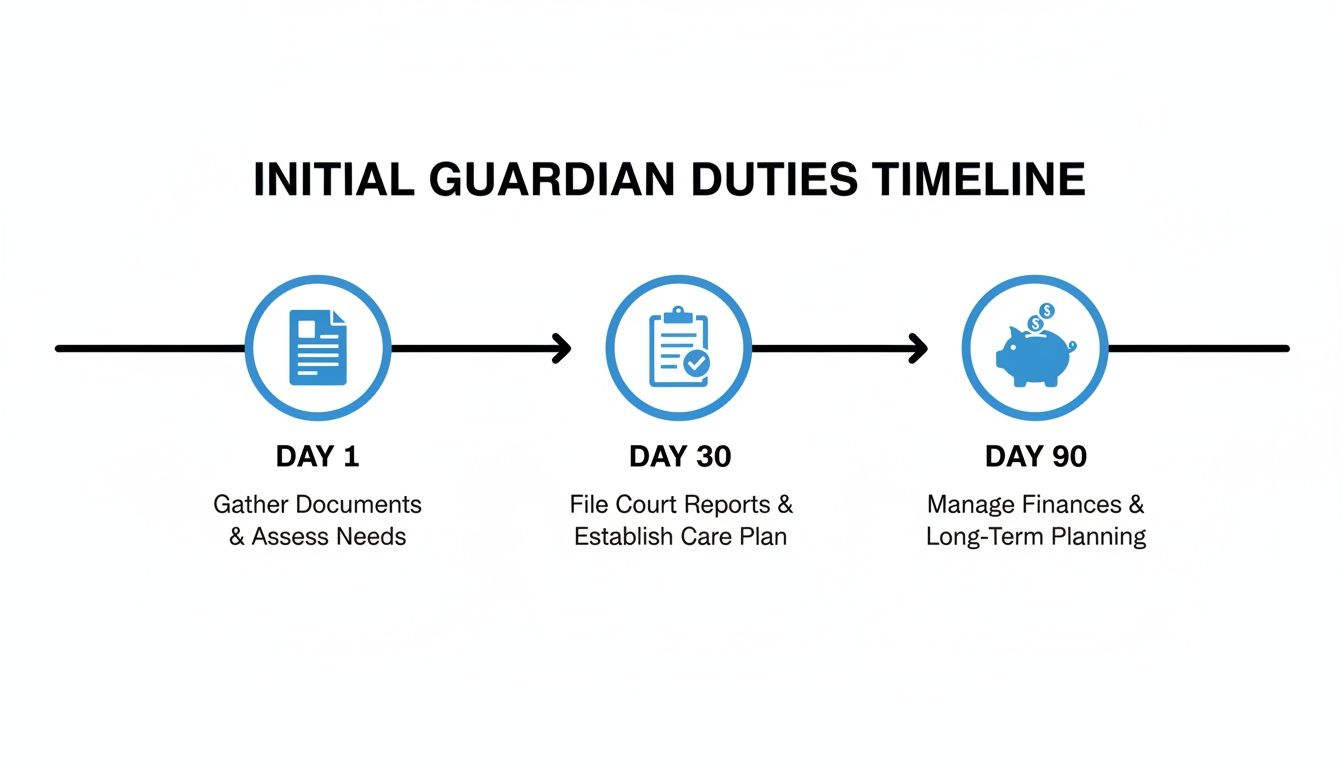
As you can see, that first month is intense. The 30-day deadline for the Inventory sets the stage for all future financial management and reporting.
Initial 90-Day Guardian Action Plan
Navigating these initial steps can feel like a whirlwind. To help you stay on track, we've put together a practical checklist for new Guardians of the Estate. Following this plan will help ensure you meet your legal obligations under the Texas Estates Code and start your guardianship on solid ground.
| Task | Deadline | Purpose |
|---|---|---|
| Obtain Letters of Guardianship | Day 1-5 | This court-issued document is your legal authority to act. |
| Identify & Locate All Assets | Day 1-20 | Create a comprehensive list of all real estate, accounts, and property. |
| Notify Financial Institutions | Day 5-25 | Present your Letters to banks, brokerages, etc., to gain control. |
| File Inventory with Court | By Day 30 | Submit the formal Inventory, Appraisement, and List of Claims. |
| Secure All Property | Day 1-30 | Change locks, secure vehicles, and take possession of valuables. |
| Establish Guardianship Account | Day 30-60 | Consolidate funds into a single, clearly labeled bank account. |
| Set Up Record-Keeping System | Day 30-90 | Create a system to track every dollar in and every dollar out. |
| Pay Necessary Bills & Debts | Ongoing | Use the ward's funds to manage their expenses from the new account. |
This action plan provides a roadmap, but we recognize that every family's situation is unique. The key is to be proactive, organized, and transparent from day one.
Immediate Security Measures
While you're working on the inventory, you also need to act fast to secure the ward's assets. The Letters of Guardianship issued by the court are the key that unlocks your authority to take control.
Your first moves should include:
- Notifying Financial Institutions: Take your Letters of Guardianship to every bank, credit union, and investment firm. This is how you get your name registered as the guardian on all accounts, effectively freezing out unauthorized access.
- Consolidating Accounts: If the ward has accounts scattered across multiple banks, your goal should be to consolidate them. Moving funds into a single, new account titled something like, "[Ward's Name], by [Your Name], Guardian of the Estate" makes management and reporting infinitely easier.
- Securing Property: Don't overlook physical assets. Change the locks on the ward’s home, secure any vehicles, and bring valuables like jewelry or important documents to a safe place to prevent them from being lost or stolen.
The scale of this responsibility in Texas is massive, with thousands of active cases managing billions in assets. As detailed in documents like a recent Ward County Audit Report, courts demand strict accounting to ensure transparency and protect the ward. This is why following the rules isn't just a good idea—it's a legal requirement.
Navigating these first 90 days can be challenging, but you don't have to do it alone. If you're feeling unsure about how to appraise property, track down hidden assets, or just get started, our firm is here to help.
How to Safeguard and Prudently Manage Assets

After the court approves your inventory, your job shifts gears. You're no longer just cataloging what the ward owns; you're now actively managing and protecting it for their future. This is the heart of your responsibility as a guardian—a role built on a sacred trust.
You have a sworn duty to be careful, responsible, and conservative with someone else's money. This is what the law calls a fiduciary duty. Every decision must be made with the ward's best interest at the forefront to avoid any hint of a breach of fiduciary duty. Your goal isn't to chase high returns; it's to preserve the ward’s capital so it can support them for the rest of their life.
Adhering to the Prudent Investor Rule
The Texas Estates Code doesn't leave this up to interpretation. It holds guardians to a standard known as the “prudent investor rule.” This is a legal principle that requires you to manage the ward’s property with the same care and skill that a person of ordinary prudence would use in managing their own affairs (Texas Estates Code § 1161.002).
Essentially, it means you must prioritize preserving the money over taking big risks.
Hypothetical Scenario: Let’s say you’re the guardian for a teenager in Fort Bend County who received a large settlement from a car accident. The prudent investor rule would steer you away from volatile tech stocks or cryptocurrency. Instead, you'd be looking at conservative, low-risk options like government bonds or insured certificates of deposit (CDs). The focus is on making sure that money is safe and available for their college education or future care needs.
Establishing Financial Clarity and Control
One of the first and most important things you must do is open a separate bank account exclusively for the ward's funds. There are no exceptions to this rule. Mixing the ward’s money with your own (commingling) is a serious misstep that can lead to your removal as guardian and other legal penalties.
This account needs to be titled correctly to reflect the guardianship. For instance: "Jane Doe, Incapacitated Person, by John Smith, Guardian of the Estate."
All of the ward's income—Social Security benefits, pension payments, investment dividends—must be deposited directly into this account. And every single one of the ward’s expenses must be paid from it.
Maintaining a separate guardianship account is not just good practice; it is a legal requirement. It creates a clear paper trail that simplifies annual accounting and demonstrates your adherence to fiduciary standards to the court.
This clean separation of funds is your best defense against any accusation of mismanagement. You can find a more detailed breakdown in our guide on essential Texas guardianship bank account rules. For more information on your broader duties, our Guardianship page is an excellent resource.
Managing Real Estate and Major Assets
If the ward owns real estate, your responsibilities extend beyond just keeping the lights on. Managing a home or rental property involves significant work. Your duties will likely include:
- Paying the mortgage, property taxes, and homeowner's insurance on time.
- Coordinating necessary maintenance and repairs to preserve the property's value.
- If it's a rental property, collecting rent and handling any tenant issues.
But what if you need to sell the ward’s home to pay for their move into an assisted living facility? This isn't a decision you can make on your own. Selling real estate requires explicit permission from the court.
You'll need to file a formal application that proves the sale is truly in the ward's best interest. A judge, for example, in the Dallas County Probate Court, will want to see hard evidence like property appraisals and a budget showing why the funds are needed. This process is in place to protect the ward from a bad deal and to protect you, the guardian, from any claims of acting improperly.
Mastering the Annual Accounting Report
After a full year of carefully managing the ward's finances, it's time to show your work. The Annual Accounting Report is how you demonstrate your accountability as a guardian in Texas. We encourage you to think of this document not as a chore, but as your legal shield—a formal record proving you've acted responsibly and in the ward's best interests.

This report tells the detailed financial story of the past year. It’s due on the anniversary of your appointment and must be filed with the correct probate court, whether that's in Travis County or elsewhere in Texas, as required by Texas Estates Code § 1163.001.
Core Components of the Annual Report
Under the Texas Estates Code, your Annual Accounting has to be incredibly thorough. The court isn't looking for a simple summary; it demands meticulous detail on every financial event that happened on your watch.
Your report must include:
- All Income Received: This means every Social Security check, pension deposit, investment dividend, or bit of rental income you collected for the ward.
- All Expenses Paid: Every single dollar out must be listed, from major costs like nursing home fees and medical bills down to groceries and personal allowances.
- A Complete List of Remaining Assets: The report has to conclude with a clear snapshot of all property and cash on hand at the end of the reporting period.
Your Annual Accounting is much more than a list of numbers. It’s a testament to your integrity and shows the court that you've upheld your fiduciary duty with complete transparency.
A Practical Scenario in Austin
Let's say you're the guardian for your elderly mother, who lives in an Austin-area nursing home. To get your annual report ready, you’d start by gathering every bank statement, receipt, and invoice from the past 12 months.
From there, you would itemize each transaction. For instance, you'd list the $5,500 monthly payment to her nursing facility, the $150 co-pay for a specialist visit, the $50 weekly cash allowance you provide for her personal items, and the $1,200 quarterly property tax payment on her home. Every entry needs documentation to back it up, creating a verifiable paper trail for the court. This level of detail is absolutely non-negotiable when managing ward assets in Texas.
The High Cost of Non-Compliance
Filing this report isn't optional. The court system in Texas relies on these accountings as a critical check and balance to protect vulnerable people from financial abuse. Unfortunately, compliance is a surprisingly big issue.
A Texas Guardianship Compliance Project uncovered a startling statistic: 43% of cases were found to be out of compliance with reporting standards. In one glaring example, a guardian was found to have improperly withdrawn $44,683.35 from a ward's funds for personal, non-essential items.
The penalties for failing to file a complete and accurate report are severe. A judge can hit you with sanctions, hold you in contempt of court, order you to pay fines, or even remove you as guardian. Meticulous record-keeping is your best defense against these painful outcomes. For more detailed help on this, see our guide on the annual accounting for a Texas guardianship.
This process can feel overwhelming, but our team at The Law Office of Bryan Fagan is here to help. We can guide you through preparing your annual accounting to make sure it meets every legal requirement, giving you peace of mind.
Handling Complex Transactions and Digital Assets
A guardian's job today is much more than just paying bills and balancing a checkbook. Some of your most important duties will involve navigating major financial events and securing your ward's entire online life—two areas that demand extreme care and, more often than not, a judge's permission.
Not all transactions are created equal. While you have the authority for day-to-day expenses, any big financial move that could significantly alter the ward's estate requires court oversight. This is a critical protection baked into Texas law, ensuring every major decision genuinely serves the ward’s best interests.
When You Must Get the Court's Approval
Think of the court as your partner in protecting the ward. You have to file a formal application and get a judge’s order before you can take certain actions. These aren't just suggestions; they are legal mandates under the Texas Estates Code (Title 3, Subtitle G).
Common situations that require you to get the court's blessing first include:
- Selling Real Estate: You can't just call a realtor and list the ward’s home. You must prove to the court that the sale is necessary and that you’re getting a fair market price for the property.
- Settling a Lawsuit: If the ward has a pending lawsuit, like a personal injury case, any settlement offer must be approved by a judge to make sure the terms are favorable.
- Making Significant Investments: You have a duty to manage assets prudently, but making a large new investment or overhauling the entire investment strategy usually requires court sign-off.
- Spending Principal on the Ward’s Behalf: Sometimes a ward's income isn't enough to cover their expenses. If you need to dip into the principal—the core assets of the estate—you’ll need an application and a court order to do so.
Getting the court's approval isn't a sign you're doing something wrong. It’s the hallmark of a diligent and responsible guardian. This process creates a transparent record of your actions and shields you from liability down the road. This intersects with broader Probate and Estate Planning considerations, which aim to make asset management clearer.
Navigating the World of Digital Assets
Your responsibilities don’t stop with physical property. You are also in charge of the ward's entire digital world. This covers everything from online bank accounts and social media profiles to emails, digital photos, and even cryptocurrency. All of it is considered part of the estate.
The real challenge? These assets are often invisible and locked behind passwords. Managing digital assets became a new hurdle for Texas guardians after the Uniform Fiduciary Access to Digital Assets Act (UFADAA) was passed in 2017, which grants guardians limited access to a ward's online accounts. As our deep dive on digital guardianship and a ward's online accounts explains, poor record-keeping can easily obscure these assets, a key reason so many guardianship audits find issues with compliance.
As a guardian, you'll need to:
- Identify all digital accounts and list them in your inventory.
- Secure login information when you can, or use your legal authority to gain access from the company.
- Manage these accounts to protect the ward’s privacy and financial information from online threats.
Keep in mind that digital information is fragile. Device failure can lead to data loss, and you might need to use professional data recovery services to retrieve crucial information from a damaged phone or computer.
A Real-World Example: Protecting a Young Adult's Digital Life
Imagine you’re the guardian for a 22-year-old with disabilities who has an active online life. Your duties would include accessing their social media to monitor for online scams or identity theft. You’d also need to manage their online banking and any payment apps like Venmo or PayPal to secure their funds. Your job is to strike a balance between respecting their privacy and fulfilling your duty to protect them from digital dangers.
Effectively managing ward assets in Texas now means being as diligent with passwords and online accounts as you are with bank statements and property deeds. You can get more practical insights by exploring our full guide on digital asset management challenges on TexasGuardianshipLawyer.net.
Common Financial Mistakes and How to Avoid Them
Even the most well-intentioned guardians can make honest mistakes that snowball into serious legal trouble. While serving as a guardian is an act of profound care, that care must be matched with strict compliance with Texas law. We want to empower you by highlighting common financial pitfalls and, more importantly, how you can steer clear of them to protect both the ward and yourself.

The path to financial trouble often begins with a small, seemingly harmless misstep. Understanding these potential errors from the outset is your best defense, ensuring your guardianship journey is smooth and fully compliant with the probate court’s expectations.
Mixing Personal and Ward Finances
The single most dangerous mistake a guardian can make is commingling funds. This is what happens when you mix your personal money with the ward's money in the same bank account. It can happen by accident—maybe you deposit a reimbursement check into the wrong account or use the guardianship card to pay a personal bill.
Regardless of your intent, the court views this as a major breach of your fiduciary duty. It completely clouds the financial picture, makes accurate accounting impossible, and can easily look like impropriety or even theft. You must always maintain a separate, clearly labeled guardianship account for every single transaction involving the ward's funds.
A Real-World Example: I once saw a case where a guardian used the guardianship debit card to buy groceries for her father (the ward) and her own family in one shopping trip. She planned to pay her share back right away. Unfortunately, this simple act of convenience was flagged during the annual accounting review. It led to a very difficult court hearing and a formal warning from the judge.
The Problem with Cash and Poor Records
In a digital world, using cash for the ward’s expenses might feel easier in the moment, but it’s a record-keeping disaster waiting to happen. Cash simply doesn't leave an automatic paper trail. If you withdraw $200 for the ward's weekly spending money but fail to keep every single receipt, you have no way to prove to a judge how that money was spent for their benefit.
This brings us to another common pitfall: failing to keep meticulous records. Every single expense, no matter how small, has to be documented with a receipt, an invoice, or a clear bank statement entry. This isn't just about satisfying the court; it's about building a clear, defensible history of your responsible managing of the ward's assets in Texas.
Common record-keeping failures we see all the time include:
- Not saving receipts for small cash buys like a coffee or magazine.
- Forgetting to note the purpose of an expense in a checkbook register or spreadsheet.
- Losing track of medical co-pay receipts or pharmacy bills.
These small slip-ups can add up to a massive headache when it's time to file your annual accounting. Our advice? Start a filing system—physical or digital—on day one and be absolutely disciplined about using it.
Misunderstanding Your Financial Authority
Guardians often run into trouble by making financial moves they think are helpful but are actually illegal without court permission. This is especially true when it comes to "loaning" money from or to the estate.
A classic—and heartbreaking—scenario involves a guardian facing a personal financial emergency. They might "borrow" money from the ward's account, with the full intention of paying it back on their next payday. This is strictly forbidden. The ward's money is for the ward's benefit only, and using it for any other reason, even temporarily, is considered self-dealing and a serious breach of trust.
On the flip side, you cannot loan your own money to the estate and then just pay yourself back. If the estate is short on funds for a necessary expense, you must petition the court for instructions on how to handle it. Never act unilaterally.
To help you stay on the right path, we've put together a table summarizing some of these common mistakes and the correct legal procedure to follow instead.
Guardian Financial Mistakes and Their Legal Solutions
This table breaks down some frequent errors guardians make and shows you the proper way to handle these situations under Texas law.
| Common Mistake | Why It's a Problem | The Correct Legal Approach |
|---|---|---|
| "Borrowing" from the estate for a personal emergency | This is self-dealing and a severe breach of fiduciary duty. The intent to repay doesn't matter. | The ward's funds must never be used for the guardian's personal benefit, period. |
| Using cash for many expenses without receipts | It creates huge gaps in your accounting and makes it impossible to prove the expenses were valid and for the ward's benefit. | Use the dedicated guardianship account's debit card for all purchases. Keep every single receipt, no exceptions. |
| Paying yourself for your time without court approval | Compensation must be formally requested and approved by the judge. You cannot decide your own salary. | Keep a detailed time log of your guardianship duties and formally request compensation as part of your Annual Account filing. |
Think of this table as a quick reference guide. Understanding these rules now can save you from major legal issues down the road.
The rules for managing ward assets in Texas aren't there to punish you; they exist to create a strong shield around vulnerable individuals. The absolute best way to protect both yourself and your loved one is to be overly cautious. When you're in doubt about any financial decision, just stop. Take a breath and seek legal advice before you act.
If you are facing these challenges or have questions about your duties, you are not alone. The Law Office of Bryan Fagan is here to provide the clarity and support you need. Schedule a free consultation with us today to ensure you are managing your loved one’s assets with confidence and care.
Frequently Asked Questions About Managing a Ward's Assets
Taking on the role of a guardian comes with a steep learning curve, and it's completely normal to have questions. We see it all the time. Families are often facing emotional stress and practical challenges, and the legal rules can feel overwhelming.
This section is designed to give you direct answers to the questions we hear most often from new guardians in Texas. We’ll cut through the legal jargon and give you the straightforward advice you need to manage a ward’s estate with confidence, all based on the Texas Estates Code.
What Happens If I Miss the Annual Accounting Deadline?
Missing an annual accounting deadline is a big deal in Texas probate courts. They take these filing dates very seriously. Once the deadline passes, you can expect the court to issue a formal order demanding you appear to explain why the accounting wasn't filed.
This isn't a position you want to be in.
If you continue to ignore the deadline, the consequences get worse. The court can issue fines, sanctions, and may even begin the process of removing you as guardian. A missed deadline is a major red flag for a judge, often leading to a much closer look at how you've been managing the estate.
The best approach is always to be proactive. If you know you're going to be late for a legitimate reason, have your attorney file a motion with the court asking for an extension. Explaining the situation upfront is always received better than making the court track you down.
Can I Get Paid for My Time as Guardian of the Estate?
Yes, Texas law allows you to be paid for your service as a guardian of the estate. The role demands a lot of your time and energy, and the law acknowledges that your efforts deserve reasonable compensation.
However—and this is critical—you cannot simply write yourself a check from the ward’s funds. All compensation must be approved by the court first.
You’ll need to formally request payment, usually as part of your annual accounting. This involves submitting a detailed log of the time you spent and the specific tasks you completed. Vague entries won't cut it. You need to be specific.
A judge will review your request and decide on an amount they consider "reasonable and necessary" for an estate of that size and complexity. Detailed, real-time records are your best tool for justifying your compensation and avoiding any hint of improper conduct.
Do I Need Permission to Sell the Ward’s Personal Items?
For almost anything with significant value, the answer is a firm yes. While you can probably get rid of things that are clearly worthless or perishable without a problem, selling valuable personal property requires getting court permission first. This includes items like furniture, jewelry, artwork, or a vehicle.
To do this, you'll file an application with the court explaining why the sale is in the ward's best interest. A common example is needing to sell a classic car to raise money for the ward’s ongoing nursing home expenses.
The court's involvement protects the ward in two main ways:
- It ensures the item is sold for its fair market value.
- It confirms the money from the sale is correctly deposited back into the guardianship estate and accounted for.
If you sell property without court approval, the judge can hold you personally liable for the full value of the items sold. It’s a costly mistake to make.
What Is the Difference Between a Guardian of the Person and a Guardian of the Estate?
This is one of the most fundamental distinctions in guardianship law, and getting it wrong can cause serious legal trouble. These are two completely separate roles, even if the same person is appointed to both.
A guardian of the person makes decisions about the ward’s physical care and well-being. This includes decisions about healthcare, daily living, and where the ward resides.
A guardian of the estate, which is the focus of this guide, manages the ward’s financial life. This person is responsible for all property, paying bills, managing income, and filing the required financial reports with the court.
It's a point of confusion for many, but the separation is strict. If you are only the guardian of the person, you have absolutely no legal authority to touch the ward's bank accounts or manage their property.
We know that managing a loved one's assets is a role filled with complex duties and profound responsibility. You don't have to carry this weight alone. At The Law Office of Bryan Fagan, PLLC, we guide Texas families through guardianship with clarity and care. For personalized guidance on your specific situation, schedule a free consultation with our experienced team today.