Skip to content
When you're fighting to protect a loved one, the "evidentiary hearing" is the most critical moment in a Texas guardianship case. This is the formal court hearing where a judge will listen to evidence and decide if your family member is legally incapacitated and truly needs a guardian to manage their life and finances. We understand that this step, while necessary, can feel overwhelming.
It’s where all your efforts come together. All the preparation, paperwork, and worry come down to this single proceeding, where you must prove that your loved one can no longer safely care for themselves. The court's job is to balance its duty to protect a vulnerable person against the need to preserve their fundamental rights. At The Law Office of Bryan Fagan, our mission is to guide Texas families through this process with clarity and care.
Understanding the Purpose of a Guardianship Hearing
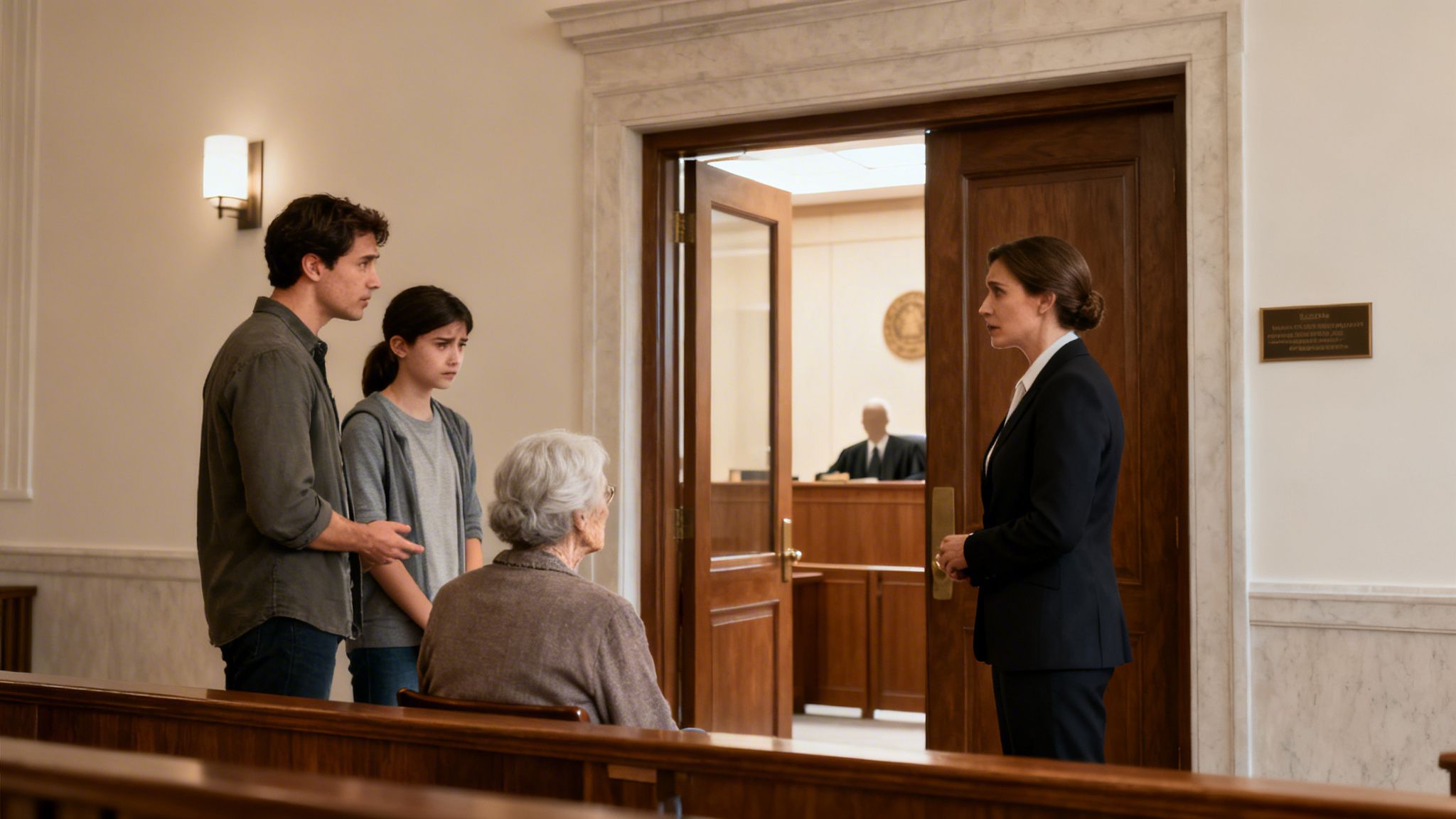
When you petition a court to become a guardian, you’re asking for something extraordinary. You’re asking a judge to take away some of a person's most basic rights—the right to choose where they live, what medical treatment they receive, or how they spend their own money.
Because this is such a monumental step, Texas law demands a formal court hearing. It ensures the decision is made with extreme care and is based on solid, undeniable proof. This process can feel intimidating, especially when you're already carrying the emotional weight of a loved one's declining health. We want to pull back the curtain on this experience and give you clarity and compassionate support.
The Key People in the Courtroom
Walking into the courtroom can be less nerve-wracking if you know who’s who. An evidentiary hearing brings several people together, each with a specific role laid out by the Texas Estates Code.
Here are the main players you'll see:
- The Applicant: This is you—the person who filed the paperwork asking the court to create a guardianship.
- The Proposed Ward: This is your loved one. They have an absolute right to be present at the hearing and have their voice heard.
- The Attorney Ad Litem: The court appoints this independent attorney to represent the proposed ward's best interests. Their job is to be a neutral advocate, ensuring your loved one’s rights and personal wishes are front and center. You can learn more about the specific duties of a guardian ad litem in Texas.
- The Judge: The judge is the ultimate decision-maker. They run the hearing, listen to all the evidence presented, and decide whether a guardianship is necessary and who is best suited to serve as guardian.
To help you get a clearer picture, here is a quick breakdown of how these roles fit together in the hearing.
Key Components of a Texas Guardianship Evidentiary Hearing
| Component | Description | What It Means for Your Family |
|---|---|---|
| Purpose | To determine if a person is legally incapacitated and needs a guardian. | This is the official court date where the judge will make a final decision about your loved one's future. |
| Key People | Judge, Applicant, Proposed Ward, and Attorney Ad Litem. | Each person has a specific job, all focused on getting to the truth and protecting your family member. |
| Standard of Proof | Clear and Convincing Evidence. | You must provide strong, persuasive proof that leaves the judge with a firm belief your loved one needs help. |
| Evidence | Medical records, doctor's letters, witness testimony, financial statements. | Your attorney will use this evidence to build a compelling case that meets the high legal standard. |
| Outcome | The judge can grant a full or limited guardianship, or deny the application. | The result will directly impact your loved one’s autonomy and your legal ability to care for them. |
This table shows how each element of the hearing is designed to ensure a fair, thorough, and just outcome for the person at the center of it all: the proposed ward.
The Standard of Proof: Clear and Convincing Evidence
In many civil cases, the winner is decided by a "preponderance of the evidence"—meaning their side was just a little more believable. That's not how it works in a guardianship hearing.
The standard here is much, much higher: clear and convincing evidence.
This legal standard means the proof you present must create a firm belief or conviction in the judge's mind that what you are saying is true. It isn’t enough to show it’s probably true; you have to demonstrate a high degree of certainty that your loved one is truly incapacitated.
This high bar exists for a very good reason: to protect a person's liberty and freedom. It's your attorney’s job to gather compelling proof—like a doctor’s detailed capacity evaluation and testimony from those who know your loved one best—that can meet this strict requirement in courts like the Harris County Probate Court or the Dallas County Probate Court.
While the hearing is a serious and formal event, its goal is rooted in compassion. The purpose is to protect, not to punish. With the right preparation and legal partner, you can walk into that courtroom with confidence, ready to secure the protections your loved one desperately needs. You don't have to face this journey alone.
The Legal Framework for Texas Guardianship
A guardianship hearing isn't just a casual meeting; it's a formal, rule-based legal proceeding. The entire process is built on a solid foundation of state law, specifically Title 3 of the Texas Estates Code. This body of law is the court’s playbook, outlining every step to make sure the hearing is fair, orderly, and always focused on protecting your loved one.
Think of the Estates Code as the official instruction manual for the judge. It provides the legal definition of "incapacity," clarifies who can serve as a guardian, details the evidence that must be presented, and spells out the rights the proposed ward keeps throughout the process. It's this framework that ensures a judge’s decision to take away someone’s fundamental rights is never made on a whim but is grounded in clear, established legal standards.
The Role of Court-Appointed Officials
To keep the process unbiased, the court doesn't just take the applicant's word for it. The Texas Estates Code requires neutral, third-party professionals to get involved. Their job is to give the judge a complete and objective view of the situation.
Two key people are appointed by the court in every guardianship case:
- The Court Investigator: This person serves as the court's "eyes and ears" on the ground. As required by Texas Estates Code § 1054.152, the investigator meets with the proposed ward, explains what’s happening in simple terms, and evaluates their living conditions. They then file a factual, firsthand report for the judge.
- The Attorney Ad Litem: This is a court-appointed lawyer whose only job is to represent the proposed ward. They are the ward’s dedicated advocate, fighting for their client's stated wishes and best interests. If the proposed ward wants to contest the guardianship, the attorney ad litem is the one who will make that argument in court.
These roles are crucial for creating a system of checks and balances. They guarantee your loved one has a voice and that the court sees the whole picture before making a decision that will change their life forever.
The "Clear and Convincing Evidence" Standard
The standard of proof in a guardianship case is "clear and convincing evidence." This isn't just legal jargon; it's a deliberately high bar. In Texas law, it's the second-highest standard, right below the "beyond a reasonable doubt" used in criminal trials. So, what does that actually mean for you?
It means you must present evidence that is so powerful and persuasive that it leaves the judge with a firm belief that a guardianship is absolutely necessary. It’s not enough to show that your loved one is getting older or making a few bad decisions. You have to prove they truly lack the ability to make safe choices for themselves.
This high burden of proof is there for a reason: it protects the fundamental rights of every Texan. The law starts with the assumption that every adult is capable of managing their own life. Your evidence must be compelling and consistent enough to overcome that presumption.
An experienced guardianship attorney knows how to collect the right kind of evidence—from detailed physician's reports to credible witness testimony—that can meet this demanding legal threshold.
Why Local Court Rules Matter
While the Texas Estates Code sets the rules for the whole state, each county can have its own specific procedures, known as "local rules." These local rules might impact everything from filing deadlines and document formatting to how you're expected to behave in the courtroom.
For example, the way a hearing gets on the docket in a Harris County Probate Court might be slightly different than the process in a Travis County Probate Court. These small variations are exactly why having a lawyer with deep experience in your specific county is so critical. An attorney who is in that courthouse regularly will know the judges' preferences and the unwritten rules that can make or break a case, helping you avoid simple mistakes that could cause frustrating delays or even get your application dismissed.
Presenting the Right Evidence for Guardianship
When you walk into a guardianship hearing, you need to bring more than just your word. A Texas judge will not strip someone of their legal rights based on feelings or guesswork alone. Their decision has to be built on a foundation of solid, persuasive proof.
Think of it like building a case brick by brick. Each piece of evidence—each document, each testimony—connects to create a clear picture for the judge, showing them two critical things: first, that your loved one is legally incapacitated, and second, that a guardianship is truly the best and only way to keep them safe.
This requires a strategy, and that strategy always starts with one single, non-negotiable document.
The Cornerstone of Your Case: The Certificate of Medical Examination
The most critical piece of evidence in any Texas guardianship is the Certificate of Medical Examination (CME). Let's be very clear about this: under the Texas Estates Code, this document isn't just a good idea—it is mandatory. A judge cannot legally grant a guardianship without a valid CME on file.
And this isn't just any doctor's note. To be accepted by the court, the CME must be:
- Recent: The doctor’s exam must have taken place within 120 days of filing the guardianship application.
- Detailed: It has to come from a licensed Texas physician who has personally examined the proposed ward.
- Specific: The report needs to clearly describe the nature, degree, and severity of the incapacity. It must also state whether the person can handle their own food, shelter, clothing, and physical health.
The CME translates your personal observations and worries into objective, clinical facts that a judge can rely on. Without a properly completed CME, your case simply cannot move forward. If you're wondering about the specifics, you can learn more about the role of a physician's certificate for guardianship in Texas in our detailed guide.
Building a Complete Picture Beyond the CME
While the CME is absolutely essential, it's rarely enough to win your case on its own. To meet the high standard of "clear and convincing" evidence, you need to back up the doctor’s clinical findings with proof that paints a picture of your loved one’s daily reality. Your attorney will be your guide in gathering the right documents and testimony to tell a compelling story.
Think of it this way: the CME is the expert diagnosis, but your other evidence shows the real-world symptoms.
Scenario: Let's look at David, an adult son seeking guardianship for his mother, Maria, who has advancing dementia. Maria, who lives in Harris County, has started missing bill payments, forgetting to take her heart medication, and was recently tricked into sending a large sum of money to a phone scammer.
Here is how David’s evidence would work together to build a strong case:
Certificate of Medical Examination (CME): David’s first move is to take Maria to her geriatrician. The doctor performs a capacity evaluation and fills out the official CME form, confirming a dementia diagnosis and stating that Maria no longer has the ability to make sound financial and medical decisions.
Medical and Financial Records: Next, David and his attorney gather documents showing a clear pattern of decline. This includes past medical records tracking her dementia’s progression and bank statements that reveal unpaid utility bills, erratic spending, and the wire transfer to the scammer.
Witness Testimony: Finally, during the evidentiary hearing, David takes the stand to testify about his mother's growing confusion and memory loss. A home health aide also testifies, giving the judge specific examples of Maria forgetting to eat or take her medication on several occasions.
Each piece of evidence reinforces the others. The bank statements validate the doctor’s opinion on Maria’s financial judgment. The caregiver’s testimony brings the medical diagnosis to life, showing the judge the real-world safety risks Maria faces every day.
By weaving together the medical expert’s opinion, tangible proof of daily struggles, and heartfelt personal testimony, you give the judge a 360-degree view of the situation. This comprehensive approach is what it takes to build a case strong enough to meet the high bar for guardianship in Texas and get your loved one the protection they desperately need.
Navigating the Courtroom on Hearing Day
Let’s be honest: stepping into a Texas probate court for an evidentiary hearing is intimidating. For most people, it's an unfamiliar, formal environment filled with complex procedures. Our goal is to pull back the curtain on this experience, giving you a clear, step-by-step picture of the day so you can walk in with confidence instead of anxiety.
A guardianship hearing isn't the chaotic courtroom drama you see on TV. It’s a very structured event. There’s a specific order for who speaks and when, and every action is guided by established rules. Just knowing the sequence of events can make a world of difference in managing your stress.
The Typical Sequence of a Guardianship Hearing
From the moment you arrive at the courthouse to the judge's final decision, the hearing follows a predictable path. While there might be small differences between counties like Harris or Dallas, the core structure is consistent across Texas.
Here’s how the hearing will generally unfold:
- Opening the Hearing: The judge begins by calling your case. Your attorney and the attorney ad litem will stand and announce that they are ready to proceed.
- Your Attorney Presents Your Case: Your lawyer takes the lead, formally presenting the evidence you’ve worked to gather. This is when the doctor’s Certificate of Medical Examination (CME) is officially entered into the record, and your witnesses are called.
- Witness Testimony: You will almost certainly be the first person to testify. Your attorney will guide you through your story with questions (direct examination) about your loved one’s situation and why you believe a guardianship is necessary. Afterward, the attorney ad litem gets a turn to ask you questions (cross-examination).
- Ad Litem’s Report: The attorney ad litem then presents their independent findings to the judge. Their report will include their professional opinion on whether your loved one is incapacitated and if a guardianship is truly in their best interest.
- Final Arguments and Decision: Once all the evidence and testimony have been heard, the judge will make a final ruling based on everything presented.
The judge pieces together this evidence to get a complete picture of the situation.
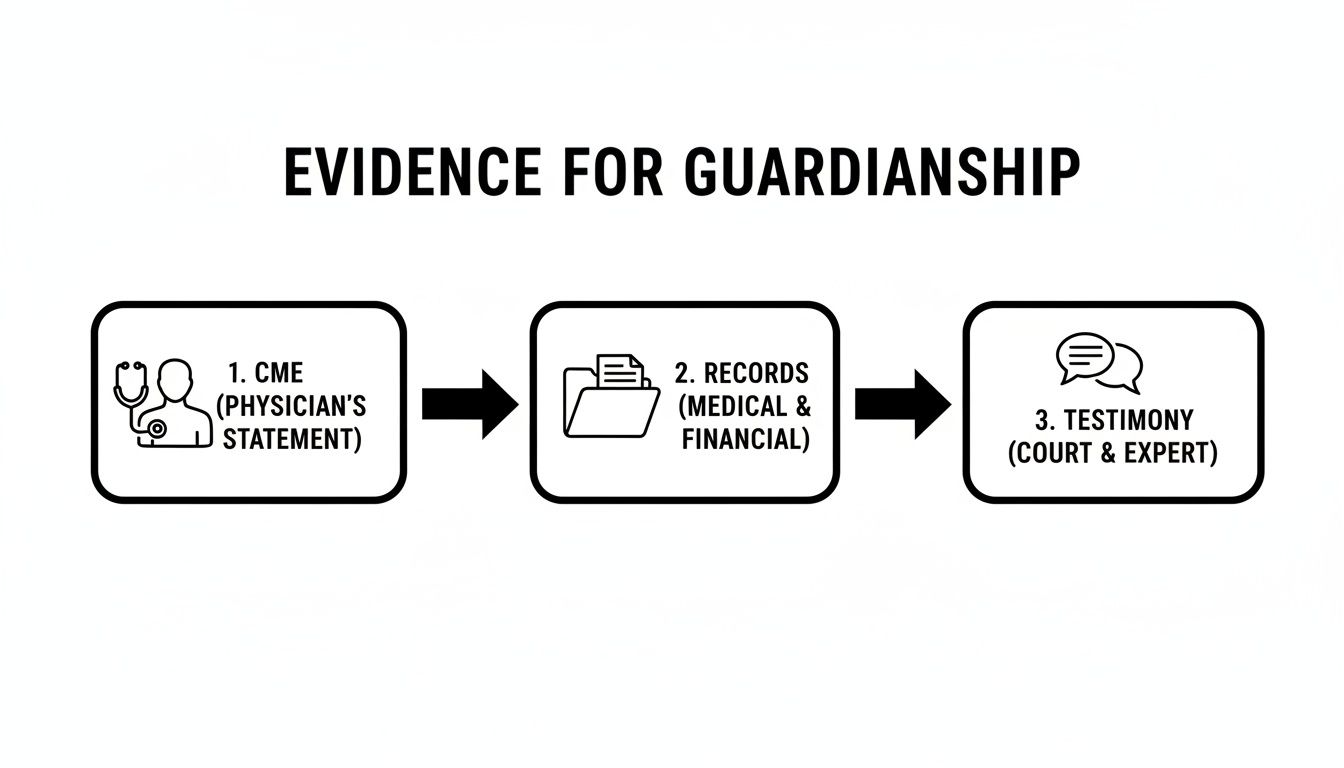
As you can see, it's about combining the doctor’s clinical opinion with documented records and firsthand testimony to show the court what’s really going on.
Understanding Courtroom Procedures and Timelines
The legal system has its own clock, and everything is governed by strict timelines. For permanent guardianships, the procedures are particularly formal. For instance, Texas Estates Code Section 1054.152 requires a court investigator to personally meet with the proposed ward before the hearing. In that meeting, they discuss the facts of the case, explain the ward’s legal rights, and explore whether any less restrictive alternatives could work instead. These safeguards are a critical part of the process, and you can discover more insights about guardianship timelines and requirements in Texas on our site.
When you testify, you’ll face two kinds of questioning:
- Direct Examination: This is when your own attorney asks open-ended questions, allowing you to tell your story and explain the situation in your own words.
- Cross-Examination: This is when the attorney ad litem asks more pointed questions, which are often "yes" or "no" questions designed to clarify or challenge parts of your testimony.
The key is to stay calm, listen to the full question before answering, and always be honest. Your attorney will spend time with you before the hearing to prepare you for both styles of questioning.
Your job isn’t to be a legal expert on the stand. It’s to be an honest, credible witness. Speak from your experience and observations. The judge needs to hear your firsthand account to understand the reality of your loved one’s situation.
The Possible Outcomes of the Hearing
After all is said and done, the judge will issue a ruling. It’s vital to be prepared for any of the potential outcomes, as the court has several options. The final decision hinges entirely on whether you, the applicant, successfully proved incapacity by “clear and convincing evidence.”
There are three primary outcomes:
- Full Guardianship Granted: If the evidence is compelling, the judge may grant a full guardianship. This gives the guardian authority over both the person (medical and personal decisions) and the estate (financial matters).
- Limited Guardianship Created: If your loved one only needs help in certain areas, the judge can create a limited guardianship. For example, the court might appoint a guardian of the estate to manage finances but let the ward continue making their own healthcare choices.
- Application Denied: If the evidence doesn't rise to the “clear and convincing” standard, the judge will deny the application for guardianship.
This careful, measured approach ensures the court’s decision is tailored to your loved one's actual needs, protecting them while preserving as much of their independence as possible. Facing these possibilities can be emotional, but our team at The Law Office of Bryan Fagan is here to provide the compassionate guidance you need. We invite you to schedule a free consultation to discuss your family’s unique situation and how we can help.
How to Prepare for Your Guardianship Hearing

Walking into that courtroom for the final guardianship hearing is the culmination of a long, often emotional journey. How you prepare can genuinely make the difference between securing the guardianship and facing a heartbreaking denial. This is your moment to prove to the judge that you are organized, capable, and ready for this profound responsibility.
Think of it this way: your preparation is the ultimate act of advocacy for your loved one. Getting your documents and thoughts in order helps you build the strongest possible case. This checklist will walk you through the practical steps to feel more confident and in control when you face the judge in a Texas evidentiary hearing.
Gather and Organize Your Documents
Long before the hearing date, you and your attorney need to have a complete file of every single piece of evidence. Procrastination is your enemy here. The judge needs to see a clear, organized narrative explaining exactly why guardianship is necessary.
A great first step is to create a binder with clearly labeled tabs for each category:
- Medical Information: This must include the mandatory Certificate of Medical Examination (CME). You'll also want any supporting medical records, current medication lists, and the contact information for all treating physicians.
- Financial Records: Gather recent bank statements, examples of unpaid bills, any evidence of financial exploitation, and a simple summary of your loved one's assets and debts.
- Key Incidents: It’s incredibly helpful to keep a simple log of specific events that show a lack of capacity. Just note the date, a brief description of what happened, and why it demonstrates your loved one is at risk.
This level of organization does more than just help your attorney. It sends a powerful message to the court about your competence and attention to detail. A well-prepared applicant is seen as a well-prepared future guardian.
Practice Your Testimony with Your Attorney
Testifying in court is nerve-wracking for almost everyone. The best way to calm those nerves is to practice. Your attorney at The Law Office of Bryan Fagan, PLLC, will run through your testimony with you, helping you tell your story in a clear, straightforward way.
Your testimony isn’t a speech you need to memorize. It’s about honestly and calmly answering questions about your loved one's condition, their needs, and why you are the right person to help. The judge wants to see you as a credible, caring, and reliable person.
During these practice sessions, your attorney will likely play the role of the attorney ad litem, asking you the same tough questions you can expect in the hearing. This process helps you get comfortable with the courtroom format and refine your answers to be direct and effective. The key is to breathe, listen to the full question, and answer only what was asked.
Prepare for Potential Questions
The judge and the attorney ad litem have a legal duty to make sure that guardianship is the only viable solution. The law requires them to consider less restrictive alternatives first. You have to be ready to explain why other tools, like a power of attorney, are no longer enough.
Be ready to answer questions like:
- "Can you give me a specific example of when your mother was unable to make a sound medical decision?"
- "Have you tried using a Durable Power of Attorney or a Medical Power of Attorney?"
- "Why do you believe those less restrictive options are insufficient to protect your father now?"
- "If appointed guardian, what is your plan for ensuring your loved one's needs are met?"
Having thoughtful, specific answers to these kinds of questions demonstrates to the court that you've carefully considered all your options. It reinforces that you're seeking guardianship not as a first choice, but as a last resort born out of necessity and a deep commitment to your loved one’s well-being.
Preparing for your hearing is a challenging but critical task. It is your opportunity to speak for the person you love and get the legal authority you need to protect them. If you are facing an evidentiary hearing for guardianship in Texas, our compassionate team is here to guide you. We encourage you to schedule a free consultation for personalized guidance and support.
Why an Experienced Guardianship Attorney Is Essential
Trying to navigate a Texas guardianship hearing on your own is a serious risk. This isn't just about filling out some paperwork; it's a formal court proceeding with its own complex set of rules.
The entire process is governed by the Texas Estates Code, strict rules of evidence, and the unique procedures of local probate courts. For someone without legal training, making it through successfully is next to impossible, especially when you have to meet the high “clear and convincing” standard of proof.
An experienced guardianship attorney does so much more than file documents. They build a solid legal strategy from the ground up, know exactly what kind of evidence a judge needs to see, and present it in a clear, persuasive way. They’ll prepare you for the tough questions that will come from the judge and the attorney ad litem, advocating for your loved one's best interests every step of the way.
The Growing Complexity of Guardianship Cases
The need for a skilled lawyer is more critical now than ever. Texas courts are under immense pressure as guardianship filings have skyrocketed over the past couple of decades.
Between 2000 and 2010 alone, the state’s guardianship caseload shot up by 25.5 percent. This trend is largely driven by a growing number of Texans diagnosed with conditions like Alzheimer's disease.
For families, this means that courts in major counties like Harris and Dallas are juggling incredibly busy and complex dockets. An experienced attorney knows how to cut through the noise and move your case forward effectively. You can read the full study about the growth of guardianship filings in Texas and their drivers to see the data for yourself.
Think of your attorney as your advocate, guide, and partner. They take the confusing legal jargon and turn it into a straightforward, actionable plan. They make sure every deadline is met and every document is filed correctly, freeing you up to focus on what matters most: caring for your family.
An experienced attorney understands that a guardianship proceeding is deeply personal and emotionally taxing. They provide not just legal expertise, but also compassionate support, helping you through a difficult but necessary journey with clarity and care.
Your Compassionate Partner in Court
At The Law Office of Bryan Fagan, PLLC, our attorneys have spent years representing families just like yours in guardianship hearings across Texas. We are intimately familiar with the procedures of local probate courts and know exactly what it takes to build a compelling case.
Our firm was built on a foundation of compassionate advocacy. We make sure you feel supported, heard, and informed from the moment you first call us until the judge makes a final decision.
Protecting your loved one is your top priority, and it’s ours, too. You don’t have to face the legal system alone.
Schedule a free consultation with our team today for personalized legal guidance on your Guardianship case. We're here to help you get the legal authority you need to provide the best possible care for your family member.
Common Questions About Guardianship Hearings
It's completely normal to have a flood of questions as you approach a guardianship hearing. The legal process can feel overwhelming, but getting clear, practical answers can make all the difference. We’ve put together this brief FAQ to address the concerns we hear most often from families just like yours, helping you step into the courtroom with more confidence.
How Long Does a Guardianship Hearing Usually Last?
This is one of the first questions most people ask, and the honest answer is: it depends. There’s no single, set timeframe for an evidentiary hearing for guardianship in Texas.
If everyone is on the same page and agrees that guardianship is necessary, the hearing can be surprisingly quick—sometimes wrapped up in less than an hour. However, if the guardianship is contested or involves complicated family dynamics or financial issues, you should prepare for a longer process. These hearings can easily take up several hours or even span multiple days as the judge needs to carefully consider all testimony and evidence presented.
What Happens If My Loved One Objects to the Guardianship?
The person you are seeking to protect—the proposed ward—has an absolute right to be at the hearing and to say they don't want a guardian. If they object, their court-appointed attorney ad litem is legally required to argue on their behalf and present their wishes to the judge.
This is a moment where your evidence becomes absolutely crucial. When a loved one objects, the burden is on you to prove with clear and convincing evidence that they truly lack the capacity to make safe decisions for themselves, even if they sincerely believe they can.
What Are the Total Costs for a Guardianship Hearing?
The total cost of a guardianship case can vary dramatically, and it’s important to understand what contributes to the final number. No two cases are exactly alike, so the expenses will depend on the unique complexities of your family’s situation.
Several key costs are almost always involved:
- Court Filing Fees: Every county, from Harris to Dallas, has set fees just to file the initial application.
- Attorney Fees: This figure includes the cost of hiring your own attorney and the fees for the court-appointed attorney ad litem who represents the proposed ward.
- Court Investigator Fees: The county also appoints an independent court investigator to assess the situation, and you will be responsible for their fee.
An initial consultation is the best way to get a realistic estimate based on the specific details of your circumstances.
Navigating the emotional and legal maze of a guardianship hearing isn't something you should do alone. You need a steady, experienced guide. The team at The Law Office of Bryan Fagan, PLLC is committed to providing compassionate and sharp legal support for Texas families. We manage every detail of the process, from the first filing to the final hearing, ensuring you and your loved one are protected. For personalized guidance on your Guardianship case, schedule a free consultation with our team today.