Skip to content
A lot of families end up reading about guardianship and hospital disputes in the middle of a crisis.
Your mother is in a hospital bed in Houston. The doctor says she needs to go to a rehab facility. Your brother says she should come home. You have a Medical Power of Attorney. The hospital says it needs to review your authority. Someone mentions an ethics committee. Suddenly, a decision that felt private and personal starts to sound like a legal hearing.
That confusion is normal.
When a loved one is sick, families often assume one person clearly has the final say. In reality, the answer depends on several moving parts: whether the patient still has capacity, whether a valid medical directive exists, whether a guardian has been appointed, what the court order states, and whether Texas law requires more process before a major decision can be made.
The timing matters, too. In U.S. practice, delays over guardianship can hold up discharge and increase risk. A hospital-focused review reported that when guardianship had to be obtained, the process was associated with a 37% longer total length of stay, 23% higher total charges, and 1 in 6 patients awaiting guardianship suffered a hospital-related complication after they were already medically ready for discharge, as discussed in this hospital discharge and guardianship review.
If you're facing that kind of conflict in Texas, you need more than general advice. You need a practical path. You need to know who speaks first, when the hospital can push back, and what to do next if bedside conversations stop working.
Introduction When Medical Care and Family Wishes Collide
The hardest hospital disputes usually don't start with a courtroom. They start with a sentence like, “We need to move forward today.”
A daughter may be holding a signed Medical Power of Attorney while a physician questions whether the patient can still speak for herself. A son may believe a nursing facility isn't safe, while the discharge planner says the hospital can't keep his father any longer. A spouse may say, “He never wanted this treatment,” while another relative urges the hospital to do everything possible.
None of that means anyone is acting in bad faith.
Hospitals are focused on medical safety, legal exposure, and discharge planning. Families are focused on dignity, prior wishes, fear, and grief. Those goals can overlap, but they don't always line up neatly in the moment.
Practical rule: The question isn't just “Who cares most?” The legal question is “Who has authority right now, for this decision, under Texas law?”
That distinction is where many families get stuck. They may have the right document, but not the right document for this exact problem. Or they may have authority, but the hospital wants proof. Or the patient may still have enough capacity to make the decision personally, which changes everything.
Texas guardianship law tries to balance protection and autonomy. Under Texas Estates Code Title 3, Subtitle G, a court can appoint a guardian when a person is incapacitated and needs help with personal or financial affairs. But guardianship isn't supposed to erase rights more than necessary. The court decides what powers the guardian has, and those powers can be limited.
For worried families, the most useful question is usually not “Who wins?” It's “What is the next step I should take today?”
The Hierarchy of Medical Decision-Makers in Texas
In a hospital dispute, authority works less like a family vote and more like a ladder. The first question is always: who is legally allowed to make this medical decision right now?
Start with the patient.
The patient comes first if the patient has capacity
If your loved one can understand the treatment choice, grasp the likely consequences, and clearly communicate a decision, that decision usually controls. Capacity is decision-specific. A person may be able to decide whether to accept a blood test, but not understand a high-risk surgery or a complex discharge plan.
That point causes real frustration for families. A daughter may hold a Medical Power of Attorney. A husband may have managed every appointment for years. Even so, if the patient still has capacity for the decision in front of the doctor, the patient remains in charge.
When capacity is disputed, the practical problem is usually proof. The hospital may ask for a physician's evaluation, prior records, or the court papers that define who can act if the patient cannot.
Next is the agent under a Medical Power of Attorney
A valid Medical Power of Attorney usually lets the named agent make health care decisions once the principal cannot make them personally.
This document often resolves the dispute without guardianship. But hospitals still look closely at it. They may check whether it was properly signed, whether it is effective yet, whether the patient revoked it, or whether the patient has regained enough capacity to decide alone.
The named agent's authority also outranks general family disagreement. If one son is the appointed agent, his siblings do not gain equal decision-making power merely because they object.
A court-appointed guardian may have authority, but the order controls the scope
A guardian of the person may have power over medical care and personal decisions, but the court order is the roadmap. Some orders grant broad authority. Others reserve specific rights to the ward or require court approval for certain choices.
That is why the exact language matters so much. If you are sorting through that question, this explanation of whether a guardian can make medical decisions against a ward's wishes shows how a guardian's authority can be limited by both the order and the ward's remaining rights.
Families often assume "guardian" means final say on every issue. Texas law is more careful than that.
If there is no agent and no guardian, hospitals look for the next lawful surrogate
Sometimes there is no active Medical Power of Attorney, no guardian, and no quick agreement among relatives. In that situation, the hospital usually turns to the surrogate process allowed by Texas law and its own internal policies.
That process is meant to identify the person who can lawfully speak for the patient. It is not a prize for the most outspoken family member. Hospitals often want to know who is available, what the patient's prior wishes were, and whether the family is aligned or in conflict.
The hospital and ethics committee matter, even when they are not the final legal authority
Physicians decide what treatment is medically appropriate to offer. Hospitals also have procedures for unsafe discharge, treatment conflicts, and uncertainty about who can consent. An ethics committee may step in when the legal answer is unclear, the family is split, or the consequences are serious.
A hospital cannot rewrite a valid court order or ignore a valid power of attorney. It can ask questions, request proof, and pause while the authority issue is sorted out.
End-of-life decisions are often the hardest example. Guardianship law does not always answer every end-of-life question with one clear rule, which is one reason hospitals become cautious and families feel stuck. The practical lesson is simple. Do not rely on titles alone. Read the actual document, identify who has authority for this decision, and be ready to show the hospital why.
| Decision-Maker | Source of Authority | Key Limitation |
|---|---|---|
| Patient with capacity | Personal legal right to consent or refuse | Must have decision-making capacity for the specific choice |
| Agent under Medical Power of Attorney | Signed health care directive | Usually acts only when the principal cannot |
| Court-appointed guardian of the person | Probate court order under Texas Estates Code | Limited to powers granted by the court |
| Surrogate or next of kin | Texas law and hospital policy when no agent or guardian exists | May be challenged if family disagrees or status is unclear |
| Treating physician and hospital process | Medical judgment and facility policy | Cannot override valid legal authority without a legal basis |
Common Hospital Dispute Scenarios
Some conflicts come up so often that families can almost predict the script.
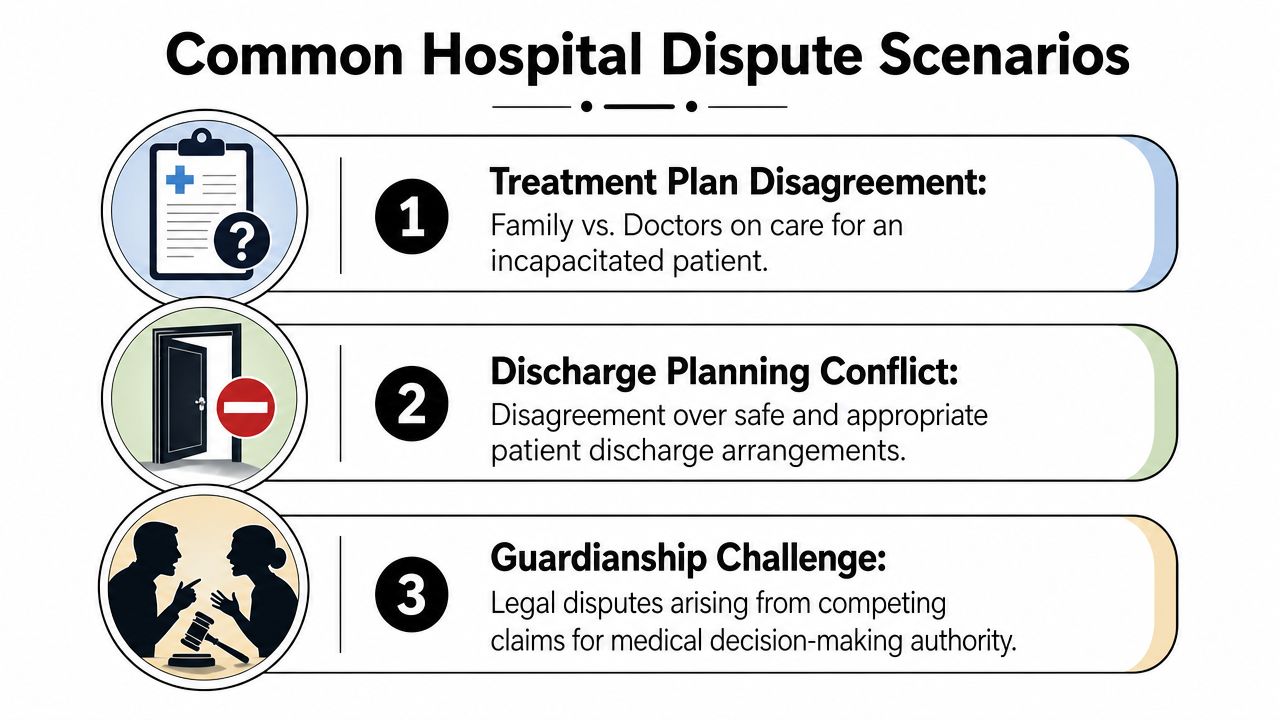
Discharge planning conflict
A Harris County hospital says your father is medically ready to leave. You believe the proposed nursing facility has poor staffing or is too far from family. The discharge planner says there are limited options and the bed must be accepted.
This isn't just an argument about preference. It becomes a legal problem if the patient lacks capacity, the decision-maker's authority is unclear, or the hospital believes the refusal creates an unsafe delay.
Treatment plan disagreement
Your sister is the guardian of your mother. A physician recommends a procedure. Your sister refuses because your mother long said she didn't want aggressive interventions if recovery was unlikely.
The hospital may question whether the guardianship order covers that choice, whether your mother's prior wishes are documented, and whether emergency treatment rules apply. That doesn't mean the guardian is wrong. It means the hospital wants legal clarity before proceeding or standing down.
End-of-life deadlock
A patient has no easy answer in the chart. One child says continue all measures. Another says comfort care only. The hospital asks for ethics review while the family argues in the hallway.
At this point, people often ask, “Who has final say?” The truthful answer is sometimes, “Not one person yet.”
Families often think conflict means someone is refusing to listen. In many cases, conflict means the legal record is incomplete.
Hospitals are not passive bystanders in these disputes. Institutional actors show up in guardianship proceedings with some frequency. In one study of 700 guardianship cases, 17% of petitions were filed by hospitals and 12% were initiated by nursing homes, as noted in this study of institutional participation in guardianship petitions.
That tells families something important. If you don't act quickly to present the right documents and clarify authority, the facility may decide to seek court involvement itself.
Your Step-by-Step Action Plan in a Hospital Dispute
The best response is usually calm, organized escalation. Start at the bedside. Move upward only as needed.
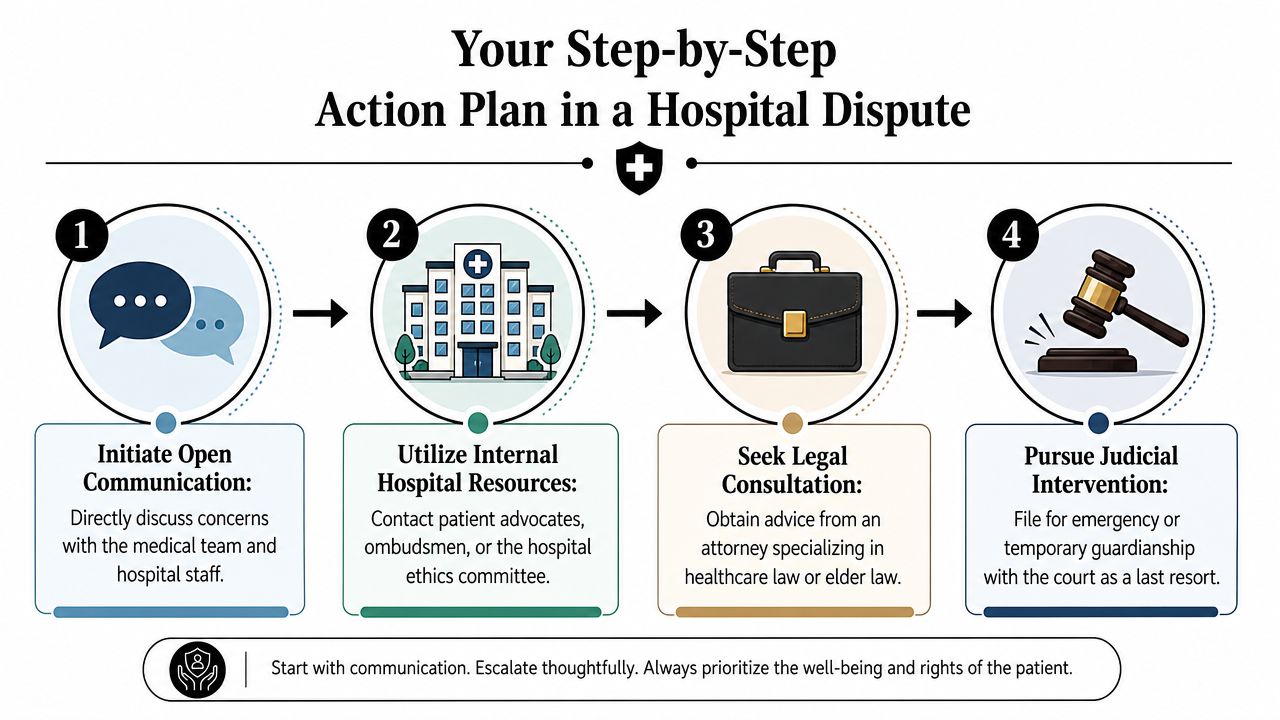
Step 1 Ask for a formal care conference
Don't keep repeating the same argument to different nurses. Ask for a scheduled meeting with the attending physician, charge nurse, case manager, social worker, and patient advocate if one is available.
Say clearly what you want answered. For example:
- Authority question: “Who does the hospital believe has legal authority right now?”
- Medical question: “What decision has to be made today, and why?”
- Discharge question: “What options are being offered, and why are alternatives being rejected?”
A short, direct meeting often clears up misunderstandings that hallway conversations make worse.
Step 2 Put your legal documents in the chart
Bring copies of the Medical Power of Attorney, advance directive, guardianship order, letters of guardianship, or any prior court orders. Ask the hospital to scan them into the chart and confirm who reviewed them.
If the dispute involves what the records show, it can help to understand how lawyers and physicians review charts. This attorney's guide to medical records gives a useful overview of how timelines, physician notes, and decision points are evaluated.
Bring paper copies even if you believe the hospital already has them. Missing paperwork causes avoidable delay.
Step 3 Request ethics or administrative review
If the bedside team won't resolve the problem, ask for an ethics consultation or escalation to hospital administration.
This is often the right move when:
- The family is split: Competing relatives are giving conflicting instructions.
- The document is disputed: The hospital questions a directive or court order.
- The decision is high stakes: Withdrawal of treatment, risky surgery, or a contested discharge is involved.
Put your position in writing. Keep it brief. State the patient, your authority, the decision in dispute, the documents provided, and the outcome you are requesting.
Step 4 Document every contact
Create a running log on your phone or in a notebook.
Include:
- Date and time
- Name and job title
- What was said
- What documents were provided
- What the hospital agreed to do next
If the conflict becomes legal, that timeline matters.
Step 5 Get legal advice before the situation hardens
The moment the hospital says you have no authority, plans discharge over your objection, or treats a guardian order as unclear, legal help stops being optional.
A Texas guardianship attorney can review whether the issue is really about capacity, scope of authority, emergency treatment, discharge law, or the need for probate court action. Families dealing with that exact roadblock often start with this resource on what to do when a hospital says you have no authority to make decisions.
If a filing becomes necessary, Law Office of Bryan Fagan, PLLC handles Texas guardianship matters involving applications, disputes, and emergency requests in probate courts across the state.
Seeking Emergency Relief from the Court
A hospital dispute sometimes reaches a point where bedside meetings, supervisor calls, and patient advocate requests are no longer enough. If a major treatment, transfer, or discharge decision cannot wait, the probate court may be the next place to ask for help.

When temporary guardianship may be needed
Temporary guardianship is the court's emergency brake. It is used when a person may face immediate harm, no one has clear authority to act, and the usual court process would take too long.
In a hospital, that can happen when the patient cannot make informed decisions, family members disagree, existing paperwork does not clearly answer the question, or the hospital refuses to rely on the documents presented. The stakes are often high. Surgery, life-sustaining treatment, placement, or discharge may be on the table.
Texas courts do not grant temporary guardianship just because a family is upset or the situation feels unfair. Judges still want proof. The court will look for evidence that the person is incapacitated, that immediate action is needed, and that a temporary guardian is necessary to protect the person or the person's property.
If capacity is disputed, expect the court to look closely at the medical facts rather than family opinions alone.
What to bring to court, and why it matters
Families often feel overwhelmed at this stage because everything seems urgent at once. It helps to treat the court filing like building a file for a teacher, a doctor, and a judge all at the same time. You need to show what is happening, who has tried to act, and why delay creates real risk.
Bring these items together as quickly as you can:
- Current medical information showing the patient's condition, limitations, and why a decision cannot wait.
- Copies of every legal document already discussed with the hospital, including powers of attorney, directives, prior guardianship papers, or probate orders.
- A short written timeline listing key events, who said what, and what the hospital plans to do next.
- A clear explanation of the danger if the court does not step in soon.
- Information about the proposed guardian so the judge can see who is willing and able to serve.
That timeline matters more than many families realize. A judge who sees a clean, dated record can understand the problem much faster than a judge hearing scattered memories from a frightened family.
For many families, it helps to hear the process explained in plain language:
What emergency court relief can actually do
Court intervention can clarify who gets to decide. It can also stop a harmful change long enough for the dispute to be heard properly.
That does not mean the court will rewrite every medical judgment. Judges usually focus on authority, safety, and immediate protection. In other words, the court is often deciding who speaks for the patient and what must pause until that question is answered.
If your family may need that kind of urgent filing, this guide on how to get emergency guardianship fast in Texas explains the process step by step.
Protecting Your Loved One and Preserving Your Rights
The central lesson in guardianship and hospital disputes is simple. The person with the strongest emotions is not always the person with legal authority. At the same time, the hospital doesn't automatically get the final word just because treatment is urgent.
Texas law tries to preserve the patient's rights first. If the patient has capacity, the patient decides. If not, the answer usually depends on the most applicable legal document or court order, followed by the proper probate process if no clear decision-maker exists.
What families can do before a crisis
The best protection often starts long before hospitalization.
- Sign planning documents early: A Medical Power of Attorney, directive to physicians, and related estate planning documents can reduce conflict.
- Review old paperwork: Make sure names, signatures, and contact details still make sense.
- Talk about wishes: Written documents help, but so do real conversations about rehab, surgery, life support, and long-term care.
If your family is planning ahead, it may also help to review related Texas legal areas such as Guardianship, Probate, and Estate Planning with counsel who handles overlapping issues.
What to do after a guardianship hearing
If a court appoints a guardian, don't assume the hard part is over.
Read the signed order closely. The guardian's actual power comes from the court's language, not from family assumptions.
Texas guardians must also follow ongoing duties that may include reporting, recordkeeping, compliance with court instructions, and acting in the ward's best interest. If the situation changes, a guardianship may need to be modified or even terminated. Families who stay organized after the hearing are in a much better position if the hospital raises new questions later.
Frequently Asked Questions About Hospital Disputes
What if a hospital ignores a valid Medical Power of Attorney
Start by asking who made that decision and why. Sometimes the problem is not refusal. It's uncertainty about capacity, authenticity, scope, or whether the document is in the chart.
If the hospital still refuses to recognize valid authority after review, contact a Texas attorney quickly. You may need a written demand, administrative escalation, or probate court action.
What if my loved one has no Medical Power of Attorney, no guardian, and no available family
This is the problem of the unrepresented patient. Hospitals face it more often than many families realize. Legal scholarship describes unrepresented patients as a growing operational issue and notes that hospitals may seek guardianship as a conflict-resolution tool, while some systems are exploring regional committees for quicker and more transparent decisions, as discussed in this overview of unrepresented patients and hospital decision-making.
If this applies to your loved one, don't wait for the hospital to define the process alone. Ask what legal pathway the facility is using, whether court involvement is planned, and whether any less restrictive alternative is being considered.
Can an out-of-state guardian make decisions in a Texas hospital
Sometimes yes, but not always smoothly. Texas facilities may want proof that the foreign guardianship is valid and may require recognition or registration in a Texas court before relying on it fully.
If the hospital is hesitating, the issue may be procedural rather than personal. A Texas probate attorney can review whether the out-of-state order needs to be filed or recognized locally before the hospital will act on it.
If you're facing a hospital dispute involving a parent, spouse, adult child, or other vulnerable loved one, a clear legal answer can make an immediate difference. The Law Office of Bryan Fagan, PLLC helps Texas families with guardianship applications, emergency filings, contested authority issues, and probate court proceedings across the state. Schedule a free consultation to talk through your specific situation and get a practical next step.