Skip to content
A lot of families start this process the same way. A daughter notices her mother is missing utility payments, giving money to strangers, and forgetting which medications she already took. Or parents realize their son is now an adult, but because of a disability, he still can't safely manage medical care or financial decisions alone. At that point, the question isn't just legal. It's personal, emotional, and often urgent.
Learning how to file for guardianship in Texas can feel intimidating given the significant implications. A guardianship case can protect someone who is vulnerable, but it can also limit that person's rights. Texas courts take that seriously. They should. Families need clear information, careful preparation, and a realistic view of what works in probate court and what tends to create delays.
Recognizing the Need for Guardianship in Texas
Guardianship is a court-supervised legal relationship. The court appoints a guardian to make certain decisions for another person, called the ward, when that person can't adequately manage important parts of life alone.

For many families, the hardest part is accepting that help is needed at all. Guardianship can feel like taking independence away from someone you love. In practice, the better way to view it is this: the court steps in only when a person needs protection and less restrictive options won't do the job.
The two main types of guardianship
Texas families usually deal with one or both of these categories:
- Guardianship of the Person. This covers personal decisions such as living arrangements, medical care, and daily well-being.
- Guardianship of the Estate. This covers money, property, bills, income, and other financial matters.
Sometimes one person serves in both roles. In other cases, the court separates them.
What families often miss early
The first issue isn't always whether your loved one is struggling. That part may already be obvious at home. The harder issue is whether the court will see guardianship as necessary and appropriately limited.
Guardianship isn't meant to be the first solution. It's the legal option Texas courts use when other protections no longer keep the person safe.
A practical example helps. If an older parent can still understand medical choices but can no longer manage bank accounts, a full guardianship may be too broad. A more limited approach could fit better. If an adult child with disabilities needs help across housing, treatment, and finances, broader authority may be necessary.
Why local court practice matters
The filing usually happens in the probate court for the county where the proposed ward lives. That could mean Harris County Probate Court in Houston, a probate court in Bexar County for San Antonio, or another county probate court depending on residence and assets. Local procedure matters because hearing settings, document review, and court expectations can differ from one county to another.
Families also need to understand that guardianship doesn't end with the court order. It starts there. The court continues to supervise the guardian, and that ongoing oversight is one reason it's so important to file carefully from the beginning.
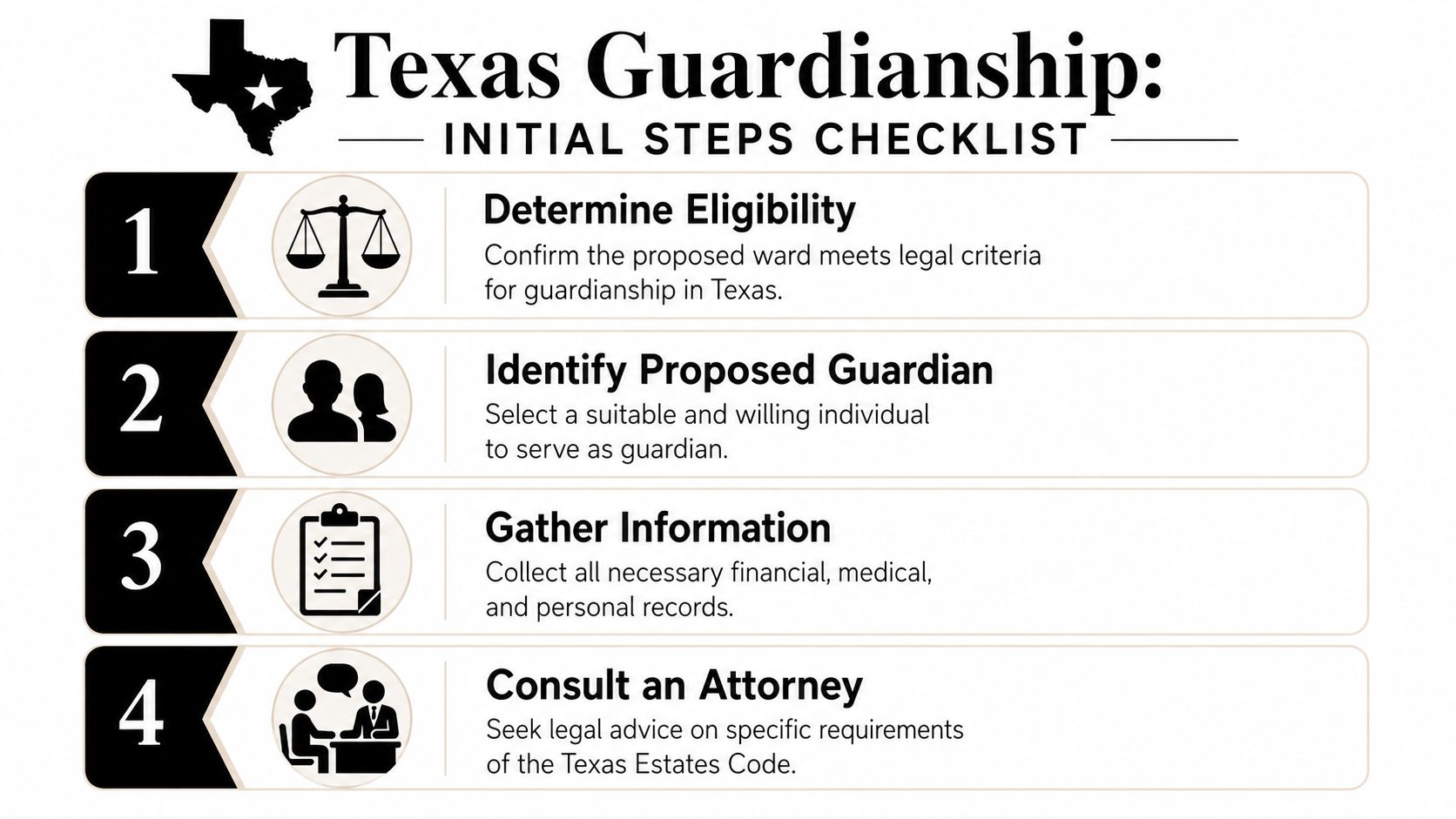
First Steps Before You File Your Application
Before anyone files papers, families need to slow down and gather the right foundation. Most weak guardianship cases don't fail because the family doesn't care. They fail because the file is incomplete, the medical proof is stale, or nobody clearly explains why other options won't work.
Start with counsel and a current medical evaluation
Texas guardianship cases aren't casual courthouse filings. The application must be prepared and filed in a form the probate court can act on, and families are usually best served by working with counsel familiar with Texas Estates Code Title 3, Subtitle G.
The medical piece is central. Under Texas Estates Code Section 1101.001, the applicant must file a sworn written application stating the proposed ward's name, birth date, and address, along with a physician's certificate confirming incapacity that was performed no more than four months before filing, or 24 months if the incapacity stems from an intellectual disability. That same section makes another point courts care about: the application must state whether alternatives to guardianship, such as supported decision-making or powers of attorney, were considered and found unfeasible.
If the certificate is outdated or vague, the case starts weak. If it doesn't match the type of guardianship requested, that also creates problems.
Document why alternatives won't work
Many families lose momentum at this point. They know their loved one needs help, but they don't build a record showing why a less restrictive option has failed or can't realistically protect the person.
A useful way to think about it is to create a short, fact-based timeline.
- List the option considered. Power of attorney, supported decision-making, automatic bill pay, joint account management, representative payee, or help from caregivers.
- State what happened. The parent revoked the paperwork, forgot it existed, refused needed care, gave away funds, or couldn't understand what they were signing.
- Connect the failure to a real risk. Missed medication, unpaid housing costs, unsafe transfers of money, or inability to consent to treatment.
Practical rule: Don't tell the court only that guardianship would be helpful. Show why other options are no longer enough.
For example, suppose a father has dementia and previously signed a power of attorney. If the bank now questions suspicious withdrawals, the father denies prior planning documents, and he won't cooperate with medical treatment, that gives the court a clearer picture than a general statement that he's "confused."
Gather the information your lawyer will need
A productive intake meeting usually includes:
- Basic identifying information about the proposed ward, close relatives, and living arrangements.
- Medical records and the physician's certificate that support incapacity.
- Financial information if estate powers are needed.
- Prior planning documents such as powers of attorney, trusts, or supported decision-making agreements.
- Examples of current problems written in plain language and tied to dates or events when possible.
If you need representation focused on guardianship of the person or estate under the Estates Code, Texas Guardianship Lawyer is one example of a practice area families often review while evaluating next steps. Families should also think carefully about alternatives before filing, including the options discussed in these Texas guardianship alternatives.
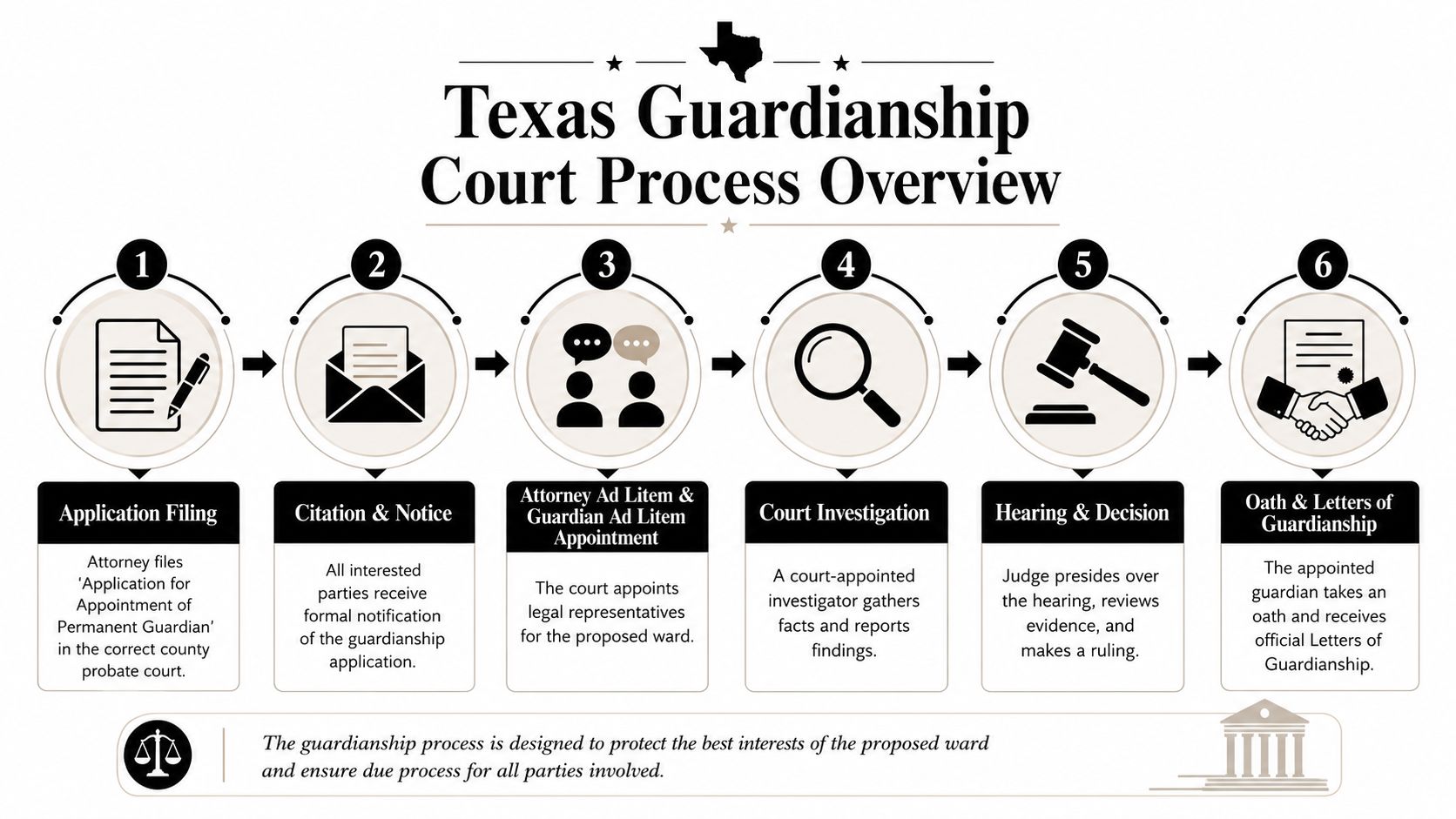
The Texas Guardianship Filing and Court Process
Once the groundwork is done, the case moves into the formal probate process. This is the point where families often feel like the system has taken over. It hasn't. But the process does become structured, and every step has a purpose.
In many counties, the first filing goes to the probate court where the proposed ward resides. For a Houston resident, that may be Harris County Probate Court. In Dallas, families may be working through a Dallas County probate court. The county matters because local filing practices, hearing requests, and court preferences can affect the pace of the case.
Filing the application and opening the case
The formal pleading is typically an application for appointment of guardian. It identifies the proposed ward, the proposed guardian, the type of guardianship requested, and the facts supporting incapacity and necessity. If the family is asking the court to restrict particular rights, the request should be specific and supported.
Texas guardianship cases usually take 30 to 90 days after the application is filed, according to this Texas guardianship timeline overview. That timeline starts after filing, not before. The same source explains that the proposed ward must be personally served by a constable and that the application must be posted at the courthouse for at least 10 days. The court also appoints an independent attorney ad litem to investigate capacity and whether guardianship is the least restrictive option.
Notice, service, and the people the court expects to hear from
Notice is not a technical side issue. It is one of the court's core due process protections.
The proposed ward must receive personal service. Other interested parties, such as close family members, must receive proper notice as required by the Estates Code and court rules. If the right people aren't notified correctly, the hearing may not move forward.
A concise way to think about the notice stage is this:
| Step | Why it matters |
|---|---|
| Personal service on the proposed ward | Protects the ward's right to know about the case |
| Notice to relatives and interested persons | Allows family members to appear, object, or provide information |
| Court posting requirements | Satisfies procedural notice rules before a hearing |
Families who live out of town often underestimate the paperwork and coordination involved here. In practice, many lawyers rely on staff support and document management help to keep probate filings organized. For readers comparing workflow help, resources about paralegals for probate cases can help explain the kind of administrative support these matters often require.
The attorney ad litem and court investigation
After filing, the court appoints an attorney ad litem for the proposed ward. That lawyer does not represent the applicant. The ad litem represents the ward's rights and investigates the case independently.
That investigation may include:
- Meeting the proposed ward
- Reviewing medical information
- Speaking with family members or caregivers
- Evaluating whether a narrower option could work
The ad litem's report often shapes how the judge views the case. Families should treat that investigation with the same seriousness they give the hearing itself.
A court investigator may also speak with the ward, relatives, and professionals involved in care. Families usually do best when they answer directly, avoid exaggeration, and focus on specific examples instead of broad labels.
Later in the process, many families want a visual overview before the hearing. This short video can help frame what the court process looks like in practice.
Preparing for and Navigating the Guardianship Hearing
A lot of families expect a long, dramatic court appearance. In many Texas guardianship cases, the hearing is fairly short. What matters is whether the judge has enough credible evidence to appoint a guardian, limit the guardianship to what is needed, and deny it if a less restrictive option would protect the proposed ward.
That last point deserves real attention. Texas courts do not treat guardianship as the default answer. The judge will often focus on whether supported decision-making, a valid power of attorney, a representative payee, a trust arrangement, informal family help, or another narrower option could work instead. If you are asking the court for guardianship, be ready to explain what was tried, what failed, and why those alternatives do not adequately protect your loved one.
Who will likely be in the courtroom
The proposed ward usually has the right to attend the hearing, and some cases involve a request for a jury trial. As explained in our overview of what to expect at a Texas guardianship hearing, the court may also consider the attorney ad litem's investigation, the medical evidence, and the specific rights the application asks the court to remove.
That matters because the hearing is about scope as much as need. If the proposed ward is an adult, the judge is not only deciding whether help would be useful. The judge is deciding which decisions the person can still make, which rights should stay in place, and whether a limited guardianship would solve the problem with fewer restrictions.
What a straightforward hearing usually looks like
In an uncontested case, the applicant's testimony is often direct and practical. The judge may ask why the guardianship is being requested now, what decisions the proposed ward cannot make safely, who is helping day to day, and why lesser alternatives are not enough.
Expect careful questions about the least restrictive alternative requirement. A judge may ask:
- What options did you try before filing?
- Is there a power of attorney in place, and if so, why is it not working?
- Could supported decision-making address the problem?
- Does your loved one need help with all decisions, or only some?
- Why should the court grant a limited or full guardianship?
Specific examples carry more weight than conclusions.
"She forgot to pay rent for three months, gave personal information to strangers, and could not explain her medications" is far more persuasive than "She cannot handle things anymore."
If you have documents showing failed alternatives, bring them. That might include revoked or ineffective powers of attorney, records showing unpaid bills despite family help, hospital discharge instructions the person could not follow, or notes from care providers describing repeated safety problems. This is often the evidence that separates a necessary guardianship from a case the court believes can be handled another way.
What changes in a contested case
Contested hearings are more demanding. A sibling may object to the appointment. The proposed ward may deny needing help. The dispute may center on who should serve, whether the guardianship should be limited, or whether any guardianship is appropriate at all.
In that setting, the court looks closely at credibility, family dynamics, and motive. The attorney ad litem's position often carries significant weight, especially on the question many families miss: whether a narrower arrangement could protect the proposed ward without removing as many rights.
I tell families to prepare for that question before they prepare for anything else. If the evidence shows your loved one can make some decisions with support, the court may reject a broad request and order something more limited. A thoughtful, well-documented explanation of why less restrictive alternatives failed is often what makes the difference.
After the Hearing Your Duties as a New Guardian
A signed order doesn't mean you can immediately walk into a bank or doctor's office and act. In Texas, there are post-hearing steps that create your legal authority, and those steps have deadlines.
Qualifying as guardian
After appointment, the guardian must sign an oath and post a bond with the court within 20 days to receive official Letters of Guardianship, according to Texas Law Help's guardianship guidance. That same resource explains that the letters expire after 16 months, and the guardian must register with the Texas Judicial Branch Certification Commission, complete a mandatory guardianship training course, and stay current with annual reporting obligations.
If a newly appointed guardian delays these tasks, the practical result can be frustrating. The judge may have approved the guardianship, but the guardian still may not have the documents needed to prove authority to hospitals, care facilities, or financial institutions.
What your role actually requires
A guardian owes duties to the ward and to the court. The exact duties depend on whether the guardian was appointed over the person, the estate, or both.
A simple breakdown looks like this:
| Guardian role | Typical focus |
|---|---|
| Guardian of the Person | Medical care, living arrangements, day-to-day well-being |
| Guardian of the Estate | Income, bills, assets, records, and court-supervised financial management |
For estate cases, a critical practical rule applies. Don't assume you can spend guardianship funds freely just because you're trying to help. Some expenditures require a specific court order. Good recordkeeping from the beginning prevents trouble later.
Annual compliance and renewal
Texas guardianship is ongoing court supervision, not a one-time appointment. Guardians must file required reports and accountings on time. If the court doesn't approve the required filings, updated letters may not issue.
The annual work usually includes:
- Status reporting about the ward's condition and living situation
- Financial reporting if there is a guardianship estate
- Bond renewal or updated bonding requirements where applicable
- Responding to court notices if anything is missing or late
For a more practical overview of the post-appointment phase, families often review what happens after guardianship is granted in Texas.
A good guardian acts carefully, keeps records, asks for court authority when needed, and remembers that every power granted by the court comes with oversight.
Guardianship can also change later. A court can modify or terminate a guardianship if the ward's condition changes, if a less restrictive option becomes workable, or if the guardian fails to meet fiduciary duties.
When You Need Personalized Legal Guidance
Some guardianship cases are orderly. Many aren't. A child may need protection after a settlement. An aging parent may face immediate exploitation. Siblings may disagree about whether incapacity exists or who should serve. In other families, the core issue isn't filing at all. It's whether a supported decision-making agreement, a power of attorney, or another planning tool could avoid guardianship.
Those differences matter because Texas courts don't grant guardianship as a convenience. They expect precision, proof, and compliance. A medically weak application, poor notice practice, or vague explanation of failed alternatives can stall the case. Procedural mistakes also carry real consequences. Common pitfalls include inadequate notice to interested persons, which invalidates 10 to 15% of hearings due to procedural defects, and incomplete annual accountings that lead to fiduciary removal in 25% of contested cases involving financial mismanagement claims, according to these Texas guardianship guidelines.

Situations that deserve extra caution
Some cases need specific strategy from the start:
- Emergency or temporary guardianship when there is imminent danger to the person or property
- Disputed guardianship cases involving family conflict or a ward who contests the case
- Minor guardianship matters tied to injury settlements or parental incapacity
- Modification or termination issues when the current order no longer fits the ward's needs
Families also benefit from reviewing related legal areas because guardianship often overlaps with probate and planning. Additional reading on Texas guardianship matters, probate concerns, and estate planning topics can help frame the bigger picture.
The right legal guidance should do more than file forms. It should help you decide whether guardianship is necessary, narrow the request when possible, prepare for objections, and set you up for compliance after the order is signed. That's what protects both the ward and the family.
If you're facing a guardianship question for a parent, adult child, or another vulnerable loved one, schedule a free consultation with Law Office of Bryan Fagan, PLLC. A personalized review can help you understand whether guardianship is appropriate, what type of guardianship may fit, what alternatives should be considered first, and how to move forward in the right Texas court with clarity and care.