Skip to content
You drive across town to see your mother in a care facility. You bring her favorite sweater, a card from the grandkids, and a short list of questions about her care. Then the front desk tells you that you're not allowed to visit because her guardian said no.
That moment leaves many families stunned. You may feel angry, embarrassed, and scared all at once. You may also wonder whether the nursing home is even allowed to do this, or whether the guardian now has complete control over who gets through the door.
If you're asking whether a guardian can restrict visitors or family access in Texas, the short answer is yes, sometimes. But the better answer is more important. A guardian's power is limited by Texas law, the ward's retained rights, and court oversight. In many cases, the primary issue isn't whether access can be limited at all. It's whether the guardian followed the right legal process, used the least restrictive option, and had a valid reason tied to harm.
Families in Harris County, Dallas County, Travis County, and across Texas run into this issue in probate courts, long-term care settings, and private family disputes. The law can feel cold when the situation is personal. Still, once you understand the rules, the path forward becomes clearer.
Texas guardianship law sits in the Texas Estates Code, Title 3, Subtitle G, and those rules matter because guardianship is never supposed to erase a person's dignity or cut off loved ones without cause.
A Heartbreaking Reality When a Guardian Denies Access
A daughter visits her father every Sunday. She helps him shave, reads the church bulletin out loud, and checks whether his hearing aids are working. One week, staff tell her she's on a no-visit list. They won't explain much beyond saying the guardian restricted contact.
That kind of scene happens more often than families expect. Sometimes the guardian is a sibling. Sometimes it's a professional guardian. Sometimes the family was already under strain long before the guardianship case began. When access is cut off, old conflicts usually get worse fast.
Why this feels so painful
This isn't just a legal problem. It's a relationship problem, a caregiving problem, and often a grief problem too. You may already be coping with dementia, illness, disability, or a recent court case. Being denied contact can make you feel like your role in your loved one's life vanished overnight.
A lot of people assume the answer must be simple. Either the guardian can ban visitors, or they can't. Texas law is more careful than that.
Families often think the dispute is about who “wins” control. In court, the focus is supposed to stay on the ward's welfare, rights, and best interests.
The question behind the question
When people ask, “Can a guardian restrict visitors or family access in Texas?” they're usually asking several questions at once:
- Can the guardian stop me immediately: even if there's no court hearing yet?
- Does my loved one still have rights: even under guardianship?
- What if the guardian is exaggerating: or acting out of family conflict?
- How do I challenge it: without making things worse for the ward?
Those are the right questions.
The answer starts with one basic point. Not every guardian has the same power. In Texas, the kind of guardianship matters, and the court order matters. That's where many families get tripped up.
A Guardian's Authority Under Texas Law
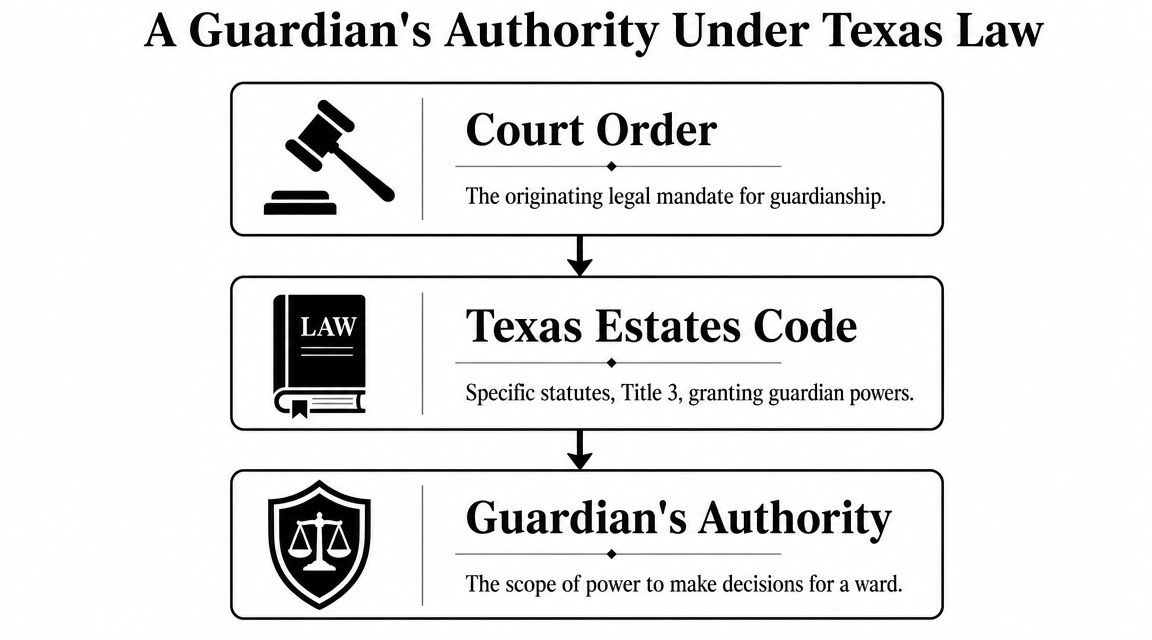
Guardians don't get authority from family status alone. They get it from a court order entered under the Texas Estates Code, Title 3, Subtitle G. That means a guardian's power comes from the judge, not from being the loudest relative in the room.
In counties with heavy probate dockets, such as proceedings handled through courts like the Harris County Probate Court system, this distinction matters every day. Judges look at what powers were granted, what rights were removed, and what rights were left with the ward.
Guardian of the person versus guardian of the estate
This is one of the most important distinctions in Texas guardianship law.
| Type of guardian | Main role | Visitation authority |
|---|---|---|
| Guardian of the estate | Manages money, property, bills, and financial matters | Generally no direct authority over personal visitation decisions |
| Guardian of the person | Handles care, living arrangements, and personal decisions | May have authority related to where the ward lives and whether contact should be limited |
A simple way to think about it is this. A guardian of the estate manages the checkbook. A guardian of the person manages day-to-day personal care decisions.
The Texas guide on adult guardianships explains that a guardian of the person may decide where the ward lives and whether to limit contact with family and friends, while changes to guardianship itself require an attorney and a court hearing through the formal process described in the Texas guide to adult guardianships.
Full guardianship and limited guardianship
Not every guardianship is total. Some are full guardianships. Others are limited guardianships.
A Texas Judicial Council study described guardianship as a court-supervised system, not an open-ended family veto, and noted that in a full guardianship of the person, the guardian can decide whether to limit family contact, while in a limited guardianship the judge specifies which rights remain with the ward in the Texas Judicial Council guardianship study.
That means you can't answer a visitation dispute by saying, “The guardian said so.” You have to ask:
- What type of guardian was appointed
- Was it a full or limited guardianship
- What does the court order say
Practical rule: Before arguing about access, get a copy of the guardianship order. It often answers questions that family members spend weeks fighting about.
Guardianship establishment, temporary guardianship, and emergency guardianship cases all begin with that same core idea. The court defines the power. The guardian doesn't write their own job description.
The Protected Rights of the Ward in Texas
Many people assume a ward loses all personal rights once a guardianship starts. That isn't how Texas law works. A guardianship removes only the rights the court finds necessary to remove.
That matters because visitation starts from a strong legal default in Texas. The ward is not supposed to become socially isolated just because someone else was appointed to help manage care.
The default rule favors contact
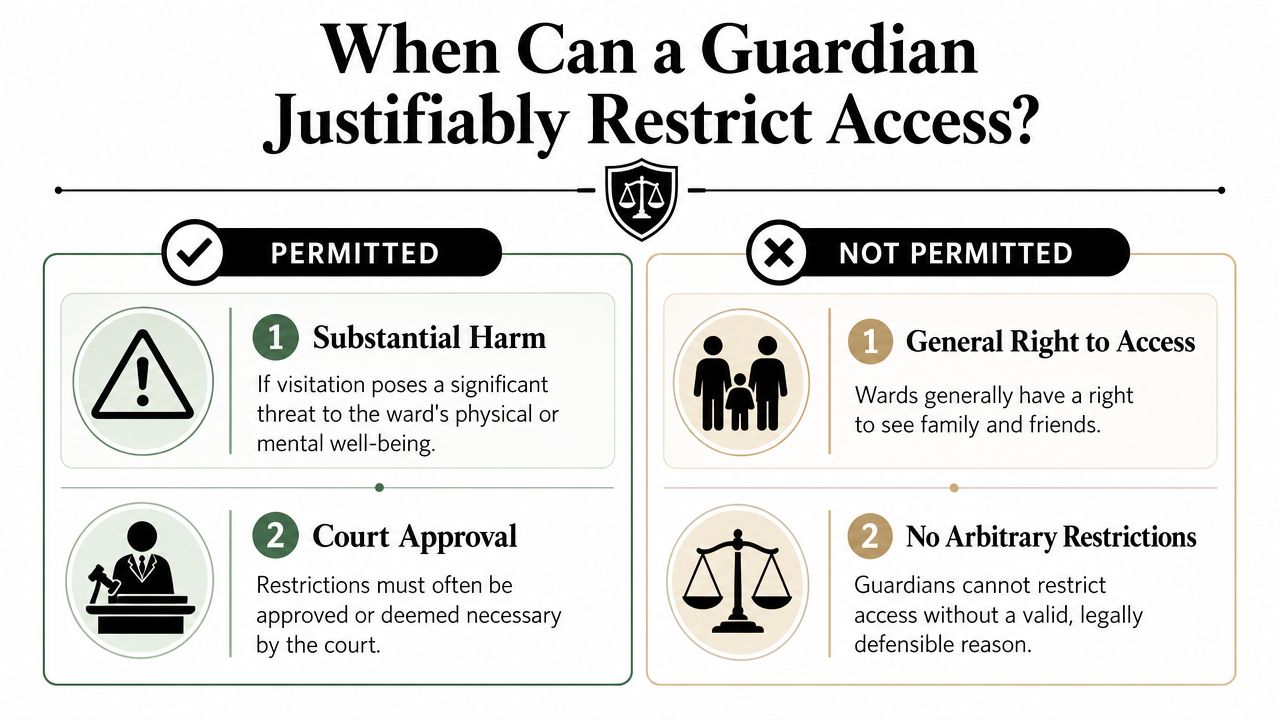
Under Texas guardianship law, a ward retains the right to “unimpeded, private, and uncensored” visits and communication unless a court order limits that right, which is why a guardian can't impose blanket no-contact rules based only on preference, as explained in the visitation rights factsheet discussing Texas guardianship law.
That phrase matters. Unimpeded, private, and uncensored is strong language. It means contact is the starting point, not the exception.
If you're a family member who has been told, “The guardian doesn't want visitors,” that statement by itself should raise concern. The legal question isn't what the guardian prefers. The legal question is whether there is a lawful reason to limit contact.
Why retained rights matter so much
The ward is still the center of the case. Not the guardian. Not the facility. Not the most organized family member.
Texas guardianship reforms pushed courts and practitioners toward preserving as many rights as possible. That principle shows up in several parts of guardianship practice:
- During establishment: the court should tailor powers rather than remove more rights than necessary.
- During disputes: restrictions should match the actual risk, not family tension.
- During modification or termination: families may ask the court to revisit powers if the arrangement has become too broad.
A simple example
Suppose your aunt is under guardianship because she has trouble managing medications and understanding complex medical decisions. That doesn't automatically mean she loses the right to speak privately with her sister, receive cards from her church, or visit with a longtime friend.
Those personal connections are often part of a person's stability.
The law recognizes that protection and connection both matter. A guardianship should protect a vulnerable adult without turning their life into confinement.
If a guardian wants to interfere with those rights, the burden shifts to the guardian to justify the restriction. That's where the concept of substantial harm becomes central.
When Can a Guardian Justifiably Restrict Access
A guardian can sometimes restrict visitors. But under Texas law, that power is tied to protection from harm, not family politics.
The key idea is substantial harm. That phrase can sound technical, but the basic question is practical. Is this visitor causing a real risk to the ward's physical, emotional, or financial well-being?
Situations that may justify restriction
A guardian is on firmer legal ground when the visitor's contact appears to put the ward at risk. Examples may include:
- Financial exploitation concerns: A relative pressures the ward to sign checks, change beneficiaries, or hand over debit cards.
- Severe emotional distress: A visitor repeatedly triggers panic, agitation, or confusion that seriously affects the ward's condition.
- Interference with medical care: Someone urges the ward to refuse needed treatment in a way that creates danger.
- Abuse or threats: The visitor has engaged in intimidation, coercion, or harmful conduct.
Those examples aren't automatic winners in court. The guardian still needs to connect the restriction to actual protection of the ward.
Situations that usually are not enough on their own
Many visitation fights come from facts that feel important emotionally but may not justify legal restriction.
These situations usually need much more before they support a limit on access:
- Old family resentment
- A sibling rivalry
- The guardian personally disliking a visitor
- Arguments about money that don't involve the ward's safety
- Different views on caregiving style
A guardian can't lawfully use visitation control as a tactic in a family disagreement.
If your dispute also involves where the ward lives, nursing home placement often overlaps with access issues. Families dealing with both questions may want to review this related guide on whether a guardian can place someone in a nursing home in Texas.
What courts tend to care about
Courts usually look for a clear link between the restriction and the ward's best interests. In plain language, judges want to know:
- What exactly happened
- Why the guardian believed the ward was at risk
- Whether the restriction matched the risk
- Whether a less severe option could have worked
That last point matters a lot. A total ban is harder to justify than supervised visits, shorter visits, or limits on certain topics or conduct.
A legal restriction should solve the danger. It shouldn't punish the visitor or erase the ward's relationships more than necessary.
This is why two families with similar conflict may get very different results in probate court. The court isn't deciding who is nicer. The court is deciding whether the restriction was necessary and proportionate.
The Legal Process for Limiting Visitation
Many articles stop too soon. They say a guardian can restrict contact if visits are harmful, and leave it there. Texas practice is more structured than that.
A guardian's authority is not just about having a reason. It's also about following the proper process.
Least restrictive response first
When a guardian believes contact is harmful, the response should be the least restrictive one that protects the ward. That means the guardian shouldn't jump straight to the harshest possible limit if a narrower fix would work.
Examples help:
- A supervised visit may be enough if the concern is verbal pressure.
- A shorter visit may work if the ward becomes tired or confused.
- A ban on discussing finances may address exploitation concerns.
- Meeting in a facility common area may reduce risk without cutting off contact.
A full no-contact rule is usually the most severe option. Courts often want to know why something less restrictive wasn't used.
Court accountability matters
Texas guidance also points families to an important procedural safeguard. A guardian restricting contact on grounds of harm must use the least restrictive response and may need to file a petition with the court within 10 days explaining the restriction, unless an abuse investigation or another court proceeding is already pending, according to the Texas State Law Library guide on guardianship rights and responsibilities.
That detail changes the conversation. It means a guardian may not be able to impose an indefinite restriction in the shadows. The court may need to review what happened.
If your concern is that the current order gives the guardian too much power, families often explore whether the arrangement should be narrowed through modifying guardianship powers in Texas.
Why procedure matters in real life
Procedure protects everyone involved.
For the ward, it helps prevent unnecessary isolation. For the guardian, it creates a record showing that the decision was made for protection, not preference. For families, it creates a path to review.
This is also why guardianship disputes often become formal probate matters instead of informal family negotiations. Once the court appoints a guardian, disputes over visitation, powers, compliance, and even termination often come back to the court's supervision under the Estates Code.
How Families Can Challenge a Guardian's Decision
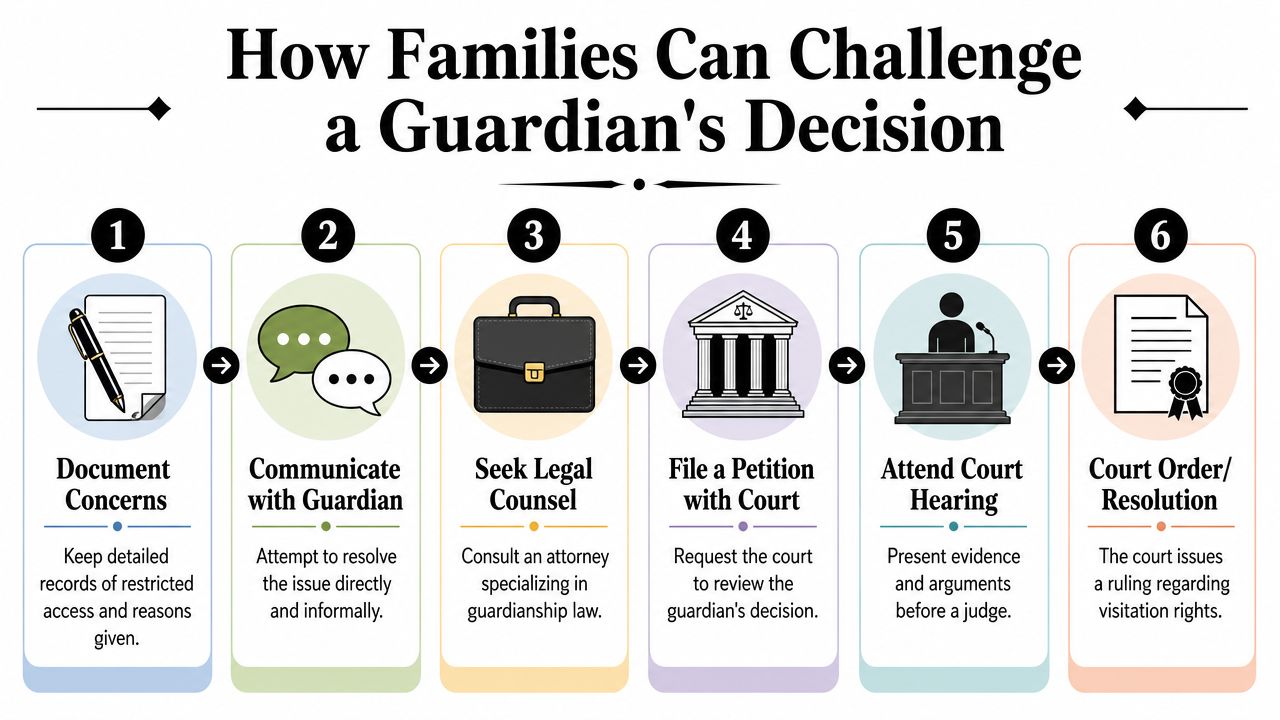
If a guardian blocked your access, don't assume your only choices are to give up or start a fight at the facility. A better approach is organized, written, and focused on the ward's well-being.
Probate judges in courts such as Dallas County Probate Court want evidence and clarity. They don't want hallway accusations.
Start with documentation
Write down what happened while it's fresh. Keep copies of emails, texts, voicemails, facility notes, and any written explanation you received.
A useful record often includes:
- Dates and times: when you tried to visit or call
- Who denied access: the guardian, facility staff, or both
- Reason given: exact wording if possible
- Impact on the ward: missed medical updates, emotional distress, sudden isolation
- Past contact pattern: whether visits were previously regular and peaceful
Make a calm written request
Before filing anything, send the guardian a short, respectful written request. Ask:
- why access was restricted,
- whether there are conditions under which visits can occur,
- whether supervised or limited visits are available,
- and whether the guardian has sought court review if required.
Written communication creates a paper trail. It also shows the court that you tried to resolve the issue without making things worse.
Keep your message focused on the ward. Don't fill it with family history unless that history directly relates to safety.
Bring the matter to probate court
If informal efforts fail, the next step is usually to ask the probate court overseeing the guardianship to review the restriction. That may involve a motion, application, or other filing depending on the county and the facts.
At that stage, families often gather:
| Helpful evidence | Why it matters |
|---|---|
| Emails and texts | Show what the guardian said and when |
| Care staff observations | May help explain the ward's condition during or after visits |
| Prior visitation records | Show whether contact had been normal and beneficial |
| Witness statements | Can support or challenge claims of harm |
| Guardianship order | Defines the guardian's powers |
A lawyer can help frame the issue in the language the court needs. In some cases, the right request may be review of the restriction. In others, it may be modification of powers or even removing a guardian in Texas.
What to expect at a hearing
The judge will usually want to hear both sides. The guardian may explain the alleged harm. You may explain why the restriction is unnecessary, unsupported, or too broad. The court may decide to allow visits, require supervision, set conditions, or leave the restriction in place.
If there's a temporary or emergency guardianship in play, the timeline can move quickly. Those cases can affect access in a very immediate way, so it's important to act promptly.
Families should also remember that alternatives to guardianship, and later termination of guardianship, can matter in the larger picture. If the current arrangement no longer fits the ward's needs, the visitation dispute may be a sign of a broader compliance problem.
Protecting Your Relationship and Seeking Legal Guidance
The law in Texas doesn't give a guardian unlimited power to cut people off. A guardian of the person may have authority to restrict contact in some situations, but only within legal limits, with attention to the ward's rights, and under court supervision.

That's why the answer to whether a guardian can restrict visitors or family access in Texas is more nuanced than commonly understood. The question isn't only whether the guardian had authority. The question is whether the guardian used that authority lawfully, carefully, and in a way that effectively protected the ward.
What families should do next
If you're living through this now, try to keep your next steps practical.
- Get the court order: You need to know whether the guardianship is full or limited and what powers were granted.
- Preserve records: Save every communication and note every denied visit or call.
- Avoid confrontations at the facility: Those moments rarely help and may later be used against you.
- Look at related legal options: Some disputes point toward broader issues involving Guardianship, Probate, or Estate Planning.
- Get legal advice early: A guardianship attorney can help you evaluate whether to request visitation, seek modification, challenge noncompliance, or pursue termination.
One option families use for these matters is the Law Office of Bryan Fagan, PLLC, which handles Texas guardianship cases involving establishment, modification, disputes, and compliance issues.
A short video may also help if you're trying to understand how guardianship disputes work in practice.
You don't have to sort through this alone. These cases are emotionally draining because they involve real people, not just legal rules. A clear plan can protect both your loved one and your relationship with them.
If you need help with a visitation dispute, a guardianship hearing, or questions about modifying or challenging a Texas guardianship, schedule a free consultation with Law Office of Bryan Fagan, PLLC. Our team helps families across Texas understand their options, prepare for probate court, and protect vulnerable loved ones with clarity and care.