Skip to content
A phone call from the hospital can change a Texas family's life in minutes. Your adult son is recovering from a traumatic brain injury, doctors need consent for treatment, the rehabilitation facility needs someone to coordinate care, and bills keep arriving at home. You may be the person everyone trusts, but being a parent, spouse, or child of an injured adult doesn't automatically give you legal authority to make decisions.
Guardianship can provide that authority. It can also remove important legal rights from the injured adult. That tension should guide every decision about guardianship of a brain injured adult in Texas. The right approach is not to seek the broadest order available. It's to identify the actual deficits, use the least restrictive tool that protects the person, and build a plan that can change as recovery develops.
When a Brain Injury Changes Everything for a Texas Family
At a Houston hospital, a mother sits beside her adult son after a motorcycle collision. The care team is discussing surgery, medication, and rehabilitation. She knows his medical history and understands what he would usually want, but the hospital asks who has authority to consent. His father is trying to figure out how the family will pay the next mortgage while also arranging a safe discharge.
The family's problem isn't a lack of love. It's a gap between family responsibility and legal authority. An adult who can't understand medical information, recognize danger, manage money, or choose a safe living arrangement may need a court-appointed guardian when no effective planning documents exist.
A guardian of the person may receive authority over medical care, residence, personal services, and safety decisions. A guardian of the estate may manage money, property, benefits, claims, and financial obligations. Some families need both. Others need only a limited order covering one area, such as medical decisions.
Practical rule: Start with the specific decision your family cannot legally make, not with the label “full guardianship.”
Brain injury recovery often requires more than a single legal filing. Rehabilitation teams may identify new abilities, changing risks, or improvements in communication and judgment. Families should coordinate legal planning with medical care, including a qualified neurological rehabilitation guide when the person's treatment team recommends continued therapy.
If the person remains unconscious or cannot communicate, families may face special urgency. A related resource on guardianship for someone in a coma in Texas can help explain why the court process may become necessary even when the injury occurred suddenly.
Guardianship protects a vulnerable adult, but it also limits self-determination. Texas law therefore favors an arrangement no more restrictive than necessary. A careful application should preserve every decision the injured adult can still make safely and should leave room for the order to narrow or end as capacity returns.
Who Qualifies as an Incapacitated Person Under Texas Law
Texas doesn't appoint a guardian merely because relatives disagree with an adult's choices. Under Texas Estates Code Title 3, an incapacitated person includes an adult who, because of a physical or mental condition, is substantially unable to provide food, clothing, or shelter, care for personal physical health, or manage financial affairs. The court must connect the condition to actual functional limits.
That distinction matters after a traumatic brain injury. A person may understand personal care but be unable to manage a settlement account. Another person may handle ordinary purchases but lack the ability to understand a complicated medical procedure. The application should describe those differences instead of using broad statements such as “he can't make decisions.”
The physician certificate is central
Except in narrow statutory exceptions, the applicant must submit a written certificate from a physician or qualified advanced practice registered nurse. The certificate must be dated within 120 days before filing, and the examination must occur within that same 120-day period. Texas requires the certificate to address the person's condition, functional limitations, and whether improvement is possible, including when reevaluation should occur. See the Texas Estates Code requirement for the physician certificate.
The medical evidence should use plain, concrete descriptions. “Cognitive impairment” is less useful than explaining that the person cannot compare treatment options, remember instructions, recognize financial exploitation, or understand the consequences of signing a contract.
A family arranging medical care at home may also benefit from a coordinated in-home geriatric primary care resource, although a brain injury case still requires the appropriate statutory examination and certificate.
The same principle applies after a stroke. Families can review guardianship after a stroke in Texas when evaluating whether the person's limitations affect medical, personal, financial, or multiple areas.
For a practical explanation of why a case begins with documented incapacity, see The Certificate of Medical Examination in Texas Guardianship. The medical certificate isn't a formality. It supplies the evidence the judge needs to decide whether guardianship is legally justified and how broad it should be.
Choosing the Right Type of Guardianship
The legal tool should match the injury. Texas courts may appoint a guardian of the person, a guardian of the estate, or both. The court may also limit authority to particular decisions when the evidence shows that the adult can safely manage other parts of life.
Guardianship of the person generally addresses personal and medical decisions. It may fit an adult who cannot consent to treatment, choose a safe residence, manage medication, or protect basic health. It doesn't automatically give authority over money.
Guardianship of the estate addresses property and finances. It may be needed when the injured adult cannot manage bank accounts, benefits, real estate, lawsuits, or bills. The guardian must keep the ward's funds separate from personal funds and follow court reporting rules.
A dual guardianship combines both roles. It may be appropriate where the brain injury affects medical judgment and financial management. Even then, the order should identify the powers the evidence supports.
Limited and temporary options
Texas policy favors the least restrictive arrangement that protects the person. A person who can manage a paycheck but cannot understand surgery consent may need a limited guardianship of the person, not broad control over every decision. A person who can make personal choices but cannot manage a personal-injury settlement may need estate authority only.
Texas courts also have temporary and emergency procedures. A temporary guardianship can address an urgent need while the court evaluates the larger case. An emergency ex parte appointment may provide short-term protection when immediate action is required, while temporary guardianship procedures can last up to 60 days under the applicable Texas framework. County procedures matter, so families should check the rules for the local probate court, including courts serving Harris County, Dallas County, Tarrant County, and other Texas counties.
| Guardianship Type | Scope of Authority | Best-Fit Brain Injury Scenario |
|---|---|---|
| Guardian of the person | Medical, residential, and personal decisions ordered by the court | The adult cannot understand treatment or live safely without supervision |
| Guardian of the estate | Money, property, benefits, and financial claims | The adult cannot manage accounts, bills, or settlement funds |
| Dual guardianship | Person and estate authority | The injury affects both care decisions and finances |
| Limited guardianship | Only the areas identified in the court order | The adult retains meaningful ability in some decision-making areas |
| Temporary or emergency guardianship | Short-term authority for an urgent protective need | Immediate treatment, placement, or safety concerns require court action |
Families comparing Texas Guardianship Lawyer services should ask whether the representation addresses guardianship of the person, guardianship of the estate, and the limits imposed by the Texas Estates Code.
Filing the Guardianship Application in a Texas Probate Court
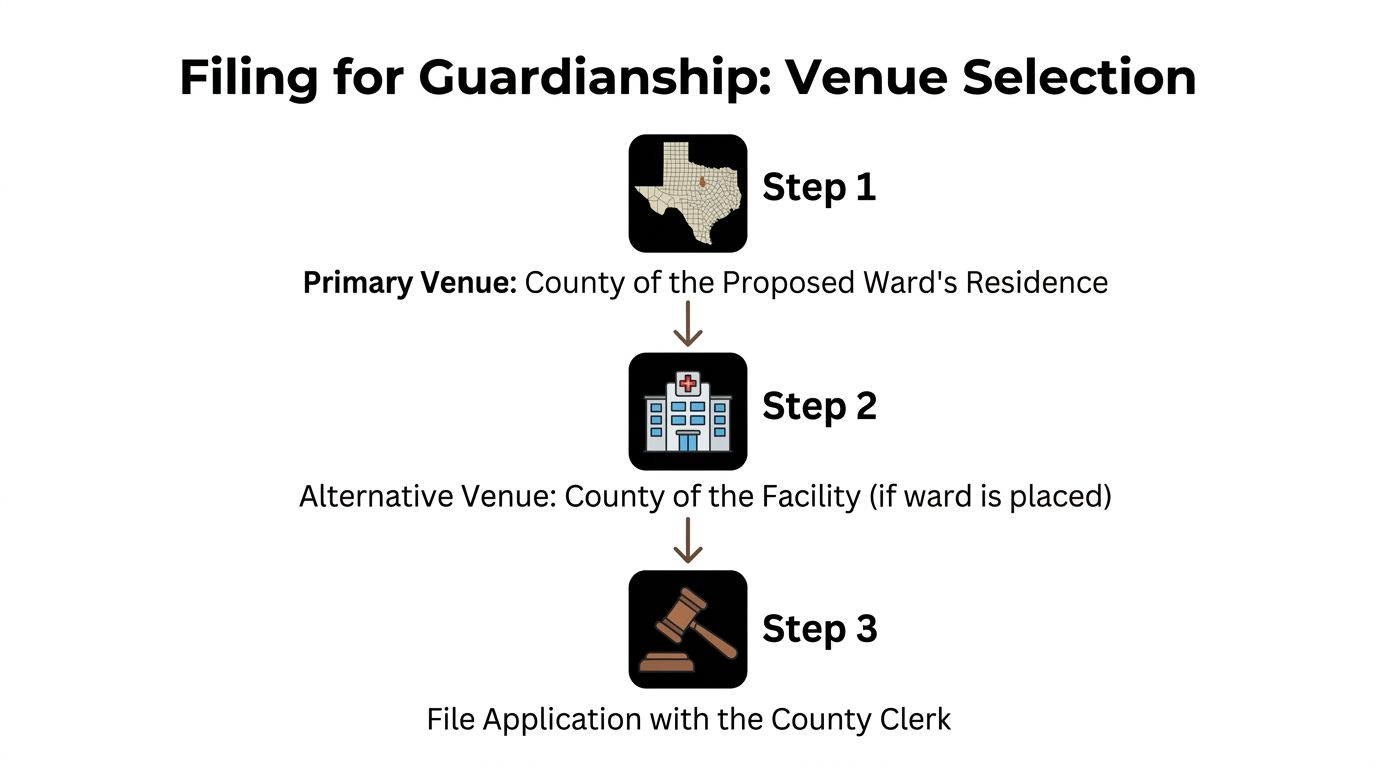
Begin with venue. An adult guardianship application generally belongs in the probate court or court handling probate matters in the county where the proposed ward resides. If the adult was placed in a facility, the relevant domicile before admission may control. A family in Houston may work with a Harris County Probate Court, while a family in Fort Worth may deal with Tarrant County probate procedures. Local forms and filing practices can differ.
Prepare the evidence before filing
The physician certificate is the first major document. Confirm that the examination and certificate fall within the statutory 120-day window before filing. Gather hospital records, rehabilitation evaluations, medication information, discharge plans, and examples showing how the injury affects daily decisions.
The application should identify the requested guardianship, the proposed guardian, and the proposed ward's known relatives. It should also include the proposed guardian's sworn willingness to serve and estate information when financial authority is requested. Don't file until the requested powers match the medical evidence.
Complete service and court review
After filing, the clerk issues citations and notices required by law. The proposed ward and relevant adult relatives must receive proper notice. The court may appoint a court investigator and, when needed, a guardian ad litem to protect the proposed ward's interests.
A practical workflow looks like this:
- Review local rules: Obtain the probate court's current forms and procedures.
- Secure medical proof: Schedule the qualifying examination and collect supporting records.
- Draft carefully: Prepare the application, proposed order, declarations, and estate information.
- File and request citations: Confirm that the clerk issues every required citation.
- Complete service: Use the method required by the court and preserve proof.
- Check the file: Confirm returns of service before the hearing date.
Filing costs vary by county and case details. Don't rely on a guessed total. Ask the clerk or counsel to identify filing fees, service costs, bonds, and other case expenses before filing.
For a related explanation of the filing process, review the Texas guardianship application.
The court's educational video may also help families understand the general process.
Expired medical certificates, incorrect county forms, and missing citations create avoidable problems. Accuracy at filing saves time and protects the proposed ward's right to a fair hearing.
What to Expect at the Guardianship Hearing
A Texas guardianship hearing is usually a bench proceeding before a probate judge. The judge doesn't just approve a family agreement. The court must confirm jurisdiction, notice, medical evidence, and the need for the powers requested.
The proposed ward has a right to receive notice and may have a right to attend. If the person's medical condition makes attendance impractical, the court will address that circumstance, but families should never assume the person's participation is unimportant.
The judge tests the application
The applicant may testify about the brain injury, current deficits, care needs, finances, and relationship with the proposed ward. The physician certificate is part of the evidence. A court investigator's report may address incapacity, the proposed guardian, and whether guardianship is necessary. A guardian ad litem may separately investigate and report when the court appoints one.
Expect questions such as:
- What decision cannot the proposed ward make safely?
- Why is a power of attorney or supported decision-making arrangement insufficient?
- Would limited authority protect the person?
- What does the proposed ward want?
- Can the proposed guardian manage conflicts and follow court duties?
- If estate authority is requested, how will the guardian protect and track the assets?
The court may also ask about recovery. Texas medical certificates must address whether improvement is possible and when reevaluation should occur. A brain injury may produce uneven progress, so the order should not assume that the first assessment answers every future capacity question.
If the evidence supports the application, the judge signs an order. The guardian then completes required qualification steps, including the oath and any bond requirements, before letters of guardianship authorize action. Don't treat the hearing as the finish line. The order defines the guardian's authority, and later actions must stay within that scope.
Family disputes can arise when one relative wants immediate guardianship and another believes the injured adult can recover without it. Keep disagreements focused on evidence, safety, and the least restrictive plan. Courts can hear objections, consider competing proposed guardians, and limit authority when full control isn't justified.
Less Restrictive Alternatives Families Should Consider First
Guardianship should be the backup plan when another legal structure can safely meet the adult's needs. Texas law requires courts to consider alternatives and available supports and services before appointing a guardian. That requirement reflects a basic principle: protective help should not remove more rights than necessary.
The first question is whether the injured adult signed valid documents before the injury. A medical power of attorney may authorize an agent to handle health care decisions. A durable power of attorney may authorize financial actions and remain effective during incapacity. These documents only help if they were validly signed while the principal had the capacity required to create them.
Supported decision-making takes a different approach. The adult keeps legal decision-making authority while chosen supporters help explain information, communicate choices, and assist with understanding options. This can work for a person who has slowed processing or memory problems but can still express informed choices with support.
Compare the tools honestly
| Alternative | Scope of Authority | Key Limitation for Brain-Injured Adults |
|---|---|---|
| Medical power of attorney | Health care decisions under the document | It doesn't automatically control finances or every personal decision |
| Durable power of attorney | Financial and other authority stated in the document | The document must have been validly signed before capacity was lost |
| Supported decision-making | Assistance with understanding and communicating choices | The adult retains authority and must be able to participate |
| Representative payee | Management of designated benefit payments | It doesn't provide general authority over property or medical care |
| Management or special needs trust | Holds and manages trust assets | Trust terms and benefit rules limit how funds may be used |
| Joint account | Shared access to an account | It can create misuse, ownership, and creditor concerns |
| Declaration for mental health treatment | Documents treatment preferences | It doesn't replace broad guardianship authority |
Texas recognizes formal alternatives including powers of attorney, representative payee arrangements, management trusts, special needs trusts, joint accounts, and supported decision-making. Families should also examine whether medical consent rules under Texas Health and Safety Code Chapter 313 address a particular non-crisis decision.
A layered plan often works better than one sweeping order. For example, supported decision-making may cover routine choices while a representative payee handles designated benefits. A trust may protect assets without stripping capacity. Full guardianship belongs in cases where these tools cannot safely address the adult's actual needs.
Ongoing Duties, Annual Reports, and Possible Termination
Appointment is only the beginning. A Texas guardian remains under court supervision and must follow the order, protect the ward's interests, maintain records, and report to the court. Brain injury cases need especially careful monitoring because capacity may improve, fluctuate, or change as rehabilitation continues.
Know the annual deadlines
A guardian of the person must file an Annual Report every year within 60 days after the anniversary of the date the guardian qualified. The report covers the ward's mental and physical condition, social and intellectual functioning, and living conditions. Texas courts explain this continuing reporting structure in their guardianship guidance.
When the guardian has authority over both the person and estate, two pleadings are due during that same 60-day window:
- Annual Report: Describes the ward's condition, functioning, care, and living situation.
- Annual Account: Provides detailed information about estate receipts, disbursements, assets, and financial management.
The reporting period generally covers 12 months beginning when the guardian qualifies, although the court may adjust it within statutory limits. The reporting deadline cannot be extended beyond the permitted period. Give the ward any notice required by the court, keep proof of filing, and calendar the deadline before it arrives.
| Filing | Who Must File | Frequency | Statutory Basis |
|---|---|---|---|
| Annual Report of the person | Guardian of the person | Every year, within the required 60-day window | Texas Estates Code Chapter 1163 and court reporting rules |
| Annual Account | Guardian of the estate | Every year when estate guardianship continues | Texas Estates Code Title 3, Subtitle G and court order |
| Medical or capacity update | As ordered or needed for modification | Based on recovery, court direction, or a new request | Texas Estates Code guardianship provisions |
| Restoration or modification pleading | Ward or interested person | When capacity or support needs change | Texas Estates Code Chapter 1202 |
Missing reports can lead to court action, including removal and personal liability for fees. A guardian who mixes personal funds with ward funds, pays expenses without records, or ignores the court order risks harming both the ward and the guardian.
A guardian's private good intentions don't replace public court records. Save receipts, bank statements, medical updates, and copies of every filing.
Reassess as recovery unfolds
A guardianship shouldn't become permanent by neglect. If rehabilitation restores some abilities, the family should ask whether the order can be narrowed. A person who once needed help with every financial decision may later manage ordinary spending with safeguards. Another person may regain medical decision-making while still needing estate management.
Texas law allows a guardianship to end when the ward regains full capacity or has enough capacity with supports and services. The ward or an interested person may seek restoration through a verified motion. Medical evidence should address current functioning, not merely repeat the original diagnosis.
Modification may be the better request when recovery is partial. The court can limit powers, change bond requirements, appoint a different guardian, or close an estate while leaving a personal guardianship in place. Ask the treating physician and rehabilitation team to document concrete abilities, supervision needs, judgment, communication, and the person's ability to understand consequences.
Use this family checklist
- Check existing documents first: Look for a medical power of attorney, durable power of attorney, advance directive, supported decision-making agreement, trust, or representative payee arrangement.
- Document the injury: Gather the diagnosis, hospital records, rehabilitation notes, discharge concerns, and specific examples of unsafe or unmanageable decisions.
- Secure the certificate: Confirm that the physician or qualified examiner meets the Texas timing and licensing requirements.
- Choose the correct court: Identify the proper county probate court and review its local filing rules.
- Request only needed powers: Decide whether the case calls for person authority, estate authority, both, or a limited order.
- Prepare for objections: Tell the proposed ward and relatives what is being requested, and address disagreements with evidence rather than accusations.
- Protect finances: Keep separate accounts and complete every required accounting.
- Calendar compliance: Track the Annual Report and Annual Account deadlines from the date of qualification.
- Plan reevaluation: Ask when medical reassessment should occur and preserve rehabilitation milestones.
- Revisit the order: Seek modification or restoration when the ward's abilities change.
Families often feel guilty for considering guardianship and overwhelmed by its financial demands. Those emotions are normal, but delay can leave a vulnerable adult without a lawful decision-maker during treatment, discharge, benefits, or financial crises. The better course is a focused legal review that asks what authority is needed today and what independence can be preserved tomorrow.
Schedule a free consultation with the Law Office of Bryan Fagan to review the brain injury, existing documents, medical certificate requirements, county court process, and limited versus full guardianship options. The firm can help you evaluate guardianship, probate, and estate planning issues together, calculate estimated filing fees and attorney costs, and create a plan that can evolve with the ward's recovery.
The Law Office of Bryan Fagan, PLLC helps Texas families establish, modify, contest, and close guardianships involving medical, personal, and financial needs. Visit the firm to schedule a free consultation and discuss a rights-preserving guardianship plan for your loved one.