Skip to content
When a parent can't keep up with bills, forgets medication, or is getting pressured by someone who shouldn't have access to their money, families often reach the same painful question, what legal step protects them? A guardianship application Texas families file is not just a stack of forms. It's a court process that can affect where someone lives, who makes health decisions, and who handles money.
Texas law treats that decision with care. The court has to consider less restrictive alternatives before granting guardianship, and it must find by clear and convincing evidence that the proposed ward is incapacitated and that guardianship is in the person's best interest, under Texas Estates Code Title 3, Subtitle G and the guardianship provisions in Chapter 1101 (Texas Estates Code § 1101.101 et seq.). That's why a filing in Harris County Probate Court, Travis County Probate Court, or any other Texas probate court is never just about filling out paperwork. It's about building a record that shows why protection is necessary and why narrower options won't work.
Introduction to Guardianship Application Texas
A daughter in Houston may be paying her father's rent, setting up his doctor visits, and trying to keep his bank account safe, all while he still insists he can manage on his own. A son in Austin may be watching his mother sign documents she doesn't understand, then wondering whether the court can step in before things get worse. Those families are usually not looking for a legal fight, they're looking for a safe path.
Texas guardianship law gives families that path, but only if they follow the court's process carefully. The rules start with a formal application in county court or another court with probate authority, and they continue through service, notice, medical proof, hearing preparation, and post-appointment compliance (TexasLawHelp guardianship overview). The judge does not only ask whether a loved one needs help, the judge is asking whether the law allows guardianship and whether something less restrictive would do the job first.
Practical rule: If the person can still make some decisions safely, ask whether a limited order or another support tool could protect the person without removing every right.
The hardest part for many families is not understanding that guardianship exists, it's understanding why the court may say no if the file is thin. Texas public guidance is clear that courts must evaluate alternatives and supports before granting guardianship, and that issue often gets less attention than the forms themselves (Texas Governor's disability and guardianship guidance). A careful application answers that question early, before the hearing becomes a scramble.
Understanding guardianship options in Texas
A family often reaches this point after seeing the same problem from more than one angle. A parent may still recognize familiar faces but miss bills, forget medication, or make unsafe choices about where to live. Texas recognizes more than one way to protect that person, and choosing the wrong option can slow the case or remove more rights than the situation calls for.
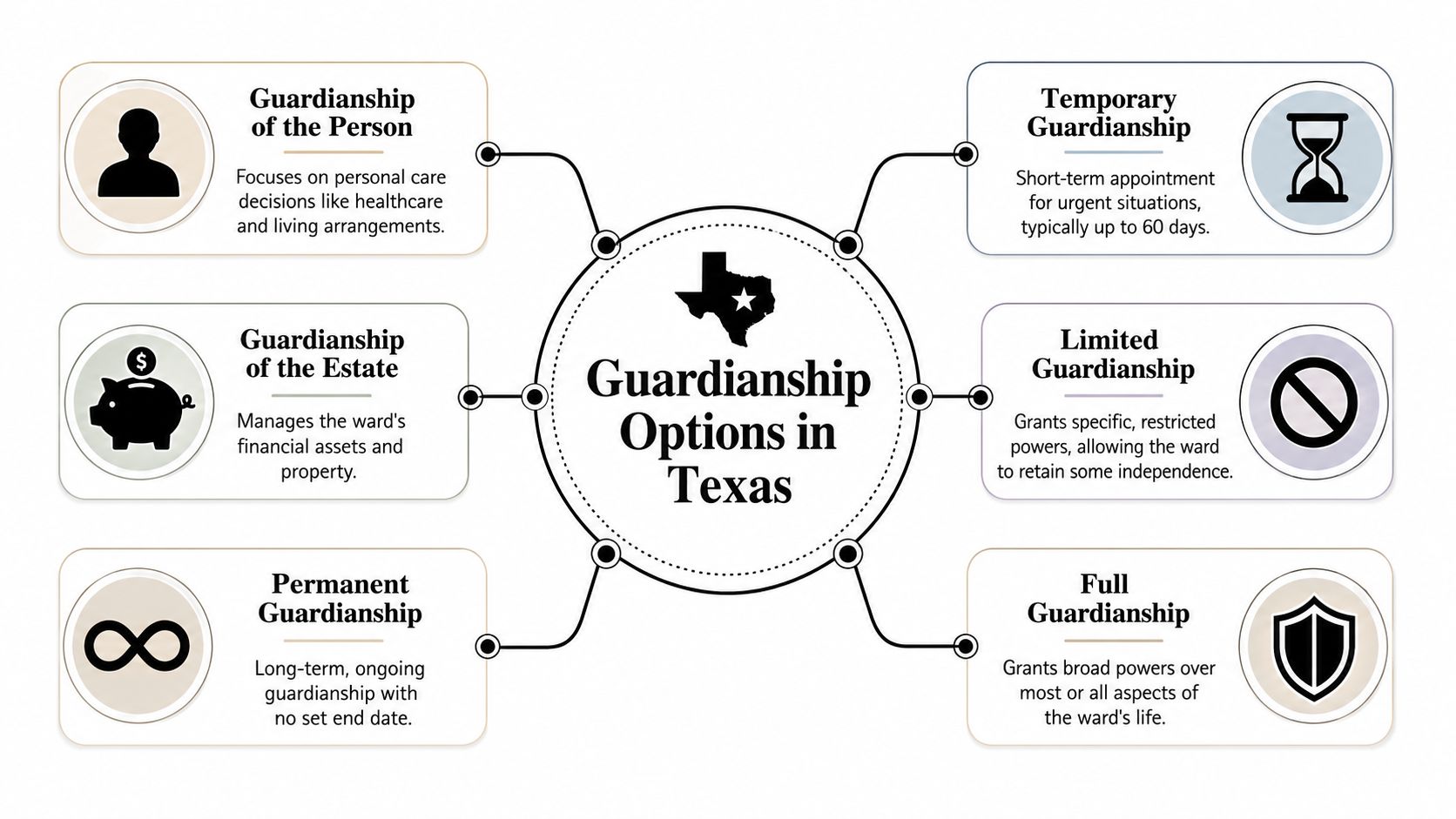
The first split is simple, guardianship of the person versus guardianship of the estate. A guardian of the person handles care decisions, such as medical treatment and living arrangements. A guardian of the estate handles money, property, and bills. If you want a plain-language overview of more than one way to protect a vulnerable person, that distinction is the place to start.
Matching the order to the problem
The right order depends on the specific problem, not on a template. A grandmother with dementia may need help paying utilities and consenting to medical care, yet still be able to decide who stays in her home. In that kind of case, a limited guardianship may fit better than a full order, because the court can remove only the rights that need court control rather than taking everything away.
Texas guidance says a limited order should identify the specific rights being removed, including residence, voting, driving, and marriage. That level of detail matters because the judge is not guessing at the problem, the judge is deciding exactly which rights, if any, the person can no longer exercise safely.
A temporary or emergency order serves a different need. If a parent is suddenly hospitalized and there is an immediate risk to health or property, a temporary guardianship can cover the gap while the permanent case is pending. Texas sources describe it as a short-term tool, which makes it useful when waiting for the normal process would leave the person exposed.
Why alternatives matter first
The court does not jump straight to guardianship. It must look for less restrictive alternatives and supports or services before granting that authority. That can include powers of attorney, supported decision-making, or other help that addresses the problem without stripping away more rights than necessary.
The same idea shows up in Texas practice guides and in the state's public materials, and it is easy to miss if you are focused only on the petition. The legal question is whether another option already solves the issue in a reliable way, not whether guardianship feels simpler for the family. A court will usually expect the applicant to explain why those alternatives are not enough.
Choosing the right scope
A useful way to sort the options is to ask what decision needs court authority. If the issue is only money, ask for authority over money. If the person needs help with both care and finances, the request should match that need and stop there. That approach shows the court you are asking for the narrowest order that still protects the person.
Different tools also carry different effects on independence, so families should be careful before asking for a broader order than the facts support. A limited or temporary setup may solve the problem now, while a permanent full guardianship may be more than the case requires. Understanding the choice at this stage helps the rest of the application stay focused on the person's actual needs.
Preparing your guardianship application
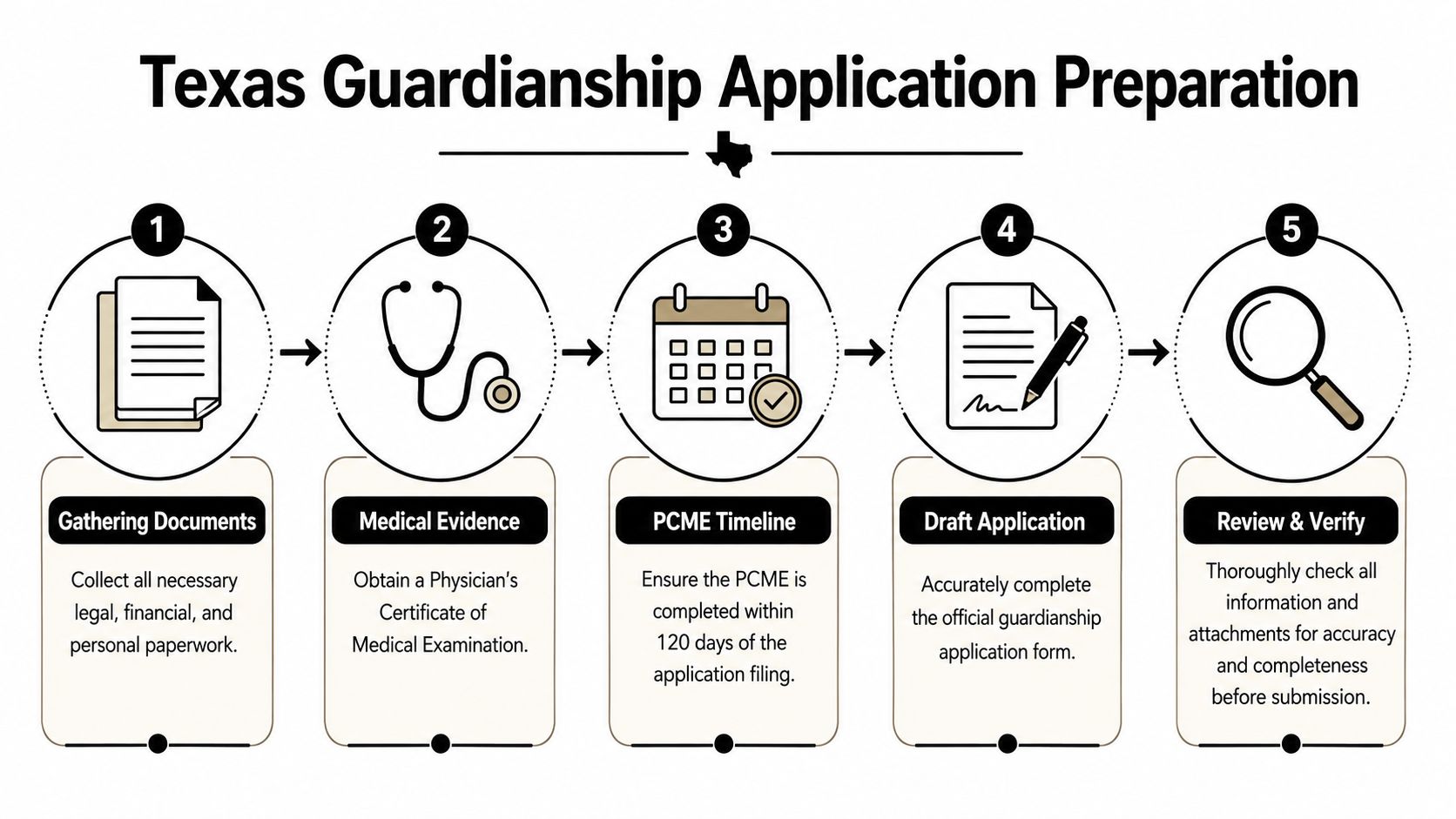
A solid filing begins before the petition ever reaches the clerk's desk. Texas requires a recent Physician's Certificate of Medical Examination, often called a PCME, and for adults the filing must be supported by a PCME completed within 120 days of the application (Bryan Fagan overview of the Texas application process). That timing matters because an outdated exam can slow the case before the court even sets a hearing.
Start with the medical proof
The doctor's paperwork should explain the diagnosis, the person's limits in making decisions, and the kind of help the court may need to order. If the case involves intellectual disability, Texas guidance allows a qualified psychologist's exam in some situations, and that exam needs to be recent enough to fit the hearing schedule. The court wants current evidence, not old records buried in a file cabinet.
A careful medical packet does more than confirm a condition. It helps the judge see why the requested order matches the person's actual needs, and it gives the family a clearer picture of what the court can and cannot approve.
Gather the court file with care
The application usually needs more than the petition itself. Families should also prepare a list of interested persons, supporting medical records, and any documents showing why the proposed ward cannot manage finances or personal care safely. If the case involves the estate, a surety bond is generally required before the guardian receives authority, and Texas courts note that the proposed guardian must be registered with the Judicial Branch Certification Commission after filing (Bryan Fagan step-by-step overview).
Good preparation answers the judge's first questions before the hearing starts. What rights are at issue? What medical evidence supports incapacity? What less restrictive options were tried or considered? Those answers belong in the written record, not just in a hallway conversation outside the courtroom.
A useful local reference for the required forms is Guardianship Forms Texas, and families in larger counties like Dallas and Bexar often need the same core documents even when local filing practices differ. For a quick visual, the short training video below shows the structure of the process in plain language.
Keep the filing tied to the county where the person lives
Texas practice sends the application to the probate court in the county where the proposed ward lives (Bryan Fagan application overview). That matters for families helping someone in another city. A daughter in Fort Worth caring for a mother who lives in Tarrant County should expect the filing to move through that county's probate process, not her own home county.
Helpful habit: Build a one-page summary with the person's diagnosis, living situation, bills, current supports, and the specific rights you're asking the court to address. Judges and ad litems often read that summary first.
Navigating service rules and hearing preparation
A guardianship case can move only after the court has proper notice and the record shows who was told about the filing. Texas law treats that step seriously because guardianship can limit important rights. The proposed ward must be personally served, interested persons must be notified, and an attorney ad litem must be appointed to protect the proposed ward's interests. Families sometimes assume a cooperative relative makes service unnecessary. It does not.
Service is not a formality
Personal service tells the proposed ward that the case has been filed and gives them a chance to respond. It also gives the court proof that notice was handled correctly, which is why the return of service matters just as much as the citation itself. If the proposed ward cannot be found, or if service is delayed, the hearing can stall even when everyone involved agrees that help is needed.
Interested persons must also receive notice. In practice, that usually includes close family members and others who have a legal stake in the outcome. The purpose is simple, to prevent surprise, reduce later disputes, and give the judge a full picture of the family situation.
Use the hearing to answer the judge's core questions
By the time the hearing starts, the judge wants clear answers to four points, whether the person is incapacitated, whether guardianship is necessary, whether less restrictive alternatives were considered, and whether the applicant is suitable. The applicant should be ready to speak plainly about the person's day-to-day struggles, the medical evidence, and the exact powers requested. Families do better when the testimony stays specific. A court hearing is not the place for general worry. It is the place to show what problems exist, what support has already been tried, and why the requested order is no broader than it needs to be.
A binder helps keep the hearing on track. Put the PCME, medical records, notice documents, proposed order, and a list of witnesses in one place. If the matter is contested, add records showing conflict, prior planning documents, or attempts to solve the issue without court intervention. That file becomes the family's roadmap, and it helps the judge follow the evidence without having to piece everything together from memory.
For a closer look at service practice, the guide on Service of Citation for Guardianship in Texas explains the notice step in a way families can use. In cases with conflict, that step often decides whether the hearing moves forward or gets reset.
The attorney ad litem is there to protect the proposed ward, not to help the applicant win. Families should expect questions about the person's wishes, current supports, and whether the requested order is narrower than it first appears.
What happens after filing outcomes and timelines
A family may file a guardianship application and still wait through several court steps before anyone gets legal authority. Texas courts move on their own schedule, so the timeline depends on whether the case is uncontested, whether service goes smoothly, and whether the judge needs more evidence before deciding. In straightforward matters, the process is often measured in weeks or a few months. If someone objects, the case can take much longer, especially when the court has to sort out medical proof, notice, and whether a narrower option could meet the person's needs.
Fees and appointment steps
Families often want to know what the case may cost before they begin. Filing fees are commonly in the few-hundred-dollar range, attorney ad litem fees often fall in the low-thousands, and attorney fees for routine matters usually begin in the low-thousands as well. Those amounts still vary by county, by how much work the court requires, and by whether the hearing turns contested, so a harder case can cost more because each extra hearing and filing adds time and expense.
After the judge signs an order, the work is not finished. The guardian still has to take the oath, post any required bond, and wait for the clerk to issue Letters of Guardianship. Those letters are the paper proof that third parties ask for, much like showing the right key before a bank, doctor, or other institution will open the door. The guardian must also keep track of renewal duties, because the letters do not stay useful forever. If those follow-up steps are missed, a family can have a signed order but still run into trouble proving current authority.
Think beyond the hearing date
The hearing is only one stage of the process. Families also need to think about what happens after appointment, especially if the guardianship covers property, because bond handling, letters, and ongoing reporting all have to stay in order. If the court appoints a limited guardian, everyone involved should understand which rights were taken away, which rights remain with the ward, and what decisions still require court approval.
The legal question before the judge does not end with the appointment order. Texas courts also expect the proposed guardian to have considered less restrictive alternatives before asking for full authority, and that issue can matter both at the hearing and after appointment if the file is later reviewed. A family that keeps the order narrow and follows the required reporting steps is usually in a better position to avoid later problems.
For families weighing whether to ask for help from counsel, the Law Office of Bryan Fagan, PLLC handles guardianship, probate, and estate planning matters for Texas families and can help line up the case so it is ready for hearing. That kind of support matters most when the county's calendar is crowded and the file has to be clean on the first pass.
Bottom line: A guardianship case can be approved and still fail later if the oath, bond, letters, or renewal deadlines are missed.
Common pitfalls and sample timeline checklist
A guardianship case often goes off track long before the hearing date. A missed deadline, an outdated medical exam, or a notice problem can stall the file, even when the family has a real need. Texas courts and JBCC guidance treat this as a rules-driven process, and that includes the post-appointment duties many families do not expect (JBCC guardianship FAQs).
The mistakes that derail good cases
A family can have a genuine need and still lose time if the PCME is outdated, the ward was not personally served, or the bond was not posted before letters were requested. Another common mistake is forgetting that letters expire after 16 months unless the reporting and renewal steps are handled on time. Those are not minor errors, because banks, doctors, and other third parties usually want current authority before they accept a guardian's decisions.
Some families also under-document why the guardianship is needed in the first place. If the record does not show that less restrictive options were considered, the court may push back even when the family's concern is real. That risk is higher when the requested order is broad but the facts support only limited authority.
A practical checklist families can use
- Confirm the county: File in the probate court where the proposed ward lives.
- Check the PCME date: Make sure the medical exam is current enough for the filing window.
- List interested persons: Keep addresses and contact details organized before service starts.
- Track service: Save proof that the proposed ward was personally served and notices went out.
- Prepare the bond file: If the estate is involved, have the surety bond issue handled before authority is needed.
- Calendar the renewal date: Put the 16-month letter expiration date on every family calendar.
A family in San Antonio may handle care well for weeks, then run into trouble when a bank asks for current Letters of Guardianship. A simple calendar note can prevent that delay.
Best practice: Keep one folder for filing papers and a second folder for post-appointment papers. Mixing them together makes deadline tracking harder.
Conclusion and next steps
A guardianship application in Texas can feel overwhelming because it touches family conflict, medical proof, court procedure, and long-term care all at once. The process gets much easier when you treat it like a sequence, not a single filing. Start with the question the court will ask first, whether guardianship is really needed or whether a less restrictive option can solve the problem.
If you're helping a loved one in Houston, Dallas, Austin, San Antonio, or a smaller county court, the safest next step is to check your timeline, gather the medical evidence, and review every notice deadline before you file. A careful case protects the person's dignity as well as their safety.
A CTA for Law Office of Bryan Fagan, PLLC. If you're considering a guardianship application in Texas, schedule a free consultation so our team can review your facts, explain your options, and help you move forward with a plan that fits your family's needs.