Your mother insists she can manage alone. She refuses a caregiver, won't move from the house where she raised you, and becomes angry when you mention unpaid bills or missed medications. You may be watching real danger grow while feeling unable to intervene without taking away her independence.
That conflict is especially painful in Texas. Guardianship of a parent with dementia who refuses help isn't just a medical question. It's a court process that can remove important decision-making rights, so families must prove specific functional problems and show why narrower solutions won't protect the parent. The following steps can help you approach that decision with compassion, evidence, and a clear understanding of Texas law.
Understanding Capacity When a Parent Refuses Help
A dementia diagnosis can explain a parent's behavior, but it doesn't automatically establish legal incapacity. Your parent may still be able to make some decisions, express preferences, and manage parts of daily life. Texas law protects those rights unless a court finds that guardianship is necessary.
Consider a parent living alone in a Texas home. She forgets a medication, leaves food spoiled in the refrigerator, and sends money to someone she believes is a friend. Yet she can still describe her wishes, recognize familiar people, and decide what to eat. Her children may feel certain that she needs protection. The court, however, must examine what she can no longer do safely, not solely whether she refuses assistance.
Under Texas Estates Code Section 1101.101, a court may appoint a guardian only after clear and convincing evidence establishes incapacity, guardianship is in the proposed ward's best interest, the person's rights or property will be protected, and less restrictive alternatives were considered and found infeasible. Texas defines an incapacitated adult broadly as someone substantially unable to provide food, clothing, or shelter, care for physical health, or manage financial affairs. See the statutory requirements in the Texas Estates Code provisions on incapacity and guardianship.
Refusal is not the legal test
A parent can reject home care because of pride, fear, cost concerns, or a desire to remain in familiar surroundings. Those reasons may create family conflict, but refusal alone isn't proof of incapacity. Stronger evidence connects the refusal to a condition that prevents the parent from understanding consequences or meeting basic needs.
Useful questions include:
- Medication management: Can the parent identify prescriptions, follow directions, and obtain refills?
- Financial affairs: Can the parent pay essential bills, recognize scams, and protect accounts?
- Physical health: Can the parent arrange medical care and respond to urgent symptoms?
- Basic needs: Can the parent reliably obtain food, clothing, and shelter?
A parent might safely handle groceries but not banking. Texas law allows authority to be adjusted, and one person may serve as guardian of the person while another serves as guardian of the estate if that arrangement best serves the ward. Before filing, families should also review practical support options, including Approved Lux Personal Assistant care coordination, when organized assistance may address safety concerns without court intervention.
For a broader Texas-focused discussion of this difficult gray area, review what to do when a parent refuses help but clearly needs it in Texas. The central question remains simple, even when the facts are not: What specific limitation makes legal protection necessary?
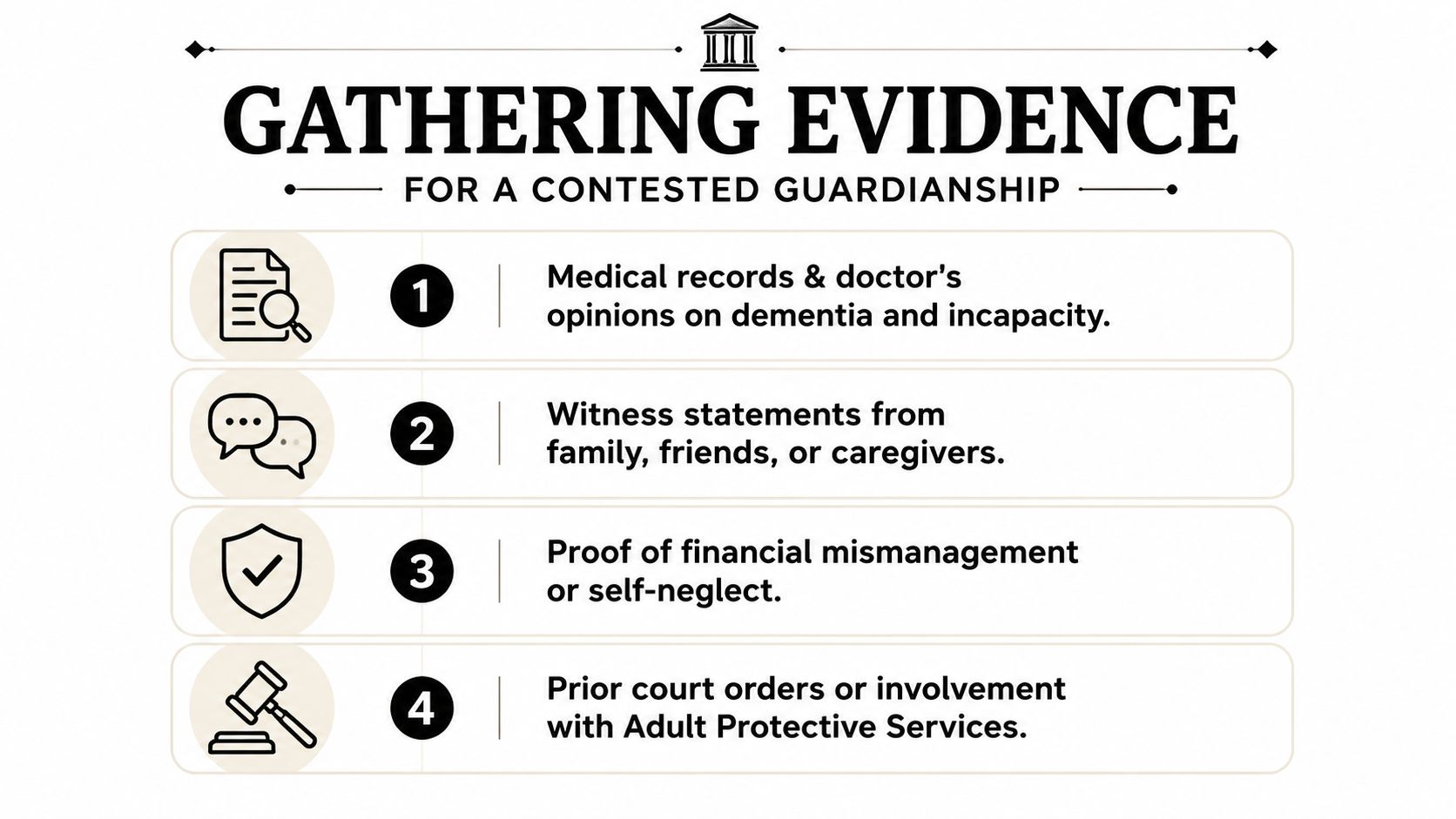
Gathering Evidence for a Contested Guardianship
A contested guardianship case depends on organized facts, not family frustration. Start a dated record of incidents that show how dementia affects your parent's ability to manage health, safety, or money. Avoid conclusions such as “Mom is irrational.” Record what happened, who observed it, and what risk followed.
Build the medical foundation
Texas generally requires a physician's written letter or certificate before most adult guardianship cases can proceed. Ask the treating physician to address functional capacity, not just the diagnosis. The useful medical evidence explains whether dementia affects the parent's ability to make safe decisions about medication, treatment, living arrangements, or financial affairs.
Bring the doctor concrete information:
- Appointment history: Missed visits, repeated cancellations, or inability to explain treatment instructions.
- Medication concerns: Duplicate doses, dangerous omissions, or inability to refill prescriptions.
- Living conditions: Spoiled food, unsafe appliances, falls, wandering, or failure to maintain basic hygiene.
- Financial problems: Unpaid essential bills, unusual transactions, susceptibility to scams, or lost account information.
Medical privacy still matters. Share information through lawful channels, don't search private materials without authority, and ask an attorney how to obtain records properly. A calm factual log is more useful than confrontational recordings or social media posts.
Gather people who have observed the decline
Neighbors, relatives, friends, home-care workers, and medical professionals may each see a different part of the problem. Ask witnesses to write down what they personally observed, when they observed it, and whether they spoke with your parent about the incident. They shouldn't repeat rumors or diagnose dementia.
The court may also consider the parent's stated wishes and the views of people involved in care. A witness who says, “She refused help,” offers limited value. A witness who explains that the parent refused help after being unable to identify the medication, understand the danger, or describe a safe plan provides more meaningful evidence.
Practical rule: Document patterns and consequences, not arguments. The court needs to understand the functional loss behind the family conflict.
Review the detailed discussion of what evidence actually matters in Texas guardianship contests before organizing exhibits. A Texas Guardianship Lawyer may provide representation in guardianship of the person and estate under the Estates Code.
The court may appoint an investigator or guardian ad litem, and their independent review makes accuracy important. Keep originals, label documents by date, and give your attorney a short timeline that links each event to a safety, health, or financial concern.
This video may help families understand the broader guardianship process:
Filing the Petition and Seeking Temporary Relief
Once the evidence shows a serious problem, the formal process begins in the Texas county with jurisdiction, often through a statutory probate court or county court handling guardianship matters. In a major metropolitan area, that may include a court such as Harris County Probate Court. Filing in the wrong court or leaving out required information can delay protection, so families should confirm local procedures with counsel.
The application identifies the proposed ward, the person asking to serve, the nature of the incapacity, and the powers requested. Be precise. If the parent can't manage money but can make many personal choices, requesting control over the estate may be more appropriate than requesting broad authority over the person. Texas law requires the court to consider less restrictive alternatives and available supports and services.
What happens after filing
The court may appoint an attorney ad litem to represent the parent's interests. A court investigator or guardian ad litem may also meet with the parent, explain rights, review the circumstances, and report findings to the court. The parent's objection doesn't stop the process, but it makes fair notice, independent investigation, and credible evidence especially important.
Prepare for the parent to receive notice and to have an opportunity to attend and contest the proceeding. Don't coach answers or pressure the parent to agree. Instead, give the court a clear account of daily risks and cooperate with the professionals appointed to evaluate the case.
When immediate danger changes the plan
Texas Estates Code Chapter 1251 governs temporary guardianships. A temporary guardianship is an emergency measure, not a shortcut around a permanent hearing. It may be available when immediate protection is needed, and it expires after 60 calendar days unless extended, according to Texas guardianship guidance and the statutory framework. See Texas Estates Code Chapter 1251.
An emergency request should identify the specific danger, why it is immediate, what harm may occur without intervention, and what limited authority is needed. “My father refuses help” is too general. “My father cannot manage medication, has no safe plan for obtaining treatment, and faces an immediate health risk” gives the court facts to evaluate.
Temporary relief can protect a person while the court considers permanent guardianship, but it comes with strict limits and reporting requirements. Families considering this route can review how to get emergency guardianship in Texas and gather the medical and incident records before approaching the court.
Litigating a Contested Guardianship Hearing
A contested hearing can feel like a trial about the parent's dignity, but the legal focus is narrower. The petitioner must prove incapacity by clear and convincing evidence, show that guardianship serves the parent's best interest, and establish that less restrictive options won't work. The parent remains a participant with rights, including the ability to appear and challenge the application.
Medical testimony should connect diagnosis to function. A physician who says only that the parent has dementia may not answer the court's central question. The stronger presentation explains why the parent cannot safely manage medication, healthcare, housing, or finances and whether supports could reduce the problem.
Lay testimony fills in daily details. A neighbor may describe repeated wandering. A caregiver may explain that the parent cannot follow a medication plan. A family member may provide bank records showing missed payments. Each witness should stay within personal knowledge and avoid exaggeration.
Comparing available solutions
Guardianship may be necessary when a parent cannot make essential decisions and refuses every workable safeguard. It may be excessive when a valid power of attorney, supported decision-making arrangement, or care plan can protect the parent with less loss of autonomy.
| Alternative | Scope | Best For |
|---|---|---|
| Durable power of attorney | Financial or other authorized matters selected by the principal | A parent who still has capacity to choose an agent |
| Medical power of attorney | Healthcare decisions covered by the document | Medical decision-making when the parent has completed valid planning |
| Supported decision-making | Assistance with understanding, considering, and communicating choices | A parent who can decide with reliable support |
| Representative payee or trust | Narrow management of specified income or assets | A defined financial problem that doesn't require broad control |
| Guardianship of the person | Court-authorized personal and healthcare authority | Serious functional loss affecting health, safety, or basic needs |
| Guardianship of the estate | Court-authorized financial management | Serious inability to manage finances or protect property |
| Full guardianship | Authority over both personal and estate matters, tailored by court order | A parent whose needs extend across both areas |
Texas Estates Code Section 1002.0015 lists alternatives including medical and durable powers of attorney, representative payees, management trusts, special needs trusts, and person-centered decision-making methods. The Texas Estates Code alternatives to guardianship should be reviewed before the hearing.
If the parent becomes agitated, request a respectful setting and allow communication support. The court must preserve as many rights as possible. A confused courtroom statement shouldn't erase the parent's dignity, just as a confident statement shouldn't replace evidence of functional incapacity.
Ongoing Duties and Annual Compliance
Appointment doesn't end the legal work. Texas has an annual judicial review cycle for guardianships created after September 1, 1993. The guardian of the person must file a sworn annual report within 60 days after the reporting period ends, and the reporting period generally covers the year beginning when the guardian qualifies or on each anniversary. These requirements appear in Texas Estates Code Chapter 1201 and the guardian reporting statute.
The report should address the ward's mental and physical condition, social and intellectual functioning, living conditions, and whether the ward has enough capacity, with supports and services, for restoration or modification of the guardianship. The court investigator or visitor must meet the ward in person, use communication supports, present the ward's bill of rights in the preferred language or manner, and record the ward's preference about restoration or modification.
Protect rights after appointment
Guardianship doesn't erase every right. Texas law preserves the ward's civil and legal rights except those specifically removed by court order. A parent may still resist the guardian, reject visitors, or object to treatment. The guardian must use only the authority granted and should seek legal advice before imposing restrictions.
Visitation and communication limits must be tied to preventing substantial harm and should not become punishment for disagreement. If family members fight, keep a written record of incidents, proposed solutions, and the reason for any restriction. A guardian who blocks contact without a safety basis can create a serious court dispute.
Avoid preventable compliance problems
Missed deadlines, outdated residence information, and a failure to discuss supports can weaken the record. Keep a calendar for the reporting period and preserve receipts, care notes, medical updates, and communications with service providers.
Texas law also requires the court to consider less restrictive alternatives and available supports before appointing a guardian. See the explanation of why Texas courts ask for alternatives first. If the parent improves, or if a narrower arrangement becomes workable, the guardian should seek modification or termination rather than maintain unnecessary control.
A temporary guardianship differs from a permanent guardianship. Emergency authority expires after the statutory period unless extended, while a permanent guardianship generally continues until death or court termination. That difference makes ongoing review essential, especially as dementia symptoms and care needs change.
Next Steps and Consulting Legal Counsel
Families facing a refusing parent often begin with a safety concern, move through medical evaluation and documentation, and then confront a difficult choice between support and court intervention. The strongest cases don't treat guardianship as a reward for the most concerned relative. They identify the parent's specific functional losses, test less restrictive alternatives, and request only the authority needed to protect health, property, or both.
Start by creating a dated incident log, reviewing existing estate planning documents, and asking a physician whether the parent's condition affects daily decision-making. Gather the parent's preferences, identify possible witnesses, and determine whether an emergency creates a need for temporary relief. These steps can reduce confusion and help an attorney assess whether guardianship, a limited guardianship, or another solution fits the facts.
The process can bring emotional strain, family division, court costs, medical expenses, and continuing reporting duties. A Texas attorney can help you understand the difference between guardianship, probate, and estate planning, while preparing filings and evidence suited to the county court handling the case.
The Law Office of Bryan Fagan, PLLC offers free consultations to help Texas families understand guardianship options, rights, and next steps. Professional guidance is especially valuable when a parent refuses examination, siblings disagree, or immediate danger requires temporary protection.
The Law Office of Bryan Fagan, PLLC helps families evaluate, establish, modify, or contest guardianships involving a parent with dementia, including guardianships of the person or estate and temporary or emergency proceedings. Visit Law Office of Bryan Fagan, PLLC to schedule a free consultation and discuss the evidence, alternatives, and court strategy for your family's situation.