The phone rings before you've left the hospital parking garage. Your father has suffered a stroke, the doctors are discussing rehabilitation, and a nurse asks who can consent to treatment. At home, bills are waiting, bank access is uncertain, and no one knows whether your father's confusion will improve tomorrow or remain for years.
That fear is understandable. But guardianship after a stroke in Texas isn't one single problem with one automatic answer. Families usually face three different legal needs: immediate medical consent, short-term access to money and benefits, and long-term planning if decision-making capacity doesn't return. Each need may call for a different tool.
Texas courts treat guardianship as a last resort, not a routine consequence of a stroke. The court must consider the person's actual abilities, available supports, and less restrictive alternatives before removing decision-making rights. The sections below explain how that works in plain language, including emergency guardianship, standard court procedures, alternatives, guardian duties, disputes, and restoration.
Three Time Horizons After a Stroke
The hospital team is discussing a feeding tube. Your father cannot sign the consent form, and his speech is difficult to understand. A nurse asks who can make the decision. Before the family assumes that a permanent court case must begin, separate the problem into three time horizons.
Each horizon concerns a different kind of authority: an immediate medical decision, short-term access to money, or long-term protection when recovery remains uncertain.
The first horizon involves immediate medical decisions
In the first hours or days, someone may need authority to consent to treatment, rehabilitation, discharge, or placement. A valid Medical Power of Attorney may provide that authority. If no effective document exists and an immediate danger calls for court involvement, a temporary guardianship under Texas Estates Code Title 3, Subtitle G, Chapter 1251 may provide limited authority for the urgent situation.
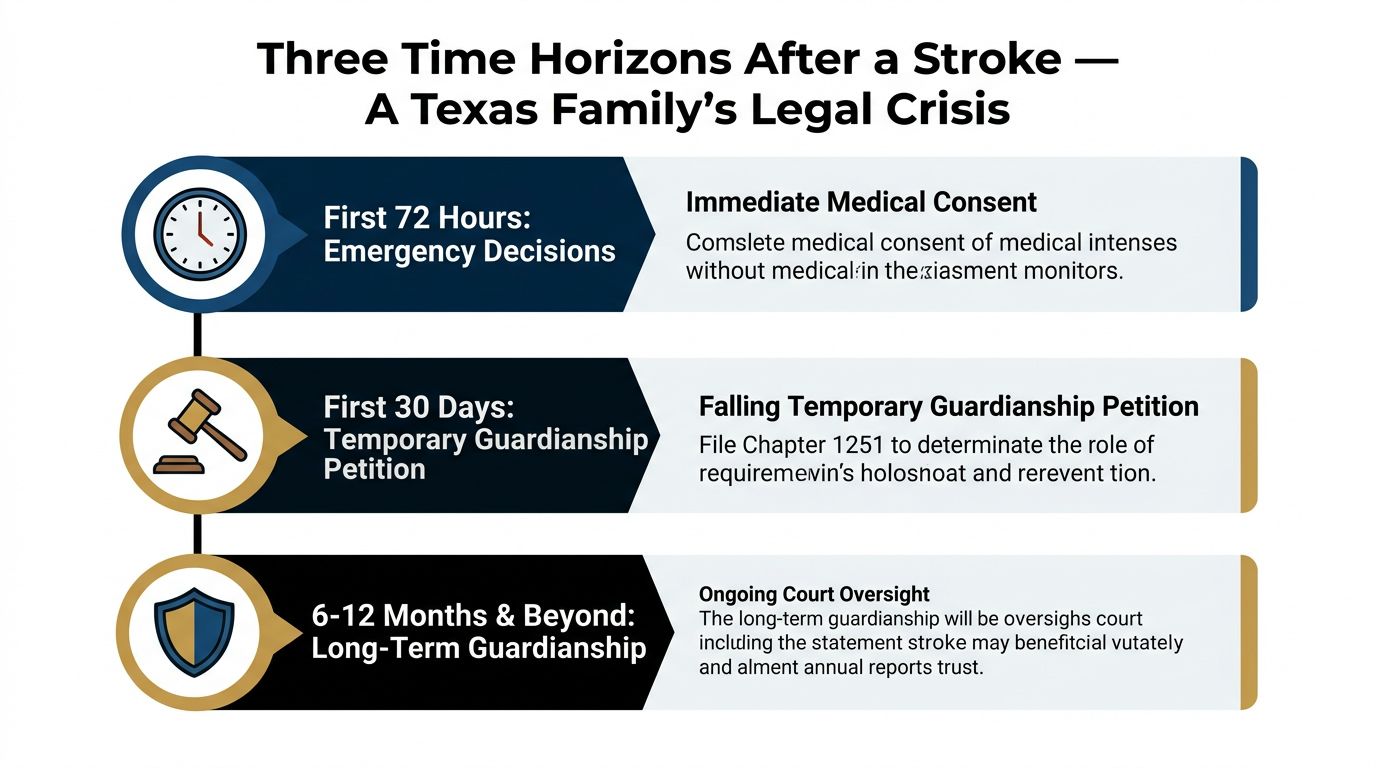
The second horizon is financial access
Over the next weeks or months, the problem may move from medical consent to daily administration. Mortgage or rent payments still come due. Online banking may be inaccessible, insurance forms may need attention, and Social Security benefits may require a representative payee. A durable power of attorney, representative payee arrangement, or trust may address some of these tasks without requiring a guardian of the estate.
The third horizon is long-term planning
Recovery may return some abilities while leaving other limits. Your father might understand personal choices but still struggle with money, medication schedules, or safety. Any guardianship should match those specific limits rather than remove more rights than necessary. If incapacity ends, Texas law provides a way to seek a complete restoration of rights and presumes that adults have capacity.
Practical rule: Match the legal tool to the decision requiring help. A rushed filing can impose broader restrictions than the circumstances call for.
The three horizons work like separate layers. An urgent medical question may need a temporary answer, while financial access and long-term planning call for their own review. That separation helps the family respond to the present crisis without treating every uncertain recovery as a permanent loss of independence.
How Texas Defines Incapacity After a Stroke
A stroke diagnosis does not, by itself, establish incapacity under Texas law. The court must see evidence that, because of a physical or mental condition, the adult is substantially unable to provide food, clothing, or shelter, care for physical health, or manage financial affairs. The court must also decide whether guardianship serves the person's best interest and whether a narrower legal tool would provide enough protection.
Texas requires clear and convincing evidence for the central findings about incapacity and the need for guardianship. Other findings, including venue, guardian eligibility, and the person's capacity status, use a lower evidentiary standard. The distinction matters in a hospital setting. A family may have genuine concerns, yet still need more specific proof before a court can restrict the adult's rights.
Build evidence around function
For someone recovering from a stroke, the useful question is not “What diagnosis appears in the chart?” It is, “What decisions can this person safely make and carry out?” A physician's certificate of medical examination is central to an adult guardianship application. The examination must occur within 120 days before filing, and the certificate should describe the nature, degree, and severity of the incapacity, whether improvement is possible, and when reevaluation should occur. The Southwestern University overview of Texas guardianship procedure explains the medical examination requirement and the need to document functional limitations rather than rely on a diagnosis alone. Texas guardianship procedure overview
The court also considers recurring acts or occurrences during the preceding six months in an adult case. One confused conversation at the hospital may result from fatigue, medication, aphasia, or an unfamiliar setting. A continuing pattern, such as missed medications, unsafe decisions, unpaid bills, or repeated difficulty understanding financial transactions, gives the court a clearer basis for evaluating capacity.
| Evidence Type | What It Shows the Court |
|---|---|
| Physician's certificate | The medical condition, severity, functional effects, possible improvement, and timing for reevaluation |
| Daily-living records | Whether the adult can manage food, clothing, shelter, personal health, and safety |
| Financial records | Whether the adult can understand, protect, and manage money and property |
| Recent examples | Whether incapacity appears through recurring acts rather than one isolated event |
| Communication evidence | Whether aphasia or another impairment limits communication, or whether the person can still express choices |
| Less restrictive options | Whether powers of attorney, supported decision-making, or another support can meet the need |
Consider Maria, a retired teacher with left-side weakness after a stroke. She remains lucid and clearly states where she wants to live, yet she cannot remember medication schedules or safely sign and monitor checks. That evidence might support limited authority over finances or personal care while preserving her ability to communicate preferences.
Aphasia isn't the same as a total loss of legal capacity. Communication difficulty can make evaluation harder, but it does not answer every capacity question. The evidence should separate speech, memory, judgment, physical safety, and financial understanding so the court can match any authority granted to the actual limitation.
Emergency and Temporary Guardianship in the First Days
A temporary guardianship is designed for a specific emergency, not as a shortcut around the regular process. Under Texas Estates Code Chapter 1251, the court may appoint a temporary guardian when there is substantial evidence of incapacity and probable cause to believe the person, estate, or both need immediate protection. The written application must be sworn and must identify the proposed ward, the imminent danger, the protection requested, the supporting facts, the proposed guardian's qualifications, and the applicant's interest. Texas Estates Code Section 1251.001 sets out those requirements.
The judge won't grant emergency authority merely because the family is worried. The filing must connect the stroke to a specific immediate risk to health, safety, or property, and it must explain why an existing legal tool won't work.
What to gather quickly
Before filing, collect:
- Medical information: The proposed ward's identifying details, hospital records, and the required physician certificate when available.
- Proof of immediate danger: Facts showing why treatment, placement, personal care, or property protection can't wait.
- Existing documents: Medical powers of attorney, durable powers of attorney, directives, trusts, benefit records, and bank information.
- Proposed guardian information: Qualifications, relationship to the proposed ward, and any required bond proposal.
- A narrow request: The exact decisions the temporary guardian needs to make, rather than blanket control.
A hospital may accept a valid Medical Power of Attorney. A Texas Emergency Response Card alone may not give a relative legal authority to consent. A bank commonly looks for a valid durable power of attorney or court-issued letters of guardianship before allowing someone else to manage an account. The institution's requirements and the court order's wording both matter.
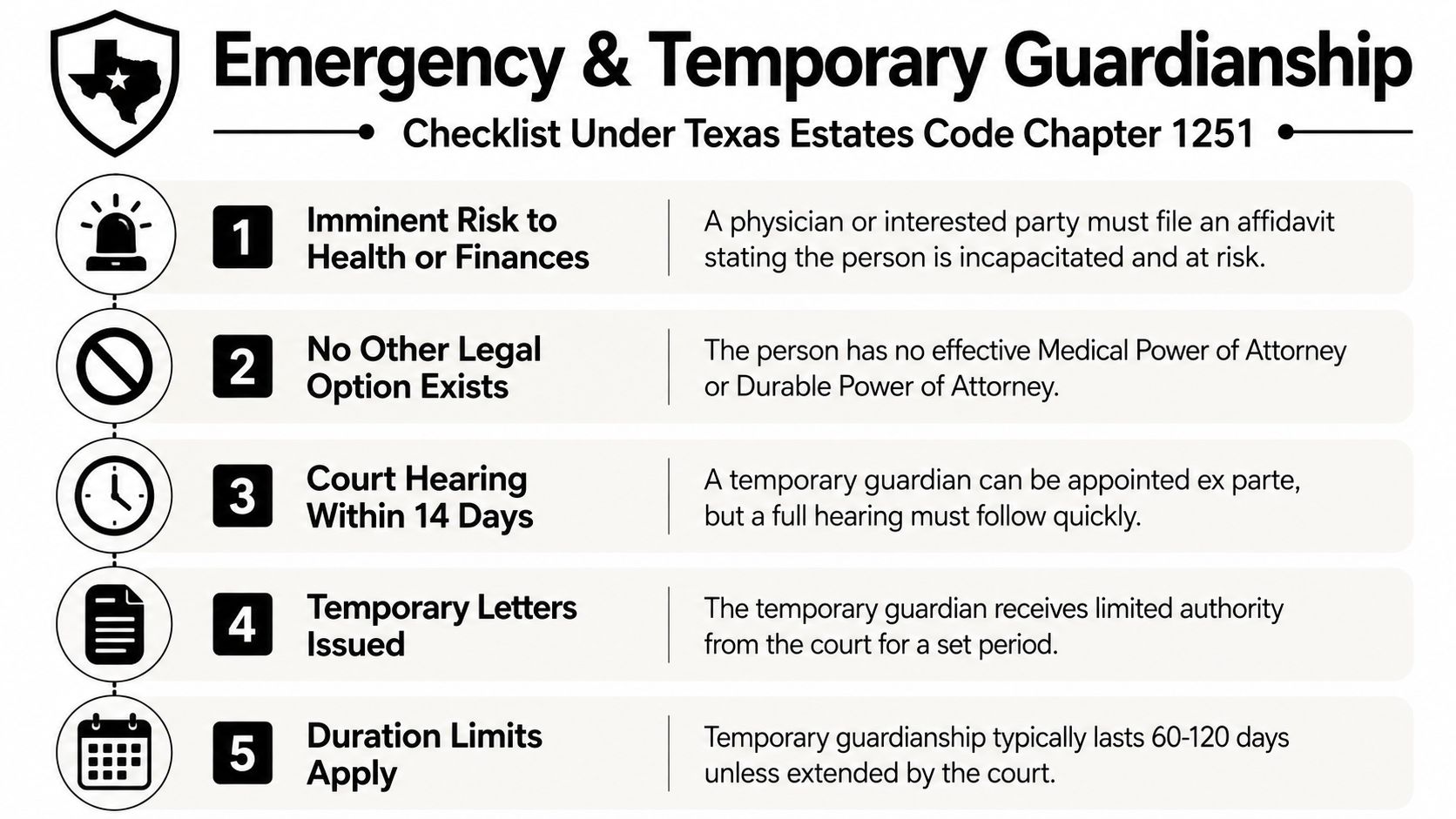
Texas guidance describes temporary guardianship as a short bridge while the regular case proceeds. A temporary order created for immediate necessity generally can't remain in effect for more than 60 days, unless extended under the statute. Section 1251.010 also requires the order to identify the reasons and the powers granted.
For a plain explanation of the broader adult process, see Guardianship of an Incapacitated Adult in Texas. Families dealing with a fast-moving crisis can also review this step-by-step guide to emergency guardianship in Texas, then obtain advice based on the actual medical and legal facts.
Filing a Standard Guardianship Petition in Texas
A standard guardianship case begins in the appropriate Texas probate court. Venue generally depends on where the proposed ward resides, with special venue rules that can apply when a non-ward spouse lives in another county. A family in Houston may work with a Harris County Probate Court, while a family in Dallas may file through the appropriate Dallas County probate court. Local filing procedures vary, so confirm them with the clerk or counsel.
The filing steps
The applicant usually works with an attorney to prepare the application under Texas Estates Code Chapter 1101. The petition should identify the proposed ward, describe the functional limitations, explain the requested authority, identify available alternatives, and name the proposed guardian. The applicant gathers the physician's certificate, relevant medical records, and information needed for any required bond before filing with the county clerk.
The court then addresses notice and representation. The proposed ward must receive service, and relatives or other interested people may require notice under Section 1101.053. The court appoints an attorney ad litem to represent the proposed ward's legal interests. A guardian ad litem may also be involved when the court needs an additional best-interest assessment. The investigator's report under Section 1101.101 gives the judge another source of information about the person, the proposed guardian, and less restrictive options.
At the hearing, the judge considers medical evidence, testimony, the investigator's report, the proposed ward's preferences, and the requested scope. The applicant must prove the statutory requirements. If the judge grants the application, the guardian qualifies by completing the required oath and bond steps, then receives letters showing the authority granted.
| Step | Day/Window | Who Acts |
|---|---|---|
| Initial evaluation | Day 0 at the hospital | Family, medical team, and attorney identify the immediate legal need |
| Medical examination | Within 120 days before filing | Physician or qualified examiner completes the certificate |
| Petition preparation | After evidence is assembled | Applicant and attorney describe incapacity, risk, alternatives, and requested powers |
| Notice and investigation | Before the hearing | Clerk, attorney ad litem, guardian ad litem if appointed, and court investigator perform assigned roles |
| Court hearing | Often 10 to 21 days after required filing steps, depending on court procedure | Probate judge hears evidence and decides whether the legal standard is met |
| Letters and qualification | After the order | Proposed guardian completes qualification requirements and receives letters |
That hypothetical sequence may place the case within a broader six- to ten-week process from filing to fully effective guardianship, but court schedules and disputes can change the timing. Families can review how to file a guardianship petition in Texas while preparing questions for counsel.
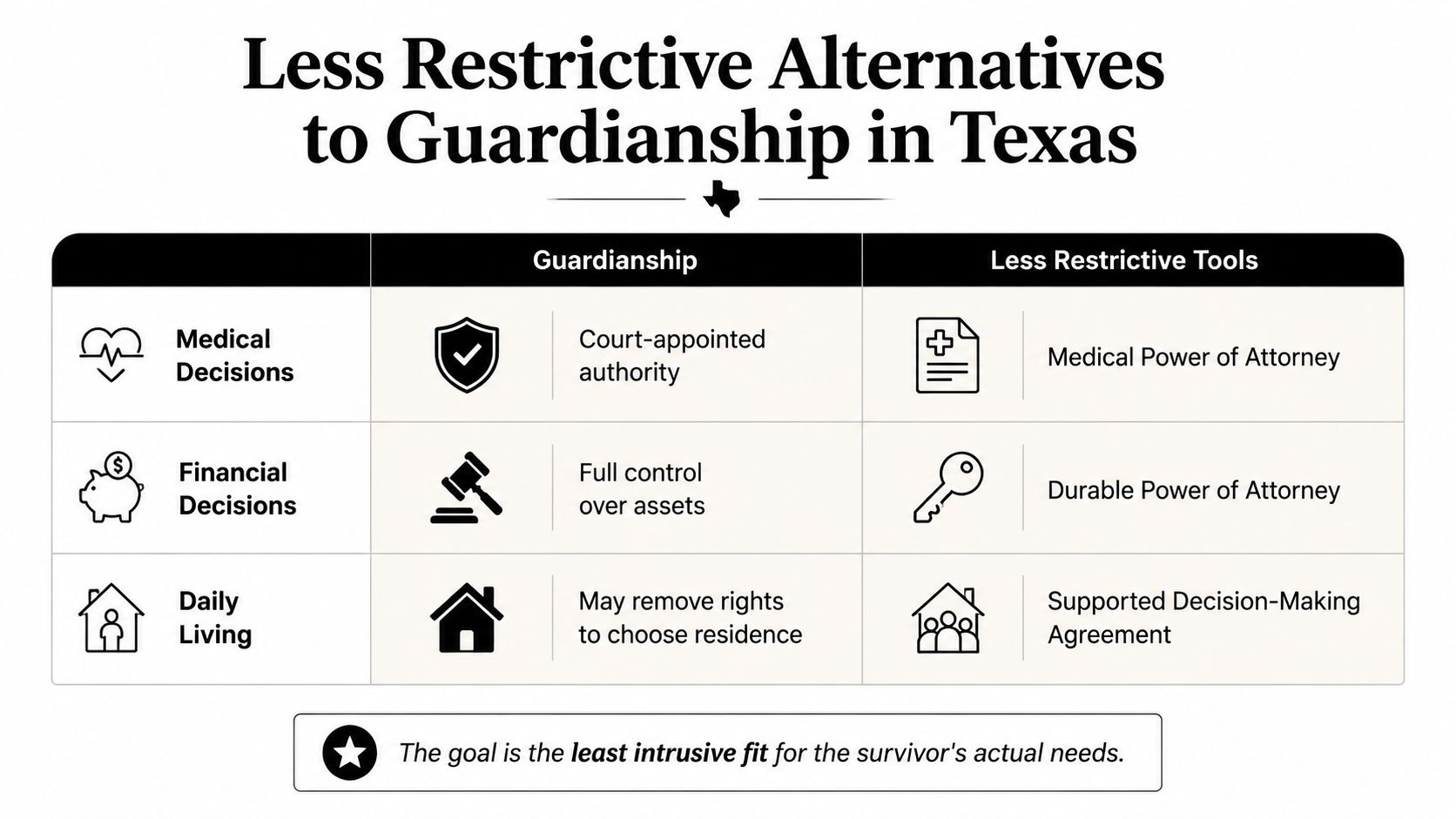
Less Restrictive Alternatives Worth Considering First
Guardianship can protect a stroke survivor, but it can also remove important rights. Texas law therefore directs families and courts to consider tools that provide support without taking more authority than necessary.
| Need | Possible Texas tool | What it can address |
|---|---|---|
| Medical consent | Medical Power of Attorney or Directive to Physicians under Chapter 166 | Treatment decisions and end-of-life instructions, depending on the document |
| Financial access | Statutory Durable Power of Attorney under Chapter 751 | Banking, bills, property, and other financial matters within the agent's authority |
| Supported choices | Supported decision-making agreement under Chapter 1357 | Help with decisions while the adult retains legal decision-making rights |
| Federal benefits | Social Security representative payee arrangement | Receipt and management of Social Security benefits |
| Ongoing funds | Management trust, family trust, special needs trust, or pooled trust | Administration of funds when direct handling is difficult or benefits must be protected |
A Medical Power of Attorney may solve the first-horizon hospital problem. A durable power of attorney may help with the second-horizon bills and accounts, although a bank may question an older document or require certifications before accepting it. A supported decision-making agreement can help an adult who understands choices but needs assistance communicating, organizing information, or evaluating consequences. It isn't a substitute decision-maker arrangement.
Texas alternatives may include a declaration for mental health treatment, representative payee arrangements, joint accounts, a designation of a future guardian, and other person-centered planning tools. A neutral discussion of supported decision-making agreements and related alternatives appears in this Texas alternatives resource.
A useful question: Can this document or support arrangement protect the person without removing rights the person can still exercise?
For a family reviewing supported decision-making, this explanation of supported decision-making agreements in Texas may help organize the discussion. Guardianship remains appropriate when the adult can't safely make necessary decisions, no effective alternative exists, and narrower powers won't address the danger.
Duties, Costs, and Annual Compliance for a Guardian
A daughter in Dallas may spend her morning arranging her father's therapy and her afternoon answering court questions about his money. Once letters of guardianship issue, family care becomes a legal fiduciary role. The guardian must separate personal concerns from the ward's interests and keep records that another person can understand.
Person and estate duties are different
A guardian of the person may make authorized decisions about care, housing, medical services, and daily needs. A guardian of the estate manages property, income, bills, and financial records. One guardian may hold both roles, but families should identify which authority the court granted.
The guardian takes the required oath and posts bond if the court requires it. Texas law also provides an oath-only affidavit of surety in a limited situation under Section 1104.058, when the will directs that no bond be required. The guardian of the estate must prepare the required inventory of property under Section 1151.052, maintain separate accounts, and record receipts and disbursements.
The guardian's file should include:
- Bank records: Statements, receipts, cancelled checks, and proof of transfers.
- Care records: Housing decisions, medical appointments, services, and significant changes.
- Court deadlines: Annual reports, accountings, notices, and orders requiring action.
- Capacity updates: Medical information showing whether recovery changes the person's needs.
The statute's annual-report rules require a guardian of the person to file a sworn report each year. The report generally covers the 12-month period beginning when the guardian qualifies and is due no later than the 60th day after that period ends. Texas Estates Code Chapter 1163 also addresses estate accountings, which are filed with the county clerk and remain on file for 10 days before the judge considers approval.
Compliance is part of protection
The Texas Guardianship Compliance report found that 27% of cases were missing annual accounts during the cited reporting cycle. The compliance report makes clear why calendar control matters. Missing reports, mixing funds, and undocumented spending can expose the guardian to court action, even when the guardian acted from good intentions.
Families should plan for filing fees, attorney fees, bond premiums, and accounting help. Costs vary by county and case complexity, so a lawyer should explain the likely categories before filing rather than promise a fixed total. The guardian's duty also includes supporting independence when possible under Section 1201.152, not maintaining unnecessary control because the court once granted it.
Modifying, Contesting, or Ending the Guardianship
A guardianship after a stroke isn't necessarily permanent. Recovery may allow the court to narrow the guardian's powers, replace a broad arrangement with a limited one, change the guardian, transfer venue, or end the case entirely. A person may regain the ability to manage finances while still needing help with certain personal-care decisions.
Updated evidence should focus on function. Useful material may include current medical opinions, rehabilitation records, functional assessments, treatment history, and testimony from people who observe the survivor making daily choices. Someone with aphasia may communicate through writing, assistive technology, gestures, or a trusted communication partner. The court should evaluate the person's actual understanding rather than confuse speech difficulty with incapacity.
Contesting an existing order
The proposed ward or another interested person may challenge incapacity, venue, notice, required findings, or the proposed guardian's suitability. The court may also address neglect, exploitation, conflicts of interest, misuse of funds, and missing reports. Depending on the dispute, the judge may appoint an attorney ad litem, request an independent evaluation, order additional records, or set an evidentiary hearing.
Start with a focused file:
- Gather current medical and functional information.
- Obtain the guardianship order, letters, inventory, reports, and accountings.
- Record specific concerns about care, money, conflicts, or missed duties.
- File the correct verified application or motion in the same probate court.
- Serve required parties and follow local court rules.
A sudden danger may justify temporary relief, but emergency authority doesn't replace notice and hearing requirements for a longer-term change. Mediation can help relatives resolve practical disagreements, although the court retains authority over the ward's legal status.
Recovery deserves a legal response. If the person's abilities change, the guardianship file should change with them.
Texas restoration proceedings can require immediate settlement of the guardianship, delivery of remaining estate assets, and revocation of the letters when the case closes. Moving the person or taking back control of an account doesn't restore legal capacity. A court order does.
When your family is weighing guardianship, probate administration, or updated planning documents, the Law Office of Bryan Fagan, PLLC offers guidance on emergency and standard guardianships, medical and financial authority, disputes, restoration, and compliance. Schedule a free consultation to review the stroke survivor's current abilities, urgent risks, available alternatives, and the narrowest safe path forward.