You've been married for years, and now you're handling the medications, paying the bills, answering the same questions, and worrying about what might happen when you aren't in the room. Your spouse may still have good days, but a missed prescription, an unsafe medical decision, or a suspicious transfer from a joint account can turn caregiving into a legal crisis.
In Texas, a diagnosis of Alzheimer's disease doesn't automatically give one spouse authority over the other. Guardianship over a spouse with Alzheimer's in Texas may be necessary, but it may also be more control than your family needs. The right answer depends on your spouse's actual abilities, existing estate-planning documents, community-property rights, and the level of immediate risk.
When Guardianship Becomes Necessary for a Spouse With Alzheimer's
Mary notices that her husband, David, is forgetting his medication. Then he begins refusing treatment because he doesn't understand why he needs it. A few weeks later, he signs paperwork for an unfamiliar salesperson and can't explain what he agreed to. Mary has always managed their household, but she discovers that being David's wife doesn't automatically let her make every medical or financial decision.
That situation is painful, but it's common in families facing cognitive decline. Guardianship may become appropriate when a spouse can't reliably manage health care, personal safety, shelter, nutrition, or financial affairs, and existing legal tools don't provide enough authority. Wandering, repeated medication errors, unsafe driving, refusal of necessary care, and vulnerability to exploitation can all signal that informal caregiving is no longer enough.
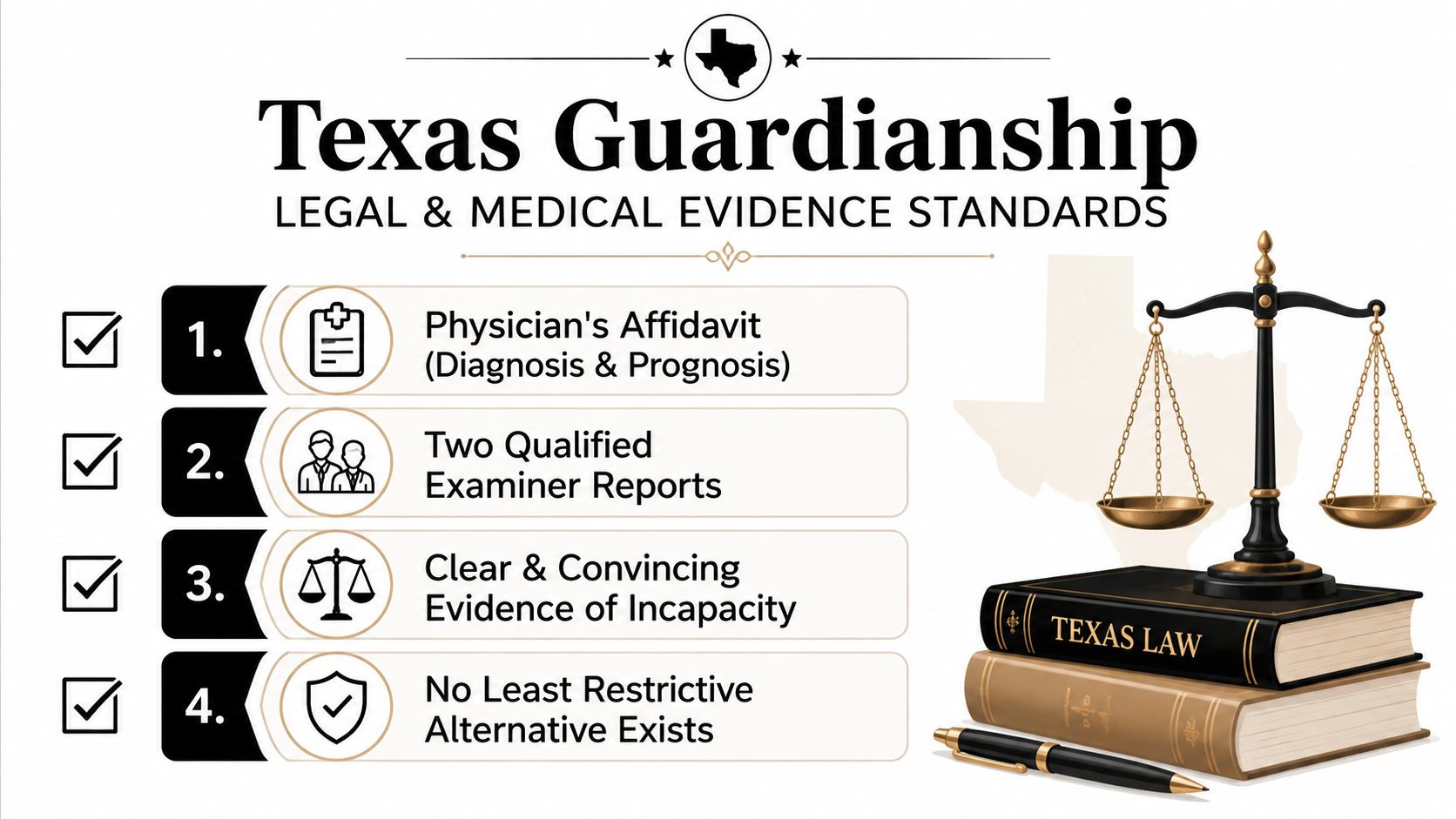
A diagnosis alone, however, isn't the legal test. The Texas State Law Library describes an incapacitated adult as someone who is substantially unable, because of a physical or mental condition, to provide food, clothing, or shelter, care for physical health, or manage financial affairs. Texas law also requires the applicant to prove incapacity, the ward's best interest, protection of the ward's rights or property, and the lack of feasible alternatives by clear and convincing evidence. Those standards appear in Texas Estates Code Section 1101.101.

Early decline may call for planning, not court intervention
If your spouse still understands the nature and effect of legal documents, a durable power of attorney, medical power of attorney, advance directive, or supported decision-making agreement may solve the immediate problem. These tools can preserve more independence and avoid court supervision. They must be created while your spouse has the legal capacity to understand what the document does.
Once Alzheimer's has progressed to the point that your spouse can't understand the authority being granted, signing new documents may not be a safe or valid solution. That's when a court-supervised guardianship becomes more likely.
Texas gives a spouse meaningful priority. If several eligible people are equally entitled to serve, the incapacitated person's spouse has preference under Texas Estates Code Section 1104.102. A husband and wife may also be appointed as co-guardians when the court finds that arrangement serves the ward's best interest.
That priority helps, but it doesn't guarantee appointment. The court still protects the proposed ward's rights and asks whether a narrower solution will work.
Legal Standards and Medical Evidence Required by Texas Courts
Texas courts don't appoint a guardian because a spouse, doctor, or adult child believes guardianship would be helpful. The applicant must present clear and convincing evidence, a demanding standard that requires more than general concern or a diagnosis. The evidence should show what the proposed ward cannot do, how those limitations affect daily life, and why less restrictive options won't adequately protect the person.
The physician certificate is a filing milestone
In most adult guardianship cases, Texas requires a physician's or advanced practice registered nurse's written letter or certificate. The examination and certificate generally must fall within 120 days before the filing date, as provided by Texas Estates Code Section 1101.103. Treat that window as a deadline, not a suggestion.
The report should describe the nature, degree, and severity of the incapacity. A statement that says only “Alzheimer's disease” may not explain whether your spouse can manage medication, understand medical risks, provide for shelter, or handle money. Ask the examining professional to connect the condition to specific functional problems and decision-making limits.
Build evidence around function, not labels
Before the appointment, prepare a factual timeline. Record missed medications, unsafe purchases, rejected care, wandering, medical misunderstandings, and conversations with banks or care providers. Include dates only when you can verify them, and preserve relevant statements, notices, and account records.
A strong preparation checklist includes:
- Medical detail: Give the physician a written summary of observed changes.
- Daily living examples: Explain problems with food, clothing, hygiene, shelter, or medication.
- Financial concerns: Identify unexplained transactions, unpaid obligations, or susceptibility to scams.
- Alternative review: Gather existing powers of attorney, directives, trusts, and supported decision-making agreements.
- Timely filing: Confirm that the certificate remains within the statutory period when the application is filed.
An outdated certificate can lead to a continuance or denial. So can a vague report that fails to explain functional deficits. Families wanting a procedural overview can review How to Get Guardianship in Texas: The Process, which presents the step-by-step court process for establishing a guardianship. For physician-specific preparation, see the Texas physician certificate guide.
Preparing and Filing the Guardianship Petition in Texas
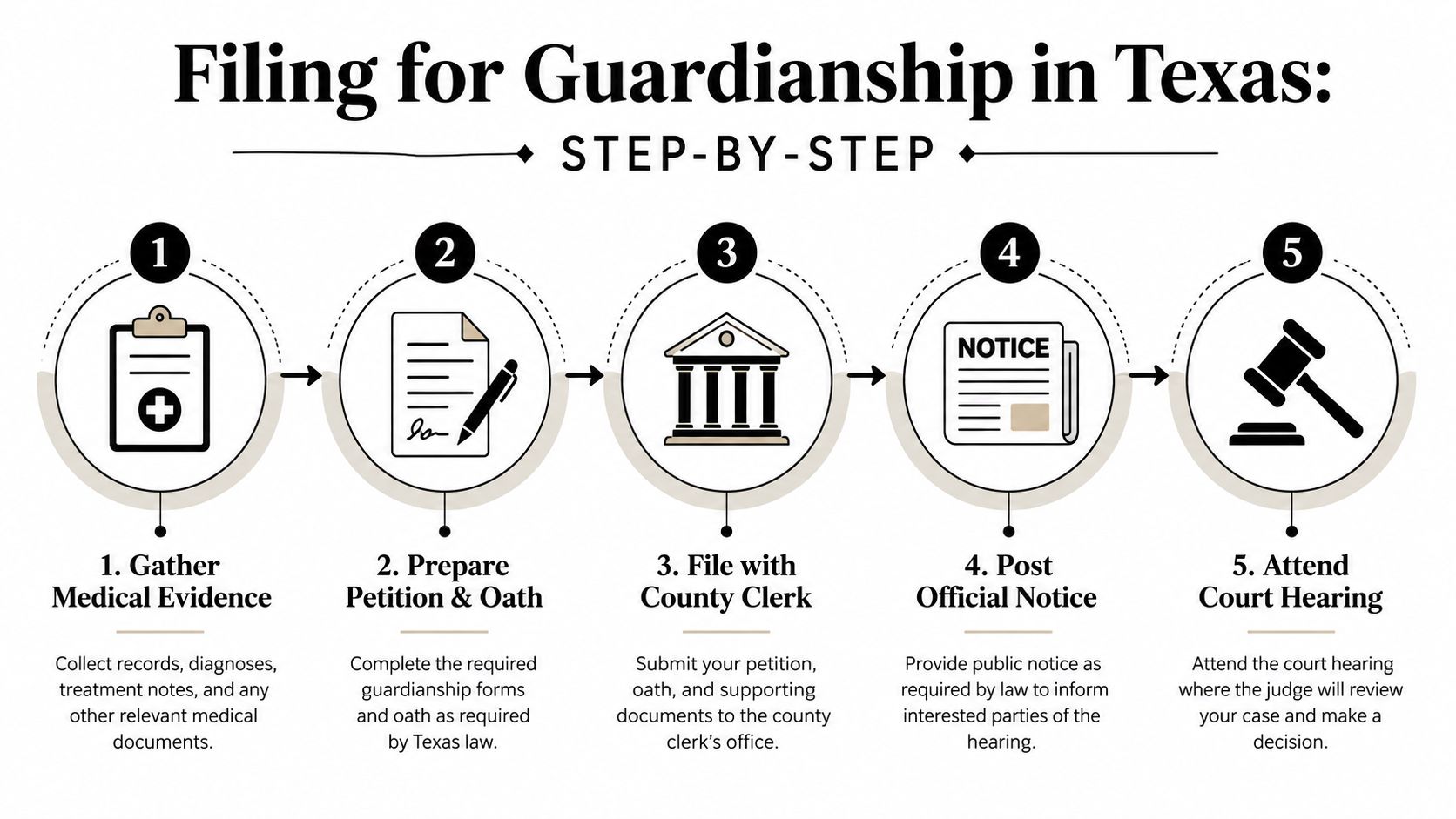
File in the Texas county where the proposed ward resides, using the court or probate jurisdiction assigned to guardianship matters in that county. In Houston, families may deal with the Harris County Probate Court. Other counties, including Travis County, may route the matter through a probate court, statutory probate court, or county court depending on local jurisdiction.
The petition identifies your spouse, explains the alleged incapacity, describes the requested guardianship, names the proposed guardian, and addresses alternatives. The filing should match the authority you need. If the problem concerns medical and personal decisions, ask whether guardianship of the person is enough. If finances require court authority, guardianship of the estate may also be considered.
Filing creates a process, not instant authority
After filing, the court handles notice and service requirements. Required relatives and interested persons may need formal notice, and your spouse receives protections designed to ensure that the proceeding is fair. The court may appoint an attorney ad litem to represent the proposed ward's interests. That attorney isn't your opponent. Their job is to investigate, communicate with your spouse, and protect your spouse's rights.
A court investigator may also examine the proposed ward's condition, living situation, and available alternatives. Prepare to answer practical questions:
- What decisions can your spouse still make safely?
- What specific events show that help is necessary?
- Which documents already exist?
- What authority are you asking the judge to grant?
- Can a limited guardianship address the problem?
Do not rely on broad statements such as “my spouse is confused.” Bring concrete examples and organized records. If relatives object, expect the court to examine both the proposed guardian and the competing concerns. A dispute may involve the proposed guardian's suitability, the extent of incapacity, the need for an estate guardian, or whether another family arrangement would better protect your spouse.
Fees, hearing dates, and local procedures vary by county and case complexity. Harris County Probate Court and Travis County courts may have different filing practices and calendars, so confirm local requirements rather than relying on a form downloaded from another county.
For a procedural starting point, review the Texas guardianship application resource.
A hearing may include testimony from the applicant, medical evidence, the investigator, and the attorney ad litem. The judge decides whether guardianship is in your spouse's best interest, whether the proposed guardian is appropriate, and whether the requested powers are properly limited.
Emergency and Temporary Guardianship Options
Some families can't wait for the ordinary guardianship process. Your spouse may be wandering, facing immediate medical danger, losing access to necessary care, or being targeted by someone seeking money. Texas addresses those situations through Title 3, Subtitle G of the Estates Code, which covers special guardianships, including temporary guardianships. The statutory structure is available through the Texas Estates Code Title 3 provisions.
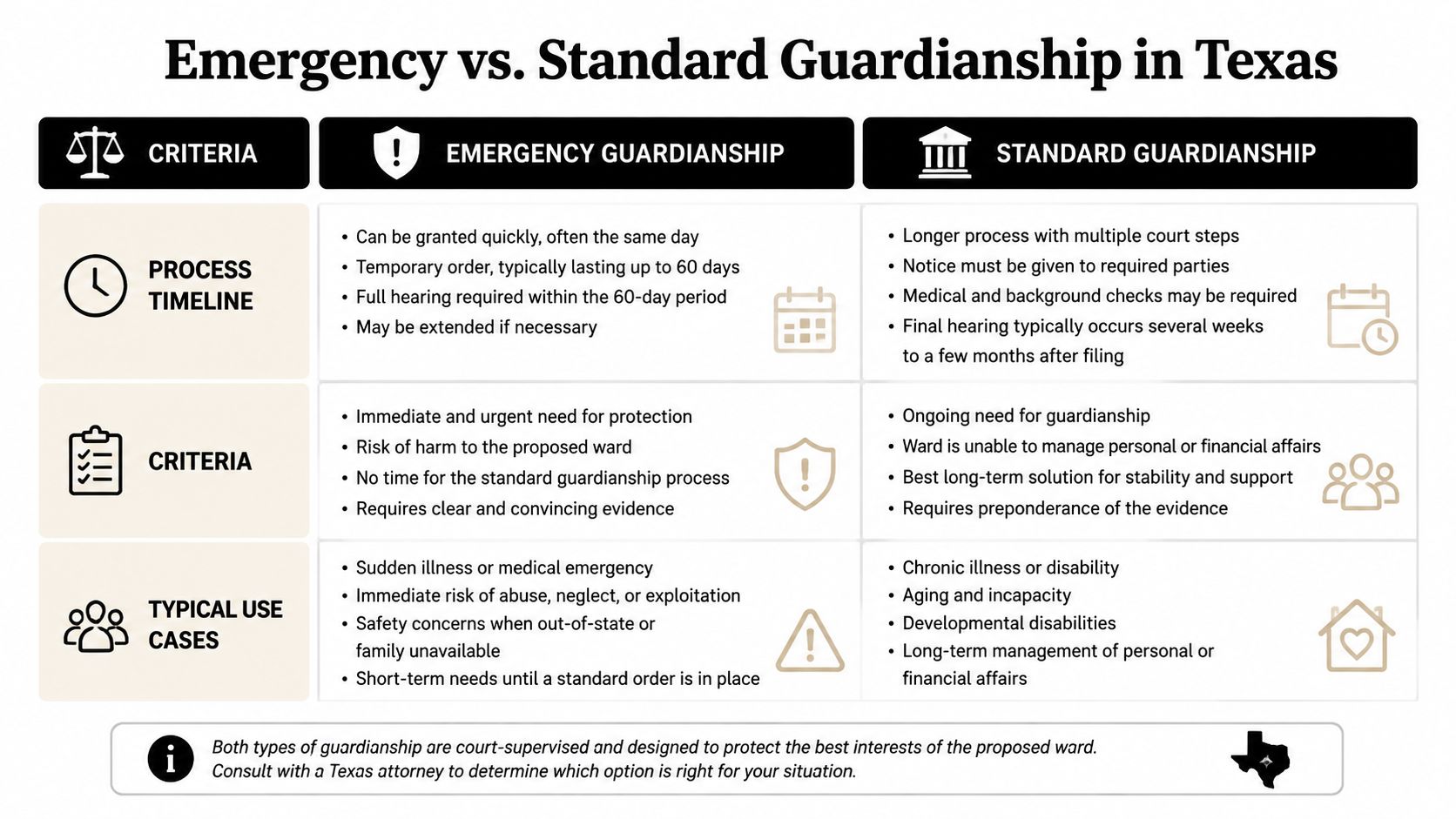
A temporary guardianship isn't a shortcut to permanent control. Under Texas Estates Code Section 1251.001, the court must find substantial evidence that the proposed ward may be incapacitated and probable cause that the person, estate, or both need immediate protection. The order grants only the powers specifically stated, and your spouse keeps rights that the order doesn't remove.
Choose the emergency tool for the actual danger
Temporary guardianship may fit when a specific, urgent threat requires court authority. It may not fit a disagreement about ordinary caregiving, a long-running family conflict, or a concern that can be addressed through medical providers, a care facility, or Adult Protective Services.
| Question | Temporary guardianship | Standard guardianship |
|---|---|---|
| Purpose | Immediate protection for the person, estate, or both | Ongoing authority after a full court review |
| Evidence | Substantial evidence and probable cause of immediate need | Clear and convincing evidence of incapacity and statutory requirements |
| Authority | Limited to powers listed in the order | Tailored person, estate, or limited powers |
| Duration | No more than 60 days unless extended under the statute, as described in Texas temporary guardianship guidance | Continues under court supervision until modified or terminated |
Use the temporary proceeding to stabilize the crisis, not to avoid preparing the permanent case. You may still need updated medical evidence, notice, investigation, and a full hearing for ongoing guardianship. Ask counsel to identify exactly what authority is needed, because an overly broad request can create resistance from the court or family members.
Guardian Duties and Ongoing Court Compliance
Appointment is the beginning of supervision, not the end of the legal work. A guardian acts as a fiduciary, meaning the guardian must put the ward's interests first, follow the court's order, protect property, and keep reliable records. Caregiving decisions that feel obvious at home can still require careful documentation when they involve money, property, or authority beyond the order.
A guardian of the person must file a sworn annual report covering a 12-month period, due no later than the 60th day after the reporting period ends. A guardian of the estate must also file an annual account until the estate closes. These duties are described in Texas Estates Code Section 1163.
Treat compliance like a household system
Texas compliance data illustrates why families need a system. During Fiscal Year 2025, guardianship compliance specialists reviewed 7,590 cases statewide and found 1,569 cases, about 34%, out of compliance with reporting requirements such as inventories, annual reports, or annual accounts. The figures appear in the Texas guardianship compliance annual report.
Practical rule: Put every court deadline on a calendar immediately after appointment, then keep a second reminder well before the due date.
Maintain a segregated record of estate assets and expenditures. Save receipts, bank statements, court orders, medical-care records, and communications that explain significant decisions. Before selling, transferring, or spending property, compare the proposed action with the order and determine whether court approval is required.
A spouse's caregiving role doesn't replace court supervision. Missed reports can create compliance problems even when the guardian is acting lovingly and responsibly. If circumstances change, seek a modification rather than acting outside the order.
Alternatives to Guardianship and Community Property Rights
Guardianship removes or limits important legal rights, so Texas families should first ask whether a less restrictive tool will solve the actual problem. Texas guidance encourages families to explore alternatives and advance directives, and the law permits limited guardianships to address genuine limitations. The question isn't whether your spouse has Alzheimer's. It's which decisions your spouse can no longer manage and which legal tool covers those decisions.
A durable power of attorney may address financial matters. A medical directive or medical power of attorney may address health-care decisions. Supported decision-making can help an adult make and communicate choices while retaining more control. A limited guardianship may address only personal or estate powers that cannot be handled another way.
| Legal tool | When it works | Limitations | Court involvement |
|---|---|---|---|
| Durable power of attorney | Your spouse has capacity to grant financial authority | May not cover every institution or decision, and signing capacity matters | Usually no appointment hearing |
| Medical power of attorney or directive | Your spouse can validly express health-care preferences and appoint an agent | It may not solve financial, housing, or property problems | Usually no guardianship appointment |
| Supported decision-making agreement | Your spouse can make choices with structured assistance | The supporter doesn't automatically gain unlimited control | Created outside a guardianship hearing |
| Limited guardianship | Only defined powers require court authority | Court supervision and reporting still apply | Court order required |
| Community-property administration | A judicial declaration of incapacity affects management of the community estate | It doesn't automatically answer every personal-care or separate-property issue | Legal analysis and documentation remain important |
The community-estate question deserves careful attention
Texas law gives the spouse of a judicially declared incapacitated spouse broad authority as community administrator over the entire community estate, including property the incapacitated spouse would otherwise manage. That can change the analysis when the goal is paying household bills, managing community assets, or handling retirement income. Read the statutory language in Texas Estates Code Chapter 1353.
This authority isn't a universal substitute for guardianship. It may not provide the personal authority needed to consent to care, select living arrangements, or resolve issues involving separate property. Still, families should analyze community property before filing for a full estate guardianship.
For a focused comparison of financial authority, see Power of Attorney vs. Guardianship in Texas. A useful decision framework is simple: identify the blocked decision, check existing documents, analyze community-property rights, consider a limited order, and file for broader guardianship only if those measures don't protect your spouse.
Taking the Next Step to Protect Your Spouse
Start with a calm inventory of the problem. Write down the decisions your spouse can no longer handle, the immediate risks, the documents already signed, and the assets or care arrangements involved. Don't begin by assuming that full guardianship is the answer, and don't wait for a crisis if your spouse still has capacity to complete sound estate-planning documents.
If guardianship appears necessary, arrange the medical examination before filing and protect the 120-day certificate window. Prepare specific evidence about function, not only the Alzheimer's diagnosis. Then determine whether you need guardianship of the person, the estate, or a limited combination of powers.
At the hearing, expect your spouse's rights to matter. A spouse has statutory priority when eligible candidates are equally entitled, but the judge still must find incapacity, best interest, protection of rights or property, and no feasible alternative. After appointment, calendar annual reports and accounts immediately, preserve records, and follow the order closely.
Termination or modification remains possible when your spouse's capacity or circumstances change. The court can tailor authority rather than treating guardianship as permanent, automatic control.
You're not betraying your spouse by asking for legal guidance. You're trying to protect the person you promised to stand beside.
Schedule a free consultation with Law Office of Bryan Fagan, PLLC to discuss guardianship, probate, estate planning, community-property authority, or alternatives based on your spouse's needs and your Texas county. The firm helps families prepare medical evidence, file guardianship applications, address disputes, appear at hearings, and manage ongoing compliance with Texas court requirements.