Skip to content
You may be here because something changed slowly, then all at once.
Maybe your father has always paid every bill on time, but now late notices are piling up on the kitchen table. Maybe your sister keeps missing medical appointments and insists everything is fine. Maybe an adult child with disabilities is turning eighteen, and you're trying to understand what legal steps, if any, your family should take next.
When that happens, most families start with the same question: “Do we need guardianship?” Close behind it comes another one: “Is that the same as conservatorship?”
In Texas, that second question matters more than many people realize. The words sound similar, but they don't mean the same thing here. And before you ask a court to take over major decisions for someone you love, it helps to slow down, understand the Texas rules, and look at less restrictive options first.
This guide to guardianship vs. conservatorship in Texas is written for families who are worried, tired, and trying to make a careful choice. The law can feel intimidating, but the basic decision often starts with a few practical questions. Is the problem medical, financial, or both? Is your loved one still able to sign legal planning documents? Is there an urgent risk that can't wait?
When You Realize a Loved One Needs Help
The first signs are often easy to explain away.
A mother forgets one doctor visit. An uncle sends money to someone who called him out of the blue. A son recovering from a serious injury can't keep track of medications or rent payments. Families usually don't jump straight to court. They try reminders, calendars, shared bank alerts, ride help, and conversations.
Then the pattern becomes harder to ignore. The same bill gets paid twice. Important mail goes unopened. A loved one leaves the stove on, agrees to unsafe living arrangements, or can't explain where their money went. At that point, concern turns into responsibility. Someone in the family has to decide what to do next.
That decision is emotional because it touches dignity, trust, and independence. People often worry about overreacting. They also worry about waiting too long.
The questions families ask first
Most Texas families aren't looking for a lawsuit. They want a safe, lawful way to help. Their questions usually sound like this:
- Is this a legal incapacity issue or a family support issue? A person may need help without needing a court order.
- Does the problem involve healthcare, money, or both? The answer affects what kind of legal authority might be appropriate.
- Can we handle this privately? In some situations, advance planning documents may solve the problem without a guardianship case.
- Is there immediate danger? If a loved one faces urgent harm, temporary court action may need to be discussed quickly.
Families often feel guilty for even considering guardianship. That feeling is common. The better question is whether the current situation protects the person or leaves them exposed.
In Texas, the right path depends on the person's actual limits, not just the family's stress level. Some people can still make financial choices but can't safely manage medical or residential decisions. Others can live independently day to day but are vulnerable to scams and unpaid bills.
That distinction becomes very important once you start looking at Texas law.
Understanding the Key Difference in Texas Law
Many people begin by searching online for “adult conservatorship.” In Texas, that search can send you in the wrong direction.
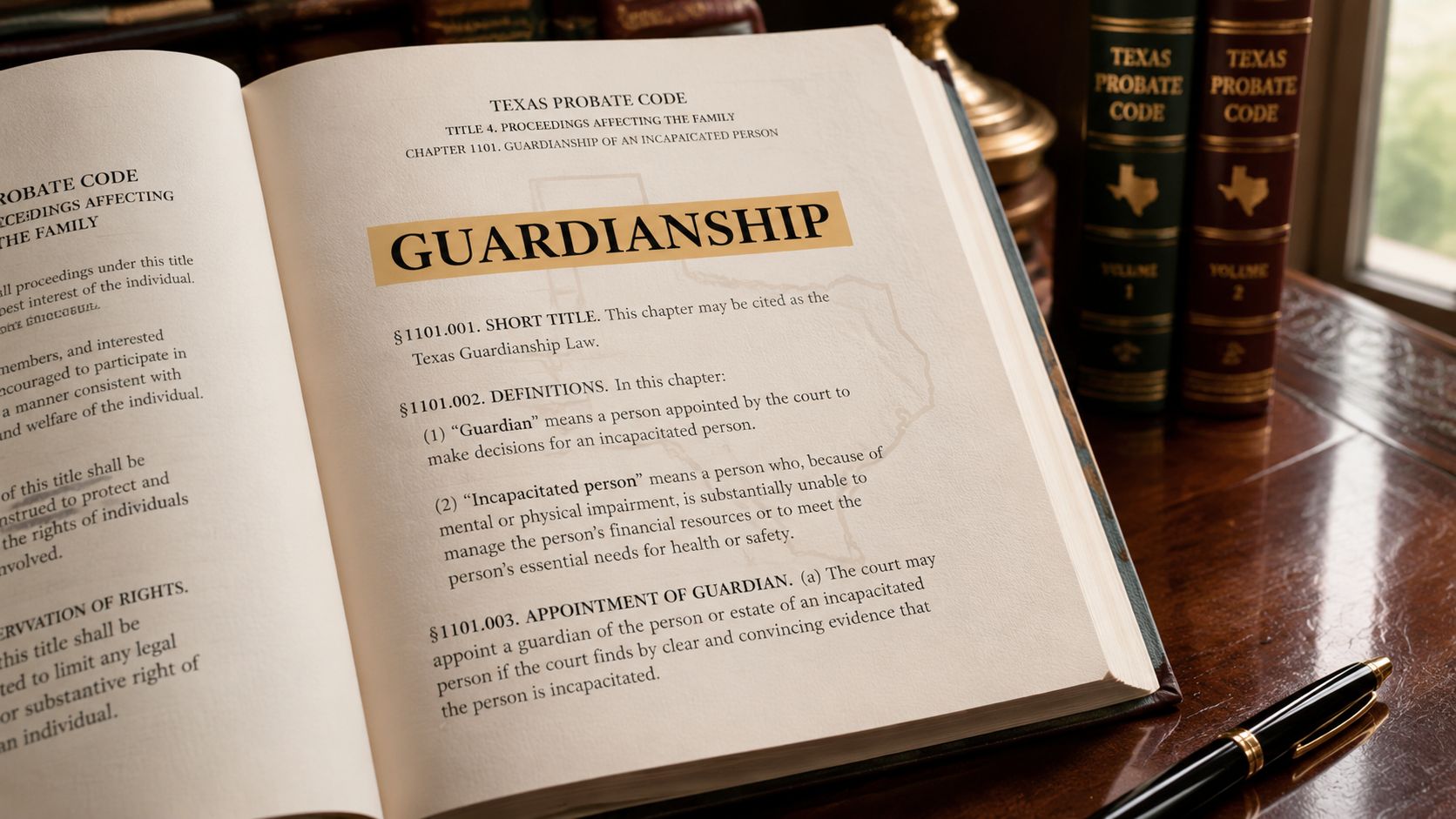
Conservatorship usually means child-related authority in Texas
Texas uses guardianship and conservatorship as different legal tools with different scopes. Guardianship is governed by the Texas Estates Code and is used for an incapacitated adult or child, while conservatorship in Texas is generally the Family Code term for parental rights and duties over a child, as explained in this overview of the difference between guardianship and conservatorship in Texas and supported by this Texas family law discussion.
If you're trying to protect an adult who can no longer manage personal or financial affairs, the correct Texas legal framework is usually guardianship, not conservatorship.
That matters because the court, venue, and evidentiary standard can differ depending on whether the case involves adult incapacity or child custody. A conservatorship case for a child is not a substitute for an adult guardianship case.
Why the wording causes so much confusion
In other states, “conservatorship” may refer to control over an adult's finances. Texans often hear that term in news coverage and assume the same label applies here. It usually doesn't.
For an adult in Texas, the legal question is often whether the person needs a guardian under Title 3, Subtitle G of the Texas Estates Code, which addresses guardianship matters. Courts treat that request seriously because guardianship can remove important rights.
That means a probate court, such as a probate court in Harris County or a statutory probate court serving another Texas county, will focus on whether legal incapacity has been shown and whether a court order is necessary.
The practical takeaway
Before filing anything, make sure you're solving the right legal problem.
- If the issue involves a child custody or parental rights dispute, conservatorship may be the correct term.
- If the issue involves an adult who may be incapacitated, guardianship is usually the correct path to evaluate.
- If you're not sure whether a court order is needed at all, start by identifying what decisions the person can still make safely.
This isn't just word choice. It shapes which court hears the case, what proof is required, and what options may be available.
Guardian of the Person vs Guardian of the Estate
Once families learn that guardianship is the right Texas term for many adult incapacity cases, the next confusion usually appears right away. People assume guardianship is one single role. In fact, Texas separates the job into two different categories.
Texas does not use the same terminology as many states. What other jurisdictions often call a financial conservatorship is handled in Texas through guardianship of the estate, while guardianship of the person covers medical, residential, and personal decisions. The court can appoint one individual for both roles or divide those duties between two people, as described in this Texas guardianship explanation.
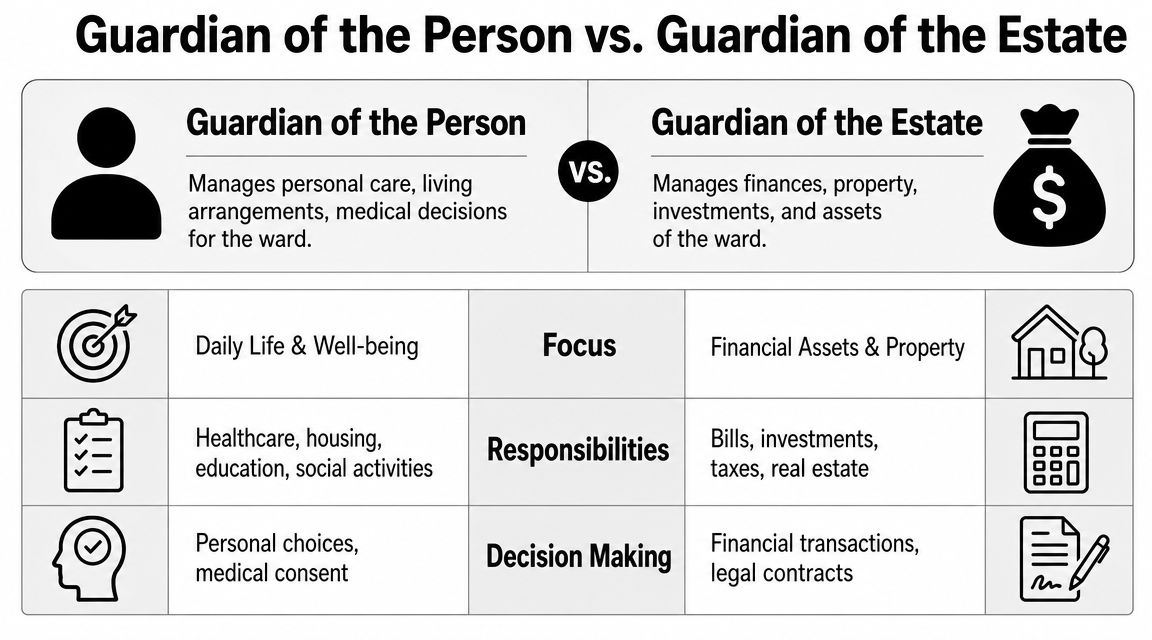
A side by side view
| Feature | Guardian of the Person | Guardian of the Estate |
|---|---|---|
| Main focus | Personal care and daily well-being | Money, property, and financial affairs |
| Typical decisions | Medical care, residence, support, basic personal needs | Paying bills, protecting assets, handling property and income |
| Common use case | A loved one can't safely make healthcare or living decisions | A loved one is vulnerable to financial mismanagement or exploitation |
| Court oversight | Ongoing court supervision | Ongoing court supervision, often with detailed financial recordkeeping |
| Can the same person serve? | Yes | Yes, or the court can split the roles |
Guardian of the person
A guardian of the person handles choices tied to day-to-day life and safety. That can include where the person lives, what medical care they receive, and who coordinates support services.
Think of an older adult with dementia who forgets medications, wanders from home, and can't understand discharge instructions after a hospital stay. If that person has finances already managed through a trust or other arrangement, the family may only need authority over personal and medical matters.
Guardian of the estate
A guardian of the estate handles the person's property and finances. This role may become necessary when someone can still function in many daily ways but can't safely manage money.
A common example is a person who lives alone, cooks, bathes, and socializes, yet repeatedly sends money to scammers, ignores taxes, or signs contracts they don't understand. In that situation, the issue may be financial vulnerability rather than inability to make all personal decisions.
Practical rule: Texas courts can tailor authority to the actual problem. A person doesn't automatically need every right removed just because they need help in one area.
One role, two roles, or a limited order
Families often assume one person must do everything. That's not always true.
Sometimes one sibling is the best choice to manage medical care because they live nearby and attend appointments. Another sibling may be better with bookkeeping, taxes, and property issues. In the right case, the court can separate those roles.
Texas practice also emphasizes proving the need for each kind of authority separately. A person may need help with personal needs but not finances, or vice versa. That's one reason courts look closely at whether a limited guardianship or narrower order could work instead of a broad appointment under the Estates Code.
How this affects real family decisions
Before talking with a lawyer or filing in probate court, write down what is going wrong.
- Medical and safety concerns might point toward a guardian of the person.
- Bill-paying, fraud, or asset issues might point toward a guardian of the estate.
- A mix of both may require both roles.
- Strong existing planning documents may reduce or eliminate the need for court intervention.
That clarity helps families present a more focused case and avoid asking for more authority than the law requires.
Navigating the Texas Guardianship Court Process
Most families feel overwhelmed because court sounds like one giant event. In reality, guardianship is a series of required steps. Texas Estates Code Title 3, Subtitle G governs much of this process, and local courts such as Harris County Probate Court or probate courts in Dallas, Bexar, and Travis County may have their own filing practices and scheduling rules as well.

What usually happens first
A guardianship case generally begins with an application filed in the proper court. Families often work from a checklist like the one in this guide on filing a guardianship petition in Texas. The filing tells the court who the proposed ward is, what kind of guardianship is requested, and why it is needed.
The court will also require notice to the proposed ward and to certain interested people. That part matters because guardianship affects rights. Texas courts want everyone involved to know that a request has been made.
Capacity evidence matters
A family's concern, by itself, usually isn't enough. The court will want evidence about the person's ability to manage personal needs or financial affairs.
In many cases, that includes a physician's certificate of medical examination or other capacity-related evidence allowed by the court. The judge isn't deciding whether someone is forgetful or vulnerable. Instead, the judge is determining whether the legal standard for incapacity has been met and what level of intervention is appropriate.
Texas law also treats guardianship as a more rights-restricting remedy, so courts require strong proof of incapacity before appointing a guardian. That's part of why careful documentation matters.
A short explanation of the process can help before a hearing:
The people the court may appoint
The proposed ward isn't left without representation. Courts commonly appoint an attorney ad litem to represent that person's interests in the guardianship case. Depending on the county and the facts, the court may also involve investigators, visitors, or others who help assess the need for guardianship.
That can feel uncomfortable for families, but it serves an important purpose. Guardianship isn't supposed to be granted just because relatives agree it would be convenient.
The court's job is to protect the proposed ward, not to make life easier for the family. Those goals often overlap, but they aren't the same thing.
What to expect at the hearing
At the hearing, the judge reviews the application, medical or other capacity evidence, and testimony from the people involved. If the court finds that guardianship is necessary and properly limited, it can sign an order appointing a guardian and defining the guardian's powers.
After appointment, the guardian may need to qualify by taking an oath, posting bond if required, and obtaining Letters of Guardianship that show third parties the guardian has authority to act.
Temporary and contested cases
Some situations can't wait for a standard timeline. If a loved one faces immediate danger, financial exploitation, or urgent medical instability, the family may need to ask about temporary or emergency guardianship options. Those cases move quickly and require focused proof.
Disputes can also complicate the process. Siblings may disagree over whether incapacity exists, who should serve, or whether the requested powers are too broad. In a contested case, preparation becomes even more important because the court may hear competing evidence and arguments before making a decision.
A Guardians Duties and Ongoing Court Requirements
Many families think the hard part ends when the judge signs the order. In practice, appointment is the start of a supervised legal role.
A guardian is a fiduciary. That means the guardian must act in the ward's best interests, follow the court's order, and keep careful records. Under the Texas Estates Code, especially within Title 3, Subtitle G, the court expects ongoing compliance, not casual oversight.
Guardianship comes with deadlines
Texas guardianship law includes post-appointment deadlines that are more structured than many families expect. A guardian of the estate must file an initial inventory, appraisement, and list of claims within 30 days of appointment, and guardians generally must submit annual reports to the court on the ward's condition and the guardian's actions, according to this discussion of Texas guardianship reporting requirements.
That requirement tells you something important about the system. Guardianship isn't just permission to help. It is court-supervised accountability.
What ongoing compliance looks like
The exact duties depend on whether the appointment covers the person, the estate, or both, but families should expect responsibilities such as:
- Recordkeeping: Keep receipts, bank records, care notes, and documentation that supports decisions.
- Court reporting: File reports or accountings on time and in the format the court requires.
- Limited authority: Follow the order carefully. A guardian can act only within the powers the court granted.
- Protection of assets: If real property or estate issues are involved, practical probate resources such as Cyber Homes' guide to probate can help families understand the property side of court-supervised administration.
Why courts monitor guardians closely
A guardianship order can affect where someone lives, who handles their money, and what medical decisions get made. Due to the profound implications for an individual's life, probate courts in places like Harris County or Fort Bend County often expect guardians to treat the role like a serious legal job, not an informal family arrangement.
If reports are late, records are incomplete, or a guardian acts outside the order, the court can raise concerns, require corrections, or take further action. Families should go into the process with open eyes. This can be the right solution, but it isn't lightweight.
Exploring Alternatives to Full Guardianship
For many families, this is the most important part of the conversation.
Texas law doesn't treat guardianship as the first thing to try. A key benchmark in Texas guardianship cases is the least-restrictive-alternative requirement. Courts do not treat guardianship as a first-line solution, but as a remedy after the applicant shows less restrictive options are insufficient, as outlined in this Texas discussion of less restrictive alternatives.

Options that may avoid a full court case
A loved one may need support without losing broad legal rights. Depending on capacity and timing, families often consider tools like these:
- Durable power of attorney: Useful when a person can still voluntarily authorize someone to handle financial matters.
- Medical power of attorney: Allows a trusted person to help with healthcare decisions if the legal standard for use is met.
- Supported decision-making agreement: Lets an adult choose trusted supporters to help understand options and communicate decisions.
- Trust planning: Can place asset management in a structured arrangement outside a full guardianship case.
- Declaration of guardian in advance: Allows a person to express preferences before a crisis deepens.
- Limited guardianship: In some cases, the court may grant narrower authority instead of full control.
The real question families should ask
Don't ask only, “Can we get guardianship?” Ask, “What is the narrowest option that still keeps our loved one safe?”
That shift matters because a person may be able to participate meaningfully in decisions even if they need help organizing information, attending appointments, or screening financial risks. Preserving that autonomy is not just kinder. It aligns with how Texas courts approach these cases.
A good legal plan doesn't take over more of a person's life than necessary.
Families who are evaluating property planning, trusts, and long-term protection of assets may also find broader estate-planning context helpful. For example, this article on how to secure your financial legacy gives a practical overview of planning concerns that can overlap with incapacity preparation.
When alternatives may not be enough
Sometimes the window for private planning has passed. If the person can no longer understand or sign documents, refuses needed help, or faces active exploitation, a power of attorney or support agreement may not solve the immediate problem.
That is often the point when families revisit whether a court order is necessary. A practical starting point is reviewing alternatives to guardianship in Texas and comparing them to the risks your loved one faces right now.
The Law Office of Bryan Fagan, PLLC handles guardianship applications, temporary guardianships, and related planning issues for Texas families who need help evaluating those options under the Estates Code.
Making the Right Choice for Your Family
The right answer depends less on labels and more on the person's real-world needs.
If your loved one can still understand and sign planning documents, less restrictive tools may protect them without a full court case. If the danger is mainly financial, the issue may be narrower than the family first thought. If the concern involves health, living arrangements, or basic safety, personal decision-making authority may be the more urgent focus. And if there is immediate risk, temporary court intervention may need to be considered quickly.
A few questions can help you sort the next step:
- Is the main problem personal care, finances, or both?
- Can your loved one still participate in planning?
- Is there already a valid power of attorney, trust, or similar document?
- Is someone objecting to the need for guardianship or to the proposed guardian?
- Would a limited order protect your loved one without removing more rights than necessary?
Families in Houston, Dallas, Austin, San Antonio, and communities across Texas often feel pressure to act fast. Sometimes that pressure is justified. Sometimes it leads people toward a broader remedy than the law requires.
The most useful next step is often a careful legal review of the facts, the available alternatives, and the evidence a probate court will expect under Texas Estates Code Title 3, Subtitle G. That kind of review can help you protect your loved one while preserving as much independence as possible.
If you're weighing guardianship, temporary emergency relief, a dispute between family members, or alternatives that might avoid court, a conversation can bring clarity. Schedule a free consultation with Law Office of Bryan Fagan, PLLC to talk through your loved one's situation, understand your options under Texas law, and get guidance specific to your family.