Skip to content
A sudden change usually doesn't arrive with a label. It starts with small things. Your mother forgets which bills she paid. Your father becomes easy to pressure on the phone. Your adult child with a disability is doing well, but you worry about who will manage money safely in the future.
Families in Texas often reach the same hard question. Do we need guardianship, or is there a less restrictive way to protect our loved one? That question carries legal, emotional, and financial weight. You want safety. You also want dignity, privacy, and as much independence as possible.
In many situations, a trust can handle the financial side of incapacity without a court stepping in. In others, a trust helps, but it won't solve the whole problem. The key is knowing where a trust fits, where guardianship still matters, and how Texas law approaches both.
The Difficult Crossroads Protecting a Vulnerable Loved One
The hardest part for many families isn't paperwork. It's the feeling that every option costs something. If you do nothing, your loved one may be exposed to missed bills, scams, or conflict between relatives. If you file for guardianship, you may be asking a court to remove rights from someone you care about.
That emotional tension is real. It shows up in families caring for a parent with memory loss, a sibling with serious mental illness, or an adult child with lifelong disabilities. Families aren't primarily seeking control. They're looking for a safe plan that doesn't take away more freedom than necessary.

A practical way to start is to separate care needs from legal needs. A loved one may need help with meals, transportation, medication reminders, or short-term supervision long before they need court intervention. Families who are stretched thin often benefit from support services such as a comprehensive guide to respite care, especially when caregiving stress is making legal decisions harder to sort through calmly.
Two very different paths
A trust and a guardianship are not the same tool.
- A trust is private planning. It lets someone set rules in advance for how property will be managed.
- A guardianship is a court case. A judge decides whether a person is incapacitated and whether someone else should be appointed to act for them.
- A trust usually addresses money and property. It does not automatically cover every personal or medical decision.
- A guardianship can reach further. Depending on the order, it can affect finances, living arrangements, and personal rights.
Families usually feel more confident once they stop asking, “Which tool is better?” and start asking, “What problem are we trying to solve?”
If the main concern is paying bills, managing accounts, and protecting assets, a trust may be the cleaner answer. If the problem includes unsafe living conditions, refusal of needed care, or conflict over medical decisions, the analysis changes.
Understanding Court-Ordered Guardianship in Texas
In Texas, guardianship is governed by the Texas Estates Code, Title 3, Subtitle G. This is the part of the law that deals with court-supervised protection for a person who cannot manage personal affairs, property, or both. Cases are often handled in probate courts, including courts such as Harris County Probate Court in the Houston area and similar county courts in Dallas, Travis, Bexar, and other Texas counties.
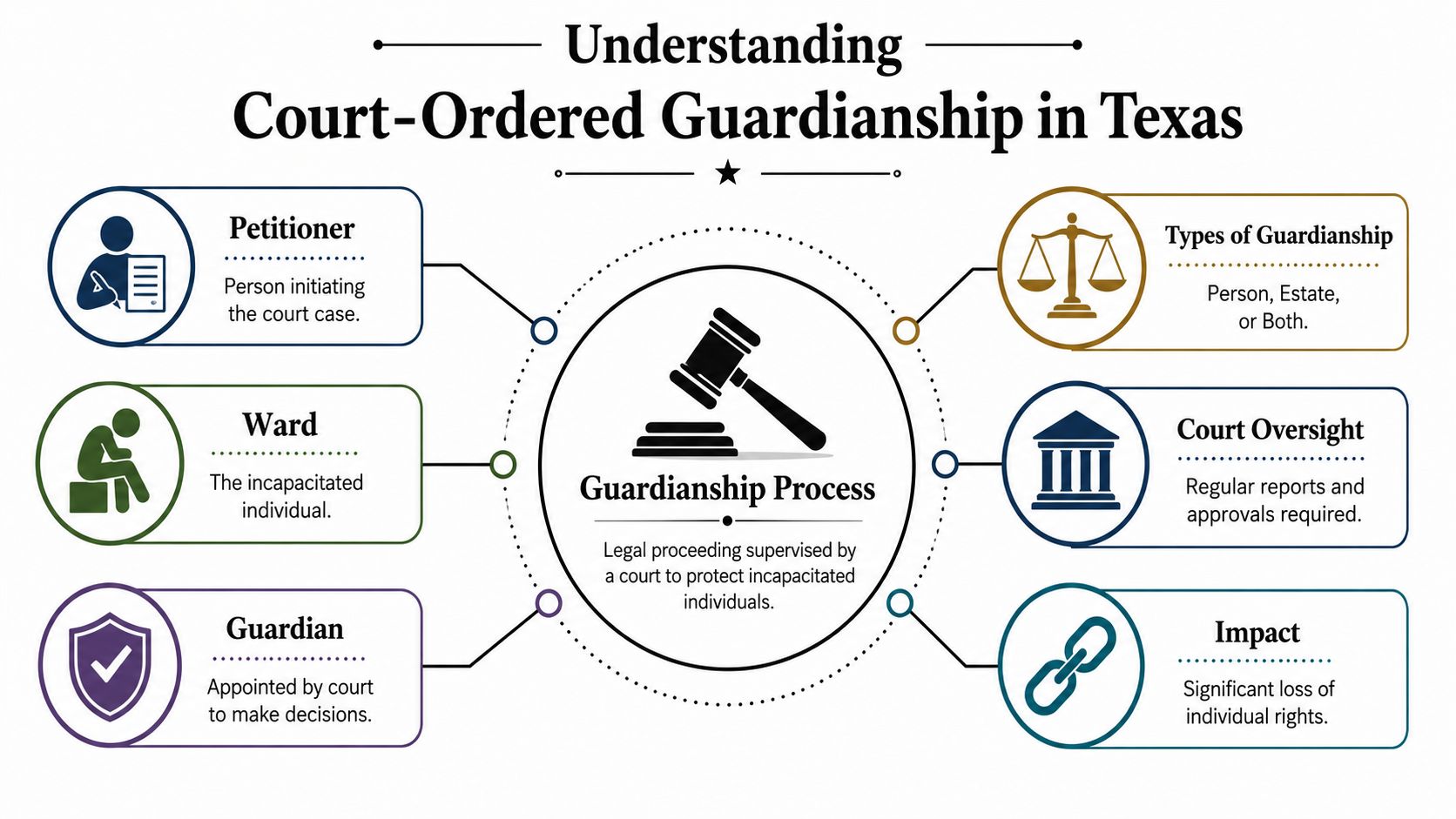
A few terms matter right away. The person who may need protection is often called the ward after a guardianship is established. The person asking the court to appoint a guardian is the applicant or petitioner. The judge decides whether the legal standard for incapacity has been met and, if so, what powers the guardian should have.
The two main types families encounter
Texas guardianship cases usually involve one or both of these categories:
| Type | What it covers |
|---|---|
| Guardianship of the person | Personal decisions, such as care, residence, and some day-to-day welfare issues |
| Guardianship of the estate | Money, accounts, property, and other financial matters |
That distinction matters because many families don't need both. If the concern is strictly financial, a full guardianship can be more intrusive than necessary.
Why Texas calls guardianship a last resort
Texas law doesn't treat guardianship as the default answer. It treats it as a last resort. The Texas Judiciary's guardianship reform materials explain that courts must use and review less restrictive alternatives when those alternatives can meet the person's needs. The same materials state that a person under guardianship can ask the court to restore rights by letter, and courts must determine annually whether the guardianship should continue, according to the Texas Judiciary's 2019 guardianship reform guidance.
That approach lines up with the structure of Title 3, Subtitle G. The court isn't supposed to remove rights casually. It must consider whether a narrower solution would work.
Practical rule: If a less restrictive option can protect the person, the court should take that option seriously.
What families often underestimate
Guardianship can protect a vulnerable person, but it also brings ongoing court involvement.
- The process is public in important ways. Court filings and hearings create a formal record.
- The guardian takes on legal duties. Those duties can include reporting, seeking approvals, and following court orders.
- The ward may lose decision-making authority. The extent depends on the order, but the loss of rights is a major issue, not a side detail.
That's why families often explore trusts, powers of attorney, supported decision-making, and related planning before filing. If the primary need is management of property, a court may not be the only path.
How Trusts Provide a Powerful Alternative
A trust works very differently from a guardianship. Instead of asking a judge to appoint someone after a crisis, the person creating the trust sets the rules in advance while they still have capacity. That planning can make an enormous difference when health changes later.

A trust creates a legal relationship. One person, called the trustee, manages property for the benefit of someone else, called the beneficiary. In many family plans, the same person starts out wearing multiple hats. A parent may create the trust, serve as the initial trustee, and benefit from the trust property during life. The document then names who takes over later if needed.
The trust most often used for incapacity planning
The tool families usually mean in this context is a revocable living trust. “Revocable” means the person who creates it can usually change or cancel it while they have capacity. “Living” means it is created during life, not at death.
This type of trust can be useful because it allows continuity. If the creator later becomes unable to manage finances, the named successor trustee can step in under the terms of the document and continue handling trust assets.
For families comparing options, alternatives to guardianship in Texas often include trusts alongside powers of attorney and supported decision-making.
Other trusts that matter in real life
Not every family situation points to the same trust.
- Special needs trusts are often used when a beneficiary has a disability and the family wants to protect assets without disrupting important benefit planning.
- Testamentary trusts are created through a will and become effective after death. They can be valuable, but they don't usually solve the same immediate incapacity problem a living trust is designed to address.
- Customized family trusts may include detailed instructions about distributions, trustee succession, and how property should be managed for a spouse, child, or dependent adult.
A short overview can also help if you're hearing these concepts for the first time.
Why families often prefer this route
The biggest advantage is control before a crisis. A trust lets a person choose the trustee, choose the backup trustee, define powers, and set limits. It also keeps the decision-making structure inside a private legal document rather than inside a contested courtroom.
A trust is often at its best when the family wants a smooth handoff of financial authority without the emotional cost of asking a court to declare a loved one incapacitated.
That doesn't make a trust automatic or universal. It means the trust is often a better fit when the main concern is asset management, not broad personal decision-making.
Comparing Trusts and Guardianships Side-by-Side
A family often reaches this point after a hard moment. A parent is missing bills, a brother is making unsafe choices with money, or an adult child with disabilities needs long-term structure. The question is rarely, "Which tool sounds better?" The core question is more practical. What problem needs solving, how fast, and with how much court involvement?
That is the lens that helps Texas families make a sound decision.
Trust vs. Guardianship in Texas a Head-to-Head Comparison
| Factor | Trust | Guardianship |
|---|---|---|
| How it starts | Created through private planning while the person still has legal capacity | Begins with a court application after a problem has already surfaced |
| Who chooses the decision-maker | The person creating the trust names the trustee and backup trustee | A judge appoints the guardian |
| Primary use | Managing property and financial assets placed into the trust | Managing the person, the estate, or both |
| Privacy | Usually handled through private documents and private administration | Requires court filings, hearings, and ongoing oversight |
| Speed | Can take effect under the trust's own terms if it was signed and funded ahead of time | Depends on medical evidence, notice requirements, and court scheduling |
| Ongoing supervision | Trustee must follow fiduciary duties, but does not report to the court in the same way a guardian does | Guardian may need court approval, accountings, and continuing compliance |
| Best fit | A family that wants advance financial planning and a private handoff of authority | A situation that calls for court-backed authority over personal care, finances, or both |
The simplest way to understand the difference is this. A trust is a plan you build before the storm. Guardianship is a remedy the court can impose after the storm has already started.
Timing changes the family's experience
In Texas, timing often decides more than legal theory does.
A guardianship case usually requires medical evidence, formal filings, notice to interested parties, and a hearing before the court can hand someone authority. Even when the need is urgent, families still have to fit their emergency into a court process. That can feel painfully slow when bills are due, a bank account is frozen in practice, or no one has clear authority to sign documents.
A trust can reduce that pressure if it was signed while the person had capacity and if the assets were transferred into it. That last part matters. An unfunded trust is a little like a safe with the door open and nothing inside. It may look protective on paper, but it cannot manage assets that were never placed under its control.
Emotional cost matters too
Families do not experience these choices as legal charts. They experience them in living rooms, hospital rooms, and tense phone calls between siblings.
Guardianship can be the right answer, especially if a loved one is at risk, refuses help, or needs someone to make personal and medical decisions under court authority. But the process can also feel exposing. The person at the center of the case may hear that others are asking a judge to declare them incapacitated. Even when the family acts out of love, that step can carry grief, embarrassment, or conflict.
A trust often feels different because the choice was made earlier by the person who signed it. That can lower suspicion and reduce family arguments. The trustee is not stepping in because a judge picked them after a dispute. They are stepping in because the loved one already said, "If I cannot handle this later, this is who I want to help."
That difference is legal. It is also deeply human.
Money and control rarely move in the same direction
Families usually want three things at once. Lower cost, more privacy, and stronger authority. In real life, those goals do not always line up.
Trust planning often costs more on the front end because the document has to be drafted carefully and the assets have to be transferred correctly. Guardianship often carries more continuing expense and effort because the court stays involved. So the financial trade-off is less about which option is "cheap" and more about when the family will spend time, money, and energy.
Control works the same way. A guardian may have broader authority, especially in situations involving personal care and safety. A trustee usually has narrower authority, but the trustee can act within a private framework that the creator chose in advance. For a family trying to protect an adult child with disabilities, a properly designed special needs trust in Texas may provide structure for assets without requiring the same type of court control over daily life.
A practical way to choose
Ask these questions in order:
- Is the main problem financial management, personal care, or both?
- Does the loved one still have capacity to sign a trust or other planning documents?
- Are the important assets already in a trust, or can they still be transferred?
- Does the family need court authority over medical, residential, or safety decisions?
- Is the family cooperative, or is conflict likely?
Those answers usually point the direction.
If the concern is mostly money management and planning can happen before incapacity, a trust is often the cleaner path. If the concern includes health, safety, living arrangements, exploitation, or family conflict, guardianship may be the tool that gives the family enough legal authority to act.
When a Trust Is the Right Choice Practical Scenarios
The law makes more sense when you put it into family situations. These examples are hypothetical, but they reflect the kinds of decisions Texas families face every day.
A married couple planning for dementia
Maria and David live in Fort Bend County. They're both healthy enough to handle their affairs, but David's mother had dementia, and he wants a plan before any diagnosis changes life overnight.
They create a revocable living trust and transfer their main financial assets into it. David serves as trustee while he is well. Maria is named as successor trustee. Years later, David's memory declines and he can't manage statements, insurance notices, or routine account decisions. Because the trust was created ahead of time and funded properly, Maria steps in under the trust terms and continues managing those assets.
This is one of the clearest examples of when a trust can replace guardianship in Texas. The issue is financial management, not a broad need for court control over David's person.
Parents planning for an adult child with disabilities
The Garcias have an adult daughter, Elena, who needs long-term support. They want to leave assets for her care, but they're concerned that a direct inheritance could create problems for her benefits planning.
A trust can help organize that support in a structured way. Families in this position often focus on how a carefully designed special needs trust in Texas can hold and manage property for the child's benefit instead of transferring assets outright.
In this situation, the trust doesn't necessarily answer every guardianship question. It does, however, address a major financial concern before it becomes a crisis.
A widowed father who can still decide, but can't manage details well
Samuel lives in Dallas County. He understands who his children are, where he lives, and what he wants. But he's making repeated banking mistakes, forgetting premiums, and falling behind on paperwork after a stroke.
His daughters disagree. One wants immediate guardianship. The other believes their father still has enough capacity to choose his own helper and sign planning documents.
This is often the decision point where legal advice matters most. If Samuel still has capacity to create a trust and related documents, a trust may preserve more autonomy. If he no longer has that level of capacity, the family may be forced into guardianship or another court-involved solution.
A situation where trust planning is not enough
Angela's brother is wandering from home, refusing medication, and allowing unsafe people into his apartment. He has money problems, but the bigger issue is personal safety.
A trust might help manage property. It won't automatically authorize someone to control living arrangements or broader welfare decisions. In a case like this, a guardianship of the person, or a combined guardianship, may still be necessary.
The right question is not whether a trust avoids court. The right question is whether the trust solves the actual risk facing your loved one.
Limitations and How to Implement Your Plan
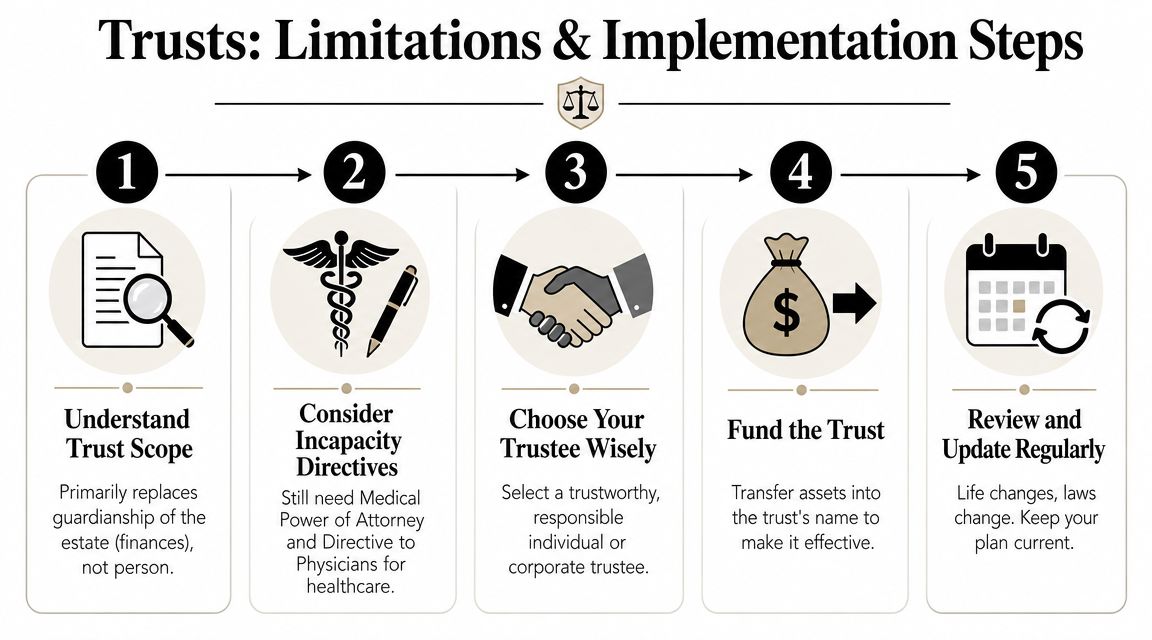
A trust can be powerful, but it is not a magic fix. The most important limitation is scope. A trust mainly addresses property and financial management, which is why it can function as a substitute for a guardianship of the estate in the right case. It does not automatically give someone authority over every medical, residential, or personal decision.
That means many families need a broader incapacity plan, not just a trust. Medical powers, directives, and other estate-planning documents often work alongside the trust so the plan matches real life.
The mistake families make most often
A revocable living trust only works for assets that are placed into it. A properly funded revocable living trust can serve as a direct substitute for a Texas guardianship of the estate because it can name a successor trustee. But if assets are not titled into the trust, the trust cannot prevent a guardianship proceeding for those untitled assets, as explained in this discussion of whether a living trust can help avoid guardianship in Texas.
That single issue causes a lot of confusion. Families think they are protected because the trust exists on paper. Then a crisis comes, and key accounts or real property were never transferred.
A workable implementation checklist
If you're considering this route, focus on execution.
Confirm the problem
Is the concern unpaid bills and investment management? Or is the person unsafe at home and unable to make personal decisions? Your answer tells you whether a trust is enough.
Choose the right fiduciary carefully
The successor trustee needs judgment, patience, honesty, and organization. If you're evaluating that role, it helps to understand the fiduciary responsibility of a trustee.
Draft for incapacity, not just death
Many trust documents are written with inheritance in mind. A good incapacity plan also addresses who takes over, how incapacity is determined under the document, and what powers the trustee needs right away.
Fund the trust completely
Retitling assets is not clerical busywork. It is the step that makes the plan operational.
Coordinate the rest of the estate plan
A family may also need wills, beneficiary reviews, and probate planning. In some situations, a probate-focused review can identify assets or procedures the trust won't cover.
Before, during, and after a hearing if guardianship is still needed
Some families will still end up in court. If so, practical preparation matters.
- Before the hearing: Gather medical information, identify less restrictive alternatives already tried, and organize financial records.
- During the hearing: Be ready to explain why the requested authority is necessary and why narrower options won't protect the person adequately.
- After appointment: Follow reporting rules, court instructions, and fiduciary duties closely.
The Law Office of Bryan Fagan, PLLC handles guardianship, probate, and estate-planning matters in Texas, including applications, hearings, and planning alternatives for families who are deciding between a trust-based approach and a court-supervised case.
Making the Right Choice for Your Texas Family
The right plan usually becomes clearer once you strip away labels and focus on the actual risk. If your loved one mainly needs help managing money and property, a trust may offer a more private, more dignified path. If your family is facing broader safety concerns, severe incapacity, or conflict that only a court can resolve, guardianship may still be necessary.
There isn't a one-size-fits-all answer for families in Houston, Dallas, Austin, San Antonio, or smaller Texas communities. What matters is matching the legal tool to the human situation. The best planning protects a vulnerable person without removing more independence than the law requires.
It also helps to think beyond the immediate crisis. Asset structure, beneficiary designations, trust funding, and even questions like life insurance for estate protection can affect how smoothly a family plan works when someone becomes ill or passes away.
If you're weighing when a trust can replace guardianship in Texas, don't wait until the bank account is frozen, the bills are overdue, or family conflict is out of control. Early planning usually gives families more options, more calm, and a better chance to preserve a loved one's dignity.
If your family is trying to decide between a trust, guardianship, or a combination of both, Law Office of Bryan Fagan, PLLC offers free consultations to help you understand the options under Texas law. We can help you evaluate capacity concerns, guardianship procedures under Texas Estates Code Title 3, Subtitle G, and practical estate-planning steps to protect your loved one's future.