Skip to content
When you decide to seek legal guardianship in Texas, the first move is filing a formal application with the probate court. We understand this is a step taken with great care, and our goal is to guide you with clarity and compassion. Your core task is to show the court that your loved one is legally "incapacitated" and needs someone to step in and protect them. This means demonstrating that due to a physical or mental condition, they can no longer manage their own affairs, and guardianship is the necessary path to ensure their safety and well-being.
Deciding if Guardianship Is the Right Path
Considering guardianship for someone you love is an emotionally weighty decision, one that usually comes after watching them face incredibly tough challenges. It’s a step you take when you see that person—perhaps an aging parent navigating dementia or a minor child who received a large injury settlement—is vulnerable and unable to protect themselves. This isn't about taking control; it's about providing a necessary shield of safety and stability when they need it most.
The legal process kicks off by filing a petition in the appropriate probate court, a path laid out by Title 3, Subtitle G of the Texas Estates Code. With an aging population, the need for these proceedings has grown. Across the nation, an estimated 1.3 million adults are under some form of guardianship, with guardians managing roughly $50 billion in assets. These figures highlight just how many families, like yours, are navigating this complex and emotional journey.
Understanding the Two Main Types of Guardianship
In Texas, guardianship is never a one-size-fits-all solution. The courts are very careful to tailor the arrangement to the specific needs of the person who needs protection, known as the proposed "ward." This is a crucial point: the law requires imposing the least restrictive measures necessary to ensure the person's safety.
To help families determine what is needed, Texas law breaks guardianship into two main categories.
| Responsibility | Guardianship of the Person | Guardianship of the Estate |
|---|---|---|
| Primary Focus | Personal well-being, health, and daily life. | Financial matters, property, and assets. |
| Key Decisions | Where the ward lives, consenting to medical care, daily supervision. | Paying bills, managing investments, handling real estate, filing taxes. |
| Goal | Ensure the ward's physical and emotional safety and care. | Protect the ward's assets from fraud, waste, or mismanagement. |
| Example Scenario | Making sure an elderly parent with Alzheimer's gets proper medical treatment and lives in a safe facility. | Managing a minor's inheritance until they reach adulthood. |
A court, like the Harris County Probate Court, might appoint one person to handle both roles (a "full" guardianship) or split the duties between two different people. For instance, one adult child might be perfectly suited to manage their parent's daily care as Guardian of the Person, while another sibling with a financial background is appointed Guardian of the Estate.
When Is Guardianship Truly Necessary?
Guardianship is a significant legal step, primarily because it removes a person's fundamental rights to make their own decisions. Because it’s so profound, courts will only grant it when there are absolutely no less restrictive alternatives available. This is a key protection under Texas law.
Before you file, you must explore whether other legal tools, like a power of attorney, are already in place. These documents are powerful because they allow an individual to choose who makes decisions for them ahead of time, preserving their autonomy and dignity.
A key question the court will ask is: "Is guardianship the only way to protect this person?" If a valid Power of Attorney exists and the appointed agent is acting properly, a guardianship may not be granted.
However, sometimes a power of attorney isn't enough. Perhaps your mother never signed one before dementia made it impossible, or the person she appointed is not acting in her best interests, creating a guardianship dispute. In these challenging situations, guardianship becomes the only viable safeguard. You can see a detailed breakdown of the key differences in our article comparing guardianship vs. power of attorney.
Making this choice is emotionally draining and can be financially taxing, but you don’t have to figure it out alone. Understanding the nuances of Texas law is the first step toward making a confident choice that truly protects your loved one.
Gathering Your Essential Documentation
A successful guardianship application is built with clear, compelling evidence. Before a Texas judge will consider granting guardianship, you must prove that your loved one is legally incapacitated. This critical process starts with getting your paperwork in order.
The most vital piece of evidence is the Physician's Certificate of Medical Examination (CME). This isn't just any doctor's note—it's a specific, court-required form that provides the medical foundation for your entire case. Under the Texas Estates Code, this certificate must meticulously detail the nature, degree, and severity of your loved one's condition, directly linking it to their inability to care for themselves.
The Crucial Role of the Medical Examination
Think of the CME as the doctor's sworn testimony on paper. The physician performs a thorough examination and then states, with a reasonable degree of medical certainty, that your loved one can no longer manage their own affairs or make sound decisions about their health and safety.
Getting this form completed requires a delicate touch. It's a conversation that needs to be handled with both sensitivity and precision, recognizing the emotional difficulty for everyone involved.
Here’s how to approach it:
- Use the Right Form: Ensure the doctor has the correct, up-to-date form required by your local court. For example, Bexar County Probate Court may have its own specific version.
- Time it Right: The CME is only valid if the examination was conducted within 120 days of filing your application. The clock is ticking, so timing is everything.
- Explain the Legal Standard: You may need to gently remind the physician that the form must address legal incapacity, not just a medical diagnosis. It needs to clearly connect the condition (like late-stage dementia) to the person's inability to live and function independently.
This can be a tough conversation. Your loved one might feel like they're under a microscope, and doctors can be hesitant to fill out legal forms. Approaching it with compassion and explaining that this is a necessary step to protect them can make a world of difference.
Assembling Your Supporting Paperwork
Beyond the CME, a strong application includes a collection of supporting documents that give the court a complete picture. Let's say you're preparing to file for guardianship for your father in Harris County. You'll need to gather a variety of records to prove his identity, your suitability as a guardian, and the extent of his assets. For any documents you prepare in Microsoft Word, knowing how to add an e-signature to a Word document can definitely help speed things up.
Here’s a practical checklist of what you'll need:
- Personal Identification: Get copies of your loved one's driver’s license, birth certificate, and Social Security card. You'll need your own ID as well.
- Family Information for the Application: You must list the full names, relationships, and last known addresses of all close family members (spouse, children, parents, siblings), as the court requires them to be notified.
- Financial Records (for Guardianship of the Estate): If you're seeking to manage finances, start collecting recent bank statements, property deeds, investment account information, and a list of any known debts.
- List of Potential Guardians: The application will ask you to name who you believe should be appointed guardian. If that's you, be ready to provide your own personal information and state why you're qualified for the role.
An organized and complete application is your best friend. A single missing document or an improperly filled-out CME can get your initial filing rejected, forcing you to start over and wasting precious time when your loved one needs help now.
Gathering all these documents is a proactive step that shows the court you're taking this responsibility seriously. Of course, you'll want to be sure you meet all the other qualifications, so it's a good idea to review the legal requirements for becoming a guardian in Texas.
This preparation phase can feel overwhelming, but every document you collect strengthens your case. If you need help getting your paperwork organized or just want to make sure you have everything the court will demand, don't hesitate to reach out. We can help you build a compelling application from the very beginning.
Filing Your Application with the Texas Court
You’ve gathered your documents and have a solid case for why guardianship is necessary. Now it's time to take that first official step into the legal process. This means filing the Application for Appointment of Permanent Guardian, which can feel intimidating but is a structured procedure. This is the moment you formally ask a Texas court to recognize the need for a guardian and appoint the right person for the job.
The application must be filed in the probate court of the county where your loved one resides. For instance, if your mother is in a nursing home in Fort Bend County, you’ll file the paperwork with the Fort Bend County court that handles probate matters. This local filing rule ensures the case is heard by a court familiar with the community and accessible to the person at the center of it all.
This chart breaks down the essential documents you'll need ready to go for the application.
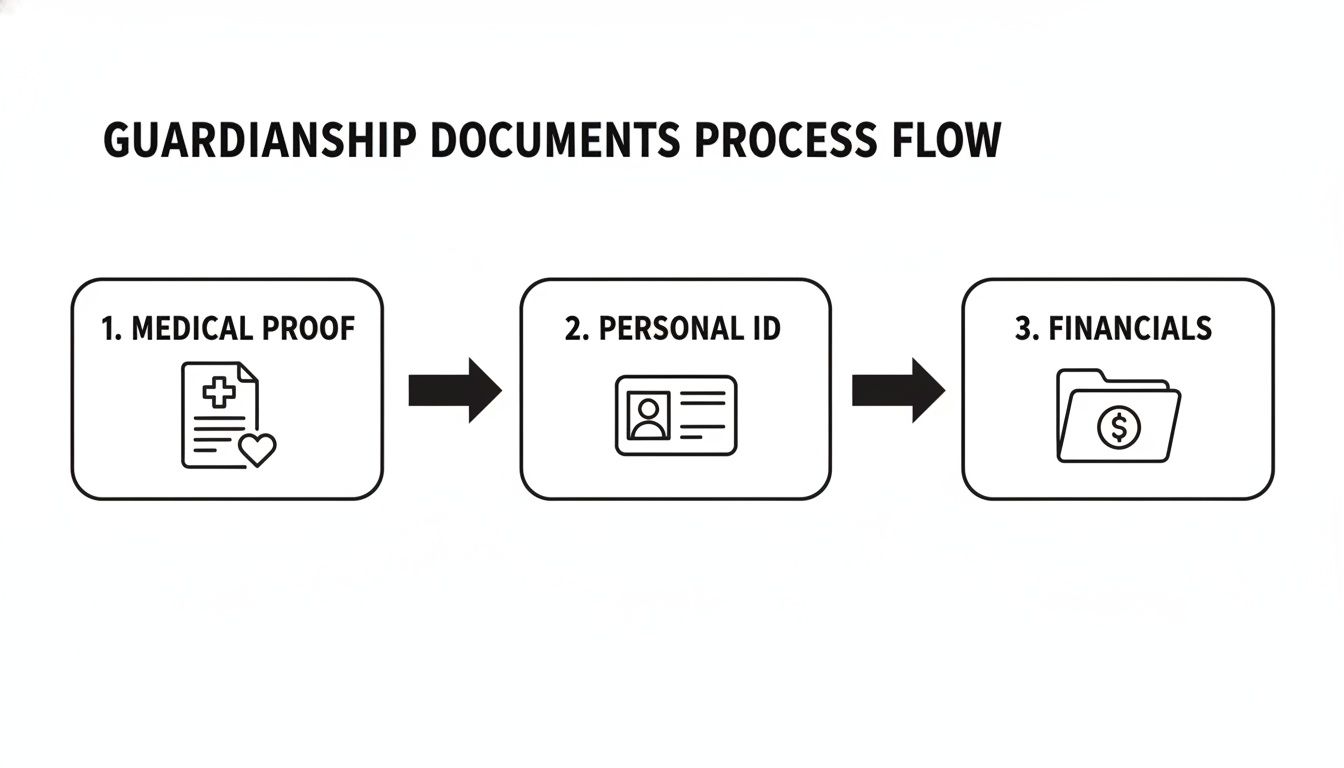
As you can see, the application is built on a foundation of medical, personal, and financial proof. Each piece of evidence serves a specific purpose, helping you paint a clear and compelling picture for the judge.
Serving Citation and Notifying Family
Once the application is filed, the court doesn’t just take your word for it. Texas law is very clear that everyone with a stake in the outcome must be properly notified. This formal notification is called service of citation, and it’s a fundamental protection. The goal is to make sure the proposed ward and their closest relatives know what’s happening and have a chance to be heard.
A sheriff or a private process server will personally hand-deliver a copy of the application to your loved one. This is how the court guarantees they’ve been officially informed that a guardianship case has been opened. Beyond that, other family members you listed in the application—like siblings or adult children—will also receive notice. This transparency is crucial. It prevents secret proceedings and gives the family a chance to either support the guardianship or voice any concerns they might have.
The Role of the Attorney Ad Litem
One of the most important safeguards in any Texas guardianship case is the court's appointment of an attorney ad litem. This is an independent attorney whose one and only job is to represent the best interests of the proposed ward. Think of them as your loved one's dedicated voice in the courtroom.
The attorney ad litem will:
- Meet with your loved one in person to explain what a guardianship is in terms they can understand.
- Discuss their wishes, fears, and preferences regarding the whole process.
- Review all the evidence you’ve submitted, especially the physician's certificate.
- Interview you, other family members, and even doctors to get a complete picture.
The ad litem’s job is to fiercely advocate for what your loved one wants. If your father is dead set against having a guardian, the ad litem has a duty to communicate that to the judge, even if you firmly believe it’s in his best interest. Their loyalty is to the proposed ward, not to you.
The attorney ad litem acts as the court's eyes and ears, providing an unbiased assessment of the situation. Their final report and recommendation to the judge carry significant weight in the ultimate decision.
The Court Investigator's Visit
In addition to the attorney ad litem, the court will also appoint a court investigator. This person is a neutral fact-finder who works directly for the court. While the ad litem is focused on legal representation, the investigator's role is to assess the practical and social side of things.
The investigator will visit your loved one's home to see their living conditions firsthand. They will also interview you, the proposed guardian, to get a feel for your suitability for the role. Expect questions about your background, your relationship with the proposed ward, and your understanding of what a guardian actually does. They are there to verify the information in your application and make sure the proposed living situation is safe and appropriate.
Understanding the distinct jobs of these two court-appointed professionals is key. The best approach is to be open, honest, and cooperative during their interviews. It helps them see that your primary motivation is the well-being of your family member. We know these interactions can be stressful, but they are essential checks and balances in a system designed to protect the vulnerable.
If you have questions about filing in a specific Texas court or want to know more about what to expect from these interviews, please reach out. Schedule a free consultation with our team, and we can provide the personalized guidance you need to move forward with confidence.
What Happens at the Guardianship Hearing
After all the paperwork and preparation, everything comes down to the guardianship hearing. This is the formal courtroom proceeding where a Texas judge will hear the evidence and make a final, life-altering decision about your loved one’s future. We know walking into a courthouse can be intimidating, but knowing what's coming can turn that anxiety into confidence.
Think of the hearing as your opportunity to explain, under oath, why you believe a guardianship is absolutely necessary. Your testimony, paired with the doctor's letter and the report from the court-appointed attorney, gives the judge the full picture they need to make the right call. This isn't about winning an argument; it's about clearly and honestly presenting the facts so the court can act in your loved one's best interest.
Who Will Be in the Courtroom
When you step into the probate court, whether you're in Dallas County or Travis County, you'll see a few key players. Understanding their roles helps demystify the process.
- The Judge: This is the person in charge. They run the hearing, listen to all the testimony, and make the final decision based on Texas law.
- You (The Applicant): You’ll be there with your attorney to present your case and answer any questions.
- The Proposed Ward: Texas law requires the person the guardianship is for to be there, unless a doctor says their health prevents it or the court agrees it wouldn't be in their best interest.
- The Attorney Ad Litem: This is the independent attorney the court appointed to represent your loved one. They will be there to share their findings and advocate for what they believe is best for the proposed ward.
- Other Family Members: Anyone who received a legal notice about the hearing, like siblings or other adult children, has the right to be there. They might even be asked to testify.
Presenting Your Case to the Judge
The heart of the hearing is when you take the stand to testify. Your lawyer will guide you with questions designed to establish the facts the judge needs to hear. The judge is listening for clear and convincing evidence that your loved one is incapacitated and that you’re the right person for the job.
The judge’s questions will be direct and focused on two things: is a guardianship truly needed, and are you qualified to serve?
A judge’s primary duty is to protect the proposed ward. They will scrutinize the application to ensure that guardianship is the least restrictive option available and that the proposed guardian is trustworthy and capable.
Be ready for questions like:
- "Can you give me some specific examples of how your mother has been unable to manage her health or her finances?"
- "Why won't a power of attorney work in this situation?"
- "If you're appointed, what is your plan for managing her daily care and medical needs?"
- "Do you have any criminal history or serious financial issues that the court should know about?"
Honesty and real-world examples are your best tools here. Vague statements won't be effective. Stick to the facts and always frame your answers around what is best for your loved one. For a deeper dive into the courtroom experience, you can learn more about what to expect at a Texas guardianship hearing on our blog.
A Sample Scenario Hearing in Action
Let’s imagine you're in a Harris County Probate Court for your father, who has advanced Alzheimer's. Your attorney might ask, "Can you tell the court why your father needs a guardian?"
An answer like, "He's just not himself anymore," isn't very helpful.
A much stronger response would be: "Yes, Your Honor. Last month, he left the stove on three different times, once causing smoke damage to the kitchen. He has also been giving thousands of dollars to phone scammers, and his bank account is now overdrawn. We tried to use his Power of Attorney to protect his finances, but during a moment of clarity, he revoked it and then forgot he did so, leaving him vulnerable."
See the difference? That answer gives the judge concrete facts that show incapacity and prove you’ve already tried less restrictive options. Being prepared with these kinds of details makes the judge's difficult job much easier and demonstrates that you're ready for the responsibilities ahead.
Once all the testimony is heard, the judge will make a ruling. If the guardianship is granted, the judge will sign a court order. From there, you'll move on to taking an oath and posting a bond. The hearing might feel like a final exam, but with the right preparation, it’s a straightforward step toward protecting the person you care about most.
Your Duties After Becoming a Guardian
That moment when the judge signs the court order officially appointing you as a guardian brings a huge wave of relief. The legal battle is over, but in many ways, your work is just beginning. This next phase is about the consistent, careful management of and advocacy for your loved one—now referred to by the court as the "ward."
Understanding these ongoing obligations is key to fulfilling your role effectively and ethically under Texas law. These rights and duties are designed to protect your loved one and ensure you are always acting in their best interest.

You can't just walk out of the courthouse and start making decisions. Even with the judge's order in hand, there are a few critical tasks you must complete first. Think of them as the final steps that officially activate your authority.
The First Steps After Your Appointment
Before you can legally perform your duties, the Texas Estates Code lays out three non-negotiable actions you have to take to qualify:
- Take an Oath: This is your formal pledge to the court and to your loved one. You'll sign a sworn statement, or oath, promising to faithfully carry out all the duties of a guardian.
- Post a Bond: If you're the guardian of the estate, the court will almost always require you to purchase a financial bond. This acts like an insurance policy, protecting the ward’s assets from any potential mismanagement. The judge sets the bond amount based on the estate's value.
- File an Inventory: Within 30 days of your appointment, you must file a detailed "Inventory, Appraisement, and List of Claims." This document is a comprehensive catalog of all the ward's property—real estate, bank accounts, personal belongings—along with its estimated value.
Once you've checked these boxes and the court has approved everything, you'll receive your "Letters of Guardianship." This is the golden ticket—the official document that proves your legal authority to banks, doctors, and anyone else you'll need to deal with on the ward's behalf.
Ongoing Reporting to the Court
Your responsibilities don't stop after the first 30 days. The court maintains supervision over the guardianship for its entire duration to ensure the ward is protected. This oversight is handled through mandatory annual reports that keep you accountable for your actions, a key component of guardianship compliance.
As a guardian, you'll often be handling the ward's finances. Learning about efficiently managing financial records, like bank statements, will be a lifesaver when it comes time for your annual accounting.
Under Title 3, Subtitle G of the Texas Estates Code, guardians are fiduciaries with a legal duty to act in the ward's best interest. The annual reporting requirements are the primary mechanism for the court to enforce this duty.
You'll typically be responsible for filing two primary reports with the court each year:
- Annual Report on the Condition and Well-Being of the Ward: This report focuses on the personal side of things. You'll give the court an update on the ward's physical and mental health, where they're living, and any other significant changes from the past year.
- Annual Account: If you're the guardian of the estate, this is your detailed financial report card. It's a line-by-line accounting of every dollar that came into and went out of the ward's estate, all backed up by bank statements and receipts.
The secret to making these annual filings less of a headache is to keep meticulous records from day one. Use a dedicated bank account for the ward's funds and keep a clear log of every single expense and all income. This discipline doesn't just satisfy the court; it protects you from any potential accusations of financial mismanagement down the road and is essential for a smooth guardianship termination process if the guardianship is no longer needed.
Thinking Beyond Guardianship: Are There Better Options?
When a loved one is struggling, your first instinct is often to find the strongest possible protection, which leads many people to ask, "How do I apply for legal guardianship?" But in Texas, guardianship is considered the nuclear option—a last resort that removes a person's fundamental right to make their own choices.
Because of this, Texas law requires courts to explore less restrictive alternatives first. For many families, these alternatives strike the perfect balance between providing support and preserving a loved one's independence. Before you file for guardianship, it is critical to explore other legal tools that might achieve the same goals.
Powers of Attorney: The First Line of Defense
The most common and effective alternatives are powers of attorney. These are powerful legal documents a person signs while they still have the mental capacity to do so, giving a trusted individual (the "agent") the authority to act on their behalf. They are a core component of proactive estate planning.
Texas recognizes two crucial types:
- Durable Power of Attorney: This gives your designated agent the power to handle financial and legal affairs—like paying bills, managing bank accounts, or even selling property. It's called "durable" because it stays in effect even if the person who signed it later becomes incapacitated.
- Medical Power of Attorney: This document lets an agent make healthcare decisions when the person can't. This can be anything from consenting to a specific treatment to choosing doctors and accessing medical records.
If your loved one already has these documents in place and the agent is acting responsibly, a court will almost certainly decide a guardianship is unnecessary. These documents are the textbook definition of a less restrictive alternative.
Supported Decision-Making Agreements
Another fantastic tool is a Supported Decision-Making Agreement. This is a formal agreement under Texas law that lets an individual with a disability choose trusted advisors—like family or friends—to help them process information, weigh their options, and ultimately make their own decisions.
A Supported Decision-Making Agreement is all about empowerment. It doesn't take away any of the person's rights. The individual is still the one in the driver's seat; their advisors are just there to help them navigate.
This approach is ideal for someone who can make decisions but just needs a bit of help understanding complex information or communicating what they want. It keeps the individual at the very center of their own life.
Guardianship vs Less Restrictive Alternatives
It can be tough to see how these options stack up. This table breaks down the key differences between a full guardianship and the most common alternatives.
| Feature | Full Guardianship | Durable Power of Attorney | Supported Decision-Making |
|---|---|---|---|
| Decision-Maker | The court-appointed guardian. | The agent, acting on behalf of the principal. | The individual, with help from trusted advisors. |
| Individual's Rights | Most are removed and given to the guardian. | The individual retains all rights until incapacitated. | The individual retains all their legal rights. |
| Court Involvement | Ongoing court supervision and annual reporting required. | No court involvement unless the agent's actions are challenged. | No court involvement is needed to create or use it. |
Looking at them side-by-side makes it clear why Texas courts prefer to avoid guardianship unless absolutely necessary. The goal is always to use the least restrictive tool that will get the job done.
When Urgent Action Is Needed: Temporary Guardianship
Of course, sometimes a situation is so critical you don't have time to weigh all the options. If a loved one is facing an immediate and substantial risk of serious physical harm or financial loss, you can petition the court for a Temporary or Emergency Guardianship.
The standard for this is extremely high. You must come to the court with clear, convincing evidence that a true emergency exists. If the judge agrees, a temporary guardianship is typically granted for only 60 days—just long enough to stabilize the crisis while you work toward a more permanent solution.
Exploring these alternatives is more than just a legal formality; it's a way to honor your loved one’s dignity. It ensures you only resort to the drastic step of guardianship when it is truly the only path forward.
Navigating these options can be complex, and choosing the right path for your family requires careful consideration of Texas guardianship, probate, and estate planning law. At the Law Office of Bryan Fagan, PLLC, our experienced attorneys can help you evaluate your situation, understand the pros and cons of each alternative, and determine the most compassionate and effective way to protect your loved one. Schedule a free, no-obligation consultation today to get the clear, personalized guidance your family deserves.
Contact the Law Office of Bryan Fagan, PLLC for a Free Consultation