Skip to content
When families search for the guardianship trial process texas, they are usually already in the middle of something hard. A parent is missing medications. Bills are piling up. A disabled adult child is turning eighteen, and school support is ending. A child received an injury settlement, and someone must legally manage the funds. The legal issue is real, but so is the grief behind it.
Families typically do not start this process because they want control. They start because they are scared something will happen if no one steps in. Texas law recognizes that fear, but it also protects the rights of the person at the center of the case. That is why guardianship is not a simple form or private agreement. It is a court process with evidence, notice, investigation, and a hearing.
Recognizing the Need for Guardianship in Texas
A common family story starts small. An older father forgets to pay the electric bill. Then he leaves the stove on. Then he signs papers he does not understand. A sister may say, “He just needs more help.” A brother may say, “We need legal authority before something worse happens.” Both reactions are human.
Texas courts use guardianship when a person cannot adequately care for themselves or manage their property, and less restrictive options are not enough. Under Texas Estates Code Title 3, Subtitle G, the court has to look carefully at whether the person is incapacitated, what help is needed, and whether a full guardianship would go too far.

Why the court process is so formal
Guardianship can affect where a person lives, who manages their money, and who makes medical decisions. Because those rights matter, the court does not grant guardianship based on family concern alone.
The judge will want proof. That usually means medical evidence, family testimony, court investigation, and a clear explanation of why other options will not work. Texas families are using this process often. As of August 31, 2017, Texas had 50,478 active guardianships, with 5,186 new cases filed in that fiscal year alone, according to the U.S. Senate Special Committee on Aging testimony discussing Texas guardianship data.
Guardianship is not always the first answer
Before filing, families should pause and ask a hard question. Is guardianship necessary, or is there a less restrictive way to protect this person?
In some cases, a person can still make decisions with support. Texas recognizes tools such as powers of attorney, representative payee arrangements, and supported decision-making in Texas. When those tools are enough, courts expect families to use them instead of seeking full guardianship.
Key takeaway: A guardianship case is strongest when the family can show both concern and restraint. Judges respond well when applicants can explain what they tried before asking the court to remove rights.
Situations that often lead to a filing
Some patterns show up again and again in probate courts:
- Aging parents with confusion: Memory loss, missed medical care, or unsafe spending.
- Adults with disabilities: A parent may need legal authority when a child becomes an adult.
- Injury or illness cases: A person may lose the ability to handle care or finances after trauma.
- Minors with property issues: A child may need a guardian of the estate for settlement funds.
The legal process can feel cold at first. It helps to remember what the court is trying to do. The goal is not to punish decline. The goal is to protect the person while preserving as much independence as possible.
The First Steps Preparing for a Guardianship Case
The strongest guardianship cases are usually built before anyone files anything. Families often think the hearing is the hard part. In practice, early preparation decides whether the case moves smoothly or gets delayed.

Start with alternatives first
Texas Estates Code guardianship provisions require the court to consider least restrictive alternatives before granting a guardian broad authority. That means families should gather any existing planning documents and evaluate whether they still work in practice.
A practical review often includes:
- Powers of attorney: Are they valid, signed, and usable with banks and doctors?
- Medical directives: Do providers accept them, and do they address the current crisis?
- Supported decision-making: Can the person understand choices with help?
- Informal help: Is a trusted relative already managing things successfully without court authority?
What does not work is telling the judge, “We just think guardianship is best.” Courts want specifics. If the bank refused an old power of attorney, say that. If the person signs contracts without understanding them, document it. If family members cannot access funds to pay for care because no valid planning documents exist, explain that clearly.
The PCME is the foundation
The medical record that matters most at the start is the Physician’s Certificate of Medical Examination, usually called the PCME. This is not a routine doctor note. It is the core evidence for incapacity.
A complete Physician’s Certificate of Medical Examination (PCME) is mandatory. It must be completed by a licensed physician within 120 days of filing. Incomplete or expired PCMEs are a primary reason for case delays, affecting an estimated 20-30% of initial filings in some Texas counties, as explained in this discussion of how to file for guardianship in Texas.
What families should ask the doctor to address
Not every physician understands what the probate court needs. Families should not assume the doctor’s office will know how to complete the form in a way the court can use.
A useful PCME should address:
- Diagnosis and condition: The physician should describe the medical basis for incapacity.
- Decision-making ability: The form should explain whether the person can make personal, medical, or financial decisions.
- Scope of need: The doctor should indicate whether help is needed in limited areas or across the board.
- Functional effects: Judges need more than labels. They need to know how the condition affects daily judgment.
Practical tip: Schedule the medical exam early and review the completed form before filing. Families lose time when they discover missing answers after the application is already on file.
Prepare your factual story
Good cases are specific. Weak cases are full of conclusions.
A better approach is to build a short factual timeline. For example, instead of writing, “My mother cannot handle things anymore,” list concrete events such as unpaid rent, missed insulin doses, repeated scams, wandering, or inability to explain income and expenses. Those details help the attorney ad litem, the investigator, and the judge understand why the request is necessary.
Gather the documents the court will expect
Different counties handle local procedure a little differently, but most families should prepare for some version of this checklist:
| Document or information | Why it matters |
|---|---|
| Proposed ward’s identifying information | Needed for the application and service |
| Family contact list | Notice must go to interested relatives |
| Existing legal documents | Shows whether alternatives were tried |
| Medical records and PCME | Supports incapacity |
| Asset and income information | Important if estate issues are involved |
| Proposed care plan | Helps the court assess suitability |
Later in the process, it also helps to have a simple plan for housing, medical care, transportation, and finances. Judges often want to know not only why the person needs help, but what you will do if appointed.
A short video can help make the process less abstract:
Know the difference between person and estate
Families often use the word “guardianship” as if it means one thing. In court, it may mean different powers.
- Guardianship of the person: Authority over care, residence, and personal decisions.
- Guardianship of the estate: Authority over money, property, and financial management.
- Both person and estate: Broader authority when both kinds of protection are needed.
That difference matters when deciding what to request. Asking for more authority than the facts support can hurt credibility. Asking for too little can leave the person exposed.
What works and what usually causes trouble
The families who move through probate court with fewer surprises usually do three things well. They get the medical evidence in place, they carefully consider alternatives, and they prepare a clean factual record.
What causes problems is equally predictable:
- Rushing the filing before the medical exam is ready
- Ignoring valid alternatives
- Leaving out relatives from the contact list
- Asking for a full guardianship without explaining why a limited order would not work
Those mistakes do not always sink a case, but they create avoidable fights.
Filing the Petition and Navigating the Investigation Phase
Once the preparation is solid, the case moves from family concern to formal court action. The application is filed in the proper probate court, usually in the county where the proposed ward lives or has primary ties. In larger counties such as Harris County, the case may be assigned to a probate court that handles guardianship matters regularly.
Families who want a clear overview of the filing mechanics often start with resources on filing a guardianship petition in Texas. The court filing starts the legal timeline, but it also starts the emotional pressure.
Filing is more than paperwork
The application must tell the court who the proposed ward is, why guardianship is needed, what powers are requested, and who the interested relatives are. It also triggers notice requirements under the Estates Code. The proposed ward must be personally served. Certain family members and interested parties must receive notice as well.
That step can create tension fast. A sibling who has been distant may suddenly object. An adult child may see the filing as an accusation. The proposed ward may feel betrayed, even when the filing is motivated by safety concerns.
The investigation period is often the hardest part
After filing, many families expect a hearing right away. Instead, they enter the waiting period where the attorney ad litem and, in some cases, a court investigator begin their work.
The 4-8 week court investigation is often the most stressful phase for families. During this time, a court investigator will visit the proposed ward's home and interview family members. Their report heavily influences the judge's decision, making your preparation for these interactions absolutely critical to the outcome, as described in this discussion of how long the guardianship process takes.
What the investigator and attorney ad litem are looking for
The investigator and attorney ad litem are not there to help one side win. They are there to evaluate the situation independently.
They are usually looking at questions like these:
- Does the proposed ward understand what is happening
- Is guardianship necessary
- Are there less restrictive alternatives
- Is the applicant suitable and trustworthy
- Is there family conflict that affects the request
That is why families should avoid treating these meetings like a performance. Overstating the problem can backfire. So can minimizing obvious risks because you are embarrassed.
Practical tip: Prepare a simple folder before the visit. Include medication lists, recent incidents, care notes, copies of powers of attorney, and contact information for doctors or facilities. Organized information helps the investigator see the case clearly.
How to prepare for the home visit
A home visit makes many families nervous. They worry they will say the wrong thing or that the house must look perfect. The focus is usually not on perfection. The focus is safety, functioning, and credibility.
Helpful preparation often includes:
- Document daily challenges: Keep a short log of missed medications, confusion, wandering, falls, unpaid bills, or unsafe choices.
- Be ready to discuss alternatives: Explain what was tried and why it failed.
- Answer directly: Do not guess if you do not know an answer.
- Respect the proposed ward: Let them speak when they can. Talking over them can create a bad impression.
- Avoid family attacks: If there is a dispute, stick to facts instead of character judgments.
Managing resistance inside the family
Some of the hardest cases are not medically difficult. They are emotionally divided. One child lives nearby and handles daily crises. Another lives out of state and thinks guardianship is excessive. A parent resists because the process feels humiliating.
In those moments, language matters. It often helps to say, “We are asking the court to decide what level of help is necessary,” instead of, “We are taking over.” That framing is more accurate and less inflammatory.
If conflict is serious, keep communication in writing when possible. Short, factual emails are better than angry calls. They preserve the record and reduce the chance of later misunderstandings.
Temporary guardianship in urgent situations
Some cases cannot wait for the full timeline. If someone faces immediate danger, Texas law allows for temporary guardianship in appropriate circumstances. Temporary orders are designed for urgent needs and do not replace the full case. They bridge the gap when delay would put the proposed ward or property at risk.
Temporary relief can matter in situations involving medical crisis, immediate financial exploitation, or unsafe living conditions. Because the standards and procedure are strict, these filings need careful handling.
What families should do while waiting
The waiting period feels passive, but it should not be. Use that time well.
- Keep updating your incident log
- Respond quickly to requests from the ad litem or court staff
- Gather financial information if estate issues are involved
- Prepare key witnesses who know the person’s daily limitations
- Stay steady with care arrangements
The families who handle this period best usually do one thing others do not. They treat the investigation as part of the trial, not as a side issue before the main hearing.
The Guardianship Hearing What to Expect in the Courtroom
The courtroom is often less dramatic than families imagine, but it is still serious. The judge is not there to ratify a family decision. The judge is there to decide whether the legal requirements have been met under the Texas Estates Code, including the standards in Sections 1101 and 1102 for application and medical proof.
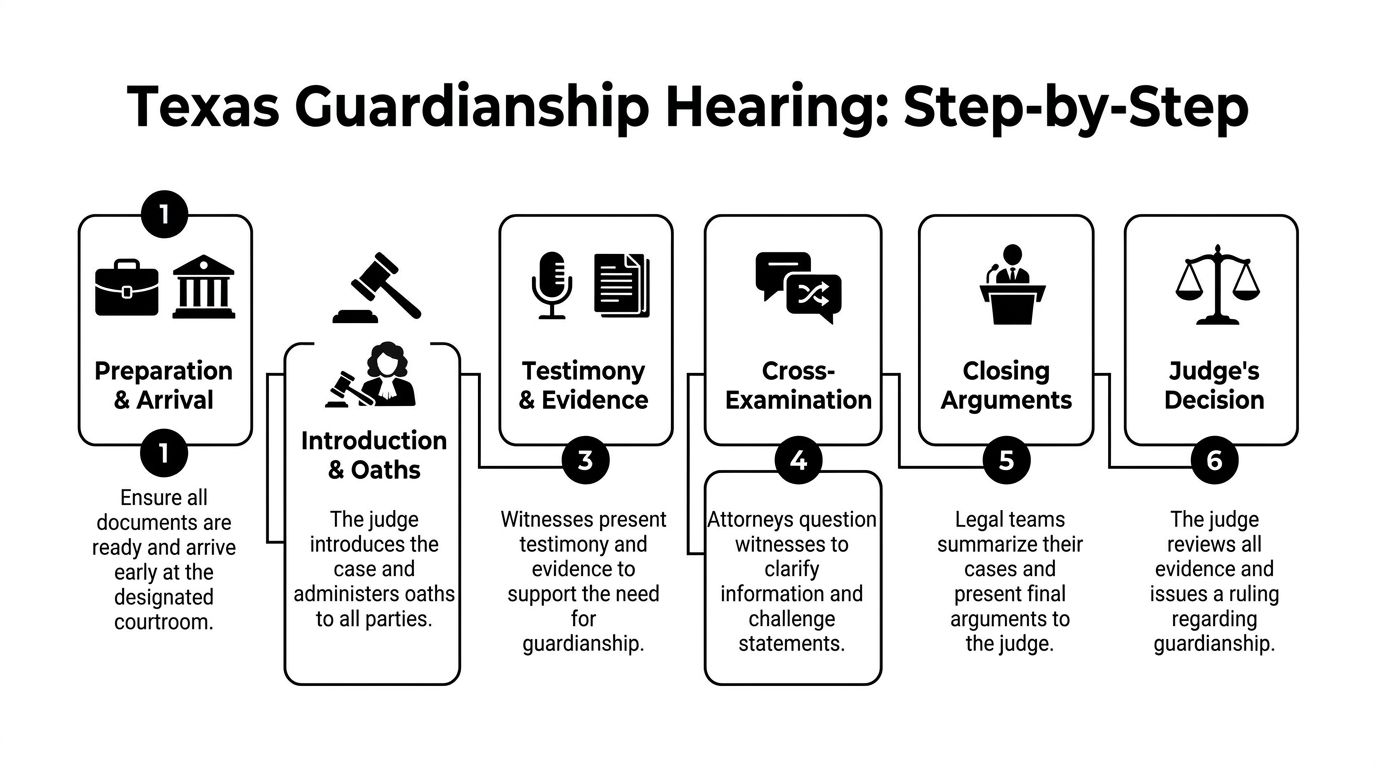
If you want a closer look at how evidence is presented, this overview of an evidentiary hearing in a Texas guardianship case is useful background. The key point is simple. The hearing is structured, and preparation matters.
Who is usually in the courtroom
A typical guardianship hearing may include:
- The applicant: The person asking to be appointed guardian
- The proposed ward: If able to attend or communicate
- The applicant’s attorney: If the applicant has counsel
- The attorney ad litem: Appointed to represent the proposed ward’s interests
- The judge: The decision-maker
- Witnesses: Family members, caregivers, and sometimes medical professionals
- Other relatives or objectors: If the case is contested
In a straightforward case, the hearing may be focused and efficient. In a contested case, it can feel much more like a trial, with competing testimony and sharp disagreement over what is necessary.
The burden of proof
This is one of the most important legal standards in the case. To succeed, you must prove incapacity by "clear and convincing evidence." While 70-85% of uncontested cases are approved, that rate can drop to 40-60% if the guardianship is contested or if the evidence of incapacity is weak. Success hinges on rigorous preparation and strong medical evidence, according to the Texas courts adult guardianship guide.
That standard is higher than simple suspicion or family belief. The judge needs evidence that is firm, credible, and specific.
What the judge wants to hear
Judges usually look for answers to a set of practical questions:
| Court question | What strong evidence looks like |
|---|---|
| Is the person incapacitated | Current medical evidence plus real-life examples |
| Are alternatives inadequate | Specific explanation of failed or unavailable options |
| Is this applicant suitable | Clean background, sound judgment, workable care plan |
| What scope is needed | Limited or full powers tied to actual needs |
A good hearing does not depend on legal jargon. It depends on credible proof.
A simple courtroom example
Consider a daughter seeking guardianship for her mother, who has dementia and keeps giving money to scammers. At the hearing, the daughter testifies about missed medication, unpaid bills, and repeated fraudulent withdrawals. The PCME supports cognitive decline and impaired judgment. The investigator confirms the concerns and reports that informal measures have not protected the mother. The attorney ad litem may agree that some guardianship is needed, but also raise whether the order should be limited rather than full.
That example shows how judges think. They are not just deciding whether help is needed. They are deciding how much authority the law should grant.
What the proposed ward can do
Families are often surprised to learn how many rights the proposed ward still has in the process. In many cases, the proposed ward has the right to be present, to speak, to object, and in some situations to request a jury.
That matters emotionally and legally. A person may clearly need protection and still strongly oppose guardianship. The court does not treat that objection as irrelevant. It becomes part of the evidence the judge must weigh.
Courtroom tip: Do not react defensively if the proposed ward says something painful or inaccurate in court. Judges expect tension. Calm responses usually carry more weight than emotional ones.
What helps and what hurts at the hearing
Helpful patterns include organized exhibits, direct testimony, and witnesses who know the person’s daily functioning. It also helps when the proposed guardian can explain the care plan in practical terms.
What hurts is exaggeration. Another common problem is requesting broad powers with little explanation for why a narrower order would not be enough. Courts take the least restrictive principle seriously.
A lawyer can help organize evidence, prepare testimony, address objections, and present a limited guardianship if that is the better fit. The Law Office of Bryan Fagan, PLLC handles guardianship applications, hearings, and related probate matters for Texas families who need representation in these proceedings.
After the Verdict Court Orders and Your Duties as Guardian
The judge’s ruling feels like the finish line, but for a guardian it is really the start of court-supervised responsibility. The order may grant a full guardianship, a limited guardianship, or deny the application. Sometimes the court continues the matter and asks for more proof or a narrower proposal.

What the court order may say
A guardian is not automatically given every possible power. The order should spell out what the guardian can and cannot do.
Three common outcomes look like this:
- Limited guardianship: The court grants only the powers that are necessary.
- Guardianship of the person or estate: The authority may be restricted to care decisions or financial matters.
- Denial or reset: The court may reject the request or require additional evidence.
That order matters more than family assumptions. Guardians must work within the language signed by the judge.
The immediate steps after approval
Most newly appointed guardians must complete formalities before acting under the order. Those often include taking an oath, posting any required bond, and receiving Letters of Guardianship. Without the letters, banks, facilities, and other institutions may not recognize the appointment.
In estate cases especially, families are sometimes shocked to learn that approval does not mean instant access to funds. There are compliance steps first.
The cost issue that catches families off guard
At this stage, many cases become stressful in a different way. The legal victory is in hand, but the financial obligations begin.
Many families are unprepared for the costs after a guardianship is granted. You'll need to post a bond and pay court-appointed attorney fees, which can reach $750 or more in counties like Harris County. Understanding and planning for these expenses is essential to avoid derailing the process at the final stage, according to the Harris County Probate Court guardianship information page.
What those post-order duties usually involve
The details depend on whether you are guardian of the person, guardian of the estate, or both, but common responsibilities include:
- Oath: A formal promise to carry out duties faithfully
- Bond: Financial protection required by the court in many cases
- Letters of Guardianship: The document institutions usually ask to see
- Annual reporting: Updates about the ward’s condition and status
- Accountings: Required when managing estate assets
Practical tip: Ask about post-appointment costs before the hearing date. Families often prepare for filing fees and medical paperwork, but not for bond premiums, annual reporting costs, or attorney ad litem fees.
Rights and duties once you are serving
Guardians owe fiduciary duties. In plain language, that means the guardian must act for the ward’s benefit, not for personal convenience or family advantage.
A guardian of the person may need to handle housing, medical care, and consent issues. A guardian of the estate must keep records, separate funds properly, and follow the court’s rules for financial decisions. Texas probate courts take these duties seriously.
Some practical habits help immediately:
- Keep records from day one
- Use a dedicated system for receipts and account statements
- Read the order carefully before making major decisions
- Calendar report deadlines early
- Ask the court or counsel before taking unusual action with property
Temporary, modified, and terminated guardianships
Not every guardianship stays the same forever. If circumstances change, the court can review whether the order should continue, be modified, or end. Sometimes a temporary guardianship expires. Sometimes a ward regains capacity in part or in full. Sometimes the existing guardian is no longer the right person to serve.
The same principle that governs the original case still applies. The court is trying to match legal authority to actual need. No more, and no less.
Your Next Steps and Common Questions Answered
If you are standing at the edge of a guardianship case, the best next step is usually not filing in a panic. It is gathering the right facts, reviewing alternatives, and getting clear on what problem the court needs to solve.
For many families, a short decision list helps:
- Identify the core risk. Is the issue medical, financial, housing-related, or all three?
- Collect the current documents. Powers of attorney, medical records, discharge papers, and care notes matter.
- Confirm the correct county. Venue problems slow cases and increase cost.
- Prepare for conflict. Even caring families can split once court papers are served.
- Think beyond the hearing. Ask whether you can handle reporting, records, and ongoing court duties.
You may also want to review related legal planning in Texas estate planning matters and broader Texas probate issues. Guardianship cases often overlap with both.
Common questions families ask
What is the difference between temporary and permanent guardianship
A temporary guardianship is for urgent situations that need short-term court action. It is used when waiting for the regular process would put the person or property at risk. The regular guardianship case involves fuller investigation, notice, and hearing procedures before a longer-term order is entered.
Can a guardianship be contested
Yes. A proposed ward can contest it. Family members can contest it. Disputes may involve whether incapacity exists, whether a less restrictive alternative is available, or who should serve as guardian.
Contested cases require tighter evidence and better witness preparation. They also tend to be more emotionally draining because the conflict is no longer private. It becomes part of the court record.
Can a guardianship be modified later
Yes. If the ward’s condition changes, or if the order is too broad or too narrow, the court can review modification requests. Courts can also remove a guardian who fails to comply with duties or no longer serves the ward’s best interest.
What if the proposed ward lives in a different county than the family
The case is usually filed where the proposed ward resides or has the strongest legal connection for venue purposes. That often means the family member helping the most is not filing in their own home county. Out-of-town and out-of-state relatives should expect extra coordination for service, investigation, and hearing logistics.
What if the person resists help but is clearly unsafe
That is common. Resistance alone does not defeat a case, but the court will still protect the person’s right to be heard. Focus on evidence, not arguments. Document unsafe incidents, failed alternatives, and the least restrictive solution that still protects the person.
Do I need a full guardianship
Not always. Sometimes a limited guardianship is more appropriate. A narrow order can protect the person while preserving decision-making in areas where the person still functions. Courts generally prefer that approach when it fits the facts.
What should I bring to the first lawyer meeting
Bring the documents you already have. That may include the PCME or medical records, a list of relatives, any powers of attorney, a summary of recent incidents, and basic information about income and assets if estate issues are involved. If you do not have everything, bring what you can. A clear timeline is often just as helpful as a file full of papers.
If your family is dealing with an aging parent, an adult child with disabilities, a minor’s settlement, or a dispute over who should serve, a personalized legal review can prevent costly mistakes. The Law Office of Bryan Fagan, PLLC offers free consultations for Texas families who need guidance on establishing, contesting, modifying, or managing a guardianship.