Skip to content
Some families arrive at this issue in the middle of a crisis. A parent has stopped paying bills. A loved one is forgetting medications. An adult child with disabilities is turning eighteen, and the family needs legal authority to help manage care. Then someone in the family disagrees.
That disagreement changes everything.
In Texas, a jury trial in guardianship case texas matters most when people do not agree about whether a guardianship is needed, who should serve, or how much decision-making power should be taken from the proposed ward. When that happens, the case is no longer just paperwork in probate court. It can become a very personal dispute about dignity, safety, trust, and control.
Families in Harris County Probate Court, Dallas County, Travis County, and Bexar County often feel overwhelmed at this point. That feeling is normal. Guardianship law is detailed, and the courtroom process can seem intimidating. But Texas law gives families an important protection. In the right case, a jury can decide core guardianship questions instead of leaving those decisions to one judge alone.
When Your Family Can't Agree on Guardianship
Maria lives in Houston. Her mother has started wandering, missing doctor visits, and giving money to strangers. Maria believes a guardianship may be necessary to protect her. Her brother disagrees. He says their mother is just stubborn, not incapacitated. He also believes Maria wants too much control over finances.
What began as a family conversation becomes a probate court case.
That situation is more common than many people realize. Guardianship disputes often grow out of love, fear, old family tension, or honest disagreement about what a vulnerable person needs. In some cases, everyone agrees that help is needed but fights over who should serve as guardian. In others, one side believes a less restrictive option, such as a power of attorney or supported decision-making arrangement, would be better.

Why these cases feel so heavy
A guardianship case is not just about legal documents. It can affect where someone lives, who manages money, who talks to doctors, and who has authority to make major choices.
For the proposed ward, the case can feel frightening or humiliating. For relatives, it can feel like being forced to choose between protecting a loved one and respecting that person’s independence.
When conflict turns into a contested case
A case usually becomes contested when someone challenges a major issue, such as:
- Capacity: One side says the person cannot make safe decisions. Another says the person still can.
- Need: One side says guardianship is necessary. Another says a less restrictive option should be used first.
- Choice of guardian: Multiple relatives may believe they are the right person to serve.
- Scope: The family may disagree about whether the guardianship should be limited or broader.
If that sounds familiar, you may also want to review guidance on contesting guardianship in Texas.
A contested guardianship does not mean your family has failed. It means the court must sort out serious concerns in a structured way.
When families ask, “What happens if the judge is not the only one deciding?” they are asking about one of the most important protections in Texas guardianship law.
Understanding Your Right to a Jury Trial in Texas
Texas law does not treat a jury trial in a contested guardianship as a special favor. It treats it as a statutory right.
Texas Estates Code §1055.051 gives any party in a contested guardianship proceeding the right to request a jury trial.
In plain English, that means if the guardianship case is disputed, a party can ask for a jury to decide important questions. According to this discussion of the right to a jury trial in Texas guardianship proceedings, those questions can include whether guardianship is necessary and who should serve as guardian. That same source explains that the decision is made by a jury of 12 and that jurors may consider physician capacity assessments, witness testimony, and court investigator reports.
What counts as contested
Not every guardianship case qualifies in a practical sense. If everyone agrees on the main issues, the matter may proceed as a standard hearing before the judge.
A case is generally contested when there is a real dispute over a core question. Common examples include:
Disagreement about incapacity
A daughter says her father can no longer understand financial decisions. Her father insists he can.
Disagreement about necessity
A brother agrees his sister needs help, but argues that a supported arrangement or existing planning documents make guardianship unnecessary.
Disagreement about the guardian
Two relatives both seek appointment and each claims the other is unfit.
A simple way to tell the difference
Consider two short examples.
In an uncontested case, a parent seeks guardianship for an adult child with significant needs, the medical evidence supports the request, no one objects, and the judge decides the matter.
In a contested case, the family disputes whether the person is incapacitated at all. That kind of disagreement can place the core issue before a jury if one is properly requested.
Why this right matters
This right matters because guardianship can remove or limit important personal rights. Texas law builds in procedural protection before that happens.
The jury does not step in for every probate issue. Its role is focused on the central factual disputes. That can give families confidence that major decisions are being tested in open court by a panel of community members, not decided only by one person on the bench.
If you are also trying to understand the evidentiary standard used in these cases, this resource on the burden of proof in Texas guardianship cases is a useful companion.
Counties and local practice
The right exists statewide, but the experience can feel different depending on the court. A case in Harris County Probate Court may move differently from a case in Dallas, Travis, or Bexar County because judges, dockets, and local procedures vary.
That is one reason families should not assume a jury request is just a simple box to check. It is a real procedural step with consequences.
How to Formally Demand a Jury Trial in a Guardianship Case
Knowing you have the right is only part of the job. You also need to assert it correctly.
In real life, a jury demand is a procedural move. It has to be filed with the court, coordinated with the case schedule, and handled carefully so the court has clear notice that a party wants the case tried to a jury.
The basic roadmap
Most families can think about the process in five parts:
| Step | Requirement | Typical Deadline |
|---|---|---|
| Review the pleadings | Confirm the case is contested on a core issue | As early as possible |
| Decide strategy | Weigh whether a jury helps or hurts your goals | Before the final hearing is set |
| File a written demand | Put the jury request in writing with the probate court | Before trial, early enough to avoid waiver |
| Pay any required fee | Check local clerk practice and filing requirements | At or near the time of demand |
| Prepare for trial setting | Expect scheduling, pretrial filings, and evidence preparation | After the demand is filed |
What the filing often looks like
The exact wording can vary, but the request is usually direct.
“Respondent requests a jury trial on all questions triable by jury in this contested guardianship proceeding and asks that this matter be placed on the jury docket.”
That short language does not win the case by itself. It preserves the right and tells the court how the party wants the disputed issues decided.
Practical steps families should take
- Talk strategy first: A jury request should fit the facts of the case, not family emotion alone.
- Check the court’s schedule: Probate courts often have their own procedures for settings, pretrial conferences, and filing logistics.
- Keep the issues clear: A vague case is harder to present to jurors. The pleadings and evidence should line up.
- Prepare documents early: Capacity records, witness lists, and background information about the proposed guardian often become central.
Common confusion points
Many families assume asking for a jury means the whole case leaves the judge’s hands. It does not. The judge still manages the case and enters orders.
Families also often assume the request is informal. It is not. If you wait too long or handle it carelessly, you can create problems that are difficult to fix later.
Filing a jury demand is not just a formality. It changes how lawyers prepare, how evidence is framed, and how the court schedules the case.
Because Texas probate courts expect careful compliance with the Estates Code, families should also gather the core guardianship materials early. That includes physician information, notice records, and information about alternatives to guardianship. If emergency protection is needed, temporary guardianship may need to be considered separately while the contested issues are pending.
Key Issues a Jury Decides in Guardianship Disputes
One of the biggest misunderstandings in a jury trial in guardianship case texas is this: people often think the jury decides everything. It does not.
The jury answers certain central questions. The judge handles other parts of the case.
What the jury may decide
When a guardianship case is contested, the jury may be asked to decide factual questions at the heart of the dispute, such as:
- whether the proposed ward is incapacitated
- whether a guardianship is necessary
- whether the proposed arrangement is the least restrictive option
- who should serve as guardian when there is a dispute between applicants
Those are major decisions. They shape the outcome of the case in a very real way.
What the judge still decides
Even in a jury case, the judge remains responsible for court administration and many legal rulings. Depending on the case, the judge may handle matters such as:
- evidentiary rulings
- trial management
- final orders
- bond and compliance issues
- later oversight of reporting and fiduciary duties
- accountings and enforcement after appointment
- questions involving modification or termination later on
A side by side example
Here is a simple comparison using a hypothetical adult guardianship case.
| Issue | Jury or Judge |
|---|---|
| Is the proposed ward incapacitated | Jury |
| Is guardianship needed | Jury |
| Which applicant should serve | Jury, if contested |
| What paperwork is admissible at trial | Judge |
| What final order is entered after verdict | Judge |
| Ongoing reporting compliance after appointment | Judge |
A practical example
Suppose parents disagree about guardianship for their adult son with disabilities. One parent wants a limited guardianship focused on medical decisions. The other asks for broader power over finances and daily living.
The jury may decide the contested core issues tied to incapacity and necessity. The judge then uses the verdict to enter an order and supervise the case going forward.
That distinction matters because families should not walk into court expecting the jury to resolve every future problem. If a guardian is later accused of mishandling funds or failing to file required reports, those issues are typically handled through court oversight, not by sending everything back to a jury.
Why this division matters
This split between jury and judge helps families understand what evidence matters most.
If the dispute is about incapacity, the evidence should focus tightly on decision-making ability, daily functioning, and whether alternatives can protect the person. If the dispute is about guardian suitability, the evidence should show reliability, judgment, and ability to carry out fiduciary duties.
That focus often lowers confusion in the courtroom and helps families present a clearer case.
Navigating the Guardianship Jury Trial Process
A jury trial is easier to face when you know the order of events. The process usually feels less mysterious once families understand what happens from the first courtroom appearance through the verdict.
Early in the case, many families benefit from a visual overview.
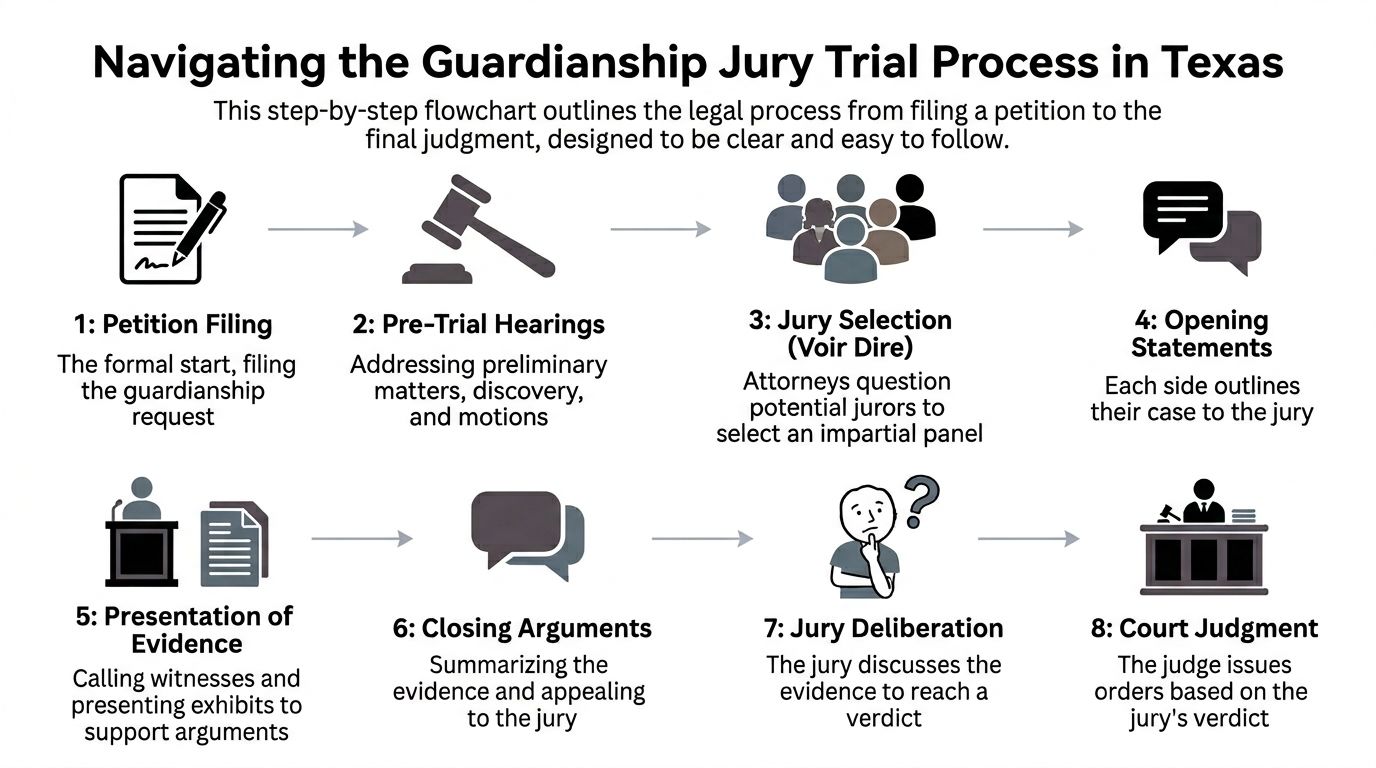
Jury selection
The trial often begins with voir dire, which is the process of questioning potential jurors.
Lawyers and the court try to identify people who can be fair and who can listen carefully to evidence about aging, disability, mental health, family conflict, and caregiving. Some jurors may have personal experiences that affect how they view these issues.
This part matters more than many families expect. A guardianship case can trigger strong reactions because almost everyone has known someone who needed help.
Opening statements
Each side gives the jury a roadmap.
The applicant may explain why protection is needed. The opposing side may argue that the proposed ward still has decision-making ability, that alternatives exist, or that a different person should serve.
Openings are not evidence. They are a guide to what each side believes the proof will show.
Presentation of evidence
Here, the case is built, piece by piece.
According to this Texas jury-trial guidance discussing clear and convincing evidence and broad-form jury submissions, jury charges in guardianship trials use the clear and convincing evidence standard, not the lower preponderance standard used in many civil cases. That source also explains that jury instructions define terms like “incapacitated person” and ask direct questions about necessity, with broad-form submissions preferred to reduce inconsistency.
Building a wall provides a good analogy. A low standard may allow a wall that barely stands. Clear and convincing evidence requires a much stronger structure. The proof must be solid, consistent, and persuasive.
Evidence may include:
- Physician capacity assessments: These often address diagnosis, functioning, and limits on decision-making.
- Witness testimony: Family members, caregivers, social workers, or others may describe what they have personally seen.
- Court investigator or related reports: These can help the jury understand the proposed ward’s situation.
- Information about alternatives: The court and jury may consider whether something less restrictive than guardianship would work.
The proposed ward’s presence can also shape the courtroom dynamic. In many cases, jurors are not just hearing about a person. They are seeing that person and observing how he or she responds.
A fuller discussion of courtroom stages appears in this guide to the Texas guardianship trial process.
Jury charge and deliberation
Near the end of the evidence, the judge prepares the questions and instructions the jury will receive.
This part is technical, but the basic point is simple. The jury does not answer whatever question a family member wishes had been asked. The jury answers the questions the law permits, using the legal definitions the court provides.
Here is a short video that helps many families get more comfortable with the courtroom setting before trial.
Verdict and judgment
After deliberation, the jury returns its answers. Then the judge enters judgment based on that verdict and any legal rulings required to finish the case.
If a guardian is appointed, the work is not over. The guardian must follow the court’s orders and ongoing duties. Those duties may include reporting, accountings, and compliance with the Estates Code. That is why trial preparation should always include a plan for what happens after the verdict, not just how to win it.
A guardianship trial is not only about proving a need. It is also about showing the court that any future guardian can carry out serious legal duties responsibly.
Strategic Considerations Before Requesting a Jury
A jury trial can be a powerful protection. It can also make a hard case harder.
Families sometimes ask for a jury because emotions are high. That reaction is understandable. But the better question is whether a jury serves the vulnerable person’s interests and the family’s practical goals.

Reasons a jury may help
A jury may be worth serious consideration when the dispute turns on credibility, family conflict, or a sharp disagreement over who should be trusted.
Some families also feel more comfortable having a panel of community members hear the case. In a very personal dispute, that can feel fairer than relying on one decision-maker alone.
A jury setting can also influence negotiations. When both sides know they may need to present the family’s conflict in open court, settlement discussions sometimes become more realistic.
Reasons a jury may create pressure
The trade-offs are real.
According to this discussion of guardianship jury-trial practical implications and appeal risk, contested guardianship jury trials can extend case timelines by months and increase attorney fees tied to jury selection and expert witness preparation. That source also notes that errors involving denial of the jury right can lead to successful appeals, which may cause further delay.
For a family trying to protect someone quickly, those added months can matter. The emotional cost matters too. Jury trials require more preparation, more testimony, and often more public airing of private family problems.
Questions to ask before filing the demand
- Is there an urgent safety issue: If someone needs immediate protection, waiting for a full jury trial may not solve the immediate problem.
- The core dispute: If the conflict is narrow, focused negotiations may work better than a jury setting.
- How strong is the evidence: Jury cases require organized proof, not suspicion or family frustration.
- Can the proposed ward handle the process: The emotional strain on the person at the center of the case should always be considered.
- What happens if the case settles late: Preparation still takes time and money even if the matter resolves before verdict.
Preparation should be deliberate
A jury case punishes rushed preparation. Families should organize medical records, communications, witness lists, and evidence of daily functioning early.
If you want a practical non-guardianship litigation resource on organizing testimony, documents, and witness preparation, this guide on how to prepare for trial offers a helpful framework.
The strongest jury decision is not driven by anger. It is driven by careful proof, a clear legal theory, and a realistic understanding of what the court can order.
For some families, the best path is a jury demand. For others, temporary protection, negotiated limits, or a narrower guardianship may better protect the proposed ward while reducing damage to family relationships.
Frequently Asked Questions About Guardianship Jury Trials
Does the jury have to agree completely
Texas guardianship jury issues are treated with great care because important rights are at stake. Families should discuss the exact verdict requirements with counsel based on the issues submitted and the court’s charge.
If the jury cannot reach the decision required by law, the case may not end cleanly that day. The court may need to address next steps based on the procedural posture of the case.
Does the proposed ward have to attend trial
In contested guardianship proceedings, the proposed ward’s attendance is often an important part of the process. That person is not just a name in court records. The court and jury may need to see and hear from the individual directly, depending on the circumstances and the court’s orders.
This is one reason families should prepare with care and sensitivity.
Can a jury trial be appealed
Yes. Like other probate rulings, issues from a guardianship jury trial can be reviewed on appeal in the right circumstances.
Appeals usually focus on legal error, not merely disappointment with the result. Examples can include problems with procedure, evidence rulings, jury charge issues, or wrongful denial of a jury right.
Can the family avoid trial even after asking for a jury
Yes. A jury demand does not force the family to finish the case with a verdict.
Parties can still negotiate. They may agree on a limited guardianship, a different proposed guardian, or another arrangement that better protects the proposed ward while preserving as much independence as possible.
Does a jury decide everything after a guardian is appointed
No. The judge continues to supervise the guardianship.
That ongoing oversight can include bond issues, annual reporting, accountings, fiduciary compliance, modification requests, and termination proceedings. If a guardian fails to do the job properly, the court remains involved.
Are alternatives to guardianship still relevant in a jury case
Yes. They are often central.
Texas courts look closely at whether guardianship is the least restrictive option. If a supported arrangement, powers already in place, or another tool can protect the person adequately, that can shape the entire dispute.
Get Compassionate Guidance for Your Guardianship Case
A contested guardianship case can feel painfully personal because it is. You may be trying to protect a parent, help an adult child, or respond to a crisis while relatives disagree about what should happen next.
A jury trial in guardianship case texas can be an important right when core issues are disputed. But it is also a strategic decision that affects timing, preparation, cost, and emotional strain. Families usually do best when they look at the full picture, including alternatives to guardianship, temporary relief, post-appointment duties, and the long-term needs of the proposed ward.
For readers interested in how law firms educate families about difficult legal processes, this article on content marketing for law firms offers useful perspective on why clear legal guidance matters.
If your family needs help with a contested guardianship, temporary guardianship, a dispute over incapacity, or questions about ending or modifying an existing arrangement, schedule a free consultation with Law Office of Bryan Fagan, PLLC. Their Texas guardianship team helps families in Houston, Dallas, Austin, San Antonio, and statewide understand the process, protect vulnerable loved ones, and move forward with clarity and care.