Skip to content
Deciding to challenge a guardianship is a profound step. It often means you've identified a serious issue—perhaps the guardianship is entirely unnecessary, the person trying to take control is unsuitable, or worse, you suspect your loved one is being exploited. When you are contesting guardianship in Texas, you are formally objecting in court to protect the rights and well-being of a vulnerable person. You are arguing that there are better, less restrictive ways to help, or that the person is not legally incapacitated. It's a courageous move to ensure your loved one’s independence is honored and their best interests are truly at the heart of the matter.
When to Challenge a Texas Guardianship

The moment someone initiates a guardianship is one of the most difficult a family can face. It places a person’s fundamental right to make their own choices directly against the need to keep them safe. While these legal arrangements are intended as a safety net, they can be mishandled or pursued when they aren't the right solution. We understand the emotional and financial challenges this brings. If you have a solid reason to believe a guardianship is not in your loved one’s best interest, you have every right to challenge it.
Here at The Law Office of Bryan Fagan, we have walked with many Texas families through this exact situation. Our mission is to bring clarity and compassionate guidance to these complex legal matters, always keeping the person's dignity and rights at the forefront.
The Proposed Guardian Is Unsuitable
One of the most common reasons to contest a guardianship is when the person applying is simply not the right fit. Under Title 3, Subtitle G of the Texas Estates Code, a court is prohibited from appointing someone who has a conflict of interest, a history of poor conduct, or is otherwise not up to the task.
Consider this common scenario: An elderly father in Harris County begins showing signs of memory loss. One of his three children—the one with a long history of financial trouble and a strained relationship with his father—suddenly files for guardianship over his father's estate. The other two siblings are rightfully concerned. Is their brother trying to protect their dad, or is he seeking control of his finances for personal gain? This is a classic example where challenging the guardianship is not just an option; it's a duty to protect your loved one.
You may have strong grounds to object if the proposed guardian:
- Has a history of mismanaging their own finances.
- Shows a pattern of neglecting or exploiting the proposed ward.
- Has a clear conflict of interest, such as owing a large debt to the proposed ward.
- Lacks the experience or skills to handle complex medical or financial affairs.
A guardianship grants immense power over another person's life. The court's primary duty is to ensure the person appointed to that role is trustworthy, capable, and acting solely in the best interests of the ward.
The Proposed Ward Is Not Incapacitated
A guardianship is a last resort, legally appropriate only when a person is proven to be "incapacitated." This is a high legal standard. It means they are genuinely unable to provide for their own food, clothing, or shelter, or they cannot manage their financial affairs. Needing some help does not automatically meet this definition.
For instance, an aging mother in a Dallas-area suburb might have physical limitations that make driving and shopping difficult. However, if she remains mentally sharp and fully capable of directing her own finances and healthcare with some support, a full guardianship may be inappropriate. If a well-meaning but overbearing relative tries to impose a full guardianship, you could contest it by demonstrating she is not legally incapacitated and that less restrictive options can provide the needed support without stripping her of her rights.
Less Restrictive Alternatives Exist
Texas law is very clear: courts must consider less restrictive alternatives before imposing a guardianship. These are legal tools that offer support without the complete loss of independence. If one of these alternatives could adequately protect your loved one, you have a solid foundation for your objection. Recognizing the signs of financial abuse is critical in determining if a less restrictive option is safe, a topic we explore in our article on red flags of exploitation in Texas guardianship cases.
If you feel a guardianship is being pursued for the wrong reasons, you are not alone. Standing up to protect a family member from an unsuitable guardian or an unnecessary loss of their rights is an act of love and courage. The legal team at The Law Office of Bryan Fagan is ready to provide the personalized guidance you need. Schedule a free consultation today to discuss your concerns and understand your options.
Building Your Case With Legal Grounds
When you believe deep down that a guardianship is wrong for your loved one, that's a powerful starting point. But in a Texas probate court, whether in Harris County or elsewhere, that conviction must be supported by a solid legal argument—what the law calls a "ground" for objection.
Building your case is not about starting a family feud. It’s about ensuring the law is applied correctly to protect the person you care about. The first step is to identify the specific legal reason under the Texas Estates Code that fits your family's situation.
The Proposed Ward Is Not Actually Incapacitated
The most direct way to contest a guardianship is to prove it isn’t necessary. A guardianship is a last resort, reserved for when someone is truly unable to care for themselves. Simply getting older, having a physical disability, or making a few questionable choices does not automatically mean a person is legally incapacitated.
The Texas Estates Code § 1002.017 provides a strict definition of an “incapacitated person.” To win on this ground, you must show the court with clear and convincing evidence that the proposed ward can still, perhaps with assistance, provide for their own food, clothing, and shelter or manage their financial affairs. This often involves obtaining a second medical opinion or gathering testimony from friends and neighbors who can speak to their daily functioning.
The Person Applying to Be Guardian Is Unsuitable
In other situations, everyone may agree that help is needed, but the person applying to be guardian is the wrong choice. The court has a legal duty to appoint a suitable individual who will always act in the proposed ward's best interest. You can contest the application by proving the applicant is disqualified.
Texas law identifies several red flags that can make someone unsuitable, including:
- Conflicts of Interest: The applicant owes the proposed ward money, is a beneficiary in their will, or has other entanglements that could compromise their judgment.
- Lack of Experience: They have no experience managing finances or complex medical situations and are not equipped for such a significant responsibility.
- A History of Bad Conduct: There is evidence of past neglect, exploitation, or abuse involving the proposed ward or others.
For example, if your uncle, who has a history of bankruptcies, suddenly wants to manage your grandmother’s life savings, his unsuitability is a powerful argument for the court to deny his application.
A guardianship grants immense power over another person's life and property. When you argue an applicant is unsuitable, you're showing the court that appointing them would create an unacceptable risk of harm, neglect, or financial abuse.
Less Restrictive Alternatives Haven't Been Tried
Texas law is clear: courts must prioritize solutions that interfere as little as possible with a person’s independence. Before a judge can grant a guardianship, they must consider whether a less restrictive alternative would be effective. If you can present a workable alternative, you have a strong case against the guardianship.
These alternatives are powerful legal tools that can provide needed support without stripping away someone's rights. Common examples include:
- A Durable Power of Attorney for managing finances.
- A Medical Power of Attorney for making healthcare decisions.
- A joint bank account with a trusted family member.
- A thoughtfully prepared trust as part of a complete Estate Planning strategy.
When you present the court with a plan that uses one of these tools, you demonstrate that you are focused on a practical solution, not just on obstruction.
To help you see how these pieces fit together, here's a summary of the common legal grounds for contesting a guardianship in Texas and the evidence you'll need.
Legal Grounds for Contesting Guardianship in Texas
| Reason for Contest | What You Need to Prove | Example Evidence |
|---|---|---|
| Not Incapacitated | The proposed ward can manage their own basic needs and decisions, perhaps with some support. | A second doctor's opinion, testimony from friends and neighbors, photos or videos showing daily capabilities. |
| Unsuitable Applicant | The person applying has a conflict of interest, a history of misconduct, or lacks the necessary skills. | Financial records showing debt, criminal background checks, witness testimony about past neglect or poor judgment. |
| Less Restrictive Option | Another legal tool can protect the person and their assets without a full guardianship. | A valid and signed Power of Attorney, a detailed care plan, proof of an existing support system. |
This process is emotionally draining and can feel overwhelming. You don’t have to face it by yourself. The experienced and compassionate attorneys at The Law Office of Bryan Fagan are here to help you understand your options and build the strongest case possible. Schedule a free consultation with our team today to get the clear, practical guidance your family deserves.
Navigating the Guardianship Court Process
Walking into a Texas courtroom to contest a guardianship can feel intimidating, but understanding the process can empower you. The journey, from filing your opposition to the judge’s final ruling, follows a clear structure. Our goal is to demystify this legal process, providing the clarity your family needs during a difficult time.
The legal challenge officially begins when you file a formal opposition in the appropriate probate court, such as one of the Harris County Probate Courts. This filing notifies the court that you are contesting the guardianship application. The case then moves into a critical fact-finding phase known as "discovery," where both sides gather and exchange information.
Building a strong case rests on three core pillars: having valid grounds, gathering the right evidence, and filing the correct legal documents.
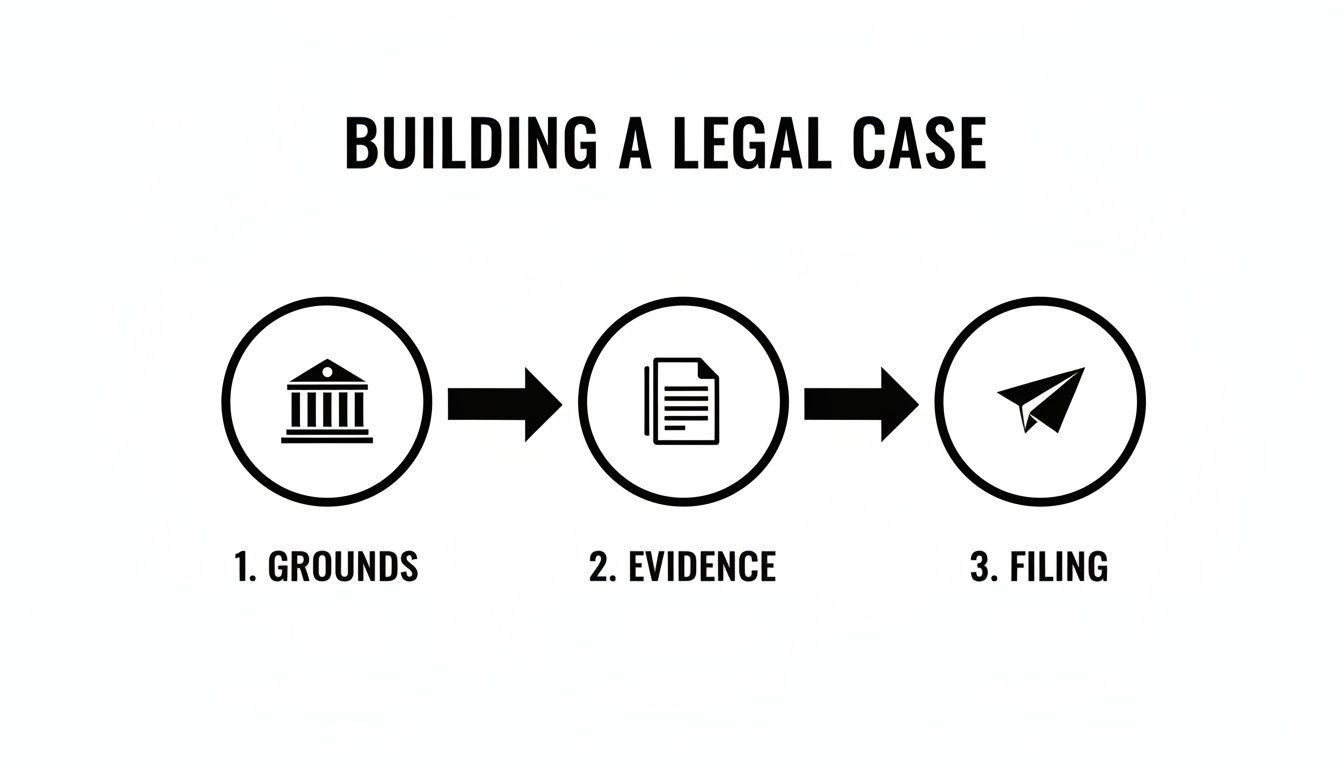
As you can see, it's a connected process. Your legal grounds determine the evidence you need, which then forms the backbone of your court filings.
The Role of Court-Appointed Professionals
In a contested guardianship, the judge will not simply take two opposing sides at their word. To obtain an unbiased perspective, the court appoints an attorney ad litem. This is an independent lawyer whose sole purpose is to represent the best interests of the proposed ward—the person at the heart of the case.
The attorney ad litem acts as the court's eyes and ears. They will meet with the proposed ward, interview family members, speak with doctors, and review all relevant records. Afterward, they submit a detailed report to the judge with their professional recommendation. This report is incredibly influential and often carries significant weight in the final decision.
Gathering Evidence and Preparing for the Hearing
The discovery phase is your opportunity to build a compelling argument against the guardianship or the person seeking to be guardian. Our legal team works tirelessly to collect the proof needed to support your position.
Evidence can come in many forms, and we'll look for anything that tells the true story:
- Medical Records: These create a timeline of the proposed ward's health and cognitive state.
- Financial Statements: Bank records, credit card statements, or property deeds can demonstrate financial competence or, unfortunately, expose financial abuse by an applicant who shouldn't be in control.
- Witness Testimony: Statements from friends, neighbors, caregivers, or other relatives can paint a vivid picture of the proposed ward's daily abilities and lifestyle.
The reasons for contesting a guardianship in Texas are often serious. Statistics from the Texas Department of Family and Protective Services highlight the high stakes, with 87,257 complaints logged in a single year. A staggering 88.2% of these cases involved allegations of abuse, neglect, or exploitation. These situations frequently lead to guardianship referrals, especially when someone shows signs of incapacity under Texas Estates Code §1002.017 and remains at risk.
The Contested Hearing and the CME
The main event in the court process is the contested hearing. This is where both sides present their evidence and make their case to the judge. One of the most critical pieces of evidence is the Certificate of Medical Examination (CME). This is a form completed by a physician that assesses the proposed ward’s physical and mental condition.
A favorable CME is often the cornerstone of a guardianship application. But you have the right to challenge it. Securing a conflicting medical opinion from another qualified doctor can be a powerful tool to turn the tide in your favor.
The legal skills needed to navigate a contested guardianship are similar to those required in other complex court matters, such as resolving contentious probate cases. And remember, even if the initial hearing doesn't go your way, it might not be the end of the road. It's important to understand how to appeal a guardianship decision in Texas.
This entire process is legally complex and emotionally taxing. You don't have to face it alone. At the Law Office of Bryan Fagan, we are here to provide compassionate, skilled guidance. Schedule a free consultation with us today to discuss your case and learn how we can help protect your loved one.
Gathering Evidence and Proving Capacity

When you decide to contest a guardianship, your entire case comes down to evidence. A probate judge, whether in Harris County or anywhere else in Texas, will not make a decision based on feelings or good intentions. They require solid, credible proof to make a ruling that will forever change someone's life.
Building a winning case means gathering the right documents and testimony to tell the true story. It’s not about simply disagreeing with the person who filed for guardianship; it's about strategically collecting facts that prove your loved one is not incapacitated or that a less restrictive option is a better fit.
The Cornerstone of Capacity Evidence: The CME
At the center of nearly every guardianship contest is the Certificate of Medical Examination (CME). This isn't just any doctor's note; it's a specific legal form a physician must complete and file with the court. The CME provides the doctor's professional opinion on the proposed ward's physical and mental condition and their ability to manage their own life.
Because this document carries so much weight, it's often the main piece of evidence a contest revolves around. If a CME states your loved one is incapacitated, it can feel like the final word—but it’s not. You have every right to challenge its findings. Our firm regularly helps families obtain a second, independent medical opinion to provide the court with a more complete picture. You can learn more about the physician's certificate for guardianship in Texas and what it involves.
Beyond the Medical Examination
While the CME is critical, it's just one piece of the puzzle. A strong case is built with multiple layers of proof that paint a full and accurate picture for the judge. We help our clients gather all the necessary evidence to do just that.
This often includes:
- Financial Records: Bank statements, tax returns, and property deeds can show a clear history of your loved one managing their own finances. They can also reveal red flags, like suspicious transactions by the person seeking the guardianship, pointing to a conflict of interest or potential exploitation.
- Witness Testimony: Nothing is more powerful than firsthand accounts. We interview friends, neighbors, caregivers, and other family members who interact with your loved one regularly. Their stories can show the court that the person is capable of self-care and making sound choices, even if they need some assistance.
- Personal Documents and Communications: We have seen journals, emails, and even social media posts used to illustrate a person’s clear state of mind, their wishes, and their ability to communicate effectively.
A guardianship contest is not won on emotion, but on evidence. The more objective, well-documented proof you can present, the more likely you are to persuade the court that your loved one's autonomy should be preserved.
Documenting Misconduct and Exploitation
In some of the most difficult cases, the reason for contesting a guardianship is to protect a loved one from an unfit individual. If you have reason to believe the applicant has a history of financial abuse, neglect, or manipulation, we must document it in a way that is admissible in a Texas court.
This is where technical details matter. Converting spoken interviews, depositions, or other recordings into written transcripts is a crucial step. This process often requires professional legal transcription services to ensure every word is captured accurately for the court record.
Sadly, this kind of oversight is desperately needed. A 2018 U.S. Senate report found that out of thousands of Texas guardianship files reviewed, a staggering 32% were out of compliance with required reporting. This shows that once an unsuitable guardian is appointed, the system often fails to catch their misconduct, making it vital to stop them from gaining control in the first place.
Trying to gather all this evidence while under intense emotional stress can feel impossible. That's where we come in. At The Law Office of Bryan Fagan, we take on the burden of building a strong, evidence-based case for you. Contact us today for a free consultation to discuss your family’s situation.
Understanding Outcomes and Next Steps
The judge's decision after a contested hearing is a major turning point, but it is rarely the final word. That ruling sets the stage for what comes next—whether that’s celebrating a hard-won victory, regrouping after a setback, or adapting to a new reality for your family. Understanding the potential paths forward is crucial for protecting your loved one in the long run.
Once the hearing concludes and the judge has considered all the evidence, a ruling will be issued. In our experience, families should be prepared for one of three main outcomes.
Potential Rulings in a Contested Guardianship
When you contest a guardianship, the judge’s decision will fall into one of these categories. Each one triggers a different set of actions for your loved one and your family.
Guardianship Is Denied: This is the outcome we strive for. The court agrees with you that a guardianship is not necessary. It’s a significant victory for the proposed ward's independence, usually because we successfully demonstrated they are not incapacitated or that less restrictive alternatives are a better fit.
Guardianship Is Granted to the Applicant: The court sides with the person who originally filed and establishes the guardianship. This can feel like a major defeat, but it is absolutely not the end of your ability to advocate for and protect your loved one.
A Different Guardian Is Appointed: Sometimes, the judge agrees that a guardianship is needed but is not convinced that either the original applicant or the person you suggested is the right choice. In these situations, the court might appoint another family member, a private professional guardian, or even a public guardianship program to step in.
No matter which way the ruling goes, the legal process doesn't just end. It simply shifts into a new phase.
Appealing a Guardianship Decision
If the court establishes a guardianship that you truly believe is wrong or will be harmful, you have the right to appeal. It’s important to understand that an appeal is not a second trial; you don't get to present new evidence or re-argue your case. Instead, you're asking a higher court to review the trial for legal errors.
To have a chance at a successful appeal, your attorney must prove the judge made a significant mistake when applying the law or interpreting the evidence—a legal standard known as an "abuse of discretion." Appeals are complex and have strict, non-negotiable deadlines. It is critical to speak with your lawyer immediately after the ruling if this is a path you wish to consider. Our firm can provide a straightforward assessment of the merits of an appeal in your specific case.
The judge's ruling at the hearing is a critical point, but it's not always the final chapter. Whether appealing a decision or monitoring an active guardianship, your role in protecting your loved one continues.
Modifying or Terminating an Existing Guardianship
What if a guardianship is already in place and has become the source of the problem? The law provides a solution for that, too. Under the Texas Estates Code, you can petition the court to modify the terms of a guardianship or, in some cases, terminate it completely.
For example, if a guardian is misusing funds, neglecting the ward's care, or failing to file their required annual reports with the court, you can file a motion to have them removed. If the ward’s health and capacity improve to the point where they can manage their own affairs again, we can file a motion to restore their rights and end the guardianship altogether.
The need for this kind of oversight is growing. The number of active guardianships in Texas grew by 37% in just five years, reaching 50,478 by 2017. This surge places incredible strain on the courts and naturally leads to more disputes, making it more vital than ever for families to know their rights when contesting a guardianship in Texas. You can explore the data yourself in the Texas Office of Court Administration's full report.
The journey of contesting a guardianship is emotionally and financially demanding. Whether you are at the beginning of this process or need to address an existing arrangement that has gone wrong, you don’t have to face it alone. The Law Office of Bryan Fagan is here to support you at every stage. Schedule a free consultation with our team to discuss your next steps and get the personalized guidance your family deserves.
When your family is facing a guardianship contest, questions and anxieties can feel overwhelming. The situation is already emotionally charged; you don't need the added stress of legal confusion. We've guided countless Texas families through this, and we want to answer some of the most common questions we hear.
How Much Does It Cost to Contest a Guardianship in Texas?
This is almost always the first question families ask, and the honest answer is: it varies. The total cost of contesting a guardianship is tied directly to the specific facts of your case. A disagreement that we can resolve quickly through negotiation will cost significantly less than a bitter fight that ends up in a contested trial.
Several factors will influence the final cost:
- The Complexity of the Case: Is this a straightforward disagreement over who is the best person to serve as guardian? Or does it involve serious allegations like financial abuse that will require a forensic accountant to unravel?
- The County and Court: Every county is different. Filing fees and court costs in a large metropolitan area like Harris County or Dallas County can differ from those in a more rural part of Texas.
- Legal and Expert Fees: The biggest expenses are typically your attorney's fees, court filing fees, the fee for the court-appointed attorney ad litem (who represents the proposed ward), and sometimes, the cost of bringing in an expert witness, like a second doctor.
A simple, quickly resolved contest might cost a few thousand dollars. However, a drawn-out, highly contentious battle can become much more expensive. At our firm, we are committed to transparency. We'll provide you with a clear fee structure and work strategically to manage costs while delivering the strongest possible legal representation.
The only way to get a realistic idea of the potential costs is to talk through the specifics of your case with an experienced guardianship attorney. After hearing the details, we can give you a much more tailored estimate.
Can I Contest a Guardianship Even If My Siblings Disagree?
Yes, you absolutely can. In Texas, any person who has a legitimate interest in the proposed ward's well-being has the legal right—what the courts call "standing"—to contest a guardianship application. This is true even if every other member of the family is on board with it.
The court's primary responsibility, as outlined in the Texas Estates Code, is to do what is in the best interest of the proposed ward. The judge's duty is not to simply rubber-stamp a family consensus.
This situation is far more common than you might imagine. We frequently work with families where siblings are at odds. One child might genuinely believe a guardianship is the only way to protect their aging parent, while another sees it as a drastic and unnecessary step, especially if they have a plan for less restrictive alternatives. If you have valid reasons to believe the proposed guardian isn't suitable or that a guardianship isn't necessary at all, the court needs to hear your side of the story. Our firm has extensive experience navigating these delicate family dynamics, always keeping the focus where it belongs: on the vulnerable adult at the heart of the matter.
What Happens If I Lose the Contest?
If the court decides against your position and establishes the guardianship, it can feel like a crushing defeat. We understand that. But it's crucial to know that this is not the end of your ability to protect your loved one. Your role simply changes—you shift from being an objector to being a watchdog.
Even after a guardian is appointed, you are still an interested person with important rights. Texas law holds guardians to very high standards through what are known as fiduciary duties. These are not suggestions; they are strict legal obligations.
These duties include:
- Filing an Annual Report: Every year, the guardian must file a detailed report with the court explaining the ward's condition, where they are living, and their general well-being.
- Filing an Annual Accounting: The guardian of the estate must submit a meticulous financial accounting that tracks every single dollar that has come into and gone out of the ward’s estate.
You have the right to review these filings, which are public records. If you find evidence that the guardian is mismanaging money, neglecting your loved one, or failing in their duties in any other way, you can and should take action. You have the right to file a motion with the court to have that guardian removed and replaced with someone more suitable. Losing the initial contest doesn't mean you've lost your power to ensure your loved one is safe. The path to protecting them simply changes.
The legal and emotional challenges of contesting a guardianship in Texas can be immense, but you do not have to face them alone. The compassionate and experienced attorneys at The Law Office of Bryan Fagan, PLLC are here to provide the clarity and support your family needs. We are dedicated to protecting the rights and dignity of your loved ones. We invite you to schedule a free, no-obligation consultation to discuss your situation and learn how we can help.