Skip to content
Many families reach this realization. A son notices his mother is remembering appointments again and wants to handle her own spending money. A parent sees an adult child with a disability learning new life skills and asking for more say in medical visits, work decisions, or where to live. A guardian who stepped in during a crisis starts wondering whether the current order still fits real life.
That question matters. A guardianship order can protect someone, but it can also become too broad if the person’s needs change. Texas law allows courts to revisit those orders because life doesn’t stay frozen on the day the judge signed the original paperwork.
For families searching for answers about modifying guardianship powers texas, the most important thing to know is this: asking for a change is not a sign that the guardianship failed. In many cases, it shows the system is working the way it should. It means the court is being asked to match the legal order to the person’s present abilities, risks, and wishes.
If you're carrying guilt, worry, or family conflict while considering this process, you're not alone. Guardianship cases often sit at the intersection of love, fear, money, medical change, and family history. Clear information helps.
Why Guardianship Powers Might Need to Change
Maria became guardian for her father after a health crisis. At the time, he couldn't manage bills, didn't understand medical instructions, and needed close supervision. A year later, things looked different. He could explain his medications, make basic purchases, and strongly preferred to take part in decisions about his bank account and living arrangements. Maria wasn't trying to walk away from helping him. She was trying to honor the progress he had made.
That is a common reason families revisit a guardianship. A court order may have been right when it was entered, but too restrictive later. In other situations, the opposite happens. A ward's condition declines, and the existing powers no longer give the guardian enough authority to protect the person or estate.

Texas families are dealing with this issue more often because guardianship itself has become more common. As of August 31, 2017, Texas had 50,478 active guardianships, a 37% increase over the prior five years, according to testimony on Texas guardianship growth. When more families are under guardianship orders, more families will eventually need a way to adjust those orders.
Guardianship isn't meant to be static
Under Texas Estates Code Title 3, Subtitle G, guardianship is supposed to fit the ward's actual needs. That means the court can limit powers, expand them, or in some cases restore rights. The focus should stay on the least restrictive arrangement that still protects the person.
A modification might involve questions like these:
- Daily choices: Can the ward now decide where to shop, who to visit, or what activities to join?
- Medical involvement: Should the ward have more input in treatment decisions?
- Money management: Is the ward ready to control a small account, allowance, or benefits spending with support?
- Living arrangements: Does the current order give too much or too little authority over residence decisions?
A modification request often starts with one honest observation: "The order on paper no longer matches the person in front of us."
Change can be a healthy legal response
Families sometimes fear the judge will think they made a mistake by seeking a modification. Usually, the more accurate view is the opposite. Courts expect circumstances to change. Recovery, skill-building, aging, illness progression, caregiver burnout, relocation, and conflict over finances can all affect whether the original order still serves the ward well.
That is why annual reviews and continued court oversight matter. Guardianship is serious, but it isn't supposed to erase dignity. A carefully customized modification can preserve protection while giving a loved one back some meaningful control.
Grounds for Modifying a Guardianship in Texas
A Texas court won't change a guardianship just because someone in the family is unhappy with the current arrangement. The court needs a legal reason tied to the ward's welfare, the guardian's ability to serve, or the scope of authority in the existing order.
In plain English, the judge needs to see that something important has changed, or that the current order is no longer the best fit.
A change in the ward's capacity
This is one of the most common grounds. Some people improve after treatment, rehabilitation, therapy, medication adjustment, or simple maturity and life experience. Others lose capacity in new areas and need added protection.
Texas data shows more than two-thirds of active guardianship cases involve people appointed between ages 18 and 44, and nearly 70% involve intellectual disability, according to Texas guardianship demographic reporting and discussion of Estates Code §1151.051. That matters because many young adults continue developing practical decision-making skills after the guardianship begins. A court can use Texas Estates Code §1151.051 to tailor powers so the ward has more input where appropriate.
A few examples help:
- Improvement after injury: A man under guardianship after a stroke regains the ability to understand routine banking and wants control over a personal spending account.
- Growth over time: An adult with developmental disabilities can now understand work schedules, transportation routines, and basic healthcare choices with support.
- Decline in condition: An older adult who once handled daily choices safely now cannot understand medication risks or financial scams.
The guardian can no longer serve effectively
Sometimes the issue isn't the ward's condition. It's the guardian's ability to keep doing the job. A guardian may become ill, move away, face a conflict with the ward, or struggle to manage reporting duties and decisions.
The court can consider whether a different guardian should serve, whether duties should be narrowed, or whether another arrangement makes more sense. If the concern involves misuse of authority or money, families may also need to understand legal action for breach of fiduciary duty by a guardian in Texas.
The current order is too broad or too narrow
Many families assume guardianship is all or nothing. It isn't. Texas courts can separate powers over the person, the estate, or specific rights within each.
A modification may be justified when the current order:
| Situation | Why modification may help |
|---|---|
| The guardian controls all finances, but the ward can manage small recurring expenses | The court may restore limited financial decision-making |
| The ward can participate in medical discussions but has no legal voice | The court may allow more say in healthcare decisions |
| The guardian lacks enough authority to prevent financial exploitation | The court may expand estate-related powers |
| Family circumstances changed after the original order | The court may clarify duties, limits, or successor arrangements |
Who can ask for a change
Texas law is broad about who may bring concerns to the court. Depending on the facts, the request may come from:
- The ward
- The current guardian
- A parent, sibling, or other relative
- Another interested person
- Someone concerned about the ward's welfare or property
Practical rule: Before filing, identify the exact power you want changed. "We want things to be better" is not enough. "We want the ward to regain authority over routine medical consent while the guardian keeps estate powers" is much stronger.
The strongest petitions usually connect the legal request to a specific real-world problem. Judges respond better to focused changes than vague frustration.
The Roadmap to Filing for a Modification
A common moment brings families to this point. A son notices that his mother can now handle her weekly spending and clearly explain her medical preferences, but the old guardianship order still gives her no legal say. Or a guardian realizes the current order does not give enough authority to stop financial exploitation. In both situations, the question is the same. How do you ask the court to update the order so it fits the person’s real needs today?
In Texas, a modification request is usually filed in the same court that created the guardianship. That sounds simple, but the first part is often more like checking a map before a trip than racing to the courthouse. You need to know exactly what order is in place, what power needs to change, and whether you are asking for a small adjustment, a broader shift in authority, or full restoration of rights.
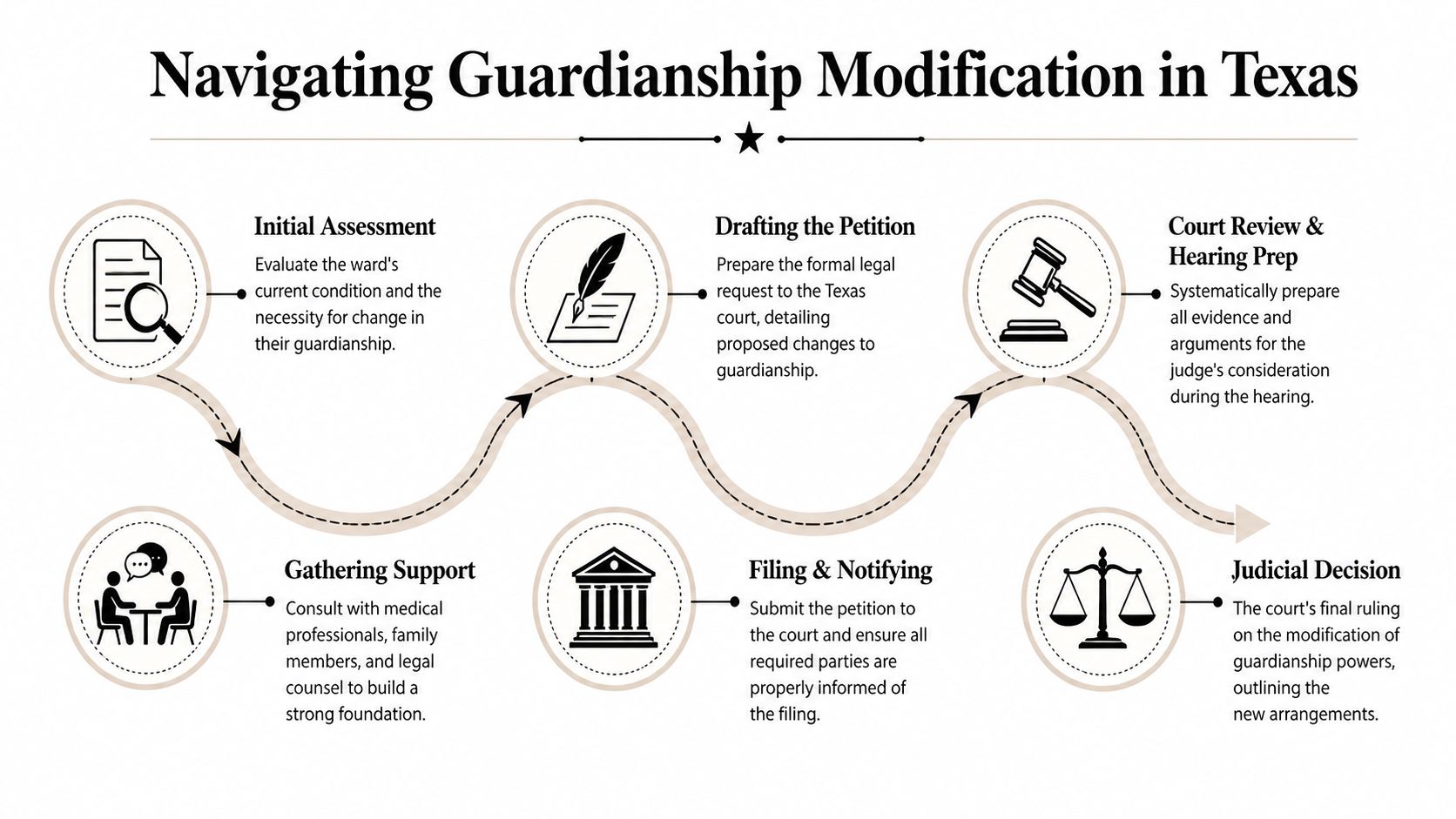
Read the current order like a checklist
Start with the signed guardianship order, not family memory. Many relatives remember that "the guardian handles everything," but court orders are often much more specific.
Read for four things:
- What type of guardianship exists: over the person, the estate, or both
- Which rights were removed or limited: medical consent, residence decisions, contracting, finances, voting, or marriage
- What the guardian must file with the court: annual reports, accountings, or care updates
- Whether the order already leaves room for independence: some orders are limited even if families do not realize it
This step matters because the petition should match the order you already have. If you ask to restore a right that was never removed, or to expand a power the guardian already has, the case gets harder than it needs to be.
Decide what change actually fits
Families often start with a feeling. "Something about this order is no longer right." That feeling may be correct, but the court needs a precise request.
Your request may involve:
- Narrowing the guardianship so the ward regains a specific right
- Expanding a power so the guardian can address a real safety or financial problem
- Replacing part of the guardianship with support, such as a Supported Decision-Making Agreement for choices the ward can make with help rather than substitution
- Ending the guardianship entirely if the person has regained enough capacity for full restoration of rights
That third option is easy to miss. Some families assume the only choices are "keep guardianship" or "end guardianship." Texas law allows a more individualized approach. In the right case, a petition can ask the court to reduce restrictions and use a Supported Decision-Making Agreement as a less restrictive alternative for certain decisions.
File a petition that is specific
The petition is the document that tells the court what you want changed and why. General statements do not help much. Specific facts do.
A weak petition says the ward is doing better.
A stronger petition says the ward has, over time, shown the ability to manage routine purchases, understand basic medical options, and communicate a consistent preference about where to live. It then asks for those identified rights to be restored while keeping other protections in place.
Courts also may appoint a Guardian ad Litem or Attorney ad Litem to look at the ward’s interests independently. That can feel intimidating to families, but it serves an important purpose. The court wants an updated, neutral look at what protects the ward and what restrictions are still justified.
Give notice to the right people
After filing, the court requires notice to the people who have a legal interest in the case. That may include the ward, the current guardian, close relatives, and others identified by the court.
This part can feel mechanical during an emotional family situation. Still, notice is one of the court’s fairness rules. It gives everyone a chance to respond before the judge changes legal rights or duties.
Small filing mistakes can often be corrected. Notice problems can cause delays, extra expense, and another hearing setting. Keep a calendar, track deadlines, and confirm who must be served.
Gather the records before the court asks twice
Good modification cases are usually built before the hearing date arrives. Waiting until the last minute creates stress and leaves gaps in the story.
Start gathering:
- Current medical evaluations or physician letters
- Therapy, counseling, or functional assessment records
- Guardian reports and accountings already filed with the court
- School, work, or program records showing daily functioning
- Statements from caregivers or others who regularly observe decision-making
- Documents that show a less restrictive option could work, including a proposed Supported Decision-Making Agreement if that is part of the request
If you want a clearer picture of what happens once the court sets the matter for proof, review what to expect at an evidentiary hearing in a Texas guardianship case.
One practical point helps many families. The court is not looking for perfection. It is trying to answer a narrower question: what level of authority and support fits this person now? When your filing stays focused on that question, the process becomes easier to understand and easier to present.
Building Your Case Evidence and the Court Hearing
Filing gets your case on the docket. Evidence is what moves it forward.
Judges in guardianship court usually want more than good intentions. They want current, credible proof that the requested change protects the ward while respecting the ward's rights.
What evidence tends to matter most
Medical evidence often carries the most weight. If the request is based on improved capacity, the court will want recent professional evaluation, not family optimism alone. If the issue is decline or risk, updated records matter there too.
Useful evidence may include:
- Physician letters or examinations: These can explain what the ward understands, where support is still needed, and whether improvement has occurred.
- Testimony from people who see daily functioning: Caregivers, teachers, therapists, social workers, or family members may describe how the ward manages routines.
- Financial records: If estate powers are at issue, accountings, spending records, and benefit management documents can show whether broader or narrower control is appropriate.
- Annual guardianship reports: These often reveal patterns in care, compliance, and capacity over time.
If you want a closer look at the courtroom side of the process, this guide to an evidentiary hearing in a Texas guardianship case can help you understand what judges expect.
Understanding the burden of proof
Texas guardianship modification cases often turn on whether the judge believes the requested change is supported by the evidence. In many modification disputes, the court applies a preponderance of the evidence standard. In everyday language, that means the judge must decide the requested change is more likely justified than not.
The situation resembles a balance scale. If the evidence tips even somewhat in favor of the requested modification, that standard may be met. Full restoration issues can involve a higher level of proof in some circumstances, which is one reason legal guidance matters.
Bring proof of function, not just proof of diagnosis. A label alone rarely answers what the ward can actually do today.
Common mistakes families make
Often, strong cases are lost under these circumstances. According to reported discussion of Texas modification outcomes, ward-initiated petitions succeed in 40% of cases with legal counsel versus less than 10% for those filed without counsel, and inadequate medical documentation can account for 35% of dismissals.
The numbers point to a practical truth. Families usually know their loved one best, but courts still require legally organized evidence.
Frequent problems include:
- Old medical records: A report from long ago may not tell the judge what the ward can do now.
- Vague requests: Asking for "more independence" without naming specific rights creates confusion.
- Family-only evidence: Judges want neutral support too, not just testimony from relatives with strong emotions.
- Poor hearing preparation: Important records get left out, witnesses aren't ready, or notice issues distract from the merits.
A short video can also help if you're trying to picture what preparation and court advocacy may involve.
What happens at the hearing
Hearings vary by county and judge, but the basic rhythm is familiar. The court calls the case. Attorneys and parties identify themselves. The judge may hear from the guardian, the ward, the attorney ad litem or guardian ad litem, and any witnesses.
The judge is often trying to answer practical questions:
| Judge's concern | What helps answer it |
|---|---|
| What has changed since the original order? | Updated medical and daily function evidence |
| Which rights can the ward safely exercise? | Specific examples of decision-making ability |
| Is the request realistic and tailored? | A narrow, well-defined proposed order |
| Will the ward remain protected? | A plan for support, oversight, or limited continued guardianship |
Most families feel nervous about the hearing. That's normal. Good preparation turns a stressful day into a focused conversation about the ward's present needs.
What Kind of Changes Can a Court Make
A successful modification doesn't always mean the guardianship ends. Sometimes the court makes a narrow adjustment. Sometimes the court replaces one guardian with another. Sometimes the court restores a significant set of rights. The result depends on what the evidence supports.
That flexibility is one reason these cases matter so much. The court isn't limited to only two choices.

Small changes can make a big difference
Many families imagine a dramatic court order. In reality, some of the most helpful modifications are targeted.
A judge may decide the ward should regain one area of control while the guardian keeps authority in another. For example, the ward may be ready to make routine personal decisions but not manage investments or large transfers of property. Or the guardian may keep healthcare authority while the ward regains more voice in social and residential decisions.
Common outcomes include:
- Limiting estate powers: The guardian no longer controls every dollar, only major assets or protected accounts.
- Adjusting personal decision rights: The ward gains more say in residence, services, education, work, or social choices.
- Changing the guardian: A successor guardian is appointed because the current guardian can no longer serve effectively.
- Clarifying duties: The order becomes more specific so conflict decreases and expectations are clear.
Full restoration and less restrictive alternatives
Some cases support full restoration of rights. Others support moving toward a less restrictive model without ending all support.
One of the most important alternatives is the Supported Decision-Making Agreement, often shortened to SDMA. Texas passed SB 1881 in 2015 to allow people to retain decision-making authority while receiving help from a trusted supporter, as described in Texas guardianship reform materials discussing supported decision-making.
That matters because many people don't need someone else to fully decide for them. They need help understanding options, asking questions, comparing consequences, and communicating a decision.
Some wards don't need a substitute decision-maker in every area. They need a legal structure that respects their voice while adding support.
An SDMA can be especially useful when a ward understands choices better with help from a parent, sibling, caseworker, or trusted adviser. In the right case, a modification hearing can be the moment to ask whether supported decision-making is a better fit than ongoing broad guardianship.
Comparing likely outcomes
| Court response | Best fit for this kind of situation |
|---|---|
| Limited modification | The ward has improved in one area but still needs protection in others |
| Expanded powers for guardian | The ward now faces higher risk and needs more oversight |
| Successor guardian | The current guardian cannot continue or has a conflict |
| Termination or restoration | The ward can now manage affairs independently |
| Transition to SDMA or other support | The ward can decide with guidance rather than full substitution |
Families also benefit from coordinating guardianship changes with related planning tools. If healthcare wishes, end-of-life choices, or substitute decision-making documents are part of the conversation, a plain-English resource on understanding Texas advance directives can help place those documents in context.
Emergency and temporary orders still matter
Sometimes families need relief before the full modification dispute is over. If there is immediate risk involving medical care, housing, or finances, temporary guardianship issues or emergency motions may be part of the larger case. Those requests are especially fact-sensitive, and local practice in places like Harris County Probate Court can shape how quickly the court acts.
The key point is simple. Modification isn't one remedy. It's a range of possible court responses designed to better match real life.
Practical Guidance Costs and Professional Help
A common scene plays out after families decide a guardianship order no longer fits. Someone asks, "What will this cost, and do we need a lawyer?" Those are fair questions. A modification case can feel like trying to repair part of a house while people are still living in it. You need to know what work is minor, what requires permits, and when a trained professional should step in.
Cost depends on what you are asking the court to change. A small adjustment, such as restoring the right to make some medical choices, usually looks different from a contested fight over money management or a request to end the guardianship and replace it with a less restrictive option like a Supported Decision-Making Agreement. Filing fees, service costs, updated medical evaluations, attorney fees, and court-appointed professional fees may all be part of the picture. If the case is contested, expenses often rise because there may be more hearings, more records to review, and more witness preparation.
For a clearer breakdown of the expenses families often see, review this guide on Texas guardianship costs and what to expect.
What to gather before meeting a lawyer
Good preparation saves money. It also helps your lawyer tell the difference between a case that needs a narrow fix and one that may support broader relief, including partial restoration of rights or a move toward supported decision-making.
Bring a folder with the documents that show where things stand now and what has changed:
- The current guardianship order: This is the court's map of the ward's current rights and the guardian's current powers.
- Letters of guardianship and any later orders: These confirm who has authority today.
- Recent medical records or evaluations: Courts usually want current information, not an old diagnosis standing alone.
- Annual reports or accountings: These may show whether the present arrangement still matches the ward's needs.
- A simple timeline: List major changes in health, housing, daily functioning, relationships, work, school, or finances.
- Names and contact information for key witnesses: Doctors, therapists, caregivers, case managers, teachers, and relatives who have first-hand knowledge.
- Any less restrictive alternatives already in use: Powers of attorney, benefit-management help, case management services, or a proposed Supported Decision-Making Agreement.
That last item matters more than families often expect. If the ward can make some or many decisions with support, the court may want to see what that support would look like in real life, not just hear that the family prefers "more independence."
Signs you should get legal help quickly
Some modification requests are manageable. Others can go sideways fast.
Get legal help sooner if any of these apply:
- The current guardian opposes the change
- Relatives disagree about safety, money, housing, or medical care
- You suspect misuse of funds, poor recordkeeping, or conflict of interest
- The ward owns significant property or receives settlement funds, trust distributions, or other protected assets
- There is an urgent health or safety concern
- You want to replace full guardianship with a less restrictive arrangement
- The ward's abilities have improved, and you may be seeking partial or full restoration of rights
- You live in another state and need to work through a Texas probate court
A lawyer's job is not only to file papers. A good guardianship lawyer helps shape the request so it fits the evidence, the law, and the court's practical concerns. For example, a family may come in asking to "end the guardianship," but the stronger legal path may be to restore some rights now, keep protection in a few areas, and propose an SDMA for daily decision support. That kind of framing can make the case clearer and more realistic.
Think beyond the hearing
The court order is only part of the work. The new arrangement has to function on Monday morning.
If powers change, banks, doctors, schools, care facilities, benefit offices, and housing providers may need copies of the new order. If a guardian is replaced, records and property may need to be transferred. If rights are restored, the ward and the family both need to understand what changed and what did not. Confusion after a hearing can create avoidable problems.
This is also a good time to look at the whole support system. Some families learn that the right answer is not "all guardianship" or "no guardianship." The better fit may be a narrower court order plus practical support tools, including a Supported Decision-Making Agreement, trusted helpers, updated medical releases, and clear financial routines. That approach can protect the ward while giving back as much decision-making authority as the person can safely use.
The emotional strain is real too. Modification cases often bring up grief, guilt, old sibling conflicts, and fear about making the wrong choice. Try to keep the focus where the judge will keep it: the ward's present abilities, present risks, and present need for support. That focus helps families make better decisions and present a stronger case.
Frequently Asked Questions about Modifying Guardianship
Can a ward file to modify their own guardianship
Yes. In Texas, a ward can ask the court to modify, restore, or otherwise revisit the guardianship. That right is part of the larger rights framework that recognizes the ward as a person with legal voice, not just the subject of a case. In practice, the ward's request is much stronger when it is supported by current medical proof and a clear description of the rights the ward wants restored or adjusted.
What if the current guardian opposes the modification
The case doesn't stop just because the guardian objects. It becomes a contested matter for the court to decide. The judge will consider the evidence from both sides, along with any attorney ad litem or guardian ad litem input. If the guardian's objection is based on genuine safety concerns, the court will weigh those carefully. If the objection appears tied to control, conflict, or poor judgment, that may also come out in the evidence.
How long does the process take in Texas
There isn't one universal timeline. The court's docket, the county, the need for medical evaluations, service of notice, and whether the case is contested all affect timing. A focused petition with complete records usually moves more smoothly than one that needs repeated amendments or emergency corrections. Harris County Probate Court may move differently than a smaller county court, and local practice often matters.
Can I ask for a temporary order while the modification is pending
Sometimes, yes. If there is an urgent issue involving health, housing, safety, or finances, temporary relief may be available depending on the facts and the procedural posture of the case. Families should raise urgent circumstances immediately with counsel because emergency requests need to be framed carefully and supported by evidence.
Do I have to ask for full restoration, or can I request one narrow change
You can request a narrow change. In many cases, that is the smarter approach. Courts often respond well to specific requests because they are easier to evaluate and easier to match to current capacity. If the ward can safely handle one category of decisions but not another, the petition should say so plainly.
Is supported decision-making only for people leaving guardianship completely
Not always. It can also be part of a gradual move toward less restriction. A family may ask the court to reduce certain powers while using a Supported Decision-Making Agreement to help the ward handle decisions with guidance. That can be a practical middle path when full independence is not yet realistic, but broad guardianship no longer fits.
If your family is considering a change to an existing guardianship, personalized advice can make the process clearer and less stressful. Law Office of Bryan Fagan, PLLC helps Texas families address guardianship modification, restoration, disputes, temporary orders, probate concerns, and long-term planning with compassion and practical guidance. Schedule a free consultation to talk through your situation, your county court process, and the next steps that best protect your loved one.