Skip to content
A lot of families first think about guardianship as the finish line. The court has appointed someone trustworthy. Daily care is stable. Bills are being handled. Medical decisions have a clear decision-maker behind them.
Then life changes.
A parent serving as guardian gets sick. An aunt who has managed everything passes away. A sibling who meant well burns out and needs to resign. In that moment, families often discover that the ward still needs protection, but the person with legal authority may no longer be able to act. That gap can create real stress, especially when a hospital, care facility, bank, or school needs a legally authorized answer right away.
In Texas, a successor guardian appointment fills that gap. It allows the probate court to place a new qualified person into the role when the original guardian dies, resigns, becomes incapacitated, or is removed. The process sounds simple, but it is formal, document-heavy, and very sensitive because the court is protecting a vulnerable person.
Introduction Why Planning for a Successor Guardian is Critical
One of the hardest conversations in any guardianship case is the one nobody wants to have. What happens if the current guardian can't continue?
For parents of an adult child with disabilities, that question often carries fear. For families caring for an aging parent with dementia, it can feel overwhelming because they have already been through one court proceeding and don't want another. But in practice, planning ahead usually makes the next transition calmer, faster, and far less disruptive for the ward.

Texas has a large and growing guardianship system. As of August 31, 2017, Texas had 50,478 active guardianships with new cases increasing by 7% annually, and a review found 41% of guardianship files were out of compliance with state requirements, according to the U.S. Senate Special Committee on Aging testimony regarding Texas guardianship oversight. Those numbers matter because successor appointments depend on an orderly file, current reporting, and clear court supervision.
Why this matters in real life
A successor appointment isn't just paperwork. It protects continuity.
If the ward lives in assisted living, someone must keep signing care documents. If the ward has income or assets, someone must keep managing them. If treatment decisions need to be made, a qualified guardian must have valid authority. Without that continuity, families can find themselves stuck between an urgent need and a legal process that still has to be completed correctly.
Practical rule: The best time to think about a successor is while the current guardian is healthy, organized, and still able to help create a plan.
The emotional side families often underestimate
Successor cases come at vulnerable moments. Families may still be grieving a death, dealing with a medical crisis, or disagreeing about who should take over. In many homes, the ward also struggles with change and may react strongly when a familiar caregiver disappears.
That is why successor guardian appointment texas cases work best when families treat them as both a legal and caregiving transition. The court wants proper filings. The ward needs stability. Good planning serves both.
A simple example helps. A mother serves as guardian of her adult son with significant disabilities. She has done everything for years. If she becomes ill and no one has prepared for the transition, the family may scramble to gather records, notify relatives, file an application, and explain to the court who should step in. If she had already identified a preferred successor and kept the guardianship in compliance, that same transition is usually much smoother.
Understanding the Grounds for a Successor Appointment
A Texas court doesn't appoint a successor guardian just because a family wants a change. The court needs a legally recognized reason, and the application should match that reason clearly.
The common events that trigger a successor case
Most successor appointments arise from one of these situations:
- Death of the current guardian: The guardian has passed away, and someone must step in so the ward isn't left without authority for personal or financial decisions.
- Resignation: A current guardian may no longer be able to continue because of illness, age, stress, relocation, or other personal limits.
- Removal by the court: If a guardian hasn't performed required duties, mishandled funds, or otherwise failed in the role, the court can remove that person and consider a replacement.
- Incapacity of the guardian: Sometimes the guardian is still living but is no longer able to function reliably enough to carry out fiduciary duties.
Those situations are not the same in court. A voluntary resignation usually leads to a different tone and a smoother transfer than a removal case. When removal is involved, the court often looks more closely at records, compliance, and whether the ward has been harmed by delay or poor management.
Who gets priority to serve
Texas courts don't choose a successor based on who speaks the loudest. They look at legal qualification and the best interest of the ward.
A parent or current guardian may sometimes help shape that decision in advance. Texas Estates Code § 1104.053 allows a surviving parent who is a guardian to designate a successor in writing, and the court will prioritize that choice unless the nominee is disqualified or the appointment isn't in the ward's best interest, as explained in this Texas discussion of successor guardian designations under Estates Code sections 1104.053 and 1104.103.
That doesn't mean the nomination is automatic. It means the court starts there.
A written designation helps, but it doesn't replace the court's duty to examine whether the proposed successor is qualified, capable, and appropriate for this ward.
What courts actually examine
In counties such as Harris County, Dallas County, and Bexar County, judges usually want to know practical things, not just family titles. The court may consider:
- Relationship to the ward: Has this person been involved consistently, or have they appeared only after a crisis?
- Ability to manage care: Can the proposed guardian coordinate treatment, housing, school needs, or day-to-day support?
- Ability to manage money if an estate is involved: The court wants a fiduciary, not just a loving relative.
- History of conflict: Ongoing family warfare can matter if it will disrupt the ward's care.
- Alternatives to full guardianship: Texas applications must address whether less restrictive options such as supported decision-making or powers of attorney were considered and remain workable.
A useful distinction for families
A successor guardian isn't the same as a backup named informally around the kitchen table.
Families often say, "We've already agreed my sister will take over." That may help reduce conflict, but it doesn't create authority. Only the probate court can do that. Until the court signs an order and the new guardian qualifies, no one should assume they can act as guardian just because the family agrees.
A short hypothetical makes the point. If a father serves as guardian of his minor child after a settlement and names his brother in writing as the preferred successor, the court will likely give that nomination serious attention. But if the brother has financial problems, lives far away, or can't explain the child's current needs, the judge may choose someone else.
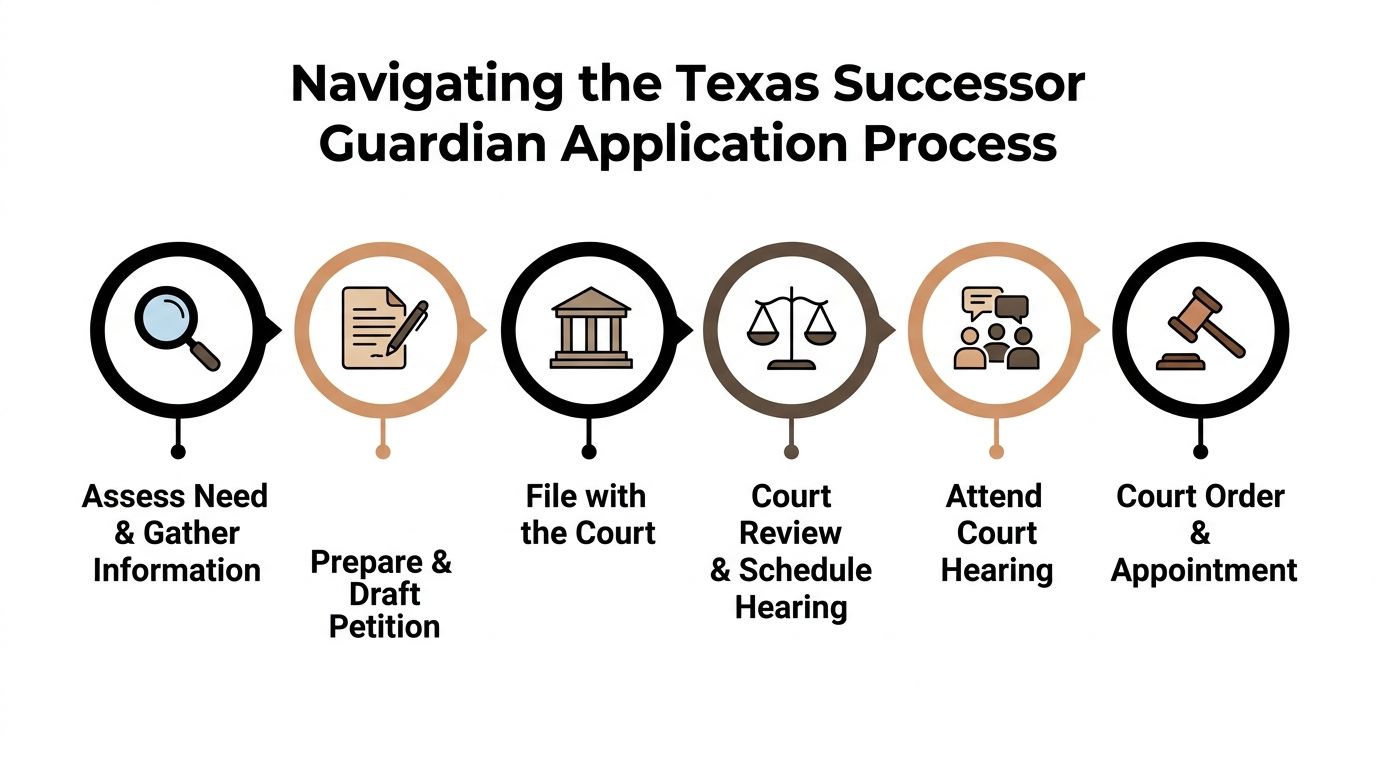
Navigating the Successor Guardian Application Process
Many families find this process challenging. While the law allows a successor appointment, the court still expects strict compliance with filing, service, and supporting documents.
Start with the right application
In most Texas courts, the process begins with an Application for Successor Guardian under Texas Estates Code Chapter 1203. The pleading should identify the existing guardianship, explain why the prior guardian can no longer serve, and state why the proposed successor is qualified.
If the prior guardian resigned, the filing should line up with that resignation. If the guardian died, the application should say so clearly. If the case involves a prior nomination or statutory priority, that should be stated plainly and supported with the correct documents.
Families who are unfamiliar with Texas probate practice often benefit from reviewing a broader guide to filing a guardianship petition in Texas because successor cases still follow many of the same procedural rules as original guardianship matters.
Gather the supporting documents early
The application is only part of the file. Courts often want a full picture before they will set or grant the matter. Depending on the case, the court may require or expect:
A verified report on the ward's condition
The court needs current information about the ward's circumstances and continued need for protection.A final accounting or estate records from the prior guardian
This matters most when there was a guardian of the estate. A messy handoff can stop the transition.Background and qualification materials for the proposed successor
Courts want to know who is stepping into a fiduciary role and whether that person is suitable.Any written designation of successor
If a parent or prior guardian properly nominated someone, include it.Information addressing alternatives to guardianship
Texas courts expect this issue to be addressed, even in successor matters.
Service and notice are where many delays happen
Families often focus on the hearing and forget the service rules. That's a mistake.
In Texas counties like Bexar, the process follows a strict local checklist based on Texas Estates Code §1203.101, and failure to comply with requirements like personal service on the ward, filing a verified report on the ward's condition, and resolving the prior guardian's final accounting causes 25-35% of delays or denials in successor appointments, according to the Bexar County Probate Court successor guardian checklist.
That means families should slow down and confirm every notice requirement before asking for a hearing date.
What usually works best
The strongest successor filings tend to share a few traits:
- Clear reason for the transition: The court shouldn't have to guess whether this is a death, resignation, incapacity, or removal matter.
- Current ward information: Judges want current facts, not assumptions based on an old order.
- Complete service record: If someone had to be personally served, the return should be in the file.
- No loose ends from the prior guardian: Unresolved accounting issues can stall the case.
- A practical care plan: Courts want to see how the ward's life will remain stable after the change.
If the file tells a clean story, the hearing is usually easier. If the file raises unanswered questions, the hearing often becomes a problem-solving session no one wanted.
County practice matters
Texas probate courts don't all move exactly the same way. A statutory probate court in Houston or Dallas may have different scheduling habits than a county court handling guardianships in a smaller county. Some courts are strict about form language. Others focus heavily on proof of service. Some want proposed orders uploaded in a particular format.
That's why local practice matters so much in successor guardian appointment texas cases. A legally sound application can still get delayed if it doesn't match the court's local procedures.
A simple example
Suppose an older sister in San Antonio is serving as guardian of the person for her brother. Her own health declines, so she files to resign and asks that their younger brother in Houston be appointed as successor. If the family submits the resignation, the successor application, a current report on the ward's condition, and proof of proper service, the transition can move in an orderly way. If they file only a short letter asking the court to "switch guardians," the court will likely require more filings and more time.
Don't treat a successor filing like an informal update
This point deserves emphasis. The court sees a successor appointment as a fiduciary change, not an administrative note. The new guardian may control healthcare, placement, benefits, or money. That is why the court expects detail, evidence, and compliance.
Families often save time by creating a checklist that tracks the petition, service, supporting reports, proposed order, and hearing settings. That sort of disciplined approach usually matters more than speed.
The Hearing and Fulfilling Your Duties After Appointment
A hearing for a successor guardian can feel intimidating, especially if the family is already under stress. Most judges are not trying to make the process harder. They are trying to make sure the right person receives legal authority over a vulnerable Texan.

What the judge is looking for
At the hearing, the court usually focuses on a few central questions:
- Is there a valid reason a successor is needed?
- Is the proposed successor legally qualified?
- Is the appointment in the ward's best interest?
- Have notice and service requirements been satisfied?
- Are there unresolved problems from the prior guardian's administration?
The judge may ask practical questions. Where will the ward live? Who takes the ward to medical appointments? How will money be managed? What contact will other relatives have? If an attorney ad litem is involved, that lawyer may also ask pointed questions about the ward's current circumstances and the proposed guardian's plan.
How to prepare for the hearing
Families do better when they prepare for substance, not just appearance.
- Know the ward's routine: Be ready to explain medications, living arrangements, school or care needs, and key supports.
- Bring organized records: Orders, death certificates if relevant, care summaries, and financial information should be easy to access.
- Answer directly: Judges appreciate clear, practical answers.
- Acknowledge your limitations: If you will need help from siblings, case managers, or facility staff, say so. Courts don't expect perfection. They expect reliability.
For a closer look at courtroom procedure, many families find it helpful to review what to expect at a Texas guardianship hearing.
Appointment is not the last step
Many people think the signed order ends the case. It doesn't.
After being appointed, a new successor guardian in Texas typically has 20 days to qualify by taking an oath and posting a bond. Failure to meet these deadlines or later annual reporting requirements can jeopardize the appointment, as discussed in this Texas overview of successor guardianship after resignation or death of a guardian.
That qualification step is what leads to Letters of Guardianship, which are the documents banks, doctors, schools, and facilities usually ask to see.
What works: Treat the order, oath, bond, and letters as one connected chain. If one link is missing, your practical authority may be delayed.
A short video may help if you're preparing for your first hearing or post-appointment responsibilities.
Duties that begin right away
Once qualified, the successor guardian steps into an active fiduciary role. That may include:
| Duty area | What it usually means |
|---|---|
| Personal decisions | Managing housing, medical care, services, and safety if you are guardian of the person |
| Financial oversight | Protecting assets, paying expenses, and keeping records if you are guardian of the estate |
| Court compliance | Filing annual reports or accountings and keeping the court informed |
| Transition management | Collecting records, meeting providers, and making sure the ward's daily life remains stable |
In practice, a smooth start often depends on how quickly the new guardian gathers passwords, records, benefit information, and provider contacts. The legal transfer matters. So does the handoff of real-world information.
When Disputes Arise Contesting a Successor Appointment
Not every family agrees on who should step in. In some cases, conflict starts before the application is filed. In others, it surfaces when relatives receive notice and decide to object.
A contest should focus on the ward's welfare, not old family grievances. Probate courts hear a lot of emotional testimony, but judges are looking for legally relevant facts.
Valid concerns versus personal frustration
A person may have legitimate grounds to challenge a proposed successor if there are concerns about qualification, judgment, honesty, caregiving ability, or conflicts of interest. Examples can include a history of financial mismanagement, a serious inability to cooperate with providers, or a situation where the nominee seems more interested in controlling assets than caring for the ward.
What usually doesn't help is broad testimony that someone is "difficult," "unfair," or "not my first choice" without facts tied to the ward's best interest.
If you're objecting
If you plan to contest a nominee, be specific and organized. Courts respond better to documents, records, and clear examples than to family accusations. Focus on conduct that affects the ward's care, safety, finances, or stability.
Families dealing with that process often need specific advice about evidence, standing, and hearing strategy. A starting point is this discussion of contesting guardianship in Texas.
If you're defending your nomination
If someone objects to your appointment, don't assume the judge will see the conflict the way your family does. Stay grounded in the ward's needs.
Bring records that show involvement. Be able to explain the care plan. Show that you understand the reporting duties and the seriousness of fiduciary obligations. Courts tend to respond well to candidates who are steady, informed, and focused on the ward instead of the family fight.
Sometimes the strongest testimony is simple. "I know her medications, I know her doctors, I know where her benefits come from, and I know what needs to happen next week."
Temporary stability during a fight
Some disputes can't be resolved quickly. If the ward needs immediate protection while the contest is pending, the court may consider temporary arrangements. In the right case, that can preserve care and financial stability while the parties litigate who should serve long term.
That option is often better than letting conflict create a vacuum. The ward should not lose care, housing stability, or access to funds because family members are locked in a dispute.
Practical Tips for Texas Families and Fiduciaries
Good successor cases rarely happen by accident. They happen because someone planned, kept records, and treated compliance seriously.
For current guardians who want to prepare
If you're serving now, one of the best steps you can take is to identify a likely successor in writing if Texas law allows it in your situation. Make sure the person understands the ward's needs, the court's reporting requirements, and the difference between helping informally and serving as a fiduciary.
Also keep the guardianship file current. Annual reports, accountings, care summaries, provider lists, and contact information should be easy to locate. When a transition comes, organized records reduce confusion and conflict.

For incoming successors
Before you agree to serve, ask hard questions:
- What kind of guardianship is this: person, estate, or both?
- What reporting is due soon: annual reports, accountings, bond matters, inventory issues?
- What does the ward need daily: medications, transportation, therapy, school support, facility communication?
- Are there family tensions: if so, can they be managed without hurting the ward?
This is also the point where some families choose structured help from a Texas guardianship firm, a probate practitioner in the county of filing, or a local attorney familiar with the assigned court. The Law Office of Bryan Fagan, PLLC handles Texas guardianship, probate, and estate planning matters, including successor applications and compliance issues.
For out-of-state relatives
Out-of-state family members often assume they can't be appointed. That's not always true. But they should expect closer scrutiny about practical oversight.
An estimated 15-20% of Texas guardianships involve interstate families, and out-of-state successor applicants face unique hurdles. While courts prioritize local oversight, post-2024 probate reforms and virtual hearings have improved success rates for remote applicants who work with local Texas attorneys, according to this Texas discussion of appointing a successor guardian, including out-of-state applicants.
What usually helps remote applicants most is showing the court a workable Texas-based plan. That might include local medical coordination, reliable travel arrangements, organized reporting systems, and Texas counsel who can respond quickly to court requirements.
Out-of-state service is rarely about geography alone. The real question is whether the applicant can provide consistent oversight from where they live.
Frequently Asked Questions About Successor Guardianship
Some questions come up in almost every consultation. The answers below are general and should not replace advice about your specific county or case.
| Question | Answer |
|---|---|
| Does a written family agreement make someone the new guardian automatically | No. Family agreement can help reduce conflict, but only a court order and proper qualification create legal authority. |
| Can a guardian resign whenever they want | A guardian can ask to resign, but the court still has to address the transition. Until the court acts and the handoff is properly handled, the legal duties do not simply disappear. |
| Will the court always choose the person named by a parent or prior guardian | Not always. A written nomination matters, but the court still decides whether that person is qualified and whether the appointment serves the ward's best interest. |
| What if the ward needs immediate help while the successor case is pending | Depending on the facts, the court may consider temporary relief to protect the ward until the permanent issue is resolved. |
| Can one person serve over the person only, while someone else handles money | Yes, in some cases Texas courts separate responsibility between the guardian of the person and guardian of the estate. Whether that makes sense depends on the ward's needs and the available candidates. |
| Do out-of-state relatives need to move to Texas first | Not necessarily. The court will focus on whether the applicant can perform the job reliably and comply with Texas court supervision. |
| How long does the process take | Timing varies by county, the court's docket, service issues, and whether the file is complete. Cases move faster when the reason for the transition is well documented and all required materials are filed correctly. |
| Are there alternatives to a full guardianship change | Sometimes the better question is whether the existing arrangement should continue at all, or whether a less restrictive alternative is available. That depends on the ward's current abilities and legal documents already in place. |
If your situation involves a recent death, a contested nomination, an out-of-state applicant, or a guardianship that has fallen behind on reporting, personalized advice can prevent expensive delay and avoidable mistakes.
If your family is facing a change in guardianship, the right next step is often a focused legal review of the current court file, the proposed successor, and any compliance issues before a petition is filed. The attorneys at Law Office of Bryan Fagan, PLLC help Texas families with guardianship, probate, and estate planning matters across Houston, Dallas, Austin, San Antonio, and through virtual consultations statewide. Schedule a free consultation to get guidance specific to your county, your loved one's needs, and the safest path forward.