Skip to content
A family often learns this the hard way. The court signed a guardianship order months or years ago, everyone adjusted, and daily life found a rhythm. Then a doctor recommends treatment, a financial account needs attention, or a care facility asks for signatures the guardian does not have authority to give.
The problem is not whether a guardianship exists. The problem is whether the existing order still fits the ward’s current needs.
A daughter may already have authority over her father’s housing and routine care. Later, his dementia progresses, medical decisions become more serious, and institutions start asking for powers that were never included in the original order. At that point, families are no longer asking how to set up a guardianship. They are asking what happens after the original order becomes too narrow.
That is the question this article answers. It focuses on the modification process in Texas, specifically how a guardian asks the court to expand existing powers under the rules that apply after appointment, not at the beginning of the case.
That distinction matters. Guardianship orders are often designed like a key cut for one lock at one moment in time. If the ward’s condition changes, the same key may no longer open every door that now needs attention. Texas law does not let a guardian assume added authority because circumstances became harder. The court must approve the change.
Families often feel caught between urgency and caution here. They are trying to protect someone they love, but they also need to respect the legal limits already in place. Understanding that balance is the first step in handling an expansion request the right way.
An Introduction to Expanding Your Role as a Guardian
You are already the court-appointed guardian. You have been handling doctor visits, prescriptions, bills, and day-to-day decisions with care. Then a hospital asks for consent you cannot give, or a bank refuses to discuss an account because your letters of guardianship do not cover that step.
That is often the moment families realize the problem is no longer getting a guardianship in place. The problem is that the existing order no longer matches the ward’s present needs.
When the original order no longer fits
A Texas guardianship order is written for the circumstances the court had in front of it at the time of appointment. That narrow focus is intentional. Judges are expected to protect the ward while preserving as many rights as possible. But life rarely stays still. Health declines, assets surface, care options change, and institutions ask for decisions that were not part of the original case.
An order works a lot like a set of instructions written for one stage of a person’s life. If the situation changes, the instructions may need to change too.
A guardian may reach that point when the ward now needs authority to:
- Consent to a wider range of medical care because treatment decisions have become more serious
- Manage assets that were not addressed before such as a newly identified account, settlement funds, or property interest
- Make added safety and placement decisions when the ward can no longer handle certain daily risks
- Act within the court’s approval for urgent situations when the current order is too limited to address what is happening
Practical sign: If a hospital, care facility, or financial institution tells you that your current letters do not authorize the decision in front of you, that is often a warning that the guardianship order may need to be modified.
Why families get stuck here
Many articles stop after explaining how to get appointed as guardian. Families then assume the original order should carry them through every later problem. In practice, that is rarely how these cases unfold.
A guardianship can begin with limited powers for good reason. Months or years later, the ward’s condition may be different enough that the guardian needs the court to expand specific powers. Texas law provides a process for that next step. The request is usually handled through the same court, but it is not automatic, and it is not granted through a simple request for broader control because caregiving has become harder.
Judges want a clear explanation of what changed, why the current order falls short, and what added authority is necessary.
A careful request, not a restart
Families often worry that seeking more authority will look harsh or overreaching. Usually, the court is asking a narrower question. Does the evidence show that the ward now needs this added protection, and can the court grant it without taking away more rights than the situation requires?
That is the heart of expanding guardian authority texas cases. You are not reopening the whole guardianship from the beginning. You are asking the court to update an existing order so it fits the ward’s current reality, under the modification rules that apply after appointment. That "what's next" process is where many families need the most guidance, and it is the part of Texas Estates Code Chapter 1202 that often gets overlooked until a real problem lands on the guardian’s desk.
Recognizing the Need for Increased Authority
A daughter may spend months doing everything she can under a limited guardianship, only to hit a wall when a memory care facility asks, "Do your Letters of Guardianship permit you to approve this move?" That is often the moment families realize the original order no longer matches the ward’s current needs.
The hard part is that good intentions are not enough. Texas courts start from the idea that a ward should keep as many rights as possible. A judge usually wants proof that the existing order leaves a real gap, not just that broader authority would make caregiving easier.
That is why this stage of an expanding guardian authority texas case is so specific. You are identifying the exact decision that cannot be made under the current order, then showing why the court should add that power now under the modification process.
What a real change looks like
Families often use the phrase "things have gotten worse," but probate courts need a more concrete explanation. A better question is: what changed since the guardianship was first signed?
Sometimes the change involves the ward’s health. Sometimes it involves money, benefits, housing, or resistance from third parties who read the existing letters narrowly. The point is not that life feels more difficult. The point is that the current order no longer covers a decision that now has to be made.
A modification request often grows out of one of these situations:
| Situation | Why added authority may be needed |
|---|---|
| A ward’s dementia has progressed | The original order may not clearly cover new medical, safety, or placement decisions |
| A move to assisted living or memory care becomes necessary | The guardian may need clearer authority to choose residence and consent to care |
| A minor ward receives settlement funds or an inheritance | Estate powers may need to be added so someone can lawfully manage the money |
| Accounts, benefits, or bills cannot be handled | The current letters may not give enough financial authority |
| A provider, facility, or bank refuses to accept the order as written | The court may need to state the guardian’s powers more precisely |
Daily warning signs families should not ignore
In many cases, the need for expanded authority shows up in ordinary moments first.
A doctor delays treatment because no one is certain who can consent.
A bank will speak with you about deposits but not withdrawals.
A facility says the ward cannot be admitted until the guardianship order addresses placement more clearly.
A benefit application stalls because asset information cannot be gathered lawfully.
Relatives begin challenging decisions and point to the limited wording of the original order.
Each of those problems points to the same question. Is the guardianship still fitted to the ward’s present reality, or is the guardian trying to solve new problems with old authority?
Limited powers, broader powers, and emergency relief are different tools
This part causes a lot of confusion.
A limited guardianship works like a key that opens only certain doors. The court may allow medical decision-making but leave property rights untouched. A broader guardianship opens more doors, but only if the evidence shows the ward needs that added protection.
Temporary guardianship is a different tool. It is meant for urgent situations and is governed by different rules. As noted earlier in the article’s cited materials, temporary relief is short-term. By contrast, a Chapter 1202 modification addresses an ongoing change in the ward’s condition or circumstances.
That distinction matters because families sometimes ask for the wrong remedy. If the problem is a lasting change, the court usually needs a targeted modification request, not a short-term emergency order.
A practical way to judge whether expansion may be necessary
Before filing anything, slow the problem down and name it clearly.
Ask:
- What exact decision am I unable to make under the current order?
- What specific facts changed after the original guardianship was created?
- What added power would solve this problem without removing more rights than necessary?
That third question matters most. Judges are often more receptive to a precise request than to a broad one. If the issue is access to accounts, ask for the authority needed to handle the estate problem. If the issue is placement in a higher level of care, focus on residence and related medical authority.
Families who are still trying to understand the starting framework may benefit from this overview of the legal requirements for becoming a guardian in Texas. And if the change in authority is tied to substance use treatment, court involvement, or questions about mandated care, this guide on legal aspects of DFW rehab gives useful background on related legal concerns.
The goal is not to ask for control in the abstract. The goal is to show the court, step by step, why the ward now needs a revised order that fits the life being lived today.
Understanding the Legal Requirements in Texas
When families hear that they must “modify” a guardianship, they often assume it’s just a simple update form. It isn’t. Texas treats any expansion of authority seriously because the court is being asked to remove or restrict more of the ward’s legal rights.
The law that controls modifications
For many expanding guardian authority texas cases, the key statutory framework is Texas Estates Code Chapter 1202. That chapter governs modification and restoration issues in guardianship cases. The judge does not merely ask whether the guardian means well. The judge asks whether the evidence justifies changing the prior order.
Related provisions in Title 3, Subtitle G also matter, especially the sections dealing with incapacity findings, physician evidence, ad litem appointment, notice, duties, and annual reporting.
If you want a broader overview of who can serve and what Texas courts generally require, this resource on the legal requirements for becoming a guardian in Texas gives useful background.
What clear and convincing evidence means in real life
Families hear this phrase and worry it sounds impossible. It doesn’t mean perfection. It means the court wants solid, reliable proof, not guesses, assumptions, or frustration.
Useful evidence often includes:
- An updated physician evaluation that describes the ward’s present limitations in practical terms
- Medical records showing decline, diagnosis progression, or a new level of care
- Guardian records demonstrating why the current order has become unworkable
- Witness testimony from people with firsthand knowledge, such as caregivers or treating providers
- Court compliance records showing the guardian has been fulfilling existing duties
A good case answers one question clearly. Why does this ward now need these added powers?
The physician’s evaluation matters more than most families expect
In many modification cases, the doctor’s evaluation is the center of the file. It should connect the ward’s condition to the specific powers requested. A weak evaluation often causes trouble because it may describe a diagnosis without explaining the actual limits that now require court action.
For adult wards, Texas Estates Code §1101.103 is part of the larger medical proof framework used in guardianship matters. In practice, judges want current, specific, and functional information. “Cognitive decline” alone may not be enough. A stronger report explains how the decline affects consent, money management, safety, or the ability to understand choices.
A doctor’s note that says a person has dementia is not the same as a physician’s evaluation that supports expanded legal authority.
Least restrictive alternative remains central
Even in a modification case, the court must consider whether the request is broader than necessary. Texas law favors preserving independence where possible. That means the family should think carefully about the exact powers needed.
For example, if the problem is unpaid bills and inaccessible accounts, the judge may be more receptive to adding estate management powers than to granting full personal and financial control across the board. Narrow requests often look more credible because they match the legal standard.
Families dealing with substance abuse, treatment refusal, or related capacity issues sometimes need to understand overlapping court concerns. In those situations, this guide on legal aspects of DFW rehab can help frame how treatment decisions and legal authority may intersect.
The attorney ad litem is not your opponent
In Texas guardianship proceedings, the court often appoints an attorney ad litem to represent the ward’s interests. Under Texas Estates Code §1054.001 and modification-related provisions, that lawyer investigates the facts, communicates with the ward, and reports to the court.
Some families get nervous when the ad litem asks difficult questions. That’s normal. The ad litem is supposed to test the request, not rubber-stamp it.
Here’s what usually helps:
- Be specific: Explain what authority is missing and why.
- Bring records: Organized documentation builds credibility.
- Respect the ward’s voice: Even if the ward lacks full capacity, their wishes still matter.
- Stay measured: Overstating the problem can backfire.
The ad litem’s report often carries real weight. If the modification is supported by medical evidence, specific to actual need, and grounded in the ward’s best interest, the ad litem may help the court see that clearly.
Navigating the Guardianship Modification Process
A guardian may do everything right under the current order and still reach a moment when the order no longer fits real life. A bank refuses to speak with you about a newly opened account. A hospital asks for consent that your present letters do not clearly cover. A care facility needs someone with authority to approve a transfer. That is the point of a modification case. You are not starting guardianship from scratch. You are asking the same court to adjust an existing order so it matches the ward’s present needs.
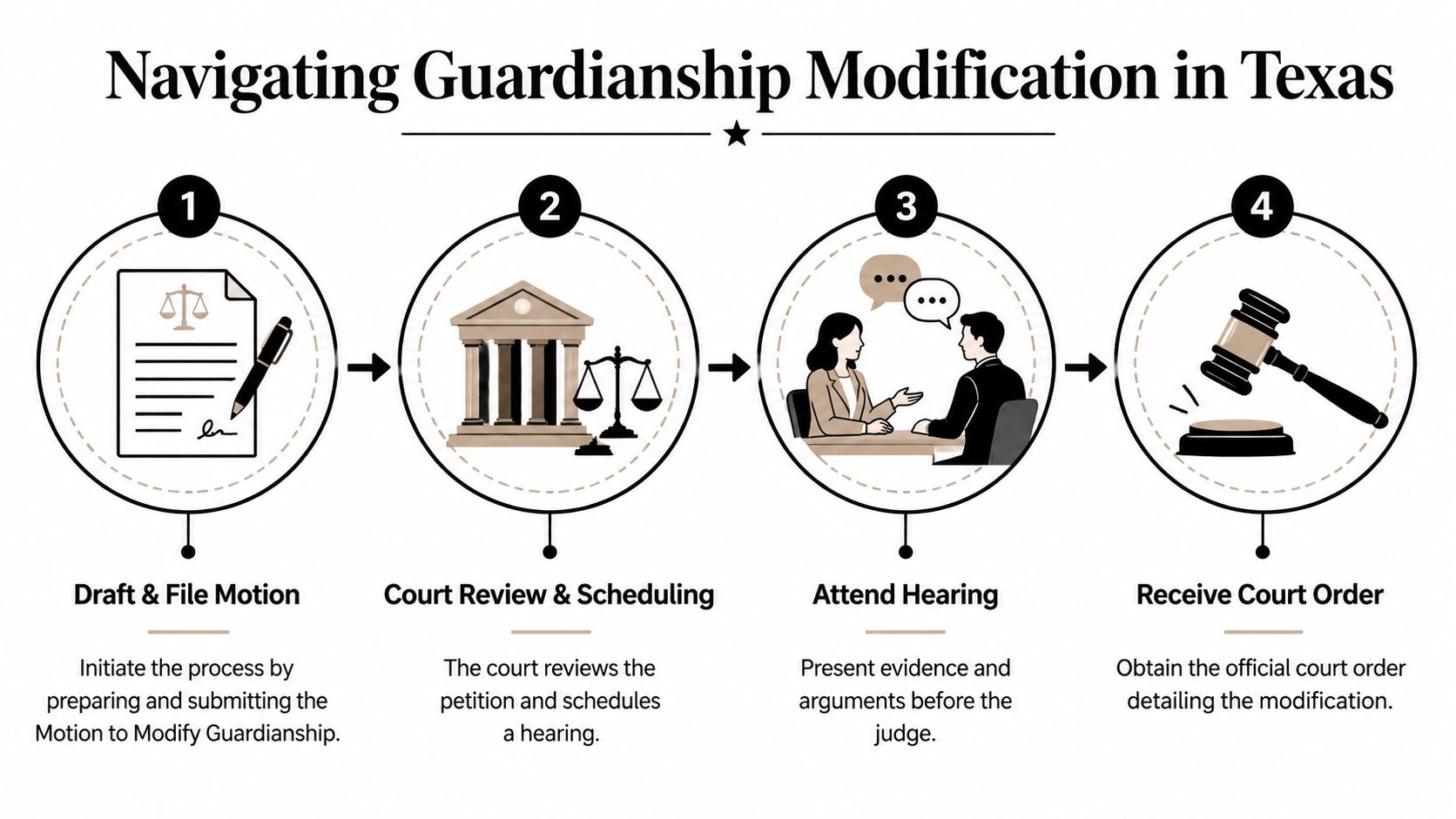
Texas handles this request under the modification framework in Estates Code Chapter 1202. That matters because the court is not asking, “Should there be a guardian at all?” The court is asking a narrower question. “What has changed since the original order, and what added authority, if any, is now justified?”
Step one begins in the original court
In most cases, the request goes back to the court that created the guardianship. The judge who signed the original order already has the file, the history, and the baseline for comparison. That history often shapes how the court views the new request.
The filing is usually a motion to modify the guardianship. It should clearly identify:
- the existing guardianship order,
- the specific powers you want added, removed, or clarified,
- the change in circumstances since the prior order,
- and the records or testimony that support the request.
Specificity matters here. “I need more authority” is too vague. “I need authority to manage newly received settlement funds and deal with the related financial institution” gives the court something concrete to evaluate.
For a closer explanation of the filing steps, many families find this guide to modifying guardianship powers in Texas helpful.
Step two requires updated evidence
Modification cases often turn on one simple idea. The paperwork must connect the new problem to the new authority you are requesting.
If the ward’s condition has declined, the evidence should explain how that decline affects real decisions. If the ward has come into money, the file should show why estate powers are now needed. If placement or treatment decisions have become more complicated, the court needs current medical or care records that explain why.
A useful filing packet often includes:
- Current physician records or evaluations tied to the decisions at issue
- The existing letters of guardianship and prior court orders
- Recent annual reports or accountings showing the guardian has stayed in compliance
- Financial records, care plans, or facility records that explain the present need
- A timeline of changes since the original appointment
Courtrooms work a lot like checklists. If the judge has to guess why the added power is needed, the request becomes harder to grant.
Step three is notice and service
Even when everyone in the family agrees, the court still has to protect the ward’s rights. That is why notice rules matter so much in modification cases. The ward may need to be personally served. Other interested parties may need formal notice as well, depending on the request and the court’s procedures.
This step can feel procedural, but it serves a serious purpose. Expanding authority affects another person’s legal rights, so the court insists on a fair process before it changes the order.
A missed service deadline or defective notice can stall a case that otherwise had strong facts. Families are often surprised by that. They should not be. In guardianship matters, procedure is part of the protection.
Step four is the court’s investigation phase
After the motion is filed, the court may require more information before setting the matter for hearing or before ruling. The attorney ad litem may investigate further, review updated records, speak with the ward, and test whether the request is limited to what is needed.
This is often the stage where a case becomes clearer. Sometimes the investigation confirms that the present order leaves a real gap. Sometimes it reveals that the requested expansion is broader than the facts support. Courts in Texas are generally careful about preserving as much of the ward’s independence as possible, so a focused request usually stands on firmer ground than a sweeping one.
Family disagreement may also surface here. A sibling may object. A facility may have concerns about who should consent to placement. The ward may oppose the change. Those facts do not end the case, but they do raise the importance of organized, current proof.
This short video gives a general look at the legal process families often face in Texas guardianship matters.
Step five is preparing for the hearing
At the hearing, the judge is usually looking for a straight line from the facts to the requested relief. The cleaner that line is, the easier the request is to understand.
A strong presentation usually addresses the following:
| Hearing issue | What the judge wants to hear |
|---|---|
| Change since the original order | What is different now, and when it changed |
| Exact authority requested | Which powers need to be added or clarified |
| Current supporting evidence | How medical, financial, or care records support the request |
| Guardian’s compliance history | Whether required reports, accountings, and prior duties are up to date |
| Best interest and least restrictive approach | How the change protects the ward without removing more rights than necessary |
That final point often causes confusion. Families sometimes assume the judge will grant every power that might be helpful. Texas law asks a more careful question. What is the smallest lawful adjustment that solves the present problem?
What uncontested and contested hearings often look like
An uncontested hearing is usually more direct. The court reviews the file, hears brief testimony, and decides whether the requested modification fits the evidence and the law.
A contested hearing takes more preparation and more restraint. Old family disputes can crowd the room quickly. The judge, however, is focused on the ward’s present condition, the existing order, and whether Chapter 1202 supports the requested change. Personal frustration rarely carries much weight unless it connects to a legal issue the court must decide.
What often delays a ruling
In modification cases, delay often comes from the guardian’s file rather than the underlying need for more authority. The court may hesitate if the request is supported by thin medical records, unclear drafting, or a history of missed reporting duties.
Common trouble spots include:
- Outdated or general physician statements
- Missing annual reports or accountings
- Notice problems
- Requests that are broader than the facts justify
- Disorganized exhibits or incomplete hearing preparation
A modification case works like a request to revise an instruction manual. The judge first looks at the current manual, then asks what page needs to change and why. If the proposed revision is precise and supported, the process is much smoother.
A practical example
Suppose a father was appointed guardian of the person for his adult daughter, and the original order gave him authority over certain medical and residential decisions only. Two years later, she receives an inheritance that must be protected and managed. The original order no longer covers the actual problem.
In that situation, the court may not need to rewrite everything. It may need to add estate-related powers, require a bond adjustment, and issue updated letters that financial institutions will accept. That is the heart of a modification case in Texas. It is a targeted legal repair to an existing order, based on what changed after guardianship was already in place.
Avoiding Common Mistakes When Expanding Authority
Families often believe the court will appreciate how hard they’ve worked and fill in the gaps from there. Probate judges do respect genuine caregiving. But they still rule on evidence, procedure, and statutory limits.

Mistake one is asking for more than you can justify
This is common. A guardian runs into one serious problem and responds by requesting broad, full authority over nearly everything. Courts in Texas generally prefer a tighter fit between the problem and the proposed solution.
If the issue is medical consent, ask whether medical authority needs clarification or expansion. If the issue is a newly discovered account or settlement funds, focus on estate powers. A narrow petition often appears more respectful of the ward’s remaining rights.
Mistake two is relying on vague medical paperwork
A short note from a doctor may help a family understand what’s happening, but it may not help the court enough. Judges need functional information. They want to know what the ward can no longer do, how the condition has changed, and why the requested powers now matter.
A stronger report usually connects the diagnosis to real decisions, such as inability to understand treatment choices, susceptibility to financial exploitation, or inability to manage property safely.
Mistake three is forgetting that your own compliance record matters
Guardians sometimes think prior reporting issues are unrelated because the new motion is about the ward’s current needs. Courts often see it differently. If a guardian wants expanded power, the judge may look closely at whether the guardian has already honored existing duties.
That includes items such as:
- Annual reports filed on time
- Annual accountings that are complete and accurate
- Court orders followed promptly
- Financial records maintained in a readable way
A modification hearing can quietly become a review of the guardian’s reliability.
Mistake four is treating the ward’s wishes as irrelevant
Even when the ward has an incapacity finding, the ward is still a person with preferences, concerns, and dignity. The court-appointed ad litem will often explore those wishes. Ignoring them can hurt both the legal case and the family relationship.
That doesn’t mean the ward’s preference controls every outcome. It does mean the guardian should be prepared to explain how the request accounts for the ward’s voice while still protecting safety and well-being.
Mistake five is trying to solve an emergency with the wrong tool
Not every urgent problem should be handled through a standard modification request alone. If the ward faces immediate danger to health, safety, or finances, a family may need to ask about temporary guardianship under the emergency provisions in Texas law. Temporary relief and permanent modification are related, but they are not the same thing.
A short comparison helps:
| Situation | Better legal approach to explore |
|---|---|
| Ongoing decline over time | Modification of existing guardianship |
| Immediate threat or urgent harm | Temporary guardianship or emergency relief |
| Family disagreement about the current guardian | Dispute, contest, or possible removal proceeding |
| The ward has regained capacity in an area | Restoration or narrowing, not expansion |
Mistake six is overlooking alternatives
Sometimes a family doesn’t need to expand guardianship at all. Depending on the facts, less restrictive tools may still help with some problems. In other cases, a prior power of attorney, benefit representative arrangement, care coordination plan, or supported decision-making approach may reduce the need for a broader court order.
That question deserves careful review because courts want the least restrictive workable option.
Compliance and Responsibilities with New Powers
Winning the order is not the end of the job. It’s the beginning of a new compliance phase.
Get the updated authority in usable form
Once the court signs the modification order, the guardian should obtain certified copies of the updated papers, including any amended Letters of Guardianship. Hospitals, banks, care facilities, and government agencies usually won’t act on a verbal explanation of what the judge did. They want current, official documents.
Keep multiple certified copies if you expect to deal with several institutions. It can save time and avoid confusion.
Review whether bond and reporting duties changed
If the court expands authority over money or property, the guardian may need to address bond requirements and more detailed financial oversight. That’s especially important for a guardian of the estate.
The broader the authority, the more carefully the court usually expects records to be kept. New powers often bring new practical tasks:
- Update account management procedures so funds are clearly tracked
- Separate the ward’s money from anyone else’s money
- Keep receipts, statements, and ledgers in a consistent system
- Note major decisions and the reasons for them
- Calendar annual deadlines immediately after the order is signed
For a closer look at day-to-day fiduciary obligations, this guide to the responsibilities of a legal guardian is a helpful reference.
Tell the right people, then follow the order closely
A modified order only works if the people around the ward know it exists. That may include physicians, facility administrators, schools, financial institutions, benefit offices, and service providers.
New authority should change your paperwork habits, not just your legal status.
Read the new order carefully. Some guardians assume the court granted every requested power when it approved only part of the motion. The signed order controls. Not the motion, not your memory of the hearing, and not what a provider says they think it means.
Keep one eye on future review
Texas guardianship orders remain under court supervision. If the ward’s condition changes again, the arrangement may need another adjustment. That could mean more authority, less authority, a transfer to a successor guardian, or even termination if the ward regains capacity in a meaningful area.
Careful compliance now makes any future court request much easier.
Partnering with an Experienced Attorney for Peace of Mind
A daughter may already have authority to handle her father’s medical decisions, then suddenly learn the existing order does not let her deal with a stalled insurance payment, sign documents for a facility transfer, or manage a new financial risk. That is often the moment families realize an existing guardianship order is only as broad as the court made it. If the ward’s needs have changed, the legal question becomes what authority should be added, what proof the court will require, and how to ask for that change under Texas law.
That is why legal help matters so much at the modification stage. Expanding authority under Chapter 1202 is different from starting a guardianship from scratch. The court is not deciding the whole case for the first time. It is reviewing an existing arrangement and asking whether new powers are justified, whether the request is suited to the ward’s present needs, and whether the guardian has handled prior duties responsibly. Families are often surprised by that distinction.
Court procedure also varies from county to county. A request that seems straightforward on paper may still raise local practice questions about notice, evidence, hearing settings, or the wording of the proposed order. In Harris County, Dallas County, Bexar County, Travis County, and other Texas courts, those details can affect both timing and outcome.
An experienced attorney helps bring order to a process that can feel personal, urgent, and intimidating all at once.
Legal guidance is especially helpful when the modification involves:
- Objections from relatives or other interested parties
- A request for temporary or emergency relief
- Unclear or incomplete medical evidence about capacity
- Financial issues connected to settlements, property, or probate administration
- Past reporting problems or concerns about how the court will view the guardian’s compliance
- Questions about whether a narrower alternative might address the problem without expanding guardianship as far as requested
Related planning may overlap with the modification request. Depending on the facts, a family may need to examine broader legal issues involving Guardianship, Probate, and Estate Planning.
A good attorney does more than fill out forms. Counsel can help define the exact power the ward now needs, gather the right supporting records, prepare for objections, and draft a proposed order that matches the evidence. That kind of precision matters. Asking for too little may leave the problem unsolved. Asking for too much may trigger resistance from the court or other family members.
If you are unsure whether the right next step is to expand, limit, contest, or update an existing guardianship order, the Law Office of Bryan Fagan, PLLC can help you assess the facts and your options under Texas law. A careful review of your loved one’s medical, financial, and daily care needs can clarify what the court is likely to require in your county and what modification request best protects the ward.