Skip to content
Losing a loved one is tough enough without the added stress of a complicated legal process. When it comes to settling an estate in Texas, many families find that the Small Estate Affidavit (SEA) offers a much simpler, faster, and less expensive path forward compared to formal probate. We understand that this is a difficult time, and our goal is to provide clear, empathetic guidance to help you navigate this process with confidence.
It’s essentially a sworn statement filed with the court, allowing you to legally transfer a loved one's property without getting bogged down in a full-blown court proceeding.
A Simpler Route Than Formal Probate in Texas
When someone passes away, their property—everything from their bank account to their car—needs to be legally transferred to their heirs. The traditional way to do this is through a court-supervised process called probate. It works, but it can be slow and expensive. If you want to get a better sense of the traditional process, you can learn more about what probate is and how it typically works.
The Small Estate Affidavit Texas form acts as a legal shortcut for smaller, more straightforward estates. It helps families avoid the time and expense of a full probate hearing, which is a huge relief during an already difficult time.
The Financial Upside of a Small Estate Affidavit
So, what qualifies as a "small" estate? In Texas, the magic number is $75,000. If the total value of your loved one's property (not counting their homestead and other exempt property) is $75,000 or less, you can likely use the SEA.
This $75,000 asset threshold is a game-changer. Formal probate can take months, sometimes even years, and the associated court costs and attorney fees can slowly chip away at the estate's value. The SEA allows you to bypass most of that, saving both time and money.
The specific rules for this process are laid out in the Texas Estates Code, particularly Title 3. This law empowers families to handle the direct transfer of assets themselves, giving them more control and privacy during a sensitive time.
Small Estate Affidavit vs. Formal Probate: A Quick Comparison
To put it in perspective, here is a quick comparison of the key differences between using a Small Estate Affidavit and going through traditional probate. This can help you understand if the SEA is the right path for your family.
| Feature | Small Estate Affidavit (SEA) | Formal Probate |
|---|---|---|
| Asset Limit | $75,000 (excluding exempt property) | No limit |
| Court Involvement | Minimal—file the affidavit and get a court order | Extensive—court supervises the entire process |
| Timeline | Typically a few weeks | Can take several months to over a year |
| Cost | Significantly lower (often just filing fees) | Much higher (attorney fees, court costs, etc.) |
| Complexity | Simple enough for many to handle without an attorney | Complex; almost always requires an attorney |
| Ideal For | Small, straightforward estates with no will or disputes | Larger, more complex estates, or when there are debts or disputes |
As you can see, the SEA is a far more streamlined option for estates that fit the criteria.
A More Compassionate Approach to Settling an Estate
The real purpose of the Small Estate Affidavit is to provide relief. The law recognizes that not every estate requires the heavy hand of formal probate. It offers a more dignified and less overwhelming path for families to settle their loved one's affairs so they can focus on what truly matters—healing.
This guide will break down everything you need to know in plain English, helping you figure out if the SEA is the right choice for your family. Settling an estate is a journey, but our goal is to give you the clarity you need to move forward with confidence.
Determining If the Estate Qualifies

Before you pour your time and emotional energy into filling out forms, the very first step is to confirm whether your loved one's estate actually meets the strict requirements set by Texas law. This is more than just a quick look at a bank statement; it’s a specific checklist defined by the Texas Estates Code.
Getting this right from the beginning can save you from a frustrating rejection by a probate court, whether you're in Harris County, Bexar County, or anywhere else in Texas.
The rule most people know about is the financial cap. To use a small estate affidavit, the total value of the decedent’s property must be $75,000 or less. But here's where it gets interesting—and where many families catch a break.
Understanding the $75,000 Asset Limit
Texas law was designed with families in mind, recognizing that a primary home shouldn't disqualify an estate from this simpler process. Because of that, the $75,000 limit does not include the value of the decedent’s homestead and certain other exempt property.
This is a game-changer for many families.
Exempt property generally covers the essential things a family might need to carry on. Think of assets like:
- One vehicle for each licensed family member
- Home furnishings, including family heirlooms
- Tools of a trade or profession
- A limited amount of jewelry
Let’s look at a common scenario. Imagine a parent passes away leaving a home worth $200,000, a car valued at $10,000, and a savings account with $30,000. At first glance, the estate seems to be worth $240,000—far over the limit. But the law allows you to subtract the home's value. That leaves just $40,000 in non-exempt assets, putting the estate well within the limit and making it eligible for the SEA.
Knowing what counts as probate property versus non-probate is crucial here. You can get a much clearer picture by exploring the details of probate and nonprobate assets.
A Key Takeaway from Our Experience
The most common mistake we see is families miscalculating an estate's value by including the homestead. Double-checking what counts and what doesn't is the single most important step you can take to determine if you're eligible.
Other Non-Negotiable Conditions
Besides the asset value, there are a few other absolute musts. If even one of these conditions isn't met, the court will not approve the affidavit, and you'll likely have to go through a more formal probate process.
First, the decedent must have passed away without a will. This is known as dying "intestate." The whole point of the SEA process is to follow Texas succession laws to identify the rightful heirs. If there’s a valid will, it needs to be probated instead.
Second, the estate’s assets must be greater than its known debts. This doesn’t include any mortgage on the homestead. Put simply, there has to be enough money or property left over to pay off all the known bills, like final medical expenses or credit card balances.
Finally, you have to wait. At least 30 days must have passed since the date of death before you can file the affidavit. This waiting period gives everyone time to gather the necessary information and allows any creditors to come forward.
By carefully checking off these requirements, you can move forward with confidence, knowing the small estate affidavit Texas form is the right tool for your family.
Getting Your Ducks in a Row: Gathering What You Need
Once you’ve determined that a Small Estate Affidavit is the right tool for the job, it’s time to get organized. Honestly, this is where the real work begins. A successful filing hinges entirely on having accurate, complete information before you even look at the small estate affidavit Texas form.
Think of this as building the foundation for your case. The more thorough you are now, the less likely you are to hit snags or delays with the court later. A missing document or a wrong number can get your affidavit rejected by a Harris County or Travis County probate court, sending you right back to square one.
Creating a Complete Asset Inventory
The heart of the affidavit is a detailed list of what the person owned when they passed away. Your task is to create a clear financial snapshot, focusing specifically on the non-exempt property that counts toward that $75,000 limit. This isn't a guessing game; you need proof for every single item.
You'll have to track down documents that prove ownership and establish the fair market value for each asset as of the date of death.
- Bank Accounts: Grab the most recent statements for every checking, savings, and money market account. The court needs to see the exact balance on the day your loved one passed.
- Vehicles: Find the title for any car, truck, or motorcycle. You can easily find its fair market value using a free online tool like Kelley Blue Book.
- Investments: For stocks or bonds, you’ll need the brokerage account statements that show their value on the date of death.
- Other Valuables: If there are items like fine jewelry or valuable collectibles, you might need to get a formal appraisal. This gives you an accurate, defensible value that the court will accept.
This list has to be exhaustive. Forgetting even a small, dormant savings account can create major headaches down the road.
Identifying All Debts and Liabilities
Just as important as listing assets is putting together a complete list of all known debts. The court needs to be certain that the estate’s assets are enough to cover its liabilities before any property gets distributed to the heirs.
Start gathering the final statements for any outstanding bills:
- Credit card balances
- Final medical bills
- Utility statements
- Personal loans
Keep in mind, a mortgage on the homestead generally isn’t counted in this part of the calculation, but you still need to be transparent about all other debts.
A critical requirement from the Texas Estates Code is that the affidavit must explicitly state that the estate’s assets (not counting the homestead and exempt property) are greater than its known liabilities. Getting this statement right is non-negotiable and protects you and every other heir involved.
Finding Your Disinterested Witnesses
Finally, you’ll need two disinterested witnesses to sign the affidavit. This is a legal term with a very specific meaning. These individuals must meet two crucial criteria: they cannot be heirs to the estate, and they must have personal, firsthand knowledge of the decedent’s family history.
These witnesses are doing more than just signing a form; they are swearing under oath that the family information you’ve provided is true. This could be a longtime neighbor, a close family friend, or a clergy member who knew the family well. Their signatures provide a vital layer of validation that Texas courts depend on.
If this part of the process feels like a lot, that's because it is. But you don't have to figure it all out by yourself. If you need personalized guidance on gathering your documents and making sure everything is in order, you can schedule a free consultation with our team. We're here to help.
Navigating the Small Estate Affidavit Form
Looking at a legal document after losing a loved one can feel completely overwhelming. But the official small estate affidavit Texas form is usually more straightforward than it first appears. The key is to be meticulous, accurate, and completely honest with every piece of information you provide.
Think of it less as a scary legal battle and more like completing a very detailed checklist. You're simply giving the court a clear, final financial picture of your loved one’s estate to make sure everything is handled correctly and fairly.
A Real-World Example
Let's walk through a common scenario to make this less abstract. Imagine ‘John,’ a widower, has just passed away in Harris County. His only heirs are his two adult children, Sarah and Michael. John owned his home outright (his homestead), drove a 2018 sedan, and had a checking account with $25,000. His only debt was a final hospital bill for $500.
This situation is a perfect fit for an SEA. John’s non-exempt assets—the car and the cash—are well under the $75,000 Texas limit, and he died without a will.
Detailing Assets and Liabilities
The form will require you to list every single asset, along with its fair market value on the day your loved one died. This has to be precise. For John’s estate, Sarah and Michael would need to list:
- Checking Account: They’ll need the bank statement from the day he passed. This shows the exact balance of $25,000.
- 2018 Sedan: They can use an online valuation tool like Kelley Blue Book to find its market value, which might be around $18,000.
After listing the assets, they must list all known liabilities. This part is absolutely crucial because you are swearing to the court that the estate is solvent—meaning it has more assets than debts. In this case, they would just list the $500 hospital bill. It's clear the assets far exceed the debts.
This infographic shows the key components you'll need to finalize the form.
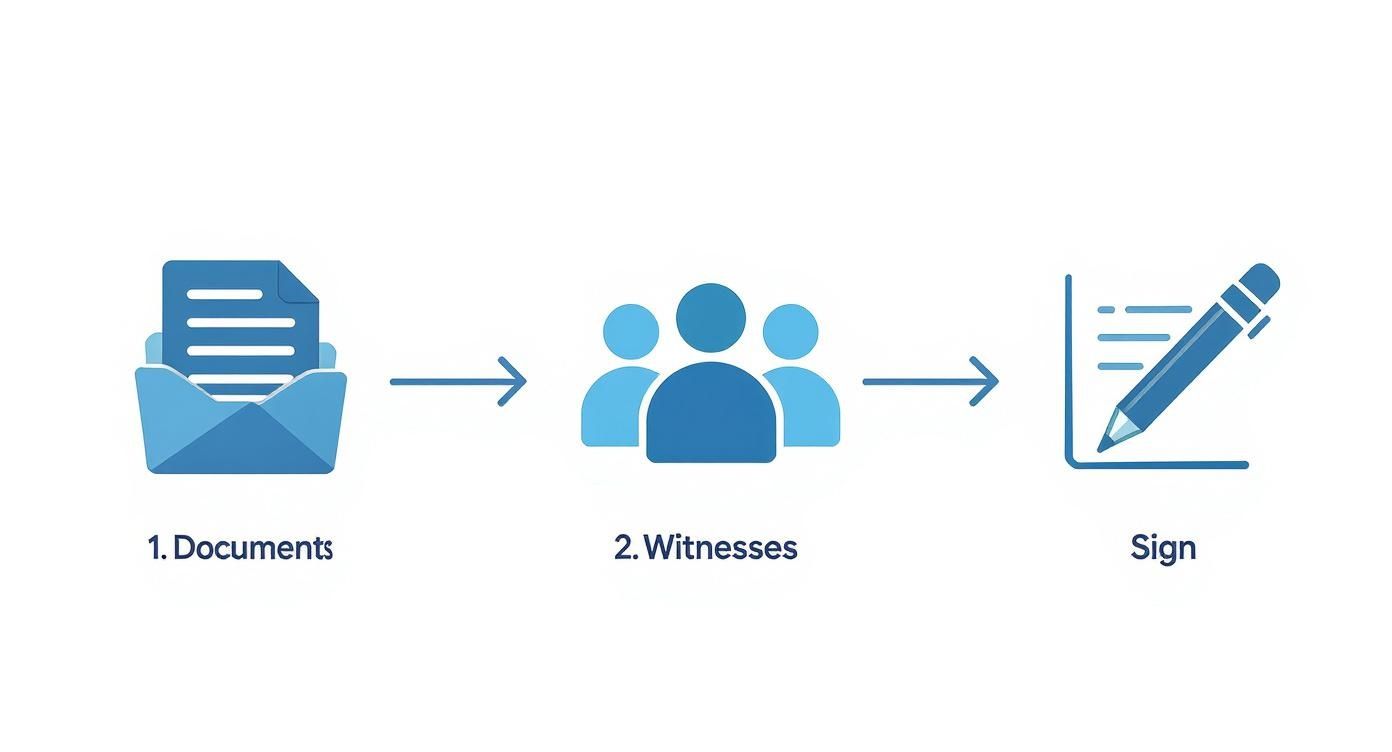
As you can see, success hinges on more than just the numbers; it requires collaboration with witnesses and formal notarization to be legally valid.
Identifying Heirs and Securing Signatures
A large part of the affidavit is dedicated to identifying the “distributees”—the legal term for heirs. Since John died without a will, Texas intestacy laws kick in. His heirs are simply his two children, Sarah and Michael, and they will each inherit 50% of his estate according to the Texas Estates Code.
The form requires a surprisingly complete family history. You’ll need information about the deceased’s parents, siblings, and even any children who may have passed away before them. This is to ensure every single potential heir has been identified.
A Critical Insight from Our Experience
I cannot stress this enough: failing to list a single rightful heir is one of the most common reasons courts reject an SEA. It doesn’t matter if they’re estranged or you don’t know where they are. You must be thorough and transparent.
The final hurdle is getting all the signatures, and this is arguably the most important step. Everything must be signed in front of a notary public.
- All Heirs (Distributees): Both Sarah and Michael have to sign. If there were five heirs, all five would need to sign. There are no exceptions.
- Two Disinterested Witnesses: You’ll also need two people who knew the deceased but won't inherit anything. These witnesses are swearing under oath that the family history you’ve laid out is true.
Once every signature is on the page and notarized, the form is officially complete. Each signature validates the truthfulness of the information, turning it from a simple document into a sworn statement ready for the court’s review. The process can feel detailed, but it's manageable. For help with the finer points of Estate Planning or any other concerns, we are here to offer support.
Filing the Affidavit and Finalizing the Estate
You’ve done the hard work of gathering all the necessary information and meticulously filling out the small estate affidavit Texas form. Now you’re on the home stretch. This is the part where all that careful prep pays off and you can finally move forward with settling your loved one's affairs.
Your next step is to get the completed and notarized affidavit filed with the probate court clerk. This is a critical detail: you must file it in the county where the person who passed away legally resided. For example, if your loved one lived in Houston, your filing destination is the Harris County Probate Court. Filing the affidavit officially brings the estate to the court's attention.
The Judge's Review and Court Order
Once it's filed, a probate judge will take a close look at your affidavit. They have a specific checklist they're working from. The judge's job is to confirm that the affidavit ticks all the legal boxes required by the Texas Estates Code, Title 3, Subtitle G.
They'll verify a few key things:
- Is the estate's value truly under the $75,000 threshold?
- Are all the assets and liabilities listed out correctly?
- Has every single legal heir been identified, and have they all signed the form?
If everything checks out, the judge will sign a court order approving your affidavit. That order is the golden ticket you need for the final steps.
A Practical Tip from Our Attorneys
Always, always ask the court clerk for several certified copies of both the affidavit and the judge's order. You'll need an official, court-stamped copy for every bank, financial institution, or agency you interact with. Having extras from the start will save you from major headaches and delays down the road.
Using the Approved Affidavit to Settle the Estate
Armed with certified copies of the approved affidavit and the court order, you now have the legal authority to collect and distribute the estate's assets.
You can walk into any bank, credit union, or even the DMV where the decedent had property, present these documents, and they are legally obligated to release the assets to the heirs named in the affidavit.
This is how you'll tackle those final, essential tasks:
- Closing out bank accounts and distributing the money to the rightful heirs.
- Transferring the title of a car or truck to its new owner.
- Gaining access to a safe deposit box to retrieve what's inside.
If the estate includes real estate, like the family home, the approved order effectively serves as a legal transfer of title. For trickier situations involving property, it can be helpful to understand how to change a deed on a house for some extra clarity. By taking these last few steps, you can bring the estate to a peaceful and orderly close, truly honoring your loved one's memory.
Common Questions About the Texas SEA Process
Even with a step-by-step guide, it's completely normal for questions to pop up when you start applying these rules to your family’s unique situation. Trying to figure out legal paperwork after losing a loved one can be overwhelming, and you absolutely deserve clear, straightforward answers about the small estate affidavit Texas form.
We've walked countless families through this exact process, and over time, we’ve noticed the same questions come up again and again. This section tackles those common concerns head-on, helping you sidestep potential roadblocks and move forward with confidence.
What if My Loved One Had a Will?
This is probably the most critical question, and the answer is a hard and fast rule. The Small Estate Affidavit (SEA) is designed only for “intestate” estates—that’s the legal term for when someone passes away without a valid will.
The entire SEA process is built on Texas succession laws, which dictate who the rightful heirs are when there's no will. If a will exists, it has to be filed with the probate court. The will’s instructions will always override the state’s default inheritance rules, making the SEA the wrong tool for the job.
Can the Affidavit Transfer a House?
Yes, but there are some major limitations you need to know about. An SEA can be used to transfer the title of the decedent's primary residence, legally known as their homestead. However, it cannot be used for any other kind of real estate, like a rental property or an empty lot.
A key detail in the Texas Estates Code is that the homestead can only be passed to specific heirs under intestacy laws, like a surviving spouse or minor children. If the primary heirs to the house are adult children or other relatives, the SEA won't work. You'll likely need a different legal process, such as an Affidavit of Heirship or formal Probate.
How Long Does This Process Take?
While every county is a little different, the good news is that the SEA process is significantly faster than formal probate. Once you’ve filed the affidavit with a court, like the Harris County Probate Court, it generally takes a judge anywhere from a few weeks to a couple of months to review and approve it.
For comparison, a formal probate case can easily drag on for six months to well over a year. That efficiency is one of the biggest reasons families choose the SEA when their estate qualifies.
Do All Heirs Need to Sign the Form?
Yes, this is an absolute must. The Texas Estates Code is very clear on this point: every single legal heir (the law calls them "distributees") has to sign the Small Estate Affidavit in front of a notary.
If an heir is a minor, their legal guardian or "next friend" must sign for them. This requirement ensures that everyone with a legal claim to the property is on the same page and agrees with what's being presented to the court. There's no getting around this one.
Trying to navigate the details of a Small Estate Affidavit while grieving is tough. If you have more questions or just want someone to make sure you're getting it right, the experienced team at The Law Office of Bryan Fagan is here for you. Schedule a free, no-obligation consultation to get the compassionate support and clear guidance your family deserves.