Skip to content
Yes, avoiding guardianship completely is often possible in Texas, and some asset-related workarounds can even avoid a full guardianship of the estate for amounts up to $100,000 in a court registry or certain real property interests up to $250,000 with court permission. But whether that works depends heavily on timing, the person's current capacity, and whether the family can use less restrictive tools before a judge has to step in.
When families start asking about guardianship, it usually means something hard is already happening. A parent is missing bills. A spouse can't explain a bank withdrawal. An adult child with disabilities needs support, but the family wants to protect independence, not take it away.
That tension is real. You want to keep your loved one safe, but you also don't want to put them into a court process that may remove major personal rights. In Texas, that concern matters because guardianship is not supposed to be the first move. It is supposed to be the last one.
The Question Every Texas Family Asks About a Loved One's Care
Your mother leaves the stove on twice in one week. Your brother notices unopened bank statements stacked on the table. At a doctor visit, your father nods along but cannot explain the treatment plan on the drive home. Then someone asks the question families across Texas ask in a moment like this: "Do we need guardianship?"
That question can feel heavy because it is really two questions at once. How do we keep someone safe? How do we do that without taking away more independence than necessary?
Many families assume guardianship is the automatic legal answer once a capacity problem appears. In Texas, the law takes a more careful approach. Guardianship is treated as a last resort, which means the court is supposed to consider whether a less restrictive option can solve the problem first.
Why families try to avoid guardianship
Families often hesitate for good reason. Guardianship can affect fundamental personal rights, including choices about medical care, finances, and other parts of daily life. It is a powerful court process, not just a helpful permission slip.
Texas guidance for families also explains that valid powers of attorney can sometimes make guardianship unnecessary because an agent already has authority to act under those documents, as described in this Texas Guardianship 101 guide.
So the better question is usually more specific. What problem are we trying to solve right now?
If the issue is unpaid bills, the answer may look different than if the issue is unsafe hospital discharge planning. If the concern is confusion about medication, the legal tool may differ from what is needed for a real estate sale. Families feel less overwhelmed once they stop treating guardianship like an all-or-nothing switch and start treating it like one option on a spectrum.
Practical rule: If a narrower legal tool can address the immediate risk safely, that option usually deserves serious attention before a family files for full guardianship.
The goal is safety with dignity
Wanting to protect a loved one without stripping away independence is not wishful thinking. It is often the right instinct.
A helpful way to frame it is to picture a toolbox. Guardianship is the largest tool in the box. Sometimes it is necessary. But many families first need a smaller tool that fits the actual problem, especially when the crisis has already started and no one had the chance to plan perfectly in advance.
Here is the basic idea:
- Guardianship transfers decision-making authority through the court.
- Planning documents can let a trusted person help without a guardianship case.
- Limited problems may have limited legal solutions.
That last point brings real relief to families. Texas law does not require you to jump straight from worry to full court control. In many cases, there is space to pause, identify the exact risk, and look for a more specific response.
What Texas Guardianship Really Means for Your Family
Guardianship is a formal court case under the Texas Estates Code, including Title 3, Subtitle G, not a private family arrangement. A judge decides whether a person lacks capacity in areas serious enough to require a court-appointed decision-maker. In places like Harris County Probate Court, that process can involve medical evidence, legal filings, hearings, and ongoing court supervision after appointment.

Guardian of the person and guardian of the estate
Texas families usually hear two phrases that sound similar but do very different jobs.
A guardian of the person handles personal decisions. That may include where the person lives, what medical care they receive, and other daily welfare choices that the court assigns.
A guardian of the estate handles money and property. That may include bank accounts, investments, debts, and real estate that the court places under supervision.
Think of guardianship as a court-issued master key. The judge doesn't hand it out lightly because once someone else gets that key, the person under guardianship may lose the ability to control important parts of life on their own.
Texas law prefers the least restrictive option
Texas law doesn't treat guardianship as the default answer. The legal framework is built around the least restrictive alternative. Courts must consider alternatives such as medical powers of attorney, durable powers of attorney, trusts, and supported decision-making before imposing guardianship, and the timing matters because those documents generally need to be signed before the person loses legal capacity, as explained by the Texas State Law Library's guide to alternatives to guardianship.
That principle shows up in the structure of Title 3, Subtitle G. Families pursuing or defending a guardianship case should expect the court to ask whether a narrower option can meet the need.
Guardianship should fit the actual problem. It shouldn't become a blanket transfer of rights just because the family is under stress.
Why the procedure matters
Guardianship cases can also become emotional because they often overlap with family conflict. One sibling may think Mom needs immediate protection. Another may believe she only needs help paying bills. A hospital may say someone lacks authority to consent. A bank may freeze access until the legal paperwork is clear.
That is why the process matters so much:
- The court reviews incapacity claims: Families don't get guardianship just by agreement.
- The judge defines the powers: Duties and limits come from the court order.
- The guardian has ongoing obligations: Reporting, accounting, and compliance continue after appointment.
If families understand that guardianship is a legal tool of last resort, they are better able to ask the right question early. Not "How do we take over?" but "What is the smallest lawful intervention that keeps this person safe?"
Proactive Planning The Best Way to Avoid Guardianship
A daughter notices her mother is still herself in many ways, but the warning signs are getting harder to ignore. Bills are stacking up unopened. The pharmacy calls about missed refills. At a doctor visit, Mom can explain what hurts but gets lost when treatment options are discussed. This is the moment many Texas families ask the same question: is there still a way to protect her without asking a court to take over?
Often, yes.
The strongest way to avoid guardianship is to put the right legal tools in place before a crisis closes that window. These tools work like a set of house keys. One key opens the medical door. Another opens the banking door. Another helps with property management. If the family has the right keys early enough, they may not need a court-appointed guardian at all.
The planning tools that do the most work
Here is a simple side-by-side view.
| Legal Tool | Controls… | Effective… | Best For… |
|---|---|---|---|
| Durable Power of Attorney | Financial and property decisions the document grants | While the signer still has legal capacity to create it, and then during incapacity if properly drafted | Paying bills, handling accounts, managing routine finances |
| Medical Power of Attorney | Health care decisions through the chosen agent | After valid signing and when the agent's authority is triggered under the document | Doctor communication, treatment decisions, hospital issues |
| HIPAA Authorization | Access to medical information | After valid signing | Letting family or an agent speak with providers and obtain records |
| Revocable Trust with successor trustee | Trust assets | Based on the trust terms and successor provisions | Managing larger or more complex assets without a guardianship of the estate |
| Supported Decision-Making Agreement | Decision support, not transfer of control | When the person can still participate meaningfully | Adults who need help understanding choices but want to keep decision-making authority |
| Designation of Guardian in Advance | Naming preferred guardian if one is ever needed | When signed with capacity | Reducing uncertainty if court involvement later becomes unavoidable |
Families are often surprised by one basic point. No single document solves every problem. A durable power of attorney may let someone handle banking, but it does not automatically fix a hospital communication problem. A HIPAA authorization may let the family get records, but it does not hand over financial authority. Good planning is less like filling out one form and more like building a small toolkit.
How these tools work in real life
A Durable Power of Attorney is often the financial workhorse. If Dad can still sign one validly, he can choose the person who will handle banking, bills, insurance, taxes, and similar tasks. That choice can prevent the freeze that happens when accounts need attention and no one has authority.
A Medical Power of Attorney addresses a different need. It lets a chosen agent make health care decisions under the document's terms. Paired with a HIPAA authorization, it often solves the common problem of an adult child hearing, "We can't discuss anything with you."
A revocable trust helps when the main concern is property or investment management. If the assets are already titled in the trust, a successor trustee can usually step in under the trust terms. That may remove the need for a guardian of the estate because control was built into the ownership plan from the start.
One more point causes confusion in many families. A power of attorney works only during life. It ends at death. If your family is sorting out both incapacity planning and what happens later, this guide on who manages affairs after death helps explain the difference.
Supported decision-making changed the conversation in Texas
Supported decision-making reflects an idea many families understand once they hear it clearly. Some adults need help making decisions. They do not always need someone else to make the decisions for them.
This is an important shift because it recognizes that some adults need support, not substitution.
For example, an adult daughter with an intellectual disability may understand where she wants to live, which doctor she trusts, and what daily routine works for her. She may still need help reading forms, comparing options, tracking appointments, or asking follow-up questions. In that kind of situation, a supported decision-making agreement may protect her independence better than a guardianship case.
That same idea often applies to early dementia, brain injury recovery, or mental health conditions where capacity is uneven. A person may struggle with complex paperwork but still communicate consistent choices. Texas families should not assume that difficulty automatically means total incapacity.
Timing is what makes the plan work
Timing often determines whether these options are available. These documents usually need to be signed while the person still has enough legal capacity to understand what they are doing. Once that ability is gone, the family may lose access to the simplest tools and have to consider more restrictive options.
That is why many families start comparing the difference between power of attorney and guardianship in Texas as soon as they see meaningful decline. Waiting until the emergency room visit, the frozen bank account, or the medication crisis can close off choices that were available a few months earlier.
Still, families should not hear this section as an all-or-nothing message. Early planning gives the widest set of options, but it is not the only time less restrictive solutions can help. Even after a capacity crisis begins, there may still be targeted ways to solve the immediate problem without full guardianship.
Navigating a Crisis What to Do When You Haven't Pre-Planned
Many families don't call a lawyer at the ideal time. They call after the stroke, after the dementia diagnosis, after the hospital asks for legal authority, or after a sibling starts moving money. That doesn't always mean full guardianship is the only path.
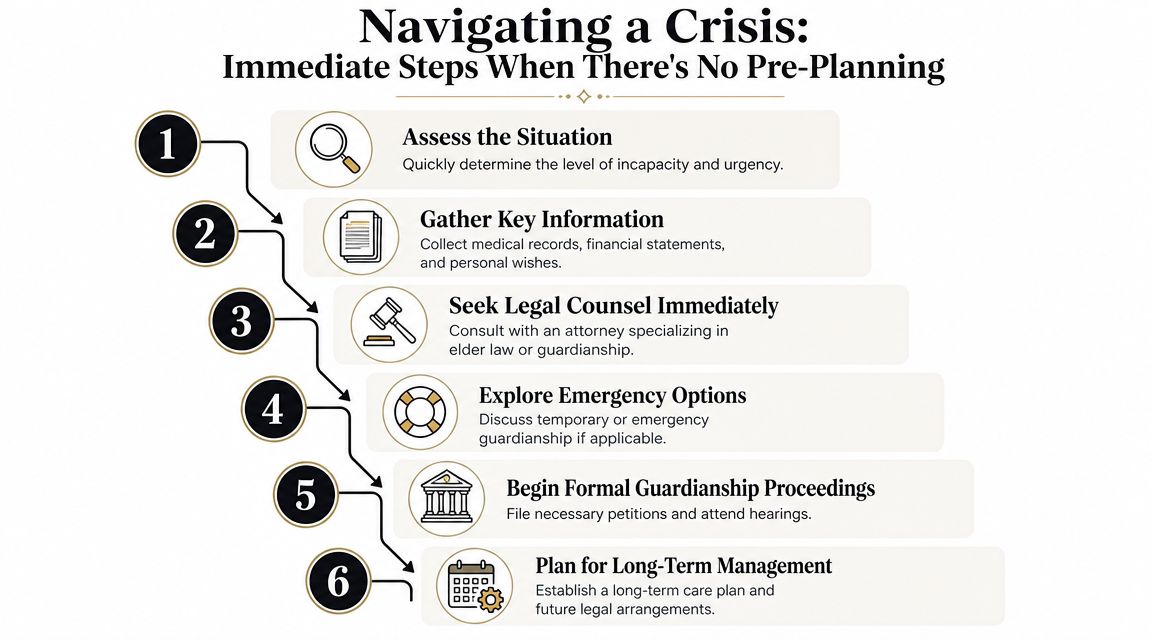
Texas families often get frustrated here because most public guidance focuses on pre-planning. But real life is messier. Texas materials acknowledge a practical gap: when a crisis has already started and capacity is partial, families may need to evaluate whether supported decision-making, a limited guardianship, or a targeted financial workaround can avoid full guardianship when key documents are missing, as discussed in this resource on establishing Texas guardianship out of court and related alternatives.
A crisis checklist for the first few days
When there is no pre-planning, families need triage. Start with the smallest question first: what problem has to be solved today?
- Medical decisions: Is someone refusing to speak with the family, or is treatment consent needed now?
- Immediate finances: Are bills unpaid, benefits interrupted, or accounts inaccessible?
- Safety concerns: Is the person at risk of wandering, exploitation, or self-neglect?
- Family disagreement: Is one relative escalating the situation faster than the facts support?
If the person still has some understanding, even if limited, that matters. Partial capacity can leave room for narrower solutions.
Some cases aren't "competent" or "incompetent." The person may be able to make some decisions, but not all of them.
For families facing a hospital authority problem, this page on what to do when a hospital says you have no authority to make decisions is especially relevant.
Tools that may still help mid-crisis
A crisis doesn't erase every option. It changes the menu.
Some families can still explore:
- Supported decision-making, if the loved one can understand enough to participate and choose support.
- A narrow court request, where the family seeks only the authority needed.
- Targeted asset solutions, especially if the problem is limited to one account, one property issue, or one benefit stream.
- Temporary or emergency relief, when immediate danger exists and waiting would put the person at risk.
This video gives a practical overview of how families often approach these urgent situations in Texas.
The emotional challenge here is that families often feel they have already "failed" by not planning sooner. Most haven't failed. They are responding to a medical or cognitive change that didn't follow anyone's calendar. The legal task now is to match the response to the actual level of need.
When Guardianship Becomes Unavoidable
Sometimes the facts leave no workable alternative. A loved one may be unable to understand documents, unable to communicate stable decisions, at risk of exploitation, and without any valid planning in place. In those cases, guardianship may be necessary under Title 3, Subtitle G of the Texas Estates Code.
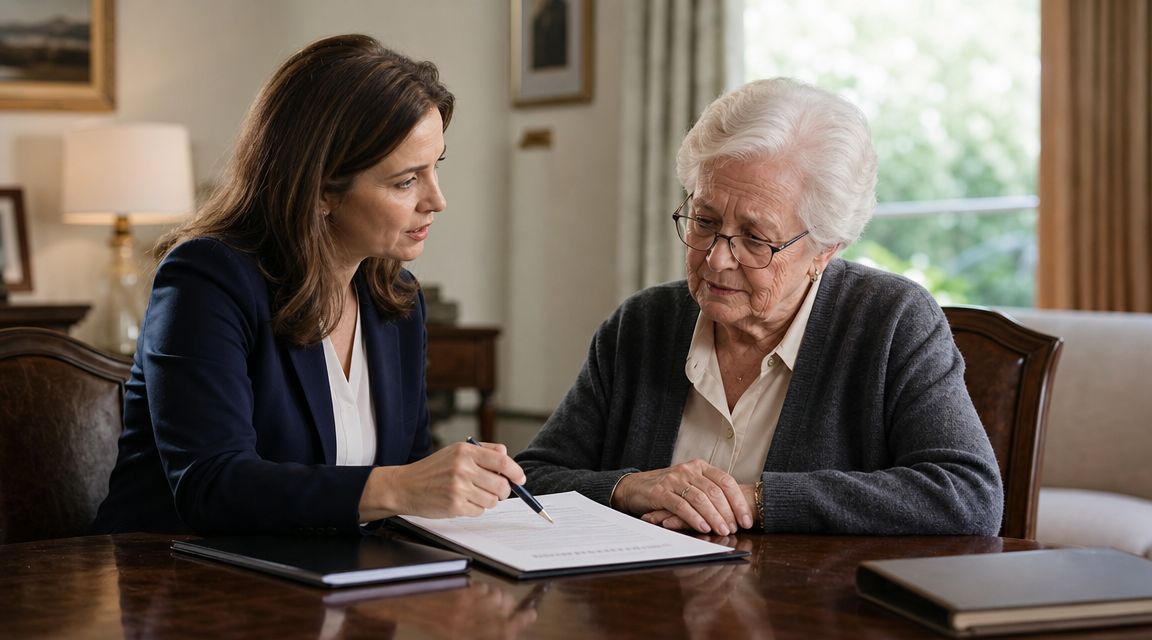
Ask for the smallest guardianship that works
If guardianship is unavoidable, the right goal is often limited guardianship, not full guardianship. In plain language, that means asking the court to transfer only the powers that are necessary.
That approach can preserve dignity. A person may need help managing investments but still be able to decide where to live or express medical preferences. In a court such as Dallas County Probate Court, that distinction can shape the order the judge signs.
A limited guardianship is more like a surgical tool than a blanket takeover. Families should be ready to show what their loved one can still do, not just what they can't.
Estate issues may still have narrower fixes
Even when the family is in court, not every financial issue requires a full guardianship of the estate. Texas offers certain alternatives for asset management. A court registry can hold up to $100,000, and with court permission, certain real property interests up to $250,000 may be sold or mortgaged without opening a full guardianship of the estate, as described in this discussion of ways to avoid guardianship of the estate in Texas.
That matters in practice because some families only need a narrow solution for a modest cash amount or a specific property transaction.
Keep this in mind: needing court help doesn't always mean needing the broadest court remedy available.
Temporary guardianship and disputes
There are also situations where the court may need to act quickly. A temporary or emergency guardianship may be appropriate when there is an immediate threat to the person or the estate. The purpose is short-term protection, not permanent overreach.
Disputes can complicate everything. One child may seek appointment. Another may object to the scope. In those cases, it helps to focus less on winning a family argument and more on proving what level of intervention is necessary. If you're dealing with that stage, this guide on when guardianship is the only option in Texas can help frame the issues.
Families also need to remember that appointment is not the end. Guardians have ongoing duties, including compliance with court orders, fiduciary responsibilities, and reporting obligations. In the right case, guardianship can later be modified or terminated if the person's condition improves or the original order proves too broad.
Your Next Steps with The Law Office of Bryan Fagan
When families search for "Can you avoid guardianship completely? Texas legal strategies," they are usually looking for certainty during an uncertain moment. The honest answer is that many Texas families can avoid full guardianship, but only after someone carefully matches the legal tool to the medical, personal, and financial facts.
A practical path forward
If you're worried about a parent, spouse, child, or sibling, a good next step is to organize the situation into three buckets:
- What decisions need attention now: health care, housing, money, or immediate safety.
- What documents already exist: powers of attorney, trust documents, HIPAA forms, beneficiary designations, or prior court orders.
- What level of help the person can still give: full participation, partial understanding, or no meaningful capacity.
That short inventory can save time and reduce panic. It also makes a legal consultation far more productive.
What working with counsel often looks like
In many Texas cases, families need help with one or more of the following:
- Reviewing whether guardianship can be avoided through existing documents, trusts, supported decision-making, or narrower estate tools.
- Coordinating a physician capacity evaluation when the facts are unclear or disputed.
- Preparing the right documents or court filings based on the timing of the case.
- Representing the family in probate court and explaining duties after any appointment.
The Law Office of Bryan Fagan, PLLC handles guardianship, probate, and estate-planning-related matters for Texas families, including capacity evaluations, court filings, hearings, and compliance with continuing duties after appointment.
A family in Houston may need guidance through Harris County Probate Court. A family in Austin may need help evaluating a trust-based solution first. A relative in San Antonio may need to contest a proposed guardianship that goes too far. The legal tools can differ, but the core question stays the same: what protects your loved one while preserving as much independence as possible?
If your situation also touches estate administration after a death, broader Texas probate guidance may be part of the conversation too.
The sooner you get clear advice, the more options you usually have. That is especially true when capacity is changing and documents may or may not still be possible.
If you're facing a guardianship question in Texas, you don't have to sort it out alone. The attorneys at Law Office of Bryan Fagan, PLLC can help you evaluate less restrictive alternatives, prepare planning documents when they're still possible, or pursue a limited guardianship when court involvement can't be avoided. Schedule a free consultation to discuss your family's situation and the next practical step.