Skip to content
A lot of Texas families arrive at this problem in the middle of a crisis. A stepparent has been driving to doctor visits, helping with medication, managing daily routines, and handling the small details that keep a household running. Then a hospital, bank, or care facility asks for legal authority. Suddenly, love and commitment aren't enough.
That shock is real. It also feels unfair.
In Texas, the law doesn't automatically give a stepparent decision-making power over a stepchild, and it doesn't let a stepparent make decisions about an incapacitated spouse's separate property unless a court grants authority or an adoption already happened. That legal reality is a major reason stepfamily disputes arise in blended homes, which make up 16% of U.S. households with children according to this discussion of Texas step-parent rights and responsibilities.
When families search for answers about stepfamily guardianship conflict texas, they're usually not looking for legal theory. They need a plan. They need to know whether probate court can help, what the Texas Estates Code requires, and how to avoid making a painful conflict worse.
Texas guardianship law sits mainly in Title 3 of the Texas Estates Code, including Subtitle G, which governs guardianship procedure, court oversight, and a guardian's duties. Those rules matter because a Texas court, such as Harris County Probate Court or Dallas County Probate Court, won't appoint a guardian just because someone has acted like family. The court needs legal proof, proper filings, notice to interested people, and evidence that the proposed arrangement protects the person at the center of the case.
If you're trying to protect a spouse, a stepchild, or an incapacitated adult in your blended family, start by learning how planning for guardianship in blended families in Texas can reduce surprises before conflict starts.
Introduction When Love and Law Collide in Blended Families
A blended family often functions on trust. One adult handles school pickups. Another manages medication. A stepparent may become the steady caregiver everyone relies on.
Then a legal emergency exposes a hard truth. Texas recognizes relationships in a very specific way, and family reality doesn't always match legal authority.
Why this problem catches families off guard
Most stepparents don't realize how limited their rights are until someone questions them. That usually happens after a medical crisis, an injury settlement involving a minor, or a decline in an aging spouse's capacity.
The court doesn't ask, "Who loves this person most?" It asks who has legal standing, what evidence exists, and whether the requested guardianship fits the Texas Estates Code.
Practical rule: Caregiving history matters, but it doesn't replace legal authority.
Where Texas law starts
Under Texas law, a guardianship can involve the person, the estate, or both. A guardian of the person makes certain personal and care decisions. A guardian of the estate handles property and financial matters, subject to court supervision and reporting requirements.
That structure becomes especially painful in a blended family. A stepparent may already be doing both jobs in practice, but without a court order, that person may have no power to sign medical papers, manage funds, or speak for a stepchild in formal settings.
Families often feel embarrassed when they learn this. They shouldn't. The confusion is common, and the solution usually starts with clear legal guidance, good planning documents, and a realistic understanding of what the probate court can and can't do.
Understanding Your Standing The Legal Hurdles for Stepparents
A common scene in my office goes like this. A stepparent has handled school pickups, doctor visits, medications, and bedtime for years. Then a crisis hits, a child is injured, a spouse becomes incapacitated, or a biological parent reappears, and the stepparent learns that caregiving and legal authority are not the same thing.

That gap is the standing problem.
Standing means you have the legal right to ask the court for a specific order. In a Texas guardianship case, standing often decides whether the judge will even consider your request. If standing is weak, the court may never reach the question your family cares about most, which is who can best protect the child or incapacitated person.
Why stepparents often start from a harder position
Texas law gives biological and legal family relationships a head start. Probate judges are used to seeing parents, adult children, or other blood relatives step into guardianship proceedings first. A stepparent can still be appointed, but the court usually wants a clearer legal basis and cleaner evidence before granting that request.
The simplest way to understand this is to picture the courthouse as a line at a secure gate. Love and day-to-day care matter. They just do not always get you to the front of the line. Legal relationship, written authority, and proof of need usually do that.
This point causes a lot of frustration because blended families often function as one household. The law does not always treat them that way.
Why HB 2350 matters, even outside a standard custody case
Recent Texas legislation has made this problem sharper. As discussed in this explanation of HB 2350 narrowing stepparent access to children, lawmakers tightened standing rules for some non-parent claims under the Family Code.
A guardianship case is not the same as a custody case. But the practical effect is similar. Judges and opposing lawyers are looking more carefully at whether a stepparent has a recognized legal foothold before the case gets very far.
For stepparents, that means early preparation matters more than it used to. Proactive documentation, a written nomination from a biological parent, school and medical records showing your actual caregiving role, and any power of attorney or related planning documents are no longer nice extras. They are often the starting materials that keep a case from being dismissed as soon as someone objects.
Another useful strategy is to match your request to the narrowest legal need. If the problem is managing settlement funds, the court may respond differently than it would to a broader request over all personal decisions. If the issue is temporary instability during a family breakup, a stepparent should also understand how guardianship works during divorce or custody disputes in Texas, because the family-law posture can affect how the probate court views your role.
What a judge is actually evaluating
Judges do not decide these cases by asking who feels most like the parent. They look for facts that fit the Texas Estates Code and show that the proposed appointment is necessary and appropriate.
A court will usually focus on questions like these:
- Who has been providing consistent daily care?
- Is the proposed ward legally incapacitated, or is the child in a situation that requires court protection?
- Is there a living parent or other legal relative with stronger priority?
- Did a biological parent sign a written nomination or other planning document naming the stepparent?
- Is there any financial conflict, family hostility, or history that could make the appointment unsafe?
- Is guardianship necessary, or is there a less restrictive option?
Those are legal questions, but they reflect family reality. A stepparent with years of caregiving may still lose to a biological relative with better legal priority. A stepparent with shorter caregiving history may have a stronger case if there is a valid written nomination and clear evidence that the arrangement protects the ward.
For parents trying to understand the broader family-law side of these disputes, this guide on how a dad can get full custody can also help explain how Texas courts think about parental rights and caregiving evidence.
In Texas, a stepparent's bond with the child or vulnerable adult matters most when it is backed by legal authority, clear records, and a request that fits the court's limited role.
How to File for Guardianship as a Stepparent in Texas
When a stepparent does have grounds to move forward, the process must be handled carefully. Texas probate courts expect strict compliance with Title 3 of the Texas Estates Code, and small errors can create delay or trigger objections.
The basic filing path
A stepparent usually begins by filing an Application for Appointment of Guardian in the proper probate court. In many counties, that means a statutory probate court. In others, it may be a county court handling probate matters.
The application needs to identify the proposed ward, explain why a guardianship is necessary, describe the requested powers, and provide required information about relatives and interested parties. If the guardianship involves a minor's settlement funds, the court will expect clear information about the money and how it should be protected.
A nomination from a biological parent can help
One of the strongest facts in a stepparent's favor is a written nomination by a biological parent. A biological parent can nominate a stepparent as guardian in a will or separate written declaration, and courts give that document "tremendous weight." If the matter is unopposed, courts approve these nominations in over 80% of cases according to this explanation of blended family estate planning in Texas.
That nomination isn't magic. But it can turn a weak position into a much stronger one.
A practical step-by-step outline
Here is the filing path in plain English:
Collect the foundation documents.
Gather the birth records, marriage records, prior court orders, medical records, and any written nomination by a biological parent.Confirm the type of guardianship needed.
Some families need a guardian of the person. Others need a guardian of the estate. Some need both.Prepare the application carefully.
Probate courts want details, not broad statements. If the issue involves incapacity, the application should clearly connect the facts to the need for court supervision.Obtain the required medical evidence when incapacity is involved.
The court usually needs a physician's evaluation or similar capacity evidence that fits the Estates Code.Serve notice on all interested parties.
This often includes biological relatives who may disagree with the filing.Appear at the hearing.
The judge may ask about family dynamics, the proposed ward's needs, alternatives to guardianship, and your plan for care or financial management.
A simple example
Assume a child receives funds from an injury settlement. The child's mother has died, and the stepfather has been raising the child for years. The biological father is absent, but not legally terminated.
The stepfather still shouldn't assume he can manage the money automatically. He may need to file for guardianship of the estate, provide notice, and show the court why his appointment protects the child's funds better than the available alternatives.
Stepparent vs. Biological Parent Authority Without a Court Order
| Decision-Making Area | Biological Parent's Authority | Stepparent's Authority |
|---|---|---|
| Medical decisions for a minor child | Usually recognized unless limited by court order | No automatic authority |
| School and educational decisions | Usually recognized unless another order controls | Often limited unless authorized |
| Handling a minor's settlement funds | Not automatic in every case, may require court involvement | No automatic authority |
| Decisions for incapacitated spouse's separate property | Not based on parenthood, depends on legal authority and property rules | No automatic authority |
| Filing for guardianship | May have stronger legal priority | Can file, but must prove standing and fitness |
Don't overlook court supervision after appointment
Winning the appointment isn't the end. A guardian in Texas takes on fiduciary duties. That means acting for the ward's benefit, following court orders, keeping records, and filing required reports or accountings.
If a guardian mishandles money, ignores reporting rules, or oversteps the court's order, the appointment can become its own dispute. That's why families should treat guardianship as an ongoing legal role, not a one-time hearing.
Building Your Case Evidence and Evaluations
A stepparent can walk into court with years of love, daily care, and good intentions and still lose if the file is thin. Guardianship cases are decided with proof. In Texas, that point matters even more now because recent legislative changes, including HB 2350, have tightened who gets heard and how closely courts examine a stepparent's request.
The practical lesson is simple. If your standing is narrower, your evidence has to be sharper.
Start with the evaluation that answers the court's actual question
For an adult ward, the judge usually needs medical evidence showing what the person can and cannot do. The key is fit. A short doctor's note saying someone is "unable to manage affairs" often leaves too much unsaid. The court is looking for an evaluation tied to function: Can this person understand treatment choices? Handle money? Stay safe without help? Communicate consistent decisions?
That evaluation works like the foundation under a house. If it is incomplete, every other part of the case feels less stable.
Families often get confused here because medical records and legal proof are not the same thing. A stack of diagnoses may explain a condition. It may not explain whether guardianship is needed, what powers are necessary, or whether a less restrictive option could work instead.
Then show why your appointment would protect the ward, not just reflect family preference
After the medical proof, the court turns to a second question. Why you?
For stepparents, the origin of much difficulty in many cases lies. A biological relative may have little day-to-day involvement but still arrive with a title that feels familiar to the court. Recent Texas changes have made that reality harder, not easier. A stepparent should expect close scrutiny and be ready with exceptionally strong proof of reliability, consistency, and a realistic care plan.
Useful evidence often includes:
- Detailed caregiving records: calendars, school emails, appointment logs, medication notes, and proof of who handled daily supervision
- Medical coordination records: communications with doctors, therapists, pharmacies, or case managers
- Financial documents: account statements, unpaid bills, benefit records, or signs that someone else has misused funds
- Neutral witness statements or testimony: teachers, social workers, neighbors, clergy, therapists, or relatives who have personally seen the care arrangement
- A written plan: where the ward will live, who will provide care, how medical decisions will be made, and how money will be tracked and protected
Specifics carry weight. "I have always been there for him" is heartfelt, but "I took him to 23 appointments in the last year, coordinated refills, managed school meetings, and kept records" gives the judge something concrete to trust.
Expect the court to test whether a less restrictive option could work
This point is often overlooked in stepfamily cases. Strong evidence is not only about proving need. It is also about proving fit between the problem and the solution.
If supported decision-making, a power of attorney, a representative payee, or another limited arrangement could address the problem, the judge may question why full guardianship is necessary. A stepparent should be ready to explain, with examples, why those alternatives are not enough in this family's situation. That explanation needs facts, not frustration.
A realistic example
A stepfather has helped care for his wife’s adult daughter for years. He manages transportation, attends medical visits, keeps track of benefits paperwork, and steps in during crises. After the mother becomes seriously ill, another relative objects to his guardianship application and argues that a blood relative should serve instead.
A persuasive case would not rest on the stepfather saying he loves her like his own child. It would include a physician's evaluation that describes her functional limits, records showing his long pattern of care, testimony from a provider or caseworker who has seen his involvement, and a written plan for housing, treatment, and finances. In the current Texas legal climate, that level of preparation can make the difference between "he means well" and "he has shown the court he is the safest choice."
One more practical point. Organize your proof before filing if possible. Judges and ad litems notice when records are dated, labeled, and easy to follow. In a blended family dispute, a well-organized binder or digital file can answer the question every contested case raises: who is acting out of steady responsibility, and who is reacting to conflict?
When Conflict Erupts Contesting a Guardianship in Court
Contested guardianship cases feel different from ordinary probate filings. The paperwork becomes more aggressive. Family members take sides. Old grievances surface. In counties such as Bexar County or Harris County, these cases can move quickly at some moments and painfully slowly at others.
What happens after someone objects
Once another interested party contests the application, the case stops being a routine appointment. The court may require more hearings, closer review of records, witness testimony, and sharper scrutiny of the proposed guardian's motives and qualifications.
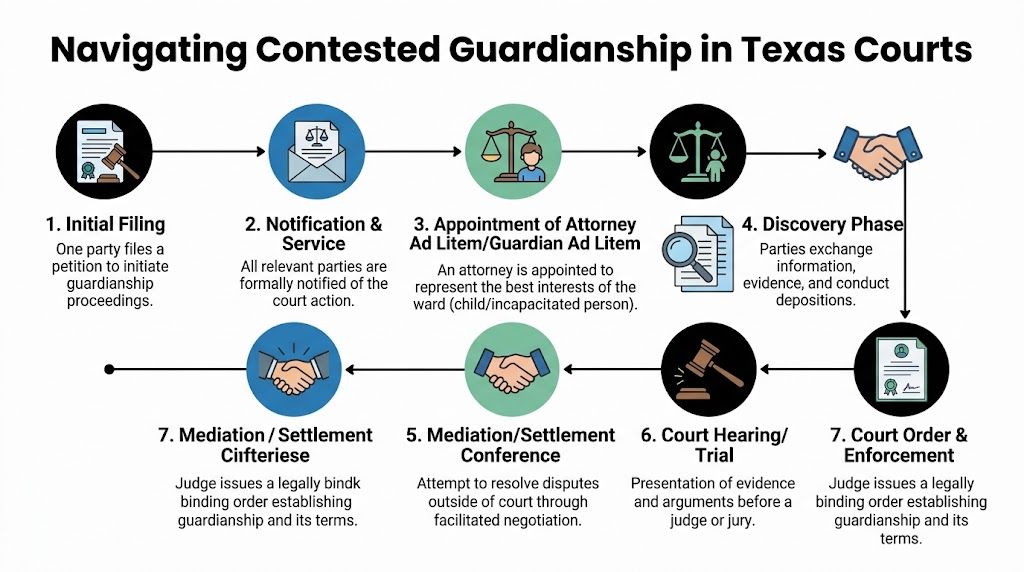
A contested case often includes these stages:
- An objection or competing application is filed
- The court reviews notice and service issues
- An attorney ad litem may be appointed for the proposed ward
- The parties exchange records and other evidence
- Mediation may be ordered or suggested
- The court hears testimony and argument
- The judge signs an order, or denies the request
The proposed ward's attorney ad litem plays a key role. That lawyer doesn't represent the stepparent or the objecting relatives. The ad litem focuses on the ward's rights and legal interests.
For readers who want a visual map of the process, this infographic helps show how a contested case typically unfolds.
Emergency and temporary guardianship
Some families can't wait for a full trial. If a loved one faces immediate risk, the court may consider temporary or emergency relief.
That option can matter if someone is in immediate medical danger, if funds are being drained, or if a vulnerable person is being isolated. Temporary guardianship requests usually require direct, credible evidence of urgent harm and a narrow request that matches the emergency.
Courts treat emergency relief seriously because it can limit someone's rights before a full final hearing. A judge will expect focused facts, current evidence, and a clear explanation of why a less restrictive tool won't protect the ward in time.
To hear more about how these disputes unfold in practice, this video gives useful background:
How to stay effective during a fight
Families often damage their own cases by turning the proceeding into a moral scorecard. Probate judges don't need a full history of every holiday argument. They need relevant facts tied to capacity, care, safety, and suitability.
A better approach is to focus on:
- Documented concerns: missed care, unsafe housing, unpaid bills, or isolation
- Reliable witnesses: people with firsthand knowledge, not rumor
- A workable plan: where the ward will live, who will manage care, how money will be protected
- Court compliance: clean filings, proper service, and respectful conduct in the courtroom
If you're already in active litigation, this guide on contesting guardianship in Texas can help you understand the procedural stakes.
Finding Common Ground Mediation and Guardianship Alternatives
Not every stepfamily guardianship conflict texas case should end in a courtroom showdown. In many blended families, the legal problem is real, but the deeper issue is fear. One side fears being cut out. Another fears the wrong person will gain control. Mediation can make space for practical solutions that a judge might never build for you.

Why mediation deserves serious attention
Mediation isn't just a softer option. It often works because families can address issues a court order can't fully repair, such as visitation schedules, communication rules, access to records, or shared input on care decisions.
According to this blended family estate planning discussion, mediation reaches a 77% success rate in parent-child cases. The same discussion notes that 40% of estate disputes involve step-relatives, and that mediation or preemptive tools like powers of attorney can reduce litigation costs by 50-100%.
That matters because guardianship litigation can drain both energy and trust. Even when one side wins, the family may lose the ability to work together.
Alternatives that may avoid guardianship altogether
Texas law generally prefers less restrictive alternatives when they can protect the person adequately. Depending on the facts, families should consider:
- Durable Power of Attorney: Lets a trusted person handle financial matters if properly signed while capacity still exists.
- Medical Power of Attorney: Allows someone to make health care decisions in the situations covered by the document.
- Supported decision-making arrangements: Useful in some disability contexts when the person can still participate in choices.
- Trust planning: Can protect funds for a minor or an adult with special needs without giving broad control to the wrong person.
- Representative payee or limited financial tools: Sometimes enough for benefits management without full guardianship.
Some of the best guardianship cases are the ones that never had to be filed because the family planned ahead while the loved one still had capacity.
Mediation in practice
A blended family mediation might involve a stepparent, adult children from a prior marriage, and a neutral mediator. The parties may agree that the stepparent will handle medical coordination, one adult child will receive regular financial reports, and a trust officer or third party will hold certain funds. That kind of result can reduce fear without forcing the court to choose one "winner."
If you're comparing local options, families in Central Texas sometimes look at resources like this Austin mediation lawyer page to better understand how family mediation works and what preparation it requires.
How a Guardianship Attorney Can Protect Your Family
A stepfamily guardianship dispute combines probate law, family dynamics, medical evidence, procedural deadlines, and courtroom strategy. That's a difficult mix for any family to handle alone, especially when emotions are high and the stakes involve a child's future or an adult's safety.
An experienced Texas guardianship attorney does more than file forms. The lawyer helps identify whether guardianship is the right tool, whether a temporary order is needed, what less restrictive alternatives should be considered, and how to present a credible case under Title 3, Subtitle G of the Texas Estates Code. That often includes coordinating with physicians, preparing a legally sufficient application, managing service on interested parties, and organizing evidence in a way a probate judge can act on.
After appointment, legal guidance still matters. Guardians have ongoing duties. They may need to qualify, post bond if required, keep funds separate, file inventories or accountings when applicable, and submit annual reports. If they miss those obligations, the court can intervene.
The most valuable legal help is often steady, practical, and calm. In a conflict involving a stepparent and biological relatives, that kind of guidance can keep the case focused on the ward's needs instead of the family's anger.
Frequently Asked Questions About Stepfamily Guardianship
Can a stepparent get guardianship of a stepchild in Texas?
Yes, but not automatically. A stepparent must usually file in the proper court, show why guardianship is legally necessary, and prove the appointment serves the child's best interest. If a biological parent has nominated the stepparent in writing, that can significantly strengthen the request.
Does marriage to the child's parent give the stepparent decision-making rights?
Not by itself. Marriage may explain the family relationship, but it doesn't automatically create legal power over the stepchild's personal, medical, or financial matters. The same is true in many situations involving an incapacitated spouse's separate property.
What court handles these cases in Texas?
That depends on the county and the facts. In some places, such as Harris County Probate Court, a statutory probate court may hear the matter. In other counties, a county court with probate jurisdiction may handle the case. The filing court matters because local procedures can differ.
What if the case involves a minor's injury settlement?
The court may require extra protection for the funds. Even a caring stepparent shouldn't assume the money can be deposited and managed informally. The judge may require a guardianship of the estate or another protected arrangement to safeguard the child's funds.
Can a biological relative block the stepparent just because they are related by blood?
Not automatically. Biological relationship is important, but it isn't the only factor. The court still looks at fitness, need, credibility, and the ward's best interest. A biological relative with poor judgment, conflicts of interest, or little real involvement may not be the best choice.
What happens after a guardian is appointed?
The guardian must follow the court order and comply with ongoing legal duties. Those may include qualification paperwork, recordkeeping, annual reporting, accountings for estate matters, and asking the court for permission before certain major actions. Guardianship is supervised. It isn't a private family arrangement.
Can guardianship be changed or ended later?
Yes. Guardianship can sometimes be modified, transferred, or terminated if circumstances change. For example, a minor may age out, an adult may regain capacity, or a guardian may need to resign or be removed. The court must approve changes, and the process should be handled carefully.
What should families do first when conflict is brewing?
Start gathering records. Get the medical picture clarified. Preserve texts, calendars, school records, and financial information. Avoid confrontational messaging. Then speak with a Texas lawyer who handles guardianship and probate disputes so you can choose the right path before mistakes harden into a court fight.
If your family is facing a guardianship dispute, a medical crisis, or confusion about a stepparent's rights, the Law Office of Bryan Fagan, PLLC can help you understand your options under Texas law. Our team assists families across Houston, Dallas, Austin, San Antonio, and statewide through virtual meetings. We handle guardianship, probate matters, and estate planning issues with a clear, compassionate approach. Schedule a free consultation to get advice suited to your family, your county, and your next step.