Skip to content
A sister in Colorado gets a late-night call from Houston. Her father missed a medical appointment, a neighbor says a new “helper” has been taking him to the bank, and no one can tell whether he understands what he’s signing. By morning, the family group chat is full of fear, suspicion, and bad advice. Someone says, “Just go down there and take over.” Someone else says, “If there’s already paperwork in Texas, you’re too late.”
Neither answer is usually right.
When you’re dealing with an out of state family guardianship dispute texas problem, the hardest part at first is that you’re trying to protect someone you love from hundreds of miles away. You may not know which court matters, whether another relative already filed something, or whether your loved one needs a guardian at all. You may also be worried that stepping in will make the conflict worse.
Those worries are normal. They also shouldn’t keep you from acting.
Texas law gives families a path to ask for protection, challenge a bad guardianship arrangement, or seek recognition of an out-of-state order when a vulnerable adult or child is in Texas. The process lives largely in Texas Estates Code Title 3, Subtitle G, which governs guardianship procedure, duties, and court oversight. In interstate cases, jurisdiction rules matter just as much as the family facts.
For many families, it helps to first understand the difference between caregiving and formal legal authority. A practical primer on legal guardianship for adults can help you frame the issue before you start making court decisions.
Answering the Worrisome Call About Your Loved One in Texas
Most interstate guardianship disputes don’t begin in a courtroom. They begin with a call that makes your stomach drop.
Your aunt in Dallas may have started wandering. Your adult son in Austin may be receiving an injury settlement and suddenly several relatives have opinions about who should manage it. Your mother in Harris County may be in the hospital, while a local family member insists that no one from out of state should be involved. These situations feel urgent because they are. But urgency doesn’t mean guessing.
What families usually get wrong first
The first mistake is assuming distance disqualifies you. It doesn’t. Texas courts care about the proposed ward’s safety, capacity, best interests, and the legal qualifications of the person asking to serve. Living in another state creates practical challenges, but it doesn’t end your case.
The second mistake is assuming every decline requires guardianship. Sometimes the appropriate answer is a less restrictive tool, such as a valid power of attorney, supported decision-making, trust planning, or a temporary arrangement while medical questions get sorted out. Guardianship is powerful. Courts treat it that way.
When families slow down just enough to gather records, confirm location, and identify who has legal authority today, they usually make better decisions than families who rush into a filing based on panic.
What matters in the first few days
Start with three questions:
- Where is your loved one physically located: County matters because guardianship filings usually go into a local Texas probate court or county court handling probate matters.
- Who currently has paperwork: Ask whether anyone has an existing guardianship order, power of attorney, medical directive, trust authority, or school-related authority if a minor is involved.
- What is the immediate risk: Missed bills and confusion are serious. So are medication errors, isolation by another relative, unexplained banking activity, and pressure to sign documents.
A simple example
Suppose your mother has lived in Houston for years. You live in Arizona. Your brother lives nearby and says she’s “fine,” but the hospital won’t tell you much, and bank alerts show unusual withdrawals. That does not mean you can march into a bank and take control. It does mean you may need Texas counsel, medical documentation, and a court strategy quickly.
That’s where clarity starts to replace panic. The next issue is the one that trips up many out-of-state families first. Where the case belongs.
Understanding Jurisdiction Where to File the Guardianship Case
A lot of out-of-state relatives assume the first question is who should serve as guardian. In interstate disputes, the first real question is usually which court gets to decide that at all. If that issue is handled poorly, families can spend weeks fighting over venue while a parent, adult child, or disabled sibling sits in legal limbo.
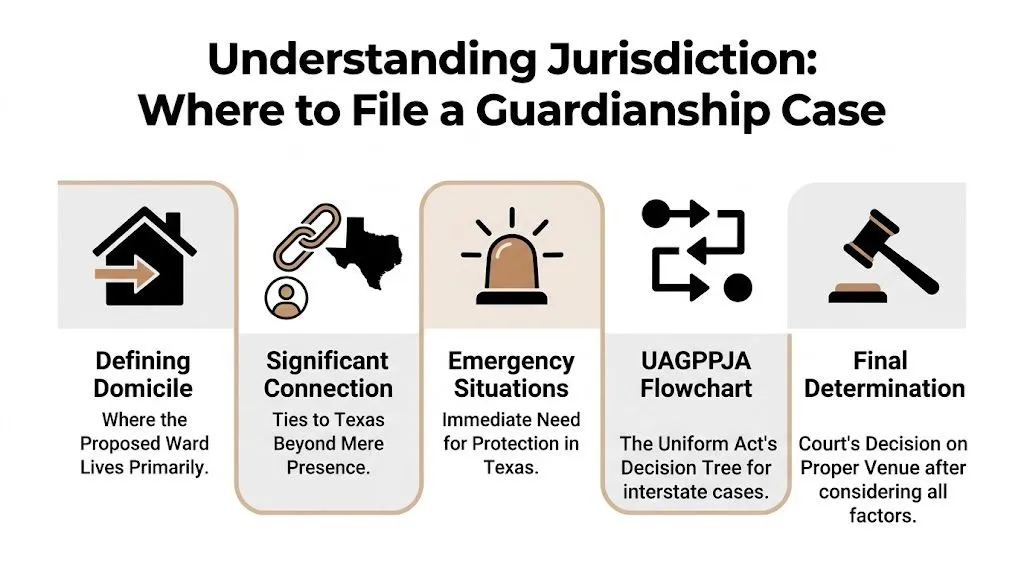
Texas follows the Uniform Adult Guardianship and Protective Proceedings Jurisdiction Act for many adult interstate jurisdiction disputes. In practical terms, the court will look closely at where the proposed ward lives, where the strongest personal and medical ties exist, and whether another state already has a valid case underway. If an order already exists somewhere else, recognition in Texas may still require filings, notice, and court review rather than automatic acceptance.
Start with the person’s real home, not the latest temporary stop
For adult guardianship cases, the home state is often the starting point. That usually means the state where the person has been living as part of ordinary life, not a short hospital stay, a rehab placement, or a temporary move to stay with one child.
Distance makes this harder because the out-of-state family member often hears facts through someone else. A brother in Colorado may be told that Mother “moved to Oklahoma,” while her mail, doctors, apartment lease, and caregivers are still in Texas. A Texas judge will care far more about records than family shorthand.
The facts that usually matter most include:
- where the person has been physically living on a sustained basis
- where primary doctors, specialists, and care facilities are located
- where the person receives daily support
- where bank accounts, benefits, housing, and bills are centered
- whether a recent move was voluntary, planned, and made while the person had capacity
A relocation during confusion, hospitalization, or family conflict often becomes the center of the jurisdiction fight.
“Significant connection” arguments decide close cases
Some cases are obvious. Many are not.
If the home state is unclear or disputed, courts may examine significant connections. That means more than a mailing address. The court is trying to determine which state has the stronger, more reliable relationship to the person’s life and evidence.
| Issue | Why the court cares |
|---|---|
| Medical history | Doctors and records are often needed quickly in a contested case |
| Family and caregivers | The court wants to know who actually provides day-to-day help |
| Housing | A long-term residence usually carries more weight than a temporary stay |
| Finances and property | Accounts, benefits, and real property can tie the case to one state |
| Intent | A planned move with capacity is different from a pressured relocation |
Out-of-state relatives often lose ground in these circumstances. They focus on fairness. The court focuses on proof. If you are arguing that Texas is still the right forum, gather lease records, admission paperwork, physician information, benefit notices, and anything showing the move out of Texas was temporary or questionable.
Recognition, registration, and transfer are different steps
Families mix these terms together all the time, and that causes expensive mistakes.
A court may recognize an out-of-state guardianship order. A party may register an order for use in Texas. A case may also need to be transferred or re-filed depending on the posture of the dispute and what authority is being requested. Those are related ideas, but they are not the same procedure.
If your family already has an order from another state, do not assume a Texas hospital, bank, or care facility will accept a photocopy and move on. Certified copies are commonly needed. Local institutions may ask whether the order has been registered or recognized here. If another relative wants to contest the order’s effect in Texas, response deadlines can arrive fast under the applicable procedure.
One practical rule helps. The day you receive notice of a Texas filing, send the papers to Texas guardianship counsel the same day. Out-of-state family members lose valuable time by spending a week arguing with siblings before a lawyer has reviewed the jurisdiction problem.
The right Texas county matters as much as the right state
Even when Texas is the proper state, filing in the wrong county can create delay and extra motion practice. Guardianship cases are generally filed in the county where the proposed ward resides or is located, subject to the specific facts and court structure involved. In real life, that means counsel needs to pin down where your loved one is living now, where they were living before the dispute started, and whether a recent move should count.
County-level practice matters too. Probate courts in large urban counties often expect detailed medical support, organized proposed orders, and prompt compliance with local procedures. Courts also look carefully at out-of-state applicants who say they can serve from afar. Judges want to know who will handle appointments, emergencies, medications, facility meetings, and financial oversight on the ground in Texas.
For a closer look at interstate guardianship issues when moving to or from Texas, review how transfer and recognition problems can develop when a loved one crosses state lines.
A common interstate problem
A mother lives for years in Fort Bend County. After a fall, one daughter takes her to Louisiana “just for recovery.” Months later, papers are filed there, and the Texas-based son insists the move was temporary and happened while their mother was confused. At that point, the first hearing may focus less on who is the better guardian and more on whether Louisiana or Texas should control the case.
That fight is not procedural trivia. It affects which judge hears the evidence, which doctors are easiest to subpoena, how quickly orders can be enforced, and how expensive the case becomes for a family already under strain.
Assessing Urgency and Protecting Rights from Afar
Distance doesn’t make you powerless. It changes the tools you use.

When a loved one in Texas may be at risk, the immediate job is to preserve facts, slow harmful decisions, and protect the person’s dignity. In some cases, a family needs to ask about temporary or emergency guardianship. In others, the better move is to stabilize the situation while a standard application or contest is prepared.
How to tell whether this may be urgent
Some facts point to a true emergency. Others point to serious concern, but not emergency court relief. You don’t need to decide that alone, but you should know what to watch for.
Urgency tends to be higher when you see:
- Medical danger: missed medication, unsafe discharge planning, wandering, refusal of needed care without clear understanding
- Financial exposure: sudden account changes, unusual withdrawals, pressured signatures, unpaid essentials
- Isolation: one relative blocking all contact, intercepting mail, or refusing to share location
- Rapid decline: confusion that seems to have sharply worsened, especially after hospitalization or a major health event
By contrast, long-standing family tension by itself usually isn’t an emergency. Neither is disagreement over who should be “in charge” if the proposed ward is still able to make informed decisions.
What you can do before a hearing
Start building a clean record. Courts trust details more than conclusions.
Keep a log with:
- Dates and times: every concerning call, hospital update, or report from caregivers
- Exact words when possible: if your father says, “I don’t know what papers I signed,” write that down accurately
- Document names: discharge papers, bank notices, APS communications, physician notes
- Witness list: neighbors, social workers, care staff, clergy, or friends who have direct observations
Don’t coach witnesses. Don’t flood the hospital with emotional emails. Don’t post accusations online.
A better way to communicate with facilities
If your loved one is in a hospital, rehab center, or assisted living setting, send a focused written notice. Ask that your contact information be placed in the chart, request notification before discharge if legally permitted, and state that there may be a pending capacity or guardianship issue. Keep the tone factual.
A useful request often includes:
- Your relationship to the patient
- A request to note safety concerns in the chart
- A request for the facility’s social worker or case manager to contact you
- A statement that legal proceedings may be pursued in Texas if necessary
For notice-related procedure in Texas cases, this overview of guardianship notice requirements in Texas helps families understand who must be notified and why mistakes at this stage cause delays.
Medical records and privacy
Many out-of-state relatives assume the hospital must talk to them because they’re “next of kin.” That’s often not enough by itself. Ask what authorization exists, whether the patient can sign one, whether an existing medical power of attorney is in place, and what records process the provider requires.
If capacity is questionable, ask for process, not argument. You are trying to learn who has legal authority and preserve information, not win a family debate over the phone.
A short educational video can also help clarify how Texas guardianship concerns arise in practice:
A short example
A daughter in New Mexico learns her father in Tarrant County is about to be discharged to the home of a cousin she doesn’t trust. She can’t stop the discharge by force. But she can document concerns, contact the social worker, gather physician contacts, identify any existing legal documents, and prepare counsel to seek court relief quickly if the facts justify it.
That is often the difference between reacting and protecting.
Building Your Case Evidence and Expert Texas Counsel
A contested guardianship case is usually won or lost on evidence quality, not family passion.
Texas courts require clear and convincing evidence in guardianship disputes. In contested matters, strong lawyers usually build the case through four evidence streams: procedural documentation, medical expert testimony, fiduciary misconduct evidence, and the ward’s own testimony. Litigants often hurt themselves by relying on stale records, especially because contested matters often last 3 to 6 months or longer, as explained in this Houston guardianship challenge analysis.
The four evidence streams that actually matter
Procedural proof
If you’re challenging an existing guardianship or registration effort, look for defects in how the original case was handled. Was notice proper? Was the right court used? Was required representation appointed? Were mandatory documents missing?
Procedural arguments can matter, but families often overestimate them. Courts usually want to know not only that something went wrong, but also why that error mattered to the outcome.
Medical and psychological evidence
The validity of many cases depends on this standard. Texas courts want reliable medical support, not a casual statement that someone “seems forgetful.”
Useful medical evidence may include:
- Current physician letters: focused on diagnosis, limitations, decision-making ability, and functional risk
- Specialist evaluations: neurology, psychiatry, geriatrics, or psychology when appropriate
- Timeline evidence: records that show whether capacity changed over time
- Contradictory records: proof that an earlier incapacity label may have been incomplete or inaccurate
A one-paragraph note saying “patient needs help” usually won’t carry the same weight as a detailed evaluation tied to legal capacity questions.
Fiduciary misconduct evidence
If the dispute concerns a guardian or family member mishandling money, vague suspicion won’t do much. Courts want records.
That may mean account statements, unexplained transfers, caregiver invoices, title records, or testimony from people who saw exploitation first-hand. In more serious estate disputes, families sometimes need accountants or other specialists. If you’re trying to understand how those professionals fit into litigation, this resource on forensic expert witnesses in Texas gives a helpful overview of expert roles.
The ward’s own voice
Never overlook the proposed ward’s testimony when they can communicate meaningfully. A court may give careful attention to the person’s preferences, fears, routines, and understanding of what help they want.
That testimony doesn’t end the analysis. But it can reshape it.
What works better than dumping documents
Remote families often make one of two mistakes. They either send almost nothing, or they send hundreds of pages with no organization.
Use a simple evidence file structure:
| Folder | What to place there |
|---|---|
| Medical | evaluations, physician letters, discharge summaries, medication lists |
| Financial | statements, benefit notices, bill defaults, suspicious transactions |
| Communications | texts, emails, voicemails, care-facility messages |
| Prior legal documents | powers of attorney, trusts, prior orders, nominations |
| Witness materials | names, contact details, short summaries of expected testimony |
Label files clearly. Include dates in file names. Save screenshots as PDFs when possible. If a text chain matters, don’t send cropped fragments that hide context.
Choosing Texas counsel for an interstate dispute
Not every probate lawyer enjoys remote-heavy guardianship litigation. Ask direct questions.
Consider asking:
- How often do you handle contested guardianship matters in Texas probate courts
- Which counties do you regularly appear in, such as Harris County, Dallas County, Travis County, or Bexar County
- How do you prepare out-of-state clients for remote hearings and testimony
- What medical proof does your court usually expect early
- How do you work with attorney ad litems and difficult family witnesses
For families who want counsel focused on these issues, the Law Office of Bryan Fagan, PLLC handles guardianship, probate, and related interstate matters from offices in Houston, Dallas, Austin, and San Antonio, including virtual consultation options for out-of-state relatives.
If expert support may be needed, this page on expert testimony in a Texas guardianship hearing is a useful starting point.
The Texas Court Process for Out of State Families
The call usually comes before you know the court rules. Your mother is in a Houston hospital. A neighbor says your brother has started controlling her accounts. You live in Colorado and need to act, but you cannot merely file papers and expect the judge to sort out a family crisis from a distance.
Texas probate courts bring structure to that problem quickly. Once a guardianship application is filed, the case stops being a family argument and becomes a question of proof under Texas Estates Code Title 3, Subtitle G. The court focuses on capacity, necessity, available less restrictive alternatives, and who can carry out the job.
What happens after filing
After filing, the court requires notice to the people entitled to receive it and makes sure the proposed ward’s rights are protected. In many cases, the judge appoints an attorney ad litem for the proposed ward. That lawyer does not represent the loudest relative, the relative paying the fees, or the person who lives closest. The ad litem represents the proposed ward’s interests.
Out-of-state relatives often underestimate that point. Good intentions matter, but they are not evidence. If you live elsewhere, assume the judge knows nothing about your family history, your caregiving role, or why distance has limited your in-person involvement. Build the record carefully.
The interstate problem inside a Texas case
Distance changes how the case is prepared, even when the hearing is in one Texas courtroom.
An out-of-state applicant may need to explain why Texas is the proper place for the case, why a local option is not better, and how day-to-day decisions will be handled from another state. A Texas sibling objecting to your appointment will usually press those points hard. Judges hear them often. The answer is not a speech about love or sacrifice. The answer is a practical plan.
That plan may include local caregivers, a property manager, regular in-person visits, online account monitoring, medical coordination by phone, and a clear system for emergencies. Courts tend to respond better to specifics than to broad promises.
What contested litigation looks like in real life
Contested guardianship cases can move in bursts. There may be a slow period while service is completed, the ad litem investigates, and records are gathered. Then deadlines tighten. Hearings get set. Family members who have ignored the case suddenly appear with accusations, old grievances, and competing narratives.
For an out-of-state family member, the pressure points are predictable:
- Travel decisions: whether you need to appear in person for a key hearing
- Witness management: lining up doctors, facility staff, neighbors, or family members who can testify clearly
- Document control: getting certified records, bank materials, and care records into usable form
- Court expectations: following county-specific procedures for exhibits, remote appearances, and proposed orders
- Cost control: deciding which fights matter and which side issues only drain resources
I often tell families the same thing. Spend money proving the points the judge must decide. Do not spend it relitigating every family insult from the last ten years.
Remote appearances can help, if they are handled professionally
Remote participation can make an interstate case manageable, but it does not excuse poor preparation. A shaky phone connection, missing exhibits, or a witness who cannot find the right document can damage credibility fast.
A useful remote-hearing checklist includes:
- Use a laptop or desktop if possible
- Log in early and test audio and video
- Have every exhibit labeled exactly the way your lawyer and the court will reference it
- Keep a printed or bookmarked hearing binder nearby
- Choose a quiet room with no interruptions
- Answer the question asked, then stop
- Dress as you would for an in-person probate hearing
Small mistakes carry more weight on video. Judges cannot read the room as easily, so clarity matters more.
What the judge is actually deciding
The court is deciding whether a guardianship is needed at all, whether a less restrictive option can protect the person, and if a guardian should be appointed, who is qualified to serve.
That may mean a guardianship of the person, a guardianship of the estate, or both. It may also mean limited powers rather than full control. In many interstate disputes, a narrower order can reduce conflict and make the arrangement more realistic. A daughter in another state may be well suited to oversee finances, for example, while local care decisions are handled with tighter court-defined limits or support from Texas professionals.
A common courtroom pattern
A daughter in Georgia seeks appointment over her father in Dallas County. Her brother in Texas argues that she lives too far away and barely visits. If she appears with organized medical proof, a realistic care plan, a record of regular contact, and a concrete explanation of how she will manage decisions from afar, distance is only one factor. If the brother appears in person but offers little beyond resentment and suspicion, physical proximity does not carry the case by itself.
Texas judges look for judgment, credibility, and workable details. In an interstate guardianship dispute, the relative who prepares for the court’s real questions usually stands on firmer ground than the relative who merely lives closer.
After the Court's Decision Navigating Your New Role
The hearing ends. The responsibility begins.
If the court appoints you guardian, your authority usually does not become fully usable just because the judge said yes in court. You may need to complete post-appointment steps such as taking an oath, posting any required bond, and obtaining the documents that third parties will rely on. Texas guardianship practice under Estates Code Title 3, Subtitle G treats appointment as the start of an ongoing supervised role.
If you were appointed guardian
Your first weeks usually involve practical tasks, not ceremony.
You may need to:
- Secure proof of authority: obtain the court documents institutions will ask for
- Set up reporting systems: calendar annual reports and, if applicable, estate accountings
- Protect property quickly: confirm access, preserve records, and stop unauthorized use
- Coordinate care: doctors, housing, benefits, school issues for minors, and daily support
Guardians of the person and guardians of the estate carry different duties. Some families underestimate that distinction. Managing a loved one’s living arrangements is not the same as lawfully managing money, accounts, or settlement funds.
The best guardians treat compliance as part of caregiving. Good records protect the ward and protect the guardian.
If the ruling went against you
A loss doesn’t always mean the concern was imaginary. It may mean the evidence wasn’t strong enough, the case was filed in the wrong posture, or a less restrictive option persuaded the court.
In some situations, families consider:
- Appeal options: when legal error may have affected the result
- Modification later: if capacity changes, abuse appears, or the current arrangement fails
- Compliance monitoring: documenting whether the acting guardian is meeting fiduciary duties
- Alternative planning: powers of attorney, supported decision-making, trust administration, or probate-related solutions
If your dispute also touches inheritance, property, or a decedent’s estate, related planning may matter as much as the guardianship itself. Families often need coordinated attention to probate matters and estate planning options so authority over the person and authority over assets do not conflict.
The long view
Guardianship isn’t a one-time victory. It’s a monitored fiduciary role. Interstate families who do well tend to build systems early, keep communication professional, and return to court when needed instead of trying to solve every conflict informally.
If you’re still deciding whether to file at all, it can also help to review broader guardianship guidance in Texas before taking the next step.
Frequently Asked Questions About Interstate Guardianship
Can I be appointed guardian in Texas if I live in another state
Possibly, yes. Being out of state does not automatically disqualify you. The court will look closely at practical caregiving, oversight, conflicts, and whether your plan is realistic for the ward’s daily needs.
What if another relative already has paperwork from another state
That may trigger recognition, transfer, or contest issues rather than a brand-new Texas case. Timing matters. Existing orders, certified copies, and notice deadlines can reshape the strategy quickly.
What if my loved one resists guardianship
Resistance does not end the case. It does mean the court will pay close attention to capacity, preferences, and whether a less restrictive alternative is available. The proposed ward’s voice matters.
How much does a contested guardianship dispute typically cost
Contested cases can cost tens of thousands in legal fees and often last 3 to 6 months or more, according to the earlier cited Texas guardianship source. Costs usually rise when families fight over medical proof, money management, or jurisdiction.
Do I need to come to Texas in person
Sometimes yes, sometimes no. Many out-of-state family members can participate remotely for major parts of the case, but some hearings, evaluations, or practical caregiving decisions may still require travel depending on the court and the facts.
Is guardianship always the right answer
No. Sometimes a valid power of attorney, supported decision-making, trust structure, or other planning tool will protect the person with fewer restrictions.
If you’re dealing with an out of state family guardianship dispute texas issue, you don’t have to sort out jurisdiction, evidence, and court procedure by yourself. The Law Office of Bryan Fagan, PLLC helps families evaluate emergency concerns, contest or establish guardianships, and manage interstate recognition and transfer issues across Texas. Schedule a free consultation to get case-specific guidance for your loved one, your county, and your next step.