Skip to content
Your brother says Mom is forgetful but still capable. Your sister says the bills are unpaid, the medication is mixed up, and someone needs legal authority now. You may be the child who has handled doctor visits for months, or the one who lives out of state and just realized how much has changed. Either way, a guardianship dispute between siblings texas families face often starts the same way. Everyone says they want to protect a parent, but no one agrees on what protection should look like.
That disagreement can move from the kitchen table to probate court fast. Once that happens, the stress becomes legal, financial, and intensely personal. These cases can cost tens of thousands of dollars in legal fees, and while uncontested matters may finish in weeks, contested cases can last from 3 to over 6 months, as noted in this discussion of Texas family guardianship disputes.
Families in Harris County Probate Court, Dallas County, Bexar County, Travis County, and courts across Texas run into the same hard truth. Love for a parent does not automatically create agreement about care, money, or authority. Texas law steps in when families cannot.
When Siblings Disagree on a Parent's Care
A common scene looks like this. One sibling has been taking Dad to appointments and sees the decline up close. Another remembers him balancing his own checkbook a few months ago and thinks guardianship is too extreme. A third worries less about medical care and more about whether one child is gaining too much control over the bank account.

That tension doesn't mean your family is unusual. It means you're facing one of the hardest parts of aging and incapacity. Guardianship disputes often surface when a parent’s decline becomes too serious to ignore, but the family still disagrees about whether court involvement is necessary and who should take charge.
What a guardianship dispute really means
In plain English, a guardianship dispute is a fight over two questions. First, does your loved one need a guardian at all? Second, if the answer is yes, who should serve?
Texas probate courts treat those as separate issues because they are separate issues. A parent may need help with finances but still be able to express preferences about daily life. Or a parent may need immediate protection from exploitation, but the sibling who first files may not be the right long-term guardian.
Practical rule: The court’s job isn’t to reward the most vocal child. It’s to protect the proposed ward.
Sibling cases often become more intense than outside-party disputes because everyone arrives with history. Old resentments, unequal caregiving, and memories of who got what financial help years ago can all become part of the story. Even when those details aren't legally decisive, they shape how people testify and whether settlement is possible.
Why families need a roadmap early
The best first step is usually information, not escalation. Before anyone files, families need to understand what Texas courts require, what alternatives may exist, and what evidence matters. Many disputes calm down once everyone sees that probate judges work from documents, medical proof, and the ward’s best interests, not sibling popularity.
If competing applications are already being discussed, this guide to competing guardianship applications in Texas helps explain why timing, filings, and evidence matter. That kind of clarity often changes the tone of the conflict.
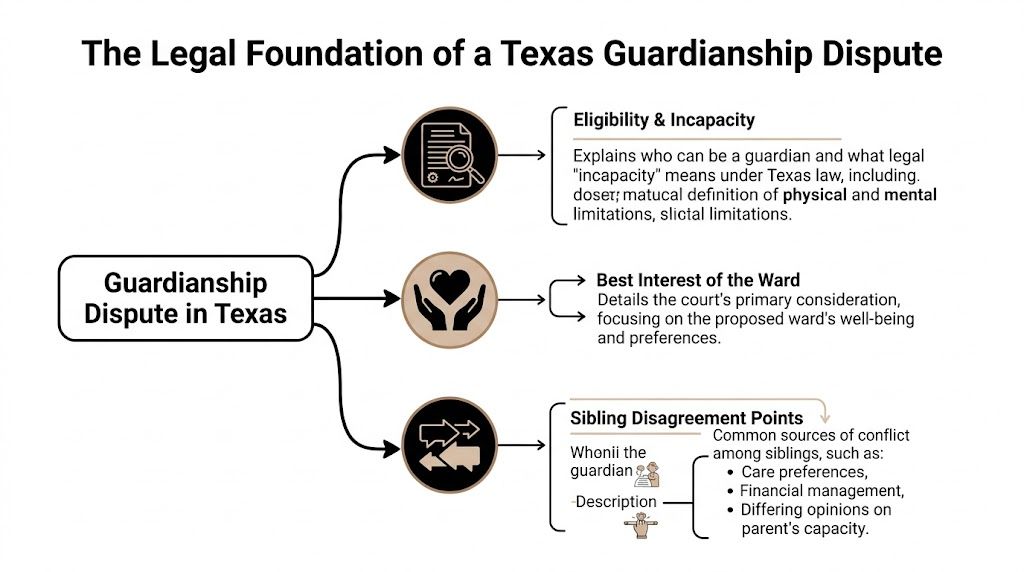
The Legal Foundation of a Texas Guardianship Dispute
Texas guardianship law sits in the Texas Estates Code, Title 3, Subtitle G. That part of the code governs when a court may appoint a guardian, what rights the proposed ward keeps, what evidence must be filed, and how the court chooses the right person if more than one relative wants the role.
The legal question isn't whether the family is frustrated. The question is whether the proposed ward is legally incapacitated and whether a guardianship is necessary after considering less restrictive options.
Incapacity is a legal finding
Many families use the word “incapacitated” casually. Courts don't. Under the Estates Code, incapacity must be proven in court, and the process starts with medical support and a formal application.
That matters because forgetfulness alone usually doesn't decide a case. A parent can make some bad choices and still retain legal rights. Guardianship is a major loss of autonomy, so judges want real proof, not just family concern or family irritation.
A useful starting point for non-lawyers is a plain-language Power of Attorney guide, because many sibling disputes begin with confusion about whether an existing power of attorney, medical power of attorney, or other planning document already gives someone authority to act.
Person, estate, or both
Texas recognizes different kinds of guardianship. In family disputes, the distinction often explains why siblings seem to be arguing about different problems.
| Type | What it covers | Common source of sibling conflict |
|---|---|---|
| Guardian of the person | Medical care, living arrangements, daily welfare | One child wants home care, another wants memory care or assisted living |
| Guardian of the estate | Money, bills, property, financial management | A sibling accuses another of secrecy, misuse, or unfair control |
| Both roles | Personal and financial authority | One family member wants complete control, others want duties split |
Take a simple example. Two sisters agree their father needs help bathing, managing medications, and getting to appointments. They do not agree on money. One sister has handled his accounts for years. The other says she never sees statements and suspects withdrawals she can't explain. That may become a fight over guardianship of the estate, even if there is less disagreement about personal care.
Why sibling cases become contested
Many of these disputes grow out of old financial history, not just present-day medical decline. Siblings often disagree over whether one child was already “paid back” through lifetime gifts or loans, or whether earlier help from a parent should matter now. These conflicts become even sharper when there is a vague will or no will at all, as discussed in this analysis of Texas sibling inheritance disputes.
A few recurring pressure points show up again and again:
- Existing planning documents: One sibling holds a durable power of attorney and says guardianship is unnecessary. Another says the document is being misused.
- No planning at all: There is no medical power of attorney, no supported decision-making agreement, and no trusted process for paying bills or arranging care.
- Different views of capacity: One child sees a parent’s best moments. Another sees the confusion that happens every evening.
- Control of information: The sibling closest to the parent has the records, the passwords, and the doctor relationships. That can create practical advantages and mistrust.
Courts in Texas don't appoint a guardian just because the family is deadlocked. Someone still has to prove the legal need for one.
Alternatives courts want considered
The Estates Code pushes courts to consider whether something less restrictive can solve the problem. Depending on the facts, that may include a valid power of attorney, a supported decision-making arrangement, informal family assistance, or a more limited guardianship rather than a full one.
That is one reason evidence matters so much. If a judge believes a parent can still make some decisions with support, a broad request for total control can backfire. Families often benefit from understanding the burden of proof in Texas guardianship cases before taking rigid positions.
How a Guardianship Dispute Unfolds in Texas Courts
The probate process feels less overwhelming once you know the order of events. In counties like Harris, Dallas, Tarrant, and Travis, the broad pattern is similar even though local court practices may differ.
At the center of every case is one basic idea. The person asking the court for authority has to prove the need for it. In Texas, incapacity must be shown by clear and convincing evidence, which is a high standard, and contested cases can take 6 to 12 months while mediation resolves around 70 to 80% of high-conflict cases, according to this summary of Texas guardianship litigation and mediation data.
The filing stage
A case usually begins when one sibling files an Application for Appointment of Guardian in the proper probate court. The filing should identify the proposed ward, explain the alleged incapacity, describe the relief requested, and include the required medical support.
The medical piece is not a formality. A physician’s letter or certificate gives the court a starting point for whether incapacity may exist. If the medical support is weak, outdated, vague, or disconnected from the legal issues in the application, the entire case can lose momentum early.
For many families, the initial filing already changes the relationship. Notice has to go out to interested parties. That means siblings who were arguing informally now receive legal papers and deadlines.
What happens when a sibling contests the case
The opposing sibling may challenge either the need for guardianship or the fitness of the proposed guardian. Sometimes both. One child might say, “Mom needs help, but my brother should not be in charge.” Another may say, “No guardian is needed because a valid power of attorney already exists.”
A contest can involve written objections, competing evidence, and in some cases a competing application. Once that happens, the court is no longer only deciding whether help is needed. It is weighing credibility, motives, and the practical realities of who can carry out fiduciary duties.
The role of the attorney ad litem
Texas courts often appoint an attorney ad litem to represent the proposed ward’s interests. Families sometimes misunderstand that role. The ad litem is not the lawyer for one sibling, and not the judge’s personal investigator.
The ad litem’s job is to evaluate the proposed ward’s situation, communicate with the ward when possible, review records, and help the court focus on the ward’s rights and interests. In a bitter sibling conflict, this can be the first neutral voice in the room.
What works: cooperating with the ad litem, producing records promptly, and answering questions directly.
What doesn't: trying to recruit the ad litem to “take your side” in a family feud.
Temporary and emergency guardianship
Some families can't wait for a final hearing. If a parent is at immediate risk because of exploitation, medical neglect, unsafe housing, or asset loss, a court may consider temporary or emergency relief.
These requests need careful handling. Judges know that families sometimes claim “emergency” when what they really mean is “urgent to me.” A true temporary guardianship request should tie specific facts to immediate harm and show why ordinary scheduling is not enough.
Examples that often trigger urgent filings include:
- Financial danger: A sibling is draining accounts, changing access, or refusing to account for spending.
- Medical risk: The proposed ward is missing essential care, medications, or supervision.
- Isolation: One child is blocking contact and preventing others from checking on the parent’s condition.
- Housing instability: The parent is being moved without clear medical need or is living in conditions that create serious safety concerns.
Investigation, records, and pretrial pressure
After filing, most cases enter a period that feels slow from the outside but is critical to the result. Attorneys gather medical records, bank records, caregiving notes, witness statements, and background information on the proposed guardians.
Many cases strengthen or weaken based on their evidence. A sibling who speaks passionately but produces little documentation often struggles. A quieter sibling with organized records, timelines, and third-party witnesses may be far more persuasive.
Texas judges often want to know practical things such as:
- Who has been providing care?
- Who lives close enough to respond consistently?
- Who can manage money responsibly?
- Has either sibling shown signs of abuse, neglect, coercion, or self-dealing?
- What does the proposed ward want, if the ward can still express a reliable preference?
Mediation before trial
Many probate courts strongly encourage mediation, and in practice it often becomes the turning point. A mediated result can include who serves, what powers they receive, how information will be shared, and whether a neutral professional should handle part of the job.
Mediation is often more useful than families expect because it allows structure. A sibling who won't agree at the dining room table may agree in mediation to monthly account statements, a caregiving calendar, or independent oversight. Those details can calm future disputes in a way a winner-take-all hearing often does not.
The hearing itself
If the case doesn't settle, the court holds a hearing. Evidence comes in through testimony, medical records, financial documents, and witness statements. The judge may hear from doctors, caregivers, neighbors, social workers, family members, and the proposed ward.
The hearing usually answers three practical questions:
- Is the proposed ward legally incapacitated?
- Is guardianship necessary, or is a less restrictive option enough?
- If guardianship is needed, who should serve and with what limits?
Families often expect a dramatic courtroom showdown. In reality, probate judges usually focus on consistency and documentation. They compare what each side says against records, timelines, and conduct.
A sibling who interrupts, attacks motives, and tries to relitigate every family grievance often weakens the case. A sibling who brings organized evidence and stays centered on the ward’s safety usually helps the judge make a clear decision.
Proving Your Case Evidence and Medical Evaluations
Winning a guardianship dispute is rarely about who sounds most sincere. It is about who can prove the right facts in the right form. The legal standard is high, so the evidence has to do more than suggest concern. It has to show the court why intervention is justified.

Medical proof carries the most weight
In most cases, the foundation is the physician’s evaluation. The court wants medical evidence that connects diagnosis to function. A label alone is not enough. “Dementia” does not automatically answer whether the parent can manage money, understand risks, consent to treatment, or express preferences.
A strong medical evaluation usually addresses daily limitations in concrete terms. Can the person remember medications? Understand bank activity? Recognize exploitation? Communicate informed choices? Those answers matter more than broad conclusions.
Some physicians use tools such as the MMSE or MoCA as part of a capacity assessment. Those tests are not the whole case, but they can help support a broader medical opinion when the doctor explains what the results mean in real life.
If your case turns on capacity, this resource on the physician certificate for guardianship in Texas can help you understand what courts expect from the medical filing.
Non-medical evidence often decides close cases
When siblings agree a parent is declining but fight over who should serve, the medical records may not separate the candidates. Other evidence does.
Useful proof often includes:
- Caregiving records: appointment logs, medication schedules, discharge instructions, and notes showing who handled what care
- Financial documents: bank statements, unpaid bills, suspicious withdrawals, or missing records
- Third-party observations: affidavits or testimony from neighbors, home health workers, clergy, social workers, or friends
- Communications: text messages or emails that show cooperation, obstruction, or refusal to share information
- Living condition evidence: photographs, inspection reports, or care facility communications
Records created close to the events usually carry more weight than memories organized later for litigation.
What judges compare between siblings
In a contested family case, the court usually isn't looking for a perfect child. It is looking for the safest and most reliable fiduciary. Under the Estates Code, judges weigh practical fitness, not just family title.
The comparison often comes down to a handful of real-world factors:
| Question the judge may ask | Why it matters |
|---|---|
| Has this sibling actually provided steady care? | Past conduct often predicts future follow-through |
| Is this person financially organized and trustworthy? | A guardian may control income, bills, and property |
| Does this sibling live close enough or have a workable plan? | Availability affects emergency response and oversight |
| Can this person follow court rules and reporting duties? | Guardianship is ongoing legal work, not just permission |
| Has this sibling respected the ward’s dignity and preferences? | The ward remains central, even in conflict |
What helps and what hurts
The strongest cases usually share a pattern. The family member has medical support, a clean document trail, and a practical care plan. The weakest cases often rely on accusation without backup.
What tends to help:
- Specific timelines: “I took her to these appointments, on these dates, and here are the discharge notes.”
- Neutral witnesses: Doctors and professional caregivers are often more persuasive than relatives repeating family history.
- A realistic proposal: Judges want to know where the ward will live, how bills will be paid, and who will handle daily needs.
What tends to hurt:
- General statements: “He’s always been selfish” is rarely useful without proof tied to the ward’s current welfare.
- Overreaching requests: Asking for broad powers when narrower relief would protect the ward can make the court skeptical.
- Messy records: If you claim financial misconduct but can't trace transactions clearly, the point may lose force.
Resolving Sibling Disputes Outside the Courtroom
Two sisters can leave the courthouse with a signed order and still be unable to agree on who will take their father to a cardiology appointment next Tuesday. That is the gap mediation and negotiated settlement are meant to address. A court can appoint a guardian. Families still have to build a working plan for day-to-day care, information-sharing, money, and boundaries.

In practice, the best out-of-court resolutions focus on the friction points that keep reigniting the fight. Who receives medical updates. Who has access to bank records. Whether one sibling can clean out the house. What notice must be given before a move, a facility change, or a sale of property. Those details often matter more than the title of guardian.
Why mediation helps in the right case
Mediation works because families can solve problems a judge may not address in detail. The legal order might answer who has authority. It usually does not create a clear routine for cooperation after the hearing.
A useful mediated agreement may include:
- Divided responsibilities: One sibling coordinates medical care. Another handles property tasks or insurance paperwork, subject to the court's order and any approval the law requires.
- Use of a neutral professional: A private guardian, care manager, bookkeeper, or geriatric case manager can lower suspicion when no sibling trusts the others.
- Regular reporting: Monthly expense summaries, shared appointment calendars, and copies of required court filings often reduce accusations.
- Decision rules: The family can require advance notice before major steps such as selling a home, changing facilities, or stopping in-home help.
- Visitation terms: Clear expectations about calls, visits, holidays, and transportation can prevent a care dispute from turning into an access dispute.
I often tell families to judge any proposed settlement by one question. Can these people follow it on a hard month, not just on a calm day in a conference room?
Co-guardianship is only workable in some families
Families regularly ask for a split arrangement because it sounds fair. Fairness is not the only test. A co-guardianship that requires constant joint approval can create deadlock if the underlying problem is distrust.
Co-guardianship tends to hold up when siblings already have decent communication, similar views about care, and enough time to respond to emergencies. It tends to fail when one sibling monitors every decision for bad motives, or when old family grievances keep bleeding into basic care decisions. In those cases, a single guardian with reporting safeguards is often the more stable choice.
Out-of-state siblings still have options
Distance does not end a sibling's role in the case or in the family. An out-of-state child may be the one who tracks medical records carefully, notices financial irregularities, or pays for extra help. Texas courts still want a realistic plan, though. If a sibling lives elsewhere, the proposal should explain who can handle local emergencies, transportation, facility visits, and face-to-face oversight.
This is also where mediation can help preserve relationships after the legal fight. A local sibling may need recognition for the daily work already being done. An out-of-state sibling may need reliable access to records and a meaningful voice in major decisions. Both concerns can be addressed without turning every disagreement into another court filing.
A few practical steps make remote participation stronger:
- Retain Texas counsel early: Local filing rules and court expectations affect timing and strategy.
- Keep records in one place: Organized digital files, medical timelines, and expense logs make settlement talks more productive.
- Address the logistics directly: Spell out who will attend appointments, respond to midnight calls, and meet with facility staff.
- Use virtual mediation well: Remote sessions can save travel time and make it easier to include all necessary family members and professionals.
Here is a short video that helps frame how families can approach conflict with more intention before positions harden completely.
If a guardian is already in place and conflict continues
Some of the hardest sibling disputes start after the appointment, not before it. One child is serving. Another believes money is being mishandled, visits are being restricted, or the guardian has stopped following the court's requirements.
Texas law gives families tools to respond, including requests for accountings, modification, or removal in serious cases. The better first step, though, is not always immediate litigation. Sometimes a narrowly drafted agreement solves the problem faster. For example, a sibling who fears financial abuse may not need removal right away. That sibling may need monthly statements, a copy of the annual accounting, and a neutral CPA to review large transactions. If the guardian refuses basic transparency, the court option becomes stronger.
That practical approach matters for another reason. Families still have holidays, hospital calls, funerals, and caregiving decisions after the case ends. A settlement that protects the parent and leaves some room for dignity between siblings is often worth more than a scorched-earth win.
Life After the Verdict A Checklist for Moving Forward
The hearing ends. The family story doesn't. Some siblings leave relieved. Others leave hurt, angry, or ashamed. Both sides still have to decide what happens next for the parent and for the family.
The encouraging part is that healing isn't always out of reach. In mediated cases, 65% of families reunite within 18 months, and Texas guardianship modifications rose 28% in 2025, often resolving through voluntary sibling handoffs after reporting disputes, according to this discussion of post-dispute guardianship outcomes in Texas.
If you were appointed guardian
Your authority comes with duties. Under the Texas Estates Code, guardians must follow the court’s order, act in the ward’s best interests, protect the ward’s property, and comply with required reporting and accounting rules. In many cases, the court may require a bond, inventories, annual reports, annual accountings, or other filings depending on the type of guardianship.
Your first weeks should be practical and organized:
- Get certified copies of the order and letters: Banks, doctors, care facilities, and insurers may ask for them.
- Read the limits of your authority carefully: Some orders are broad. Others are limited.
- Separate the ward’s money from your own: Never blur those lines.
- Build a reporting system now: Keep receipts, logs, and account records from day one.
- Communicate more than you feel like communicating: Reasonable updates can prevent the next fight.
If your petition was denied or your sibling was appointed
You may still have an important role. A denied petition does not erase your concern, and it does not always cut you out of the picture. Depending on the order and the facts, you may still monitor the case, review public filings, raise concerns through counsel, and maintain healthy involvement with your parent.
The most productive approach is usually steady oversight, not constant confrontation.
Consider this checklist:
- Read the signed order carefully. Know exactly what powers were granted.
- Track deadlines for reports or accountings. Compliance issues often become visible there.
- Document concerns factually. Dates, amounts, missed care, and written communications matter.
- Keep contact with the ward respectful and calm. Don't make the parent choose sides.
- Ask whether modification is more realistic than appeal. In some situations, changed circumstances matter more than relitigating old ones.
Some families don't rebuild trust by revisiting the verdict. They rebuild it by creating smaller, reliable habits after the verdict.
Rebuilding the family after the case
Legal closure is not emotional closure. If the parent is still living, siblings will likely continue seeing each other at hospitals, rehab centers, holiday gatherings, and care conferences. A few deliberate choices can lower the temperature.
Try these steps:
- Use one communication channel: a shared email thread or care portal is often better than scattered texts.
- Keep updates factual: medications changed, appointment moved, account filed.
- Bring in outside help when needed: a counselor, clergy member, care manager, or mediator can help with recurring conflict.
- Protect the parent from the dispute: don't argue in front of the ward and don't use the parent as a messenger.
- Review planning documents once the crisis settles: estate planning, powers of attorney, and beneficiary designations may need attention.
A guardianship order is not always permanent. If the ward’s condition changes, if the guardian fails in the role, or if a better structure becomes available, the court can be asked to review the arrangement. Families who keep good records and stay focused on the ward’s welfare are usually in the best position to move forward wisely.
If you're facing a guardianship dispute between siblings in Texas, personalized advice matters. The facts, the medical evidence, the county court, and the family dynamics all affect the right next step. Law Office of Bryan Fagan, PLLC offers free consultations for families who need help establishing, contesting, modifying, or understanding a Texas guardianship case.