Skip to content
When a guardian stops doing the job well, families often feel stuck between worry and guilt. You may be seeing missed medical appointments, unpaid bills, tension at the care facility, or a guardian who has moved away and can’t respond when your loved one needs help. In other cases, the current guardian may have died, become ill, or reached the point where they can’t continue.
Texas law gives families a path forward. Substituting a guardian means asking the probate court to replace the current guardian with another qualified person or entity. This isn’t an informal family decision. It’s a court-supervised process designed to protect the ward, preserve continuity, and keep care from falling through the cracks.
The court’s focus is not family preference alone. The judge wants to know whether there has been a real change that justifies intervention, and whether the proposed change serves the ward’s best interests. That’s why preparation matters. Records matter. Timing matters.
If you need background on how successor guardianship works when a guardian can no longer serve, this Texas successor guardianship overview is a useful starting point.
Understanding When a Guardian Change Is Necessary
A guardian change usually comes to a head in an ordinary week. The care facility calls because consent paperwork is sitting unsigned. The ward’s bills are behind. The current guardian is still on paper, but no one can get a timely answer when a real decision has to be made.
That is often the point where a family starts asking the right question. Has something changed enough that the court should replace the current guardian?
In Texas, substitution is not based on family disagreement alone. The court wants proof that the current arrangement no longer fits the ward’s needs or no longer protects the ward the way the law requires. In plain English, you need to show a material change in circumstances. That can mean the guardian has become unable to serve, the ward’s condition or placement has changed, or the existing setup is now causing missed care, financial risk, or repeated court compliance problems.
This point matters because families often focus on who would do a better job. Judges usually focus first on what changed since the current guardian was appointed. If you cannot identify that change clearly, the case is harder to win even when the family’s concerns are real.
What "material change in circumstances" means
A material change is a meaningful shift in facts, not general frustration. The court is looking for evidence that the problem affects the ward’s care, property, safety, or legal compliance.
Common examples include:
- The guardian cannot continue serving: serious illness, declining capacity, death, relocation, or another condition that prevents prompt decisions
- The guardian is failing in court-ordered duties: missed annual reports, missing accountings, unpaid bills, poor communication with providers, or failure to respond to emergencies
- The ward’s situation has changed: a new diagnosis, a move to a higher level of care, changed financial needs, or improved capacity that calls for a different arrangement
- Conflict is now affecting the ward: family conflict by itself is usually not enough, but conflict that disrupts medical care, housing, or money management can support substitution
I tell families to build the timeline first. What changed, when did it change, and how has it affected the ward? That timeline often becomes the backbone of the petition.
Why families should act sooner rather than later
Waiting can make the record worse. If reports keep going unfiled, if facility staff cannot reach the guardian, or if funds are not being managed correctly, the ward pays the price first.
Early action also helps preserve evidence. Courts respond better to dated emails, billing records, care notes, facility incident reports, and copies of delinquency notices than to a general statement that things have been bad for a while. If the current guardian is resigning because of illness or burnout, get that information documented clearly.
For families dealing with a resignation, death, or other inability to continue serving, this overview of successor guardianship when a guardian resigns or passes away gives helpful background. A substitution case often overlaps with those same practical concerns, but the court still needs a clear showing of why the present appointment should change now.
Why the change must go through the court
A guardian acts under court authority. That authority does not transfer because relatives agree on a replacement. Until the probate court signs a new order, the current guardian remains the legal decision-maker unless the court limits or suspends that authority.
That protects the ward, and it protects the next guardian too. Without a court order, the proposed substitute cannot lawfully sign medical paperwork, manage funds, deal with benefits, or act under Letters of Guardianship. Families who understand this early usually make better decisions about records, timing, and who should file the petition.
Legal Grounds for Substituting a Guardian in Texas
A substitution case succeeds or fails on one point. You must show the probate court that something important has changed since the current guardian was appointed, and that the change affects the ward’s protection, care, property, or both.
In practice, that usually means proving a material change in circumstances. Sometimes the change is straightforward, such as a guardian’s death, serious illness, resignation, or loss of ability to do the job. Sometimes it is more contested, such as financial mismanagement, neglect, repeated failure to follow court orders, or conflict that is now interfering with the ward’s care. The court is not looking for family dissatisfaction alone. The court wants facts that show the present arrangement no longer serves the ward’s best interests under the Texas Estates Code.

Voluntary resignation and inability to serve
Some substitutions are nobody’s fault. A good guardian can become unable to continue.
Common examples include:
- Death or serious illness: the guardian dies or becomes medically unable to make decisions, attend appointments, handle reporting, or supervise care
- Relocation: the guardian moves far enough away that regular oversight becomes unrealistic
- Age, burnout, or increasing demands: the ward’s needs become more complex than the current guardian can reasonably manage
- Change in the ward’s condition: a case that once required limited involvement now calls for more active medical, residential, or financial supervision
Those facts often support substitution if you can document them. Medical records, a resignation letter, proof of relocation, and records showing missed responsibilities all help the court see that the problem is real and current. Families dealing with this kind of transition should also review how Texas courts appoint a successor guardian, because the court will still want a qualified replacement, not just proof that the present guardian needs to step down.
Involuntary removal for cause
Other cases involve conduct that puts the ward or the ward’s estate at risk. Those are removal-for-cause cases, and the evidence matters.
A court may consider substitution if the guardian:
- Mismanages money: unexplained withdrawals, unpaid bills, missing records, or use of the ward’s funds for improper purposes
- Violates court orders: failure to file required reports or accountings, failure to maintain bond, or ignoring limits in the guardianship order
- Neglects the ward: missed medical follow-up, unsafe living arrangements, poor supervision, or failure to secure needed services
- Commits abuse, exploitation, or self-dealing: physical harm, emotional mistreatment, or financial misuse
- Creates ongoing conflict that harms the ward: not ordinary family disagreement, but conflict severe enough to disrupt care, placement, treatment decisions, or financial administration
Texas law allows removal of a guardian for these types of failures, and the court may appoint a successor if that protects the ward. The legal grounds and court procedures for removal, resignation, and successor appointment appear in the Texas Estates Code provisions governing guardians, including Chapter 1203 on removal and related guardianship provisions in Title 3, Subtitle G.
Grounds for Guardian Substitution in Texas
| Reason for Substitution | Voluntary Resignation | Involuntary Removal (For Cause) |
|---|---|---|
| Death of guardian | Yes | No |
| Guardian’s illness or incapacity | Yes | Sometimes |
| Relocation making service impractical | Yes | Sometimes |
| Desire to step down responsibly | Yes | No |
| Mismanagement of funds | No | Yes |
| Violation of court orders | No | Yes |
| Abuse, neglect, or exploitation | No | Yes |
| Failure to carry out fiduciary duties | No | Yes |
What works and what doesn’t
Families often lose credibility by filing on frustration instead of evidence. The judge usually will not remove a guardian because relatives believe someone else would communicate better or make different choices.
What helps is proof tied to a material change in circumstances and to the ward’s welfare:
- bank statements that do not match filed accountings
- care records showing missed appointments or medication problems
- emails or texts showing the guardian is unreachable during urgent decisions
- proof that the guardian moved away or stopped participating
- physician records showing the guardian or the ward has developed new limitations
- court notices showing missed deadlines, deficient reports, or bond problems
Judges do not substitute guardians to settle family disputes. They do it to protect the ward.
A simple example
Suppose a brother is guardian of the estate for an adult in Fort Bend County. For two years he files what the court requires. Then he stops filing annual accountings, cannot explain several transfers out of the ward’s account, and lets property insurance lapse. That is the kind of material change a court takes seriously because it shows a current risk to the estate.
Now compare that to a case with no wrongdoing. A wife serves as guardian of the person for her husband with dementia in Travis County. After her own stroke, she misses care conferences, cannot manage medications, and is repeatedly unavailable to the facility. The court may approve substitution there too, not because she failed morally, but because the facts show she can no longer carry out the duties the appointment requires.
Family priority matters, but it is not absolute
Texas courts often look to family first, but family status does not control the outcome. The proposed substitute still has to be qualified, suitable, and able to serve.
That means the court will look closely at practical fitness. A clean background helps. So do stable finances, familiarity with the ward’s needs, willingness to follow court supervision, and a record of acting in the ward’s interest rather than in a family power struggle. In a substitution case, the stronger presentation is usually the one that proves both parts of the problem. Why the current guardian should be replaced, and why the proposed new guardian is the safer choice now.
The Texas Guardian Substitution Process Step by Step
A substitution case usually starts after something has already gone wrong. A parent is in the hospital. The current guardian has stopped answering the facility. Annual accountings are overdue. Money is missing. Or the guardian is trying, but age, illness, or distance now makes the job unrealistic. At that point, families need more than a general idea. They need to know how to ask the probate court to replace an existing guardian, and how to prove the change in circumstances that justifies it.
Texas probate courts do not swap guardians because relatives agree a different person would be better. The court wants a specific request, proper notice, evidence of a material change in circumstances, and proof that the proposed substitute can step in without putting the ward at further risk.
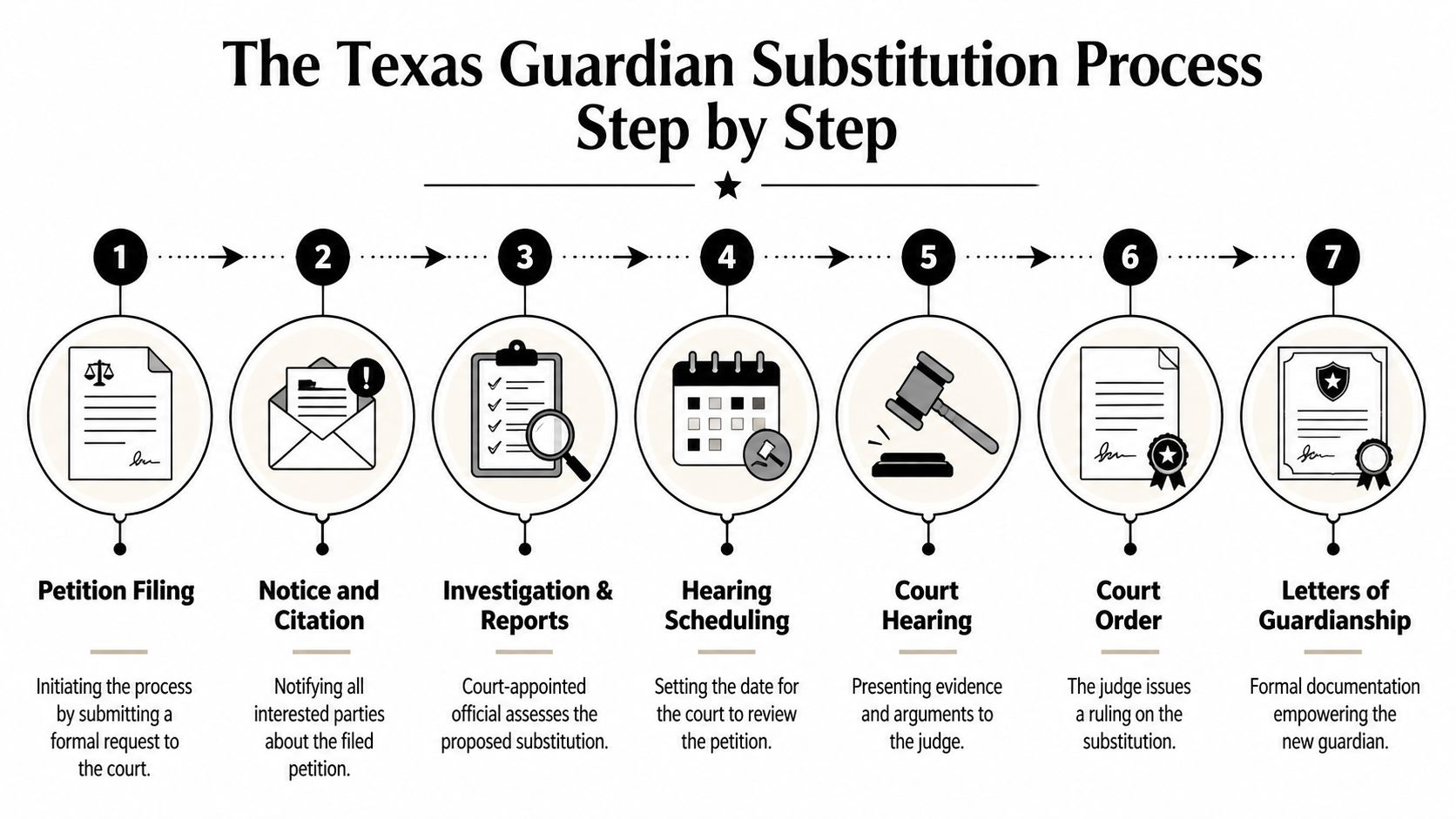
Filing the request with the probate court
The request is filed in the same court that already oversees the guardianship. In many cases, that means an application or motion tied to Texas Estates Code provisions governing removal, resignation, successor appointment, and continued administration of the guardianship.
The filing should do four things clearly:
- identify whether the change involves the guardian of the person, the guardian of the estate, or both
- explain the material change in circumstances since the current guardian was appointed
- state who should be appointed as substitute guardian
- attach or reference the records that support the change
Precision matters here. If the problem is unpaid bills, missing accountings, or unexplained transfers, focus on the estate role. If the problem is medical decision-making, placement, or day-to-day care failures, focus on the person. Families often weaken a good case by asking the court to replace every fiduciary role when the evidence supports only one.
If you are dealing with a planned transition rather than a contested removal, this guide to appointing a successor guardian in Texas helps explain what courts usually expect.
Building the record before the court sets the tone of the case
Judges usually form an early view of these cases from the papers. A thin file suggests a family dispute. A documented file suggests a guardianship problem that needs a fix.
Start collecting the records before the hearing date is close. That gives your lawyer time to sort out what proves changed circumstances and what is only background noise.
A practical file often includes:
Documents commonly used in a substitution case
- Application or motion for substitution: states the relief requested and the legal basis
- Current guardianship order: shows who now serves and what powers that guardian has
- Recent medical records or physician letters: useful if illness, incapacity, or increased care needs explain why substitution is needed
- Court compliance records: missed annual reports, missing accountings, notices from the clerk, or show-cause orders
- Financial records: bank statements, ledgers, receipts, insurance notices, tax records, and proof of unpaid expenses when the estate is involved
- Information about the proposed substitute: qualifications, contact information, background details, and bond paperwork if required
Giving notice to the right people
After filing, the court requires notice to the ward, the current guardian, and other interested persons identified by law or court order. Service rules matter. A strong case can be delayed if notice is late, incomplete, or sent to the wrong party.
This step also shapes the fight ahead. Sometimes notice brings an agreed transition into focus. In other cases, it prompts objections, competing applications, or an effort by the current guardian to cure the problems before the hearing.
Court review, investigation, and the question judges actually decide
The question is usually not whether tensions exist in the family. Probate judges see family conflict every day. The question is whether there has been a material change in circumstances that makes the current arrangement unsafe, unworkable, or no longer in the ward's best interest.
That change might be health-related. It might be financial. It might be a pattern of missed duties under prior court orders. The court may ask for background checks, review care plans, examine accountings, or require more information about the substitute guardian's ability to serve. In practice, this is the stage where unsupported accusations fall apart and documented concerns gain traction.
The role of the attorney ad litem
The attorney ad litem represents the ward's legal interests. If the ward can express a preference, the ad litem helps bring that information to the court in the proper way.
Families sometimes treat the ad litem as an obstacle. That is a mistake. If the requested substitution really protects the ward, the ad litem can help the court focus on that issue instead of getting lost in old family grievances.
Hearing, qualification, and transfer of authority
At the hearing, the judge reviews the filings, testimony, exhibits, objections, and any position taken by the ad litem. The proposed substitute should be ready to answer practical questions. Where will the ward live. Who will manage medications. How will bills be paid. Is there a current care plan. If estate funds are involved, can the substitute qualify and handle the reporting requirements.
If the court grants the substitution, the signed order is only part of the transition. The new guardian may still need to qualify, post bond, and obtain updated Letters of Guardianship before acting on behalf of the ward or estate.
What usually slows these cases down
Timing depends less on the label on the pleading and more on whether the file is ready. Courts move faster when the current guardianship record is current, the requested substitution is narrow, and the proposed substitute can qualify without delay.
Delays commonly happen when the outgoing guardian's reports are incomplete or when the incoming guardian cannot secure a new bond for the estate, as noted in the Ford + Bergner discussion of Texas guardianship decision-making at https://fordbergner.com/blog/2026/03/how-texas-courts-decide-who-becomes-a-guardian/.
That matches what I see in practice. Hearings get harder when no one has organized the financial records, the family wants the court to resolve years of unrelated conflict, or the proposed substitute is willing in theory but unprepared to meet the court's reporting and bond requirements.
Preparing for the Substitution Hearing
A substitution hearing often turns on one question. Has something materially changed since the court appointed the current guardian? Families who walk in ready to prove that change usually present a clearer case than families who only describe ongoing frustration.

Build the hearing around the change
In a substitution case, the court is not starting from zero. A judge already signed an order appointing someone. Your job is to show what is different now, why the current arrangement no longer works, and why the proposed substitute is a better fit for the ward’s present needs.
That usually means tying your proof to a timeline. Show when care needs increased, when communication broke down, when reports stopped getting filed, when money was mishandled, or when the current guardian became unavailable, ill, or unable to carry out the job. If the problem is serious misconduct, review the grounds and procedure for removing a guardian in Texas so you are clear about what must be proved.
Useful evidence may include:
- Medical records: showing increased care needs, a change in diagnosis, or a change in capacity since the original appointment
- Financial documents: statements, ledgers, receipts, unpaid bills, or irregular transactions involving the ward or estate
- Facility records: notes about missed medications, placement issues, discharge concerns, or failures to respond
- Witness testimony: relatives, caregivers, social workers, case managers, or professionals with firsthand knowledge
- Court records: missing annual reports, overdue accountings, bond problems, or notices from the probate court
The best evidence is usually plain and well organized. Judges trust dates, records, and firsthand observations more than accusations.
Get current medical input if health is part of the change
Medical evidence carries more weight when it addresses the actual issue before the court. A short letter saying the ward is "doing poorly" often does not help much. The physician should explain what has changed, when it changed, and how that change affects daily care, supervision, safety, or decision-making.
That is especially important if you are arguing that the current guardian can no longer meet the ward’s needs, that placement must change, or that the scope of the guardianship no longer matches the ward’s condition. In practice, I tell families to ask for specifics. Missed follow-up care, increased fall risk, dementia progression, or new behavioral problems are far more useful than general conclusions.
Understand the attorney ad litem’s role
Texas guardianship law places real weight on the ward’s voice and procedural protections. Senate Bill 1624, enacted in 2023, revised parts of the Estates Code dealing with guardianship procedure and representation. You can review the bill text at the Texas Legislature website: SB 1624 bill history and text. Texas also recognizes supported decision-making as an alternative in some cases under Chapter 1357 of the Estates Code.
Families should treat the ad litem as part of the court’s fact-finding process. Provide records promptly. Answer questions directly. Do not try to control the ward’s access to the ad litem or script what the ward should say.
The ad litem often helps the court separate a true protection problem from a family control dispute.
This video gives a helpful overview of how these cases are approached in practice:
Prepare testimony that matches the legal standard
A lot of testimony fails because it is too broad. "She never helps." "He only wants control." Judges hear claims like that all the time. What helps is testimony tied to events you personally saw and to the material change you are asking the court to recognize.
Be ready to explain:
- your relationship with the ward
- how often you see or speak with the ward
- what has changed since the current guardian was appointed
- what you personally observed, with dates if possible
- how the change affects the ward’s safety, care, housing, finances, or stability
- what plan you have if the court appoints you
Keep your answers direct. If you do not know something, say that. Credibility usually matters more than forceful language.
Focus on the judge’s practical concerns
At the hearing, the court is usually sorting through a short list of practical questions. Has there been a material change in circumstances. Is the current guardian still suitable. Can the proposed substitute do the work. Will the change help the ward, not just one side of the family.
Those questions come from Texas guardianship law in plain form, but the hearing itself often feels very practical. Who will schedule care. Who will handle medications. Who will keep records. Who will file the next report on time. Families who answer those questions with specifics tend to be more persuasive.
If your case also overlaps with estate administration, probate procedure, or disputes over records and authority, it helps to review broader Texas probate guidance before the hearing so you understand how the court handles related issues.
Contesting a Substitution and Exploring Alternatives
A common problem looks like this. One adult child files to substitute the current guardian because care has slipped, missed medications are piling up, or bills are not being handled. Another relative responds that nothing has changed, or that the underlying issue is family tension. At that point, the court is no longer focused on who is most upset. The court is deciding whether there has been a material change in circumstances and what arrangement now best protects the ward.
That distinction matters. A substitution case is not a general vote on who loves the ward more or who has old grievances. The judge wants proof tied to current conditions, present risk, and a workable plan.

When a substitution is contested
In a contested substitution, a few issues usually drive the result:
- Whether circumstances materially changed: What is different now from when the current guardian was appointed?
- Whether the current guardian remains suitable: Is there neglect, poor judgment, noncompliance with court duties, or a practical inability to serve?
- Whether the proposed substitute can do the job: The court will look at availability, judgment, organization, and follow-through.
- Whether the change will reduce harm or increase conflict: Some family disputes are so disruptive that the court questions whether a relative appointment will help.
If your facts point more toward misconduct, breach of fiduciary duty, or outright unfitness than a simple change in circumstances, it helps to review the standards for removing a guardian in Texas. Substitution and removal can overlap, but they are not always the same argument.
Urgent cases may need temporary relief
Some families should not wait for the normal substitution timeline. If the ward is exposed to immediate danger, the better approach may be to ask for temporary protection while the larger dispute is sorted out.
That can happen when a guardian cannot be found, when medical decisions have stalled during a health crisis, or when someone is draining the ward’s funds. Courts expect specifics. Dates, hospital records, bank activity, discharge notices, and facility reports carry more weight than broad accusations.
Alternatives can matter, even in a substitution case
Texas courts are supposed to use the least restrictive arrangement that will protect the person. That means a judge may ask whether the problem really requires replacing one guardian with another, or whether the guardianship should be narrowed, modified, or partly replaced with a less restrictive tool.
Supported Decision-Making can work for some adults who still understand choices and can communicate a preference with help. Powers of attorney may also solve part of the problem if the person has enough capacity to sign valid documents. In other cases, those options are unrealistic. Severe dementia, repeated exploitation, major medication problems, or the inability to understand basic health and safety decisions usually push the case back toward guardianship.
The safest approach is to treat alternatives as part of your proof, not as an afterthought. If an alternative will not protect the ward, explain why with facts. If a limited change would work, say that plainly. Judges tend to appreciate families who ask for no more control than the situation requires.
Comparing the main options
| Option | Best for | Limits |
|---|---|---|
| Supported Decision-Making | Adults who can still participate in decisions with support | Does not work well if the person cannot understand choices or is in immediate danger |
| Durable Power of Attorney | Planning before serious incapacity, or while the person can still sign valid documents | Depends on capacity and can be misused |
| Medical Power of Attorney | Health care decision support | Covers medical decisions only |
| Trust-based planning | Asset management in the right estate planning setup | Does not solve personal care or placement disputes |
| Guardian substitution | Existing guardianship that no longer fits because of a material change in circumstances | Requires notice, evidence, and court approval |
| Temporary guardianship | Immediate protection during a crisis | Short-term relief only |
Sometimes the right answer is a full substitution. Sometimes it is a narrower fix. Families usually do better when they frame the request around the ward’s actual needs, the specific change in circumstances, and the least restrictive option that will work.
Frequently Asked Questions About Texas Guardian Substitution
What if the current guardian refuses to cooperate or hand over records
That is a common problem. The outgoing guardian still answers to the court, and the court can require compliance with reporting, accounting, and turnover duties. If you suspect missing records, say that plainly in your filing and ask for specific relief. Broad accusations are less useful than a focused request for accountings, bank records, medical files, or facility information.
If estate assets are involved, missing records can affect whether the court is willing to discharge the old guardian and qualify the new one. In practice, judges take recordkeeping seriously because a guardian is a fiduciary.
Can I be appointed if I live out of state
Possibly. The court’s main concern is whether you can perform the job reliably and lawfully. Distance does not automatically disqualify you, but it can raise practical concerns about availability, communication, and oversight.
If you live outside Texas, be ready to show how you’ll manage medical coordination, financial duties, travel, and responsiveness. In some families, an out-of-state guardian of the estate may be workable while a local person serves as guardian of the person. In others, the court may prefer a nearby relative or qualified professional.
How much does it cost to hire an attorney for a guardianship substitution
There is no single statewide fee because cost depends on the county, the level of conflict, the amount of investigation needed, and whether the case involves person, estate, or both. A straightforward agreed substitution is very different from a contested case involving financial questions and multiple hearing settings.
You should also expect court-related expenses, and in some cases bond-related costs if the estate is involved. The more organized your records are, the easier it is for counsel to evaluate and present the case efficiently.
What happens if no suitable family member can serve
The court is not required to appoint a family member if no relative is appropriate. If the available relatives are unwilling, disqualified, significantly conflicted, or not acting in the ward’s best interests, the court can consider another qualified person or a professional guardian.
That outcome can be emotionally hard for families, but the judge’s duty is to protect the ward, not to preserve family hierarchy. If your family wants to avoid that result, it helps to present one realistic, well-documented plan instead of multiple competing applications.
Can the court reduce the guardian’s powers instead of fully replacing them
Yes, depending on the facts. Sometimes the best answer is not complete substitution. The court may modify powers, separate responsibility for the person and the estate, or consider whether some rights should be restored if the ward’s capacity has improved.
That is why the relief requested in the filing matters. An overbroad request can create unnecessary resistance. A narrower request may solve the actual problem more effectively.
What should I do before filing
Start with facts. Gather the current court orders, annual reports, accountings, medical information, and any records showing the changed circumstances. Identify whether the issue is care, money, compliance, or all three. Then think carefully about the proposed solution. Who is willing to serve, qualified to serve, and prepared to follow the court’s rules after appointment?
Substitution cases are usually won through preparation, not pressure. Families who take time to define the problem and build the file tend to put the court in a much better position to act.
If you’re facing a guardianship problem involving an aging parent, a disabled adult child, or a minor’s settlement, personalized guidance can make the process much clearer. The Law Office of Bryan Fagan, PLLC helps Texas families with guardianship, probate, and estate planning matters across Houston, Dallas, Austin, San Antonio, and statewide through virtual consultations. Schedule a free consultation to discuss whether a guardian substitution, emergency filing, or less restrictive alternative fits your family’s situation.