Skip to content
When a loved one is in immediate danger, you don’t have time to wait for a standard court date. The feeling of helplessness can be overwhelming, especially when you're watching a crisis unfold and every minute counts. We understand the emotional weight of these moments and are here to guide you with clarity and care.
Texas law provides a powerful, urgent solution for these exact moments: a temporary guardianship without notice, also known in legal circles as an ex parte guardianship. This process allows a court to grant immediate authority to protect a vulnerable person, without the usual requirement of notifying them or other family members first. It is an extraordinary measure for an extraordinary crisis.
When You Can Get Guardianship Without Notice in a Crisis

It’s a heart-wrenching situation. Maybe you’ve just discovered an aging parent with dementia is refusing life-saving medical care, or a sophisticated scammer is actively draining their life savings. In these gut-wrenching moments, you know you need to act now.
The standard Guardianship process in Texas is designed to be thorough, which means it involves formal notices and scheduled hearings that take time. A temporary guardianship without notice is different. It’s built for speed, bypassing those initial steps for one critical reason: to stop immediate, irreparable harm before it’s too late.
True Emergencies Justify Urgent Action
This is not a tool for minor family disagreements or situations that can wait. The Texas Estates Code sets an incredibly high bar. You must come to the court with substantial, clear evidence that your loved one is facing a severe and present danger.
Think of it in terms of these urgent scenarios:
- A Medical Crisis: An incapacitated person is actively refusing necessary medical treatment, and their health is declining by the day.
- Active Financial Exploitation: A predator has their claws in your loved one and is coercing them to sign over property or is rapidly emptying their bank accounts.
- An Immediate Safety Risk: A person with severe cognitive decline is wandering from home or living in squalid, unsafe conditions that pose a direct threat to their life.
In situations like these, a judge in a Harris County Probate Court can grant an emergency order to get the situation under control immediately.
A temporary guardianship without notice is a short-term, protective measure. It essentially acts as a legal "pause button," giving a guardian the authority to step in, make critical decisions, and stop the harm while the court begins the formal process of determining if a long-term solution is needed.
How the Law Protects Everyone Involved
While this process is designed to be fast, Texas law builds in strong safeguards to protect the proposed ward's rights. As soon as the emergency order is granted, the court immediately appoints an independent attorney, called an "attorney ad litem." This attorney's sole job is to represent the proposed ward's interests and be their voice in court.
This ensures that even in a crisis, that person’s rights are fiercely defended. The emergency order itself is also strictly limited in time—usually to 60 days, as specified in Texas Estates Code Title 3, Subtitle G. This provides just enough time to address the immediate danger and set a full hearing where everyone can be present and heard.
Understanding these built-in protections can bring some peace of mind during what is undoubtedly a very difficult time. While these emergency measures are lifesavers, proactive Estate Planning can often prevent these crises from ever happening. If you're facing an urgent situation, schedule a free consultation to discuss your specific options with our team. We're here to help Texas families navigate these challenges.
The Legal Standard for a No-Notice Emergency Guardianship

Securing a temporary guardianship without notice in Texas means you have to clear a very high legal bar. A probate court judge, whether in Harris County or Dallas County, won't grant this extraordinary power lightly. The court’s fundamental duty is to protect the proposed ward’s rights, and taking those rights away—even for a short time and without warning—demands an airtight case.
The entire process boils down to one critical idea: imminent danger. We’re not talking about a vague concern or a "what if" scenario down the road. This is a clear and present threat that demands immediate action to prevent irreversible harm. The law requires you to show "substantial evidence" that a crisis is happening right now.
Proving Imminent Danger
Under Texas Estates Code Chapter 1251, which governs temporary guardianships, you must prove one of two things is happening:
- There is imminent danger to the person's physical health or safety. This is when the proposed ward is at immediate risk of serious injury or death. Think of an individual with advanced dementia who lives alone and has started leaving the stove on, creating a fire hazard.
- The person's estate is at risk of being wasted or depleted. This is for financial emergencies, where assets are actively being stolen, squandered, or destroyed. A classic example is a vulnerable senior being tricked by a scammer into wiring their life savings away.
Simply saying a loved one is making bad choices isn’t nearly enough. You have to back it up with concrete, convincing proof. This is the absolute foundation of any application for a no-notice guardianship because judges must see a crisis that simply cannot wait for a standard hearing.
Emergency Guardianship vs Standard Guardianship Requirements
| Criteria | Temporary Guardianship (Without Notice) | Standard Guardianship (With Notice) |
|---|---|---|
| Legal Standard | Requires "substantial evidence" of imminent danger to health, safety, or finances. | Requires clear and convincing evidence that the person is incapacitated and a guardianship is in their best interest. |
| Urgency | An immediate crisis that will cause irreversible harm if not addressed within hours or days. | A chronic or ongoing inability to manage personal or financial affairs. The process is not designed for immediate emergencies. |
| Notice to Ward | Notice is given after the court signs the temporary order, usually within 3 days. | Notice must be served before the hearing, giving the proposed ward time to prepare and contest the guardianship. |
The key takeaway is that the "emergency" in a temporary guardianship is a true, demonstrable crisis, which is why the law allows for such an extraordinary remedy.
What Does "Substantial Evidence" Actually Look Like?
So, what qualifies as "substantial evidence" in the eyes of the court? It’s far more than just your word against theirs. While your sworn application is essential, it needs to be backed up by credible, third-party proof that tells the full story.
A judge needs to see objective facts that confirm the crisis. Your goal is to build a case that leaves no doubt about the urgency and the need for the court to step in immediately.
Here are the kinds of evidence that can meet this high standard:
- Medical Records: A doctor's signed letter or recent medical charts showing a sudden, sharp decline in cognitive function or a dangerous refusal of life-saving medical care.
- Financial Documents: Bank statements showing large, unusual withdrawals or emails from a financial advisor raising alarms about potential exploitation.
- Witness Statements: Sworn affidavits from neighbors, caregivers, or other family members who have witnessed wandering, dangerous behavior, or financial abuse firsthand.
- Official Reports: Police reports from wandering incidents or Adult Protective Services (APS) reports from an investigation into neglect or abuse claims.
In Texas, even though a temporary guardianship can be granted without telling the person beforehand, their rights are not forgotten. The law demands that notice be served very quickly after the order is signed—typically within 3 days—to protect their right to due process. This balance allows courts to act fast, sometimes issuing these orders within 24 to 48 hours of receiving a powerful, well-supported application.
The key is showing that without the court’s immediate help, your loved one will suffer harm that can never be undone. For a deeper dive into how this initial court process works, check out our guide on the ex parte guardianship process in Texas. Our team can help you gather the right evidence and present it in the most compelling way.
When a crisis strikes, the last thing you want to do is navigate a maze of legal paperwork. But if a loved one is in immediate danger, filing for an emergency guardianship is a structured, step-by-step process. Knowing what to expect can give you the confidence to act decisively when it matters most.
Think of this as your roadmap for getting the application in front of a judge. The entire effort stands or falls on the strength of your evidence. Before a single form is filled out, your first job is to gather undeniable proof that a true emergency exists. Your application is a formal request, but it's the evidence that persuades a judge to grant it.
Step 1: Gather Your Proof of the Emergency
You need to build a case that leaves no room for doubt. The goal is to present a judge with a clear, factual picture of the imminent danger your loved one is facing. A judge in a Bexar County Probate Court, for instance, can't act on your fears alone—they need to see concrete, objective evidence.
Your proof should be a compelling mix of documentation:
- Medical Documentation: This is the bedrock of your case. A signed letter from a physician is incredibly powerful, especially if it details a recent diagnosis, a sudden drop in cognitive function, or a refusal of critical medical care.
- Financial Records: Is money disappearing from their accounts? Bank statements showing large, unexplained withdrawals, letters from banks flagging suspicious activity, or emails from scammers can vividly illustrate financial exploitation.
- Witness Statements: A sworn affidavit from a neighbor who has seen your loved one wandering unsafely is crucial. A statement from a caregiver attesting to neglect or unsafe living conditions adds that vital third-party credibility.
- Official Reports: If Adult Protective Services (APS) has an open case or if police have been called for a welfare check, get those reports. They provide compelling, official validation of the crisis.
This documentation is the backbone of your application. The more specific and irrefutable your evidence, the stronger your case will be.
Step 2: Prepare the Formal Application and CME
With your evidence in hand, it’s time to tackle the legal paperwork. The key document is the Application for Appointment of Temporary Guardian. This form formally tells the court who you are, who the proposed ward is, and exactly why an emergency guardianship is the only option.
Crucial Requirement: The Physician's Certificate of Medical Examination (CME)
Under the Texas Estates Code, your application is dead on arrival without a recent CME. This is a specific form, signed by a physician within the last 120 days, that officially documents the proposed ward’s medical condition and their level of incapacity. A judge cannot and will not grant a guardianship without it.
The application will ask you to specify the exact powers you need to handle the emergency. Be specific. You might request the power to consent to a single medical procedure or the authority to freeze a specific bank account to stop the harm. You can get more details on filling this out in our guide to the temporary guardianship form.
Step 3: File With the Correct Probate Court
Once you’ve assembled the application, CME, and all your supporting evidence into one package, you must file it with the right court. In Texas, guardianship cases are handled by statutory probate courts or county courts at law. The correct court is almost always in the county where the proposed ward lives.
For example, if your loved one resides in Austin, you’d file with the Travis County Probate Court. Filing in the wrong county creates significant delays—the very thing you’re trying to avoid in an emergency.
Step 4: Attend the Ex Parte Hearing
After filing, the court will quickly schedule an ex parte hearing. "Ex parte" simply means you and your attorney will appear before the judge without the proposed ward or other family members present. This is the moment of truth where the judge reviews everything you've submitted.
At the hearing, the judge will likely ask questions to confirm the urgency and necessity of the guardianship. They will scrutinize the CME and your other evidence to ensure the high standard of "imminent danger" has been met. If the judge is convinced, they will sign the Order Appointing Temporary Guardian, giving you immediate—but limited—authority to act.
Standing before a judge can be nerve-wracking, but remember why you're there: to protect someone you care about. A well-prepared, evidence-rich application makes this step go much more smoothly.
What to Do After the Judge Grants the Order
When the judge finally signs the order, you might feel a huge wave of relief. You’ve been fighting through a crisis, and now you have the legal authority to act. But that signature isn't the finish line; it's the starting line for a new set of critical responsibilities.
The clock starts ticking the moment you have that order in hand. You now have the power to step in, but that power is specific, temporary, and comes with strict court supervision. It's completely normal to feel a bit overwhelmed as you shift from crisis mode to your official duties as a temporary guardian. What you do in these next few days is just as important as all the work it took to get here.
Understanding Your Limited Powers and Duration
First things first: a temporary guardianship order is not a blank check. The judge granted you very specific powers designed only to handle the immediate emergency. Think of it less like a master key and more like a single key for a single lock.
For example, if the crisis involved a refusal of urgent medical treatment, your authority might be strictly limited to consenting to that one procedure or hospital stay. You can’t start selling property or making long-term financial plans.
These powers are also, by definition, temporary. Under the Texas Estates Code, a temporary guardianship is typically capped at 60 days. It’s a legal bridge, not a permanent solution. The goal is to stabilize the situation while the court determines if a long-term guardianship is truly needed.
The Immediate Next Steps You Must Take
Once the order is signed, you need to move quickly to make your appointment official. If you stumble on these next steps, you could put the entire guardianship at risk and create serious legal headaches for yourself.
Here are your most important post-hearing duties:
- Qualifying as Guardian: This is a formal step where you go to the county clerk and take an oath, legally promising to faithfully carry out your duties.
- Posting a Bond: The court will almost always require you to get a surety bond. This is essentially an insurance policy that protects the ward’s money and property from being mismanaged. The judge sets the bond amount, and you must have it in place before you can take any official action.
- Serving Notice: This is perhaps the most important step of all. Even though you got the order without anyone else's knowledge, the law demands that you formally notify the ward and their close family members immediately after the fact.
This chart gives you a bird's-eye view of the process that leads to the order, which is where your duties as guardian officially begin.
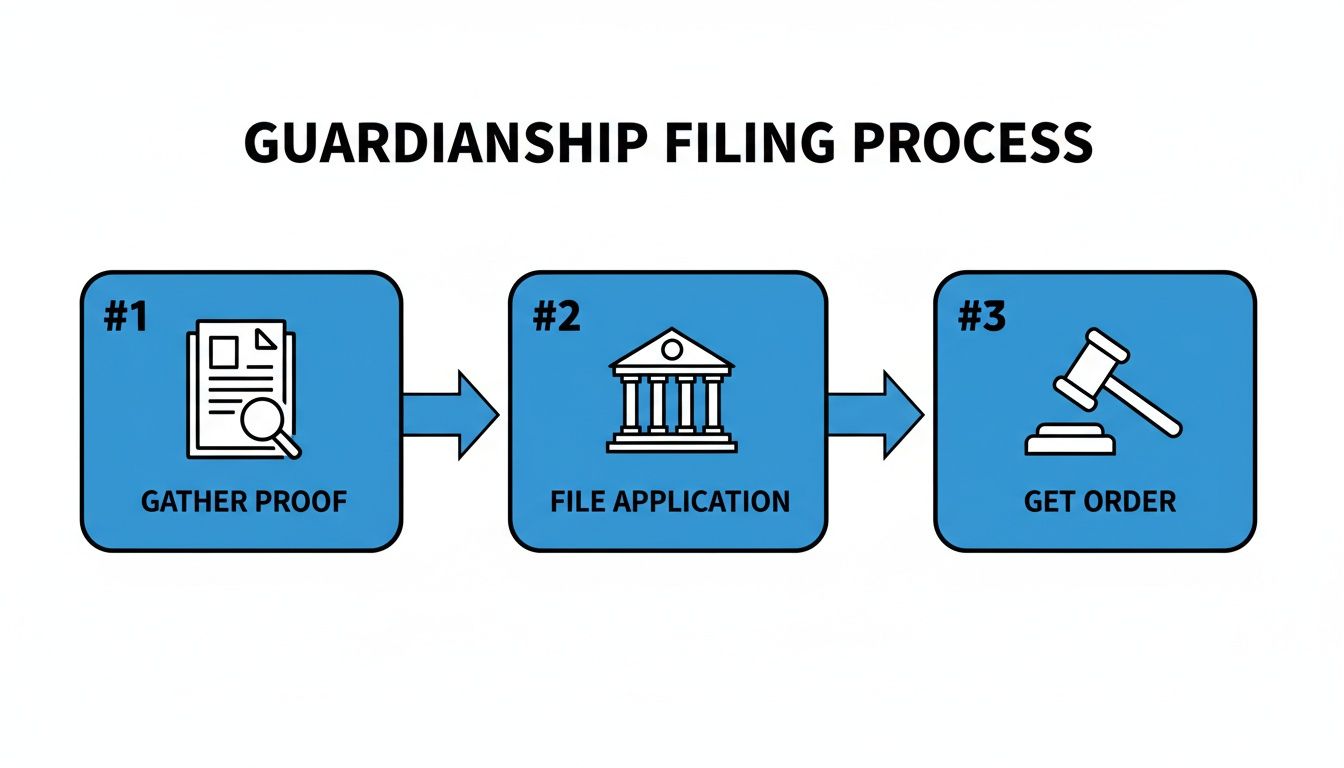
As the infographic shows, getting the order isn't the end of the road. It's the beginning of your responsibilities.
The Role of the Attorney Ad Litem
At the same time you're taking these steps, the court will appoint an attorney ad litem. This is an independent lawyer whose only client is the ward. Their job is to meet with the ward, investigate the situation, and be their voice in court.
The attorney ad litem is a critical check and balance in the system. They are there to make sure the ward’s rights are protected and that the guardianship is truly in their best interest.
Key Insight: The temporary guardianship process has to walk a fine line between taking swift action in a crisis and protecting a person's fundamental rights. Requiring notice after the fact and appointing an independent attorney is how the law ensures fairness.
Texas law is crystal clear on this. Even in these "no-notice" emergencies, the ward and their family must be notified right away, often within just 3 days of the appointment. The court will also usually set a follow-up hearing within 10 days where the ward can contest the guardianship. You can learn more about the timelines and safeguards that prevent unchecked authority by reading about when temporary guardianship is necessary.
Trying to manage these legal duties while you're still in the middle of a family crisis is a heavy lift. It's worth remembering that many of these emergencies can be avoided with thoughtful Estate Planning. If you've just been appointed as a temporary guardian and feel like you're in over your head, contact the Law Office of Bryan Fagan for a free consultation. We’re here to help you navigate this complex process with confidence.
How to Contest an Emergency Guardianship
The power of a temporary guardianship granted without notice is enormous, but Texas law builds in an equally powerful set of checks and balances to protect the proposed ward's rights. Just because a judge grants an emergency order based on one side of the story doesn't mean the fight is over. If you believe a guardianship was created unfairly or isn't truly necessary, you have an absolute right to challenge it.
This process is designed to prevent abuse and ensure fairness, especially when family tensions are running high. We see how devastating it feels when your rights—or the rights of a loved one—are stripped away without a chance for you to speak. The law gives you a clear path to make sure you are heard.
Your Right to a Hearing and Legal Representation
The moment a temporary guardianship is created, the court must give the proposed ward a powerful advocate: an attorney ad litem. This is an independent lawyer appointed by the judge, and their only job is to represent the ward's best interests and wishes. This attorney is not on the side of the person who filed for guardianship; they work exclusively for the ward.
On top of that, the Texas Estates Code gives the ward an absolute right to contest the order. This isn't just a possibility; it's a guarantee. The legal tool for this is filing a Motion to Dissolve Temporary Guardianship.
A Motion to Dissolve is a formal request asking the court to end the emergency order. Filing this motion forces the court to schedule a full hearing where both sides can present evidence, call witnesses, and argue their case in front of the judge.
This hearing is your chance to prove to the court that the so-called "imminent danger" either never existed in the first place or has already been resolved. It takes the case out from behind the closed doors of an ex parte hearing and into an open, adversarial setting where the whole truth can come out.
Hypothetical Scenario: Power Grabs and Family Disputes
Think about this all-too-common situation. An elderly mother, Martha, has three adult children. One child, Alex, lives close by and gets worried about Martha's growing forgetfulness. Believing it's a crisis, Alex rushes to the Harris County Probate Court and gets a temporary guardianship without telling his siblings, giving him control over Martha's medical care and money.
The other two siblings, however, are floored. They believe Alex exaggerated the situation to get his hands on their mother's estate. They know Martha has good days and bad days, but she's a long way from being in "imminent danger."
In a case like this, the siblings and the attorney ad litem can act immediately:
- File the Motion to Dissolve: The attorney ad litem, or another lawyer hired by the siblings on Martha's behalf, can file this motion right away.
- Gather Counter-Evidence: They can start collecting their own evidence. This could include statements from Martha's friends, recent videos of her cooking or gardening, or even a second opinion from another doctor that contradicts the first report.
- Present at the Hearing: At the hearing, they can cross-examine Alex, present their own witnesses, and argue that less restrictive options were never even considered.
This process ensures that a temporary guardianship granted without notice is never the final word. It gives everyone a fair chance to present their side, protecting the ward’s dignity and independence. For a comprehensive look at your options, you can read our guide on how to contest or terminate a guardianship in Texas.
If you or a loved one are in this situation, remember that you have rights. Contact the Law Office of Bryan Fagan for a free consultation to discuss how we can help you fight for them.
Powerful Alternatives That Can Avoid Court Intervention

While a temporary guardianship without notice in Texas is a critical tool in an emergency, it’s a solution born from a crisis. Think of it as a last resort—a legal response that, while sometimes unavoidable, can be incredibly stressful, emotionally draining, and expensive for families. The truth is, the best way to navigate a crisis is to have a plan in place long before one ever happens.
Thankfully, Texas law offers powerful, less invasive options that let you prepare for the unexpected. With a few key legal documents, you can authorize someone you trust to step in on your behalf, often eliminating the need for a court's involvement entirely. This kind of foresight protects your dignity, cuts down on family conflict, and keeps your personal affairs out of the public record.
Durable Power of Attorney for Financial Decisions
A Durable Power of Attorney is a foundational piece of any thoughtful estate plan. This document gives you the power to name a trusted person—your "agent"—to handle your financial life if you ever become unable to manage it yourself. This isn't just about emergencies; it can cover everything from paying your mortgage and managing investments to selling property.
The "durable" part is what makes it so powerful. It means the document stays valid even if you become incapacitated. Without one, your loved ones might be forced to seek a guardianship just to access your bank account to pay for your medical care.
A Durable Power of Attorney is like giving a trusted friend a spare key to your financial life. You hope they never have to use it, but if something happens, they can step in and help without having to break down the door with a court order.
Medical Power of Attorney and HIPAA Release
Just as you need a plan for your money, you absolutely need one for your health. A Medical Power of Attorney allows you to choose a trusted agent to make healthcare decisions for you if you can't speak for yourself. This person becomes your voice, talking with doctors, approving treatments, and ensuring your medical care aligns with your personal wishes.
Working hand-in-hand with this is the HIPAA Release. This simple form gives your agent the legal authority to access your protected health information. Without it, privacy laws could prevent doctors and hospitals from sharing vital details with your family, leaving your agent unable to make truly informed decisions.
These documents work together to provide a complete layer of protection, covering both your health and your wealth:
- Durable Power of Attorney: Names an agent to handle your finances.
- Medical Power of Attorney: Names an agent to make your healthcare decisions.
- HIPAA Release: Allows your agent to see your medical records.
For those looking for powerful alternatives that can avoid court intervention, learning about documents like a Power of Attorney is an excellent first step. Taking the time now to put these plans in place is a true gift to your family, saving them from the pressure and anguish of a guardianship fight during an already painful time.
Proactive planning puts you in the driver's seat. Instead of leaving these major life decisions to a judge who doesn't know you, you empower the people you trust most to carry out your wishes. Contact the Law Office of Bryan Fagan for a free consultation to talk about creating a protective plan that will give you and your family true peace of mind.
Common Questions About Emergency Guardianships in Texas
When you're facing a crisis, you don't have time for legal jargon. You need straightforward answers. Here are some of the most common questions we hear from families about getting a temporary guardianship without notice in Texas, breaking down the practical side of this urgent process.
How Much Does an Emergency Guardianship Cost in Texas?
This is one of the first questions on every family's mind, and the honest answer is: it depends. The total cost can shift quite a bit based on how complex the situation is and which county you're filing in. We recognize the financial challenges that families face during these times.
Generally, you'll have to account for attorney's fees to draft the application and represent you in court, the court’s own filing fees, and the cost of a surety bond. Because no two emergencies are the same, the only way to get a realistic estimate is to discuss the specific details of your case with an attorney in a free consultation.
Can I Get Temporary Guardianship for a Grandchild in Texas?
Yes, absolutely. Grandparents often step in when a child is at risk. If a grandchild faces immediate danger because their parents are gone, unable to care for them, or are the source of the risk, a grandparent can petition the court for temporary guardianship.
In any case involving a child, the court’s one and only focus is the child’s best interest and immediate safety.
The legal standard is the same whether you're protecting an adult or a child: you have to show the court there is an imminent danger. For a grandchild, this could mean proving neglect, abuse, or that the parents have abandoned the child, requiring the court to step in right away.
What Happens When the 60-Day Temporary Guardianship Ends?
A temporary guardianship is a short-term fix, not a permanent solution. The court order is designed to stabilize a crisis and automatically expires after 60 days, as outlined in the Texas Estates Code, unless the court specifically extends it.
Long before that 60-day mark, you and your attorney need to be preparing for a full hearing to decide if a permanent Guardianship is needed. This means gathering new medical evidence and creating a long-term care plan to present to the judge. Don't wait until the last minute—once the order expires, your legal authority vanishes.
Trying to navigate a guardianship proceeding on your own, especially during an emotional time, is an immense burden. The attorneys at The Law Office of Bryan Fagan, PLLC are here to stand with you, offering compassionate guidance and precise legal support every step of the way. To get personalized advice for your situation, schedule a free consultation with our team at https://texasguardianshiplawyer.net.