Skip to content
Facing the possibility of losing your parental rights is one of an emotionally overwhelming experiences a family can endure. The termination of parental rights in Texas is a court action that permanently cuts the legal ties between a parent and child, ending all rights and responsibilities. It’s a profound step, often called the “death penalty” of family law because the decision is irreversible.
We understand the emotional and financial challenges this process brings. Our mission is to guide Texas families through these difficult legal waters with clarity and care.
Navigating the Complexities of Parental Rights Termination

Understanding the gravity of this legal process is the first step, no matter which side you’re on. Whether you are considering filing a termination case to protect a child or are fighting to keep your parental rights, the emotional and legal stakes are incredibly high. This is not a decision made lightly; the process is tightly controlled by strict laws in the Texas Family Code to ensure such a life-altering choice is made with extreme care.
Ultimately, the court's decision will always come down to one single, overriding factor: the best interest of the child. This standard is the North Star for every judge in every family court across Texas, from the Harris County Probate Courts to smaller jurisdictions. A judge must be presented with clear and convincing evidence that termination is absolutely necessary for the child’s well-being, safety, and future.
Key Aspects of a Termination Case
To truly understand what these cases involve, it helps to break down the core components. These legal proceedings are much more than just paperwork—they represent a fundamental and permanent shift in a family’s entire structure.
Here’s a look at what’s at the heart of these cases:
- Permanent Severance of Relationship: Termination completely and forever ends the legal parent-child bond. This means no more visitation, no say in the child's life decisions, and no inheritance rights.
- Voluntary vs. Involuntary Actions: Sometimes, a parent can voluntarily sign away their rights, which often happens in a stepparent adoption. Far more common, however, are involuntary cases started by another party due to serious concerns like endangerment, neglect, or abandonment.
- High Burden of Proof: The law sets a very high bar, requiring "clear and convincing evidence." This is a much tougher standard than in most other civil cases. It means the evidence must be so strong that it creates a firm belief in the judge’s mind that the allegations are true.
The decision to terminate parental rights is one of the most drastic actions a court can take. It irrevocably alters the legal landscape of a family and is pursued only when deemed absolutely necessary for a child's safety and stability.
This guide is meant to be a compassionate starting point to help you understand this complex legal journey. At The Law Office of Bryan Fagan, we know the emotional and financial strain families are under in these situations. Our goal is to bring clarity and direction, empowering you with the knowledge you need to protect your family's future. For personalized guidance on your specific situation, we invite you to schedule a free consultation with our experienced legal team.
To give you a quick overview, this table breaks down the core components of a parental rights termination case in Texas and what they mean in practical terms.
Key Aspects of Terminating Parental Rights in Texas
| Key Aspect | What It Means for Your Family |
|---|---|
| Grounds for Termination | The petitioner must prove the parent engaged in specific harmful conduct, like endangerment, neglect, or abandonment, as listed in the Texas Family Code. |
| Best Interest of the Child | The court must find that termination is what’s best for the child’s physical and emotional well-being, stability, and future. This is the most critical factor. |
| Clear & Convincing Evidence | This high legal standard requires proof that produces a firm belief or conviction that the allegations are true. It’s more than a simple "more likely than not." |
| Permanent & Irrevocable | Once rights are terminated, the decision is final. It severs all legal ties, including inheritance, visitation, and the right to make decisions for the child. |
| Paves the Way for Adoption | Termination is often a necessary legal step before a child can be adopted by another family, such as stepparents or foster parents, providing a new, permanent home. |
This table is just a snapshot, of course. Each case has its own unique story and complexities, which is why getting advice tailored to your circumstances is so important.
The Legal Grounds for Involuntary Termination

When a Texas court is asked to involuntarily terminate a parent's rights, it cannot act on opinion or speculation. The decision must be firmly rooted in specific, provable reasons outlined in state law. These legal reasons are called "grounds," and you can find them spelled out in Section 161.001 of the Texas Family Code.
Think of these grounds as the absolute foundation of the case. If the person filing the lawsuit cannot prove at least one of them with clear and convincing evidence, the case cannot move forward, regardless of their concerns for the child's well-being.
The law demands this high bar for a good reason: it protects the fundamental constitutional right to parent. The court understands that severing the bond between a parent and child is one of the most serious actions it can take, reserved for situations where a child's safety is truly at risk.
Endangerment of the Child
One of the most common grounds a court sees is endangerment. This isn't a narrow, black-and-white term; it's a broad category that covers any parental behavior or environment that puts a child's physical or emotional health at risk.
Endangerment can be something a parent actively does, or it can be a failure to act when they should have. What the court looks for is a direct link between what the parent did (or didn't do) and the harm—or potential harm—to the child.
A few real-world examples that could qualify as endangerment include:
- Exposing a child to illegal drug use or other criminal activity in the home.
- Committing or knowingly allowing physical or emotional abuse to happen.
- Leaving a young child alone in a dangerous situation.
It's critical to understand what the law considers abuse or neglect, since these actions are often the bedrock of an endangerment claim. For a deeper dive, check out our guide on keeping Texas kids safe by reporting child abuse.
Abandonment and Lack of Support
Abandonment is another major reason a court might terminate parental rights. This is more than just physically leaving. It can also mean a parent has completely disengaged emotionally and financially over a long period.
For instance, if a parent willingly leaves their child with a relative and then makes no effort to return, call, or provide any kind of support for months on end, a court could see that as abandonment.
The key here is the parent's intent. The court will dig into whether the parent made a conscious decision to walk away from their responsibilities, leaving the child without the care and support they need.
In a similar vein, consistently failing to pay court-ordered child support can also be grounds for termination, especially when it's part of a larger pattern of ignoring parental duties.
Other Significant Grounds for Termination
The Texas Family Code doesn't stop with just endangerment and abandonment. The law lists several other specific situations that can justify terminating a parent's rights, each one pointing to a serious failure to provide a safe and stable home.
Some of the other grounds that frequently come up are:
- Imprisonment: When a parent is sentenced to prison for more than two years and their imprisonment will damage the parent-child relationship.
- Substance Abuse: If a parent's use of alcohol or drugs has created a dangerous environment for the child.
- Failure to Comply with a Court Order: This is common in CPS cases where a parent doesn't complete the services required by the court, like drug treatment or parenting classes.
- Constructive Abandonment: This applies when a child has been in foster care for a long time because the parent has been unable to provide a safe home.
The High Standard of Clear and Convincing Evidence
Simply accusing a parent of one of these grounds isn't enough. The person bringing the lawsuit has to prove it with "clear and convincing evidence." This is a much tougher legal standard than the "preponderance of the evidence" used in most other civil lawsuits.
"Clear and convincing" means the evidence has to be so strong that it produces a firm belief in the judge's mind that the claims are true. This high standard reflects just how serious this decision is, ensuring parental rights are never taken away lightly.
Whether you're facing a lawsuit to terminate your parental rights or you believe you need to file one to protect a child, understanding these grounds is the essential first step. The legal and emotional stakes are incredibly high, which is why getting professional guidance is not just a good idea—it's critical.
Understanding the Best Interest of the Child Standard
Proving one of the legal grounds we’ve talked about is really just the first hurdle in a termination of parental rights case. The second, and frankly the most critical, is proving that ending the parent-child relationship is truly in the “best interest of the child.” This is the ultimate standard, the final question a judge in Texas must answer before making such a life-altering decision.
Even if a parent’s actions clearly meet one of the statutory grounds for termination, a court will not sever their rights unless it is absolutely convinced that doing so is what’s best for the child’s future. This is not about punishing a parent. The entire focus is on shielding a child from harm and securing a safe, stable future.
To make this determination, judges don’t just go with a gut feeling. They rely on a specific set of guidelines that came from a landmark case, Holley v. Adams. Today, these are simply known as the “Holley Factors.”
Breaking Down the Holley Factors
The Holley Factors give the court a roadmap for looking at the child’s entire situation from every possible angle. A judge in Harris County or Fort Bend County isn’t trying to figure out if a parent loves their child. They are legally required to assess whether that parent can provide a safe, nurturing, and stable home for them to grow up in.
There's no magic number of factors that seals the deal; instead, the court weighs all of them to build a complete picture of the child's life. Some of the most important Holley Factors include:
- The child’s emotional and physical needs, both right now and down the road. This means looking at whether the child has special needs and if the parent is equipped to meet them.
- Any emotional and physical danger the child has faced or could face in the future. The court will dig into any history of abuse, neglect, or exposure to unsafe people or situations.
- The parental abilities of the people involved. This is a direct look at the skills, stability, and overall fitness of the parent or potential caregiver.
- The stability of the proposed home. A judge is looking for consistency and security, not chaos and constant change.
- The child's own wishes, if they are old enough and mature enough to express them. While it’s not the only thing that matters, a judge will absolutely listen to what an older child wants.
- Any actions or failures to act by the parent that suggest the parent-child relationship is unhealthy. This could be anything from a history of criminal activity to chronic instability or substance abuse.
- Any excuses for the parent’s actions or failures. The court will consider if there are valid reasons for a parent’s struggles, but this is always weighed against the direct impact those struggles have on the child.
So, how does this work in a real-world courtroom? A judge will carefully consider evidence presented for each of these factors. Below is a simplified table to help you understand what the court is really looking for.
The Holley Factors Simplified for Parents
| Holley Factor | What It Really Means |
|---|---|
| Child's Needs | Can you meet your child's daily physical and emotional needs? Are you prepared for their future needs? |
| Danger to Child | Is your child safe with you? Is there any history of abuse, neglect, or exposure to dangerous situations? |
| Parental Abilities | Do you have the skills and stability to be a good parent right now? |
| Home Stability | Can you provide a consistent, safe, and secure home environment for your child? |
| Child's Desires | If your child is old enough, what do they want? The court will listen. |
| Parental Acts/Omissions | Does your past behavior show you can maintain a healthy relationship with your child? |
| Excuses for Acts | Are there valid reasons for your past struggles, and how do they impact your child's safety today? |
Ultimately, a judge uses these factors to build a comprehensive view of what life is like for the child and what it would look like in the future if the parent's rights are—or are not—terminated.
How Courts Apply These Factors
Let’s imagine a parent has a documented history of substance abuse, which is a clear legal ground for termination. But what if that parent has since completed a tough recovery program and has been sober for a solid year? The court would use the Holley Factors to look beyond the past mistakes.
A judge would assess the stability of their current home, their day-to-day ability to meet the child's needs, and the strength of the emotional bond between them. When thinking about the child's future, courts often lean on well-established psychological principles, including the crucial insights of attachment theory. The goal is always to make a forward-looking decision that puts the child's long-term safety and happiness first.
A Texas court’s primary duty is to the child. The 'best interest' standard ensures that every decision made in a termination case is focused on creating the best possible outcome for the child's life, even when that decision is incredibly difficult.
Understanding this standard is so important because it highlights that these cases aren't just about what a parent did wrong. They are fundamentally about what a child needs to have a chance to thrive. For a deeper dive into this topic, you can learn more by understanding the child best interest standard in our dedicated guide.
Navigating these factors in court requires a legal approach that is both compassionate and incredibly skilled. If you are facing this situation, The Law Office of Bryan Fagan is here to provide the clarity and support you need.
How the Termination Lawsuit Process Works
Facing the court system for a termination of parental rights in Texas is an intimidating prospect. The process is formal and follows a very strict legal path, but understanding the basic steps can demystify the experience and reduce uncertainty. The entire journey begins when someone with the legal right to do so—like the other parent, a close family member, or Child Protective Services (CPS)—files a formal request with the court.
That initial document is called the Original Petition in Suit Affecting the Parent-Child Relationship. This officially starts the lawsuit. Inside, it details who is involved, the legal grounds being used to request the termination, and an argument for why ending the parent's rights is in the child's best interest. Once filed, the case gets assigned to a family court, whether that's in Harris County, Dallas County, or elsewhere in Texas.
The Critical First Steps: Filing and Notice
After the petition is filed, we move to one of the most important steps: service of process. This is the formal, legally required method of notifying the parent that a lawsuit has been filed against them that could sever their rights forever. You cannot ignore these papers. Failing to respond can lead to a default judgment, which means your rights could be terminated without you ever getting to tell your side of the story.
Proper notice is a cornerstone of our legal system; it’s about giving everyone a fair chance to be heard. The parent being sued is called the Respondent, and they have a very specific, strict deadline to file a formal "Answer" with the court. Missing this deadline has dire consequences.
Once the lawsuit is officially underway, the court will also appoint an attorney ad litem. This is an independent lawyer whose only job is to represent the best interests of the child. They act as the child's voice, investigating the situation, talking to the child (if they're old enough), the parents, and anyone else involved before making a recommendation to the judge.
Gathering Evidence and Seeking Resolution
With the first filings out of the way, the case moves into a phase called discovery. This is the formal process where both sides gather evidence. Attorneys can request documents, send written questions (known as interrogatories), and take sworn testimony (called depositions) to build their case. This stage is all about digging for the facts needed to prove or disprove the claims made in the petition.
Before a case ever makes it to a final trial, Texas courts almost always require the parties to try mediation. This is a confidential meeting where a neutral third-party mediator steps in to help both sides see if they can reach an agreement. It might seem impossible to find common ground in such an emotional fight, but mediation can sometimes lead to a resolution that avoids a painful and expensive trial.
The infographic below gives you a simplified look at how these key steps flow together.
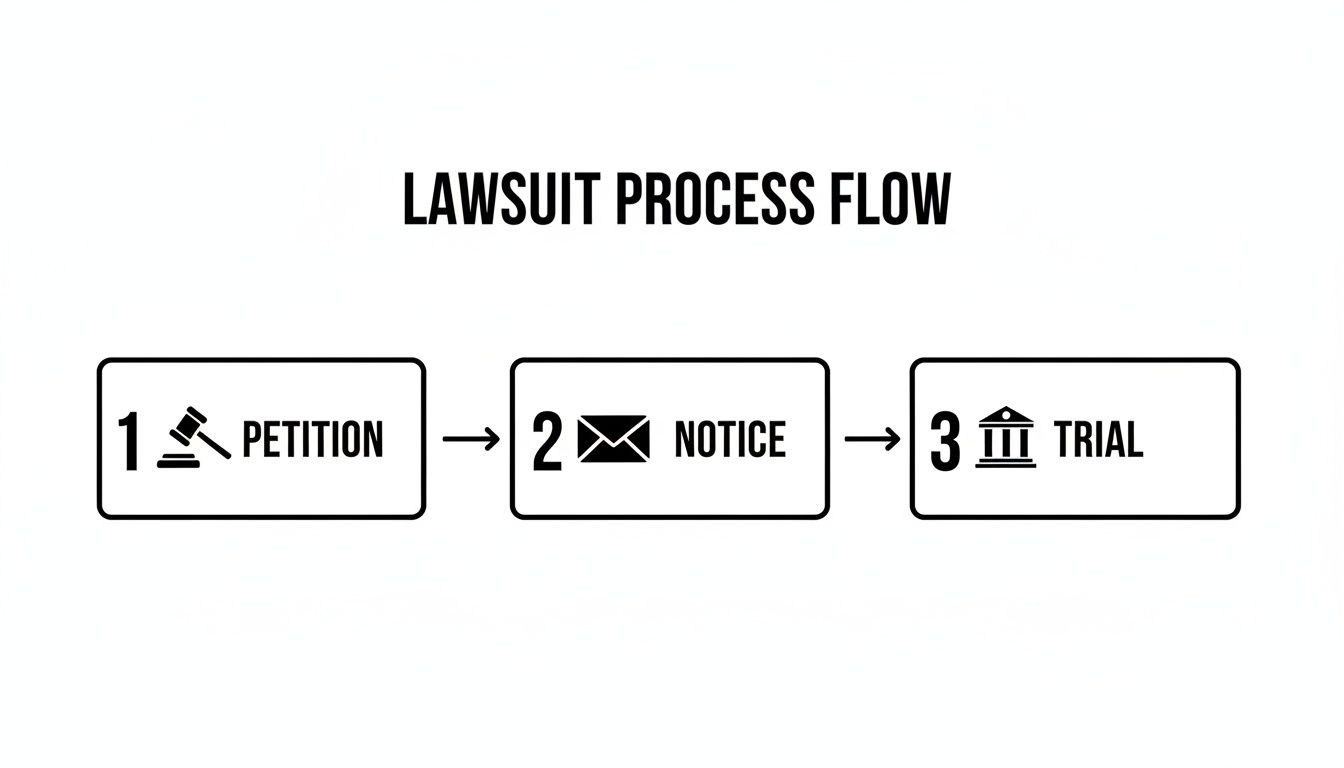
As you can see, the process moves logically from filing the petition and giving proper notice all the way to a final trial where a judge will make a decision that is legally binding.
The Final Trial and What It Entails
If mediation doesn't work, the case will be set for a final trial. This is where both sides present their evidence, call witnesses to the stand, and make their legal arguments in front of a judge. After hearing everything, the judge will make a final ruling based on that crucial two-part test: does a legal ground for termination exist, and is termination in the child's best interest?
Federal data shows that Texas courts tend to move these cases quickly. In fact, nearly 50% of reviewed foster cases had parental rights terminated before the federally recommended 15-month timeline, with termination often listed as a potential outcome from the very start. Even so, securing a permanent home for the child through adoption can still hit delays. You can explore more findings on Texas's child welfare timelines.
The legal process for termination is designed to be thorough, not fast. Every step, from the initial filing to the final verdict, is built to protect the rights of all involved while keeping the child's well-being as the absolute priority.
Understanding this roadmap is the first step toward facing the process with confidence. Because the stakes are so incredibly high, trying to navigate it without an experienced attorney is a huge risk. The Law Office of Bryan Fagan is here to provide compassionate and clear guidance through every stage. If you are facing this difficult journey, schedule a free consultation to discuss your options and protect your family's future.
The Lifelong Consequences of Termination

A final decree for the termination of parental rights in Texas isn't just another court order. It's a profound, permanent act that fundamentally reshapes a family's existence. Many family law attorneys refer to it as the "death penalty" of family law for good reason—the consequences are immediate, far-reaching, and meant to be final.
When a judge's pen hits the paper, the legal relationship between the parent and child is completely and irrevocably severed. This is not a temporary cooling-off period or a form of restricted custody. It’s a full stop.
The Permanent Severing of All Legal Ties
The finality of a termination order means the parent loses every single legal right and responsibility they have toward their child. It’s a comprehensive severance that fundamentally alters the parent-child relationship in every practical way.
The real-world effects of this legal finality include:
- Loss of All Contact: The parent no longer has any legal right to see or even speak to the child. Any future contact is entirely at the discretion of the child’s new legal guardian or adoptive parents.
- No Decision-Making Authority: All rights to make decisions about the child's life—from their education and healthcare to their religious upbringing—are completely stripped away.
- End of Inheritance Rights: The legal line of inheritance is permanently broken. The child will no longer have the legal right to inherit from the parent, and vice versa, unless someone is specifically named in a will.
This legal finality brings an incredibly heavy emotional toll. For both the parent and the child, the process can trigger profound feelings of grief, loss, and confusion. It’s a deeply painful experience that highlights why compassionate legal support is so essential every step of the way.
A termination decree legally erases the parent-child bond. It is a decision that courts in places like Harris County and Dallas County do not take lightly, reserved only for situations where it is deemed absolutely necessary for the child's best interest.
Paving the Way for a New Beginning Through Adoption
In the vast majority of cases, terminating parental rights is the necessary legal step before a child can be adopted. This is often the ultimate goal, especially in cases involving Child Protective Services. The process is designed to legally free the child so they can be welcomed into a new, permanent, and stable family.
Adoption essentially creates a brand-new legal family. The adoptive parents gain all the rights and responsibilities the biological parents once held. For the child, this is a chance at the stability and security that the court determined their biological parent could not provide.
A Glimmer of Hope: Evolving Texas Law
While termination has historically been a point of no return, Texas law is slowly beginning to evolve. The legal landscape is shifting, trying to strike a difficult balance between ensuring child safety and allowing for family reunification when circumstances dramatically change for the better.
For instance, Texas has one of the highest rates of terminating parental rights, with about 40% of cases resulting in permanent severance within five years of a child entering foster care. However, a recent law, HB 2926, now allows for the reinstatement of parental rights under very specific and rare conditions, such as when a child has not been adopted. Learn more about how these legislative shifts are impacting Texas families.
These changes, while limited, reflect an important shift in thinking. They acknowledge the immense weight of a termination order and open a narrow door for second chances when it is truly safe and in the child’s best interest.
Whether you are facing termination or seeking to provide a child with a stable home, understanding these lifelong consequences is the first step. The Law Office of Bryan Fagan can help you navigate this complex area with the care and clarity your family deserves. Schedule a free consultation today to get personalized guidance.
How to Protect Your Family and Find Support
Facing a lawsuit for the termination of parental rights in Texas is an incredibly daunting journey, and it’s not one you should ever have to take alone. This final section is all about the proactive steps you can take to protect your family's future, whether you're defending your rights or initiating a case yourself to protect a child.
We cannot overstate the importance of getting experienced legal representation. The stakes are simply too high to navigate this complicated process without a skilled advocate fighting for you in a Harris County or Dallas County courthouse. A knowledgeable attorney is your best chance to ensure your voice is heard and your rights are protected at every turn.
Taking Proactive Steps
The first step, always, is to seek guidance. A clear path forward begins with a solid understanding of your specific legal options.
Practical Steps You Can Take:
- Respond Immediately: Never ignore a legal notice or petition. Contact an attorney right away to file a formal answer and protect your rights.
- Document Everything: Keep detailed records of all interactions, support provided, and efforts made to maintain your parent-child relationship.
- Comply with Court Orders: If you are involved in a CPS case, strictly adhere to every requirement in your service plan, such as attending classes or therapy.
- Seek Help for Personal Challenges: Many termination cases involve struggles with substance abuse. For pregnant individuals dealing with opioid use, understanding safe treatment options is critical for both their own health and for protecting their parental rights. You can learn more about medication-assisted treatment during pregnancy. Taking control of these personal challenges is a powerful step toward a positive outcome in court.
The most crucial action you can take is to seek professional legal help immediately. An attorney can explain your rights, outline a clear strategy, and provide the compassionate support your family needs during this emotionally taxing time.
Our goal is to empower you with the knowledge and support you need to move forward. You do not have to face this uncertainty by yourself. We strongly encourage you to schedule a confidential consultation with The Law Office of Bryan Fagan to get the personalized guidance you and your family deserve.
Common Questions About Terminating Parental Rights
The path to terminating parental rights is fraught with legal complexity and profound emotional weight. Getting clear, straightforward answers is the first step toward navigating such a difficult time. Here are some of the most common questions we hear from Texas families facing this journey.
Can I Voluntarily Give Up My Parental Rights in Texas?
Yes, a parent can choose to sign a legal document called an affidavit of voluntary relinquishment. However, this isn't as simple as signing a form and walking away. A Texas judge must still review the entire situation and agree that terminating your rights is genuinely in the child's best interest.
This process is most common in adoption scenarios. For instance, in a stepparent adoption, a biological parent might voluntarily give up their rights to allow the stepparent to become the child's legal parent. This ensures the child doesn't end up with only one parent responsible for their support and care.
What Happens If I Ignore a Termination Lawsuit?
Ignoring a lawsuit to terminate your parental rights is the worst possible thing you can do. If you've been served with legal papers and you simply don't respond, the court can issue what's called a default judgment. This means the judge can permanently terminate your rights without ever hearing your side of the story.
It is absolutely critical to respond to any legal notice within the deadline and show up for every single court date. If you've been served with a petition, you need to contact an experienced family law attorney immediately to start protecting your future with your child.
The legal system runs on deadlines. Missing one in a termination case can mean losing your parental rights forever, sometimes without you ever setting foot in the courtroom.
Does Termination End My Child Support Obligation?
A final termination order does stop your obligation to pay any future child support. Once the judge signs that decree, your legal duty for ongoing financial support for that child ends.
But there's a crucial catch: the order is not retroactive. It does not erase any past-due child support, legally known as arrears. You are still on the hook for every penny you owed right up to the day your rights were officially terminated.
How Long Does a Termination Case Take in Texas?
There's no single timeline for a termination case; it can vary dramatically based on the facts of the situation.
- Uncontested Cases: If a parent voluntarily agrees to the termination as part of a straightforward adoption, the whole process might wrap up in just a few months.
- Contested Cases: When one parent fights the termination, things get much more complicated. These cases, especially when Child Protective Services (CPS) is involved, can easily stretch out for a year or even longer as they move through investigations, discovery, mediation, and a final trial.
Each stage has its own legal hurdles and potential for delays, which is why having an experienced guide is essential to get through the process as smoothly as possible.
Navigating the complexities of terminating parental rights requires a compassionate and knowledgeable legal partner. The attorneys at The Law Office of Bryan Fagan, PLLC are dedicated to guiding Texas families through these sensitive matters with clarity and care. For personalized guidance on your specific situation, please visit us at https://texasguardianshiplawyer.net to schedule a free and confidential consultation.