Skip to content
When you realize a loved one can no longer make safe decisions for themselves, figuring out your legal options is the first, most critical step toward protecting them. We understand this is an incredibly emotional and challenging time for your family. In Texas, you'll hear two key terms: conservatorship and guardianship. Knowing the difference is crucial, as conservatorship is almost always used in family law for cases involving children, while the legal process for an incapacitated adult is called guardianship.
This guide is designed to offer clarity and direction, helping you navigate Texas guardianship law with care and confidence.
Understanding Guardianship and Conservatorship in Texas

It’s an incredibly tough and emotional moment to face the reality that a parent, spouse, or even an adult child might need help managing their own life. You’re probably wrestling with a mix of worry, confusion, and a powerful sense of duty to do what's best for them. The legal jargon doesn't make it any easier, but we’re here to cut through the noise and bring some clarity.
While you may have heard the term "conservatorship" used for adults in other states (think of high-profile celebrity cases), Texas law draws a very clear line in the sand. Here, if you're looking to protect an adult who has lost the ability to care for themselves, you are pursuing a guardianship.
So, where does conservatorship fit in? That term is primarily reserved for family law courts dealing with divorce or child custody matters. In those cases, a judge appoints "conservators" (usually the parents) to care for the couple's minor children.
This guide is focused on the Texas guardianship process for adults—a court-supervised system that acts as a legal safety net for vulnerable people and their assets. To put it plainly, these terms are not interchangeable in a Texas courtroom. To help you keep them straight, here’s a quick-reference table.
Guardianship vs Conservatorship: How Texas Defines the Terms
| Legal Term | Applies To | Governing Law | Primary Purpose |
|---|---|---|---|
| Guardianship | Incapacitated Adults | Texas Estates Code | To protect an adult who cannot care for themselves or manage their finances due to age, illness, or disability. |
| Conservatorship | Minor Children | Texas Family Code | To establish the rights and duties of parents (or others) in a child custody case. |
Think of it this way: Guardianship is about protection for an adult, while Conservatorship is about parenting rights for a child. Using the right term from the start is the first step toward a smooth legal process.
The Legal Framework in the Texas Estates Code
The entire roadmap for adult guardianship is laid out in Title 3, Subtitle G of the Texas Estates Code. This is the rulebook that governs everything from how to file an application to the specific duties a guardian must perform. The code is written with a heavy emphasis on protecting the proposed ward’s rights and dignity every step of the way.
A core principle of Texas law is that guardianship should always be a last resort. Courts, like the Harris County Probate Court, are required to first look for less restrictive alternatives before removing a person's legal right to make their own decisions.
This isn't just a suggestion; it's the law. The court's goal isn't to strip someone of their independence. It's to provide the minimum necessary support to ensure their health, safety, and financial well-being are secure.
Why This Distinction Matters for Your Family
Knowing the difference between guardianship and conservatorship in Texas is more than just a vocabulary lesson—it’s the foundation for making an informed, compassionate decision for your family. When you use the correct legal term, your court filings will be accurate, and you'll be on the right legal track from day one.
This distinction shapes the entire legal journey ahead. The type of evidence you need to present, the specific court procedures you'll follow, and the responsibilities the judge grants are all unique to either a guardianship (for adults) or a conservatorship (for children). By demystifying these terms, we hope to give you the confidence you need to move forward.
As you consider what's next for your loved one, our goal is to provide a clear path. If you have questions about whether a guardianship is the right choice, we invite you to Schedule a free consultation today. We can help you explore every option, including alternatives that may help you avoid court altogether.
The Different Types of Guardianship in Texas
When you're looking into how to protect a loved one, it's critical to know that Texas law avoids a one-size-fits-all approach. Every family's situation is different, and the legal tools available reflect that reality. The process for what many call conservatorship in Texas—though for adults, the correct term is guardianship—is specifically designed to be tailored to an individual’s exact needs.
This isn't about taking away freedom. It's about providing support where it's needed most. The court's goal is to create a safety net, not a cage, by carefully defining what a guardian can and cannot do, ensuring your loved one keeps as much independence as possible.
Guardian of the Person vs. Guardian of the Estate
The most basic way Texas law separates guardianship duties is by splitting up personal well-being from financial management. A court can appoint a guardian to handle one of these areas, or both.
- Guardian of the Person: Think of this person as your loved one's dedicated healthcare and lifestyle advocate. They are responsible for making decisions about day-to-day life—things like medical treatments, where the person will live, and other personal care choices. Their entire focus is on the ward's physical and emotional health.
- Guardian of the Estate: This role is much more like a financial steward or manager. The Guardian of the Estate is put in charge of handling the ward's money and property. This means paying bills, managing investments, and protecting assets from loss or misuse, all under the watchful eye of the court.
For example, a family member with a nursing background might become the Guardian of the Person, while a relative who's an accountant could be named Guardian of the Estate. This allows each person to use their strengths to support the loved one.
Full Guardianship vs. Limited Guardianship
Beyond what a guardian manages, Texas law also gets very specific about the scope of their power. This is where you can really see the state’s commitment to protecting an individual’s personal liberty. As laid out in the Texas Estates Code, Title 3, Subtitle G, courts are legally required to choose the least restrictive option available.
A core principle in Texas guardianship proceedings is to interfere with the proposed ward's rights only to the extent necessary. Courts in counties like Harris County and Dallas County will not grant a full guardianship if a more limited arrangement can adequately protect the person.
This principle creates two distinct levels of authority a guardian might have:
- Full Guardianship: This is the most comprehensive and serious type of guardianship. It's reserved for situations where the court finds that the ward is completely unable to care for themselves or manage their finances. The guardian is given broad authority to make nearly all decisions for the ward.
- Limited Guardianship: This is the preferred approach whenever feasible. Here, the court gives the guardian power only in the specific areas where the ward has been proven to lack capacity. For instance, someone might still be perfectly capable of making their own daily healthcare choices but need help managing a complicated investment portfolio.
A limited guardianship honors the abilities a person still has while stepping in to provide support where it's genuinely needed. It’s a compassionate, modern way to protect vulnerable adults without stripping them of their autonomy. This careful balancing act is a key part of what a conservatorship in Texas really means for an adult. For families dealing with child custody, it's interesting to compare this to the concept of sole managing conservatorship, which shows how legal terms shift when children are involved.
Choosing the right type of guardianship is a decision with a lot of emotional and financial weight. It demands a clear-eyed look at your loved one’s specific challenges and a solid grasp of the legal options. By figuring out the right tool for the job, you can build a protective plan that works effectively while respecting your loved one’s dignity.
How the Texas Guardianship Court Process Works
The idea of heading to court can be daunting, but understanding the steps involved makes the whole process feel much more manageable. The legal path to establishing a guardianship is a carefully mapped-out process designed to protect the rights and dignity of the person at the center of it all. Knowing this roadmap helps reduce anxiety and empowers you to move forward with confidence.
Everything is guided by the Texas Estates Code, and it boils down to several key steps. From the first piece of paper filed to the final word from the judge, the court is watching over every stage to make sure the decision truly is in the best interest of the proposed ward.
The First Steps: Filing and Initial Review
The journey begins when a concerned person, called the "applicant," files an Application for Appointment of Guardian. This formal document gets submitted to the proper court—often a statutory probate court like those in Harris or Dallas County. The application needs to clearly explain why a guardianship is necessary and provide basic information about both the proposed ward and the applicant.
Soon after, the court clerk will post a notice, known as a citation, at the courthouse. Think of it as a public announcement of the case, giving family and other interested people a chance to get involved. The proposed ward must also be personally served with a copy of the application, which is a critical step to ensure they are officially notified of what's happening.
For families thinking about this path, we've put together a detailed guide on the initial paperwork. You can learn more about how to apply for guardianship to get a head start.
The Medical Evidence: A Doctor's Evaluation
Medical proof is the foundation of any guardianship case. Texas law demands that a Physician's Certificate of Medical Examination be filed with the court. This is a specific form that has to be filled out by a licensed doctor who has examined the proposed ward within the last 120 days.
This certificate isn't just a simple note; it must give a detailed medical opinion on:
- The specific nature and severity of the person's incapacity.
- Their ability to manage their own money and make decisions about their personal care.
- Whether their condition is likely to get better.
This doctor's report is one of the most persuasive pieces of evidence the judge will see. It provides an objective, professional take that helps the court decide if a guardianship is truly the right move. In more complex situations, especially those involving mental health, the insights from medico-legal experts can be absolutely essential.
The Court's Eyes and Ears: Attorney Ad Litem and Investigator
Because a guardianship takes away a person’s fundamental rights, the court brings in its own team to protect them. The judge will appoint two key people to act as neutral third parties.
First up is the Attorney Ad Litem. This is an independent lawyer whose only job is to represent the proposed ward. They will meet with the person, explain their rights, and argue for whatever their client wants in court.
Second, the court appoints a Court Investigator. This person is the court's fact-finder. They conduct an impartial investigation—visiting the proposed ward, talking to family and doctors, and looking over medical records. They then write up a detailed report for the judge summarizing what they found.
As mandated by the Texas Estates Code, Title 3, Subtitle G, the appointment of an Attorney Ad Litem is not optional; it is a required protection to ensure the proposed ward has a voice in the courtroom and that their legal rights are vigorously defended.
The Final Hearing and Court Decision
The last step is the guardianship hearing itself. This is where it all comes together in a formal court proceeding. The judge reviews all the evidence: the application, the doctor’s report, the Attorney Ad Litem’s recommendations, and the court investigator's findings. The applicant has to be there and will likely need to testify about why the guardianship is needed.
If the judge finds by clear and convincing evidence that the proposed ward is incapacitated and that a guardianship is in their best interest, they will sign an order making it official. The judge will also lay out the exact type of guardianship—whether it’s for the person, the estate, or both, and whether it will be a full or limited guardianship.
This flowchart helps visualize the different types of guardianship the court might consider.
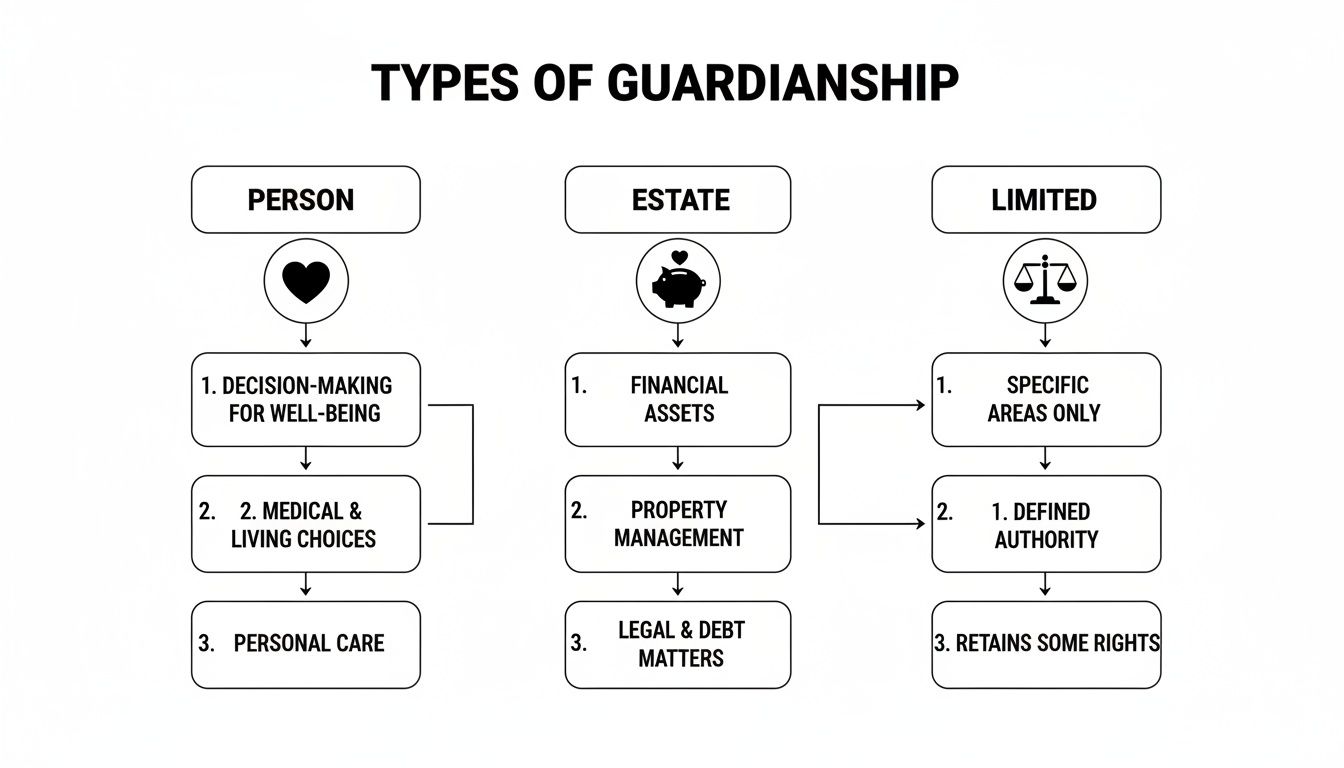
As you can see, the goal is always to tailor the guardianship to the person's actual needs, keeping personal care and financial management separate if needed and always choosing the least restrictive option possible.
Getting through this process takes careful attention to detail and a compassionate guide. If you are considering this for a loved one, Schedule a free consultation today. We can walk you through each step and make sure your family is fully prepared.
A Guardian's Key Responsibilities and Duties
Becoming a guardian for a loved one is much more than a new title—it’s a profound legal and ethical promise. The court is placing an incredible amount of trust in you to look after someone who is vulnerable. This role comes with serious legal duties, and understanding them from the start is key to caring for your family member while staying in compliance with the court.
At the absolute core of this role is what the law calls a fiduciary duty. This is the highest standard of care there is. Legally, it means you have to act with unwavering loyalty and good faith, always putting your loved one's best interests ahead of your own. Every single decision must be made with their well-being as the top priority.
The Guardian's Core Obligations
Once the judge appoints you, you’ll be stepping in to manage either personal affairs, financial matters, or sometimes both, depending on the type of guardianship. You need to think of yourself as a dedicated advocate and a completely transparent manager, acting for someone who can no longer act for themselves. Your duties generally fall into a few main areas.
Your responsibilities will likely include:
- Making Healthcare Decisions: You'll be the one consenting to medical treatments, selecting doctors, and making sure the ward gets the care they need. This demands clear communication with medical staff and a solid understanding of the ward's health issues.
- Deciding on Living Arrangements: A huge part of the job is figuring out the best place for the ward to live. Should they stay in their home? Move in with family? Or is a residential care facility the safest option? The decision must be based on their safety, comfort, and quality of life.
- Managing Finances Responsibly: If you’re appointed as Guardian of the Estate, you are now the steward of their assets. This means paying bills, collecting any income, investing their money prudently, and protecting their property, all while keeping meticulous records.
- Advocating for Their Needs: You become their voice. It's on you to make sure they get the social, educational, and professional services they need to live as full a life as possible.
The Duty to Report to the Court
You don’t operate in a silo. You are directly accountable to the court that put you in this role, and that oversight is what ensures every guardian is acting above board. The Texas Estates Code is very clear about the need for regular reporting to maintain this system of checks and balances.
Being a guardian in Texas means you are legally required to file annual reports with the court. This isn't just a suggestion; it's the law. These filings are the main way a judge keeps tabs on the ward's well-being and makes sure their money is being handled properly.
The two main reports you'll need to master are:
- The Annual Report on the Well-Being of the Ward: This document gives the judge a snapshot of the ward's life. You'll detail their physical and mental health, where they're living, and any big changes that happened over the last year.
- The Annual Accounting: For a Guardian of the Estate, this is a detailed financial breakdown. It must show every dollar that came in and every dollar that went out of the ward's estate, creating a transparent summary of all financial activity.
The Texas court system takes this monitoring seriously. Just to give you an idea of the scale, in FY 2025, Texas courts managed an incredible 7.9 million filings and maintained a 103% case clearance rate. That kind of efficiency is what allows for the timely review of guardianship cases and annual reports. You can find more insights on how Texas courts handle this volume at NCSC.org.
Failing to file these reports on time or with accurate information can lead to serious consequences, including removal as guardian. This strict oversight is all designed to protect the ward above everything else. If you're facing these responsibilities, The Law Office of Bryan Fagan can give you the guidance you need to stay in full compliance with the law. Schedule a free consultation today to talk about your duties and get the support you need.
Powerful Alternatives to Formal Guardianship

When you hear the word “guardianship,” it’s easy to think it’s the only option. But in Texas, the law sees it very differently. Because a guardianship strips a person of their fundamental legal rights, courts are required to treat it as an absolute last resort.
Before a judge will even consider granting one, they have to be convinced that no less restrictive alternative can do the job. A little proactive planning can often sidestep the need for court intervention entirely, saving your family a world of time, money, and emotional stress.
These alternatives aren't just legal documents; they're tools that protect a loved one while preserving their autonomy and dignity. The key is to put them in place before a person loses capacity. This allows them to choose who they trust to make decisions if they ever become unable to do so themselves.
Financial and Medical Decision-Making Tools
Some of the most common and effective alternatives to guardianship are powers of attorney. These straightforward legal documents grant a trusted person, known as an "agent," the authority to act on another's behalf.
- Durable Power of Attorney: This is the workhorse for financial matters. It lets your loved one appoint a trusted agent to manage their finances—things like handling bank accounts, paying bills, and dealing with property. The "durable" part is critical; it means the document stays in effect even if the person becomes incapacitated.
- Medical Power of Attorney: This document lets an individual name an agent to make healthcare decisions for them if they can't communicate their own wishes. It's a vital tool for ensuring their medical care aligns with their personal values.
- Directive to Physicians (Living Will): Often created right alongside a Medical Power of Attorney, a living will spells out a person’s wishes for end-of-life medical care. It provides clear, direct instructions to doctors and family during what is an incredibly difficult time.
These three documents are the cornerstones of a solid Probate, Estate Planning strategy and can often make a formal guardianship completely unnecessary.
Supported Decision-Making Agreements
Texas is on the leading edge of a modern, empowering alternative called a Supported Decision-Making Agreement (SDMA). This approach is particularly valuable for adults with intellectual or developmental disabilities who can make their own decisions but might need a little help understanding their options and communicating them.
An SDMA is a formal agreement where an individual picks a team of trusted supporters—like family and friends—to help them process information and talk through their choices. The most important part? The individual keeps all of their legal rights and is always the final decision-maker.
This collaborative model fosters independence instead of taking it away. By creating a structured support system, an SDMA can often eliminate the need for guardianship, allowing the person to continue directing their own life with guidance from people they know and trust. You can learn more by exploring our detailed guide to Supported Decision-Making agreements and how they work.
By exploring these less restrictive options, you can build a protective plan that truly honors your loved one’s independence. If you need help figuring out which tools are right for your family's unique situation, The Law Office of Bryan Fagan is here to help. Schedule a free consultation with our compassionate team to discuss a path forward.
Making Changes: How to Modify or End a Guardianship
Life isn't static, and neither are the circumstances that lead to a guardianship. What was absolutely necessary one year might not fit the situation a few years down the road. Thankfully, Texas law understands this. It provides clear legal paths to adjust, change, or even completely end a guardianship when the facts on the ground have shifted.
This isn't just about shuffling paperwork; it's about making sure the right level of support is in place. Sometimes, that means restoring a person's legal rights. Other times, it means ensuring the right person is in charge. Understanding your options is the first step toward advocating for your loved one, whether that means asking for a small change or fighting for their full independence.
Modifying an Existing Guardianship
Often, the need for a guardian remains, but the specifics of the arrangement need a tune-up. The legal process for modifying a guardianship is designed for exactly these kinds of life changes.
Some common reasons a modification becomes necessary include:
- Replacing a Guardian: The current guardian might pass away, become incapacitated themselves, or simply find they can no longer handle the duties. When that happens, the court needs to step in and appoint a successor.
- Changing the Guardian's Powers: As a ward's condition improves or declines, the guardian's authority may need to be adjusted. The court can expand or limit a guardian's powers to better match the ward's current needs.
- Relocating the Ward: A guardian can't just pack up and move the ward to a different county or out of state. They must get the court's permission first to ensure the move is in the ward's best interest.
To get the ball rolling, an interested party has to file a formal motion with the same court that established the guardianship in the first place, like one of the Harris County Probate Courts. This motion needs to spell out exactly what changes are being requested and, most importantly, provide solid evidence explaining why the modification is the best thing for the ward.
Terminating a Guardianship and Restoring Rights
The most significant change you can make is to end the guardianship entirely. This is known as the restoration of rights. Under the Texas Estates Code, a guardianship must be terminated if the ward regains their capacity or if they pass away.
The whole point of a guardianship is to protect a vulnerable person, not to permanently strip them of their rights. When someone recovers their ability to make their own decisions, Texas law provides a clear pathway to restore their full legal standing and end the court's oversight.
To start this process, the ward themselves (or someone acting on their behalf) files an application for full restoration with the court. Just like in the initial hearing, fresh medical evidence is key. A current Physician's Certificate of Medical Examination has to be submitted, proving the ward is no longer incapacitated. The court will then hold a hearing, review all the evidence, and decide if the ward is truly capable of managing their own personal and financial life again.
How to Contest a Guardianship Application
What if you believe a guardianship is a bad idea from the start? You have the right to challenge it before it's even established. If you believe the proposed ward isn't actually incapacitated, or if you feel the person applying to be the guardian is unsuitable for the job, you can contest the application. This immediately turns the case into a contested, or disputed, guardianship.
Contesting a guardianship means you'll be presenting your own evidence and witnesses to the court to push back against the applicant's claims. This is a high-stakes legal battle that demands a sharp understanding of court procedures and rules of evidence. After all, the outcome determines whether an individual gets to keep their fundamental rights.
The need for careful legal oversight in these matters cannot be overstated. Texas conservatorship statistics reveal a sobering link between foster care and the criminal justice system, with 3,542 inmates received by the Texas Department of Criminal Justice in Fiscal Year 2025 who had prior histories in DFPS conservatorship. These figures highlight the critical importance of proper legal guidance in any situation involving the removal of rights, emphasizing the need to prevent cycles of instability. You can explore the full report on the TDCJ website.
Whether you need to modify an existing order, seek to restore a loved one's independence, or contest an application you believe is unjust, navigating these changes requires skilled legal advocacy. Contact The Law Office of Bryan Fagan for a free consultation to discuss your options.
Common Questions About Texas Guardianship
When you're considering guardianship, which often gets mixed up with the term conservatorship in Texas, it’s natural to have a lot of practical questions. Families usually feel a mix of urgency and confusion, and getting straight answers can make a world of difference. Our goal is to clear up your immediate concerns and give you the information you need to move forward with confidence.
Here are a few of the questions we hear most often from Texas families just like yours.
How Much Does It Cost to Get a Guardianship in Texas?
The honest answer is: it depends. The final cost can swing pretty widely based on how complex your family’s situation is. You’ll have some standard expenses, like court filing fees, the required physician's exam, and the mandatory fees for the court-appointed attorney ad litem. Your own legal fees are another key part.
If everyone is in agreement and the guardianship is uncontested, the costs stay much more manageable. But if the case is challenged and ends up in a court battle, the expenses can increase significantly. The best way to get a real sense of the numbers is to sit down with an attorney who can give you a clear breakdown based on your specific circumstances.
How Long Does the Guardianship Process Take?
For an uncontested guardianship in Texas, you're typically looking at a timeline of one to three months from start to finish. A lot of this depends on factors outside your control, like the local court's docket, how quickly you can get the medical exams scheduled and completed, and how long it takes the court investigator and attorney ad litem to submit their reports.
If someone contests the guardianship, however, the process will take much longer. In those cases, it's not unusual for it to stretch out for six months or more.
Can I Get an Emergency Guardianship in Texas?
Yes, you can. Texas law provides for a Temporary Guardianship when there's solid proof that a person or their estate is facing immediate and substantial harm. It’s a powerful tool for crisis situations.
A judge can grant this for a short period, usually up to 60 days, to put protections in place while the permanent guardianship application works its way through the system. For example, if a loved one with dementia is suddenly being exploited financially, a temporary guardianship of the estate can freeze their accounts and prevent further loss. Be aware, though, that the legal bar for this is very high. You must present compelling evidence that the danger is real and happening right now.
Facing these questions is the first step toward protecting someone you love. You don't have to figure all this out on your own. The compassionate attorneys at The Law Office of Bryan Fagan, PLLC have walked countless Texas families through this process, finding the right path forward for their unique situations.
For personalized guidance, we invite you to schedule a free, no-obligation consultation today by visiting our website at https://texasguardianshiplawyer.net.