Skip to content
Losing a family member is one of life's most challenging moments, and the legal maze that follows can often feel overwhelming. In Texas, the court-supervised process for validating a will and settling an estate is called probate. This process provides a clear, official path to ensure your loved one's last wishes are respected, their debts are settled, and their property is passed on to the right people.
We understand that dealing with legal procedures while grieving is a heavy burden. This guide is designed to walk you through the process with clarity and empathy, helping you understand each step and what to expect along the way.
What Exactly Is Probate in Texas?
When someone passes away, their property doesn't just automatically change hands. Probate is the formal, legal process for transferring a person's assets after their death. In Texas, this process is managed at the county level, with courts like the Harris County Probate Court overseeing these matters.
At its heart, the goal of probating a will is to get a court's official stamp of approval on the document. This legally empowers the person named as the executor to begin managing the estate. This court oversight provides a transparent framework that protects everyone involved—beneficiaries, creditors, and the executor themselves—ensuring the estate is handled fairly and according to Texas law.
Understanding the Key Terms
Walking into the world of probate means you'll hear a few specific legal terms. Becoming familiar with them will make the process feel less intimidating.
- Decedent: The legal term for the person who has passed away.
- Will: The document outlining the decedent's wishes for who gets their property.
- Executor: The person named in the will to be in charge of carrying out its instructions.
- Beneficiary or Heir: The person, people, or organization entitled to receive property from the estate.
- Estate: The total of everything the decedent owned—property, assets, and debts.
Probate is almost always necessary when the decedent owned assets solely in their name, such as a house, land, vehicles, or bank accounts without a co-owner or a designated beneficiary. Without going through probate, there’s no legal way to transfer the title of these assets out of the decedent's name and into a new owner's.
Does Every Asset Go Through Probate?
Thankfully, no. Not everything a person owned needs to go through the court system. Many types of assets are specifically set up to pass directly to a new owner upon death, neatly sidestepping the probate process. These are called non-probate assets.
Important Takeaway: The difference between probate and non-probate assets almost always boils down to how they are titled and whether they have beneficiary designations. Smart Estate Planning can ensure a significant portion of an estate bypasses the courts, making things simpler for the family.
Here are common examples of assets that usually avoid probate:
- Life insurance policies with a named beneficiary.
- Retirement funds like a 401(k) or IRA with a beneficiary.
- Bank accounts set up as "Payable on Death" (POD).
- Property owned as "Joint Tenants with Right of Survivorship."
Before we dive deeper, let's look at the different paths an estate might take in Texas. This can help you identify which process might apply to your family's situation.
Texas Estate Settlement Paths at a Glance
| Settlement Path | When It Applies | Typical Complexity |
|---|---|---|
| Independent Administration | The will requests it, and all heirs agree. The most common and efficient path. | Low to Moderate |
| Dependent Administration | No will, or the will doesn't specify independent administration. Requires court approval for most actions. | High |
| Muniment of Title | A valid will exists, the only major asset is a home, and there are no debts (besides a mortgage). | Low |
| Small Estate Affidavit | No will, and the estate's value is $75,000 or less (excluding the homestead). | Low |
Understanding which assets need the court's attention is the first, most critical step. To get a better handle on this, you can learn more about how to distinguish between probate and non-probate assets in our detailed guide. This will give you a clearer idea of whether you need to proceed with a formal Probate proceeding.
The Texas Probate Process: A Step-by-Step Guide
Stepping into the Texas probate process can feel like being handed a map to a foreign country. It’s completely normal to feel lost, worried about court dates, legal jargon, and deadlines. Our goal is to provide a clear, straightforward guide, breaking down each stage so you know what’s coming next.
To make this real, let’s walk through a common scenario. Imagine the Rodriguez family from Houston. Their father, Carlos, passed away, leaving a valid will naming his daughter, Maria, as the executor. She feels the weight of this responsibility and is overwhelmed by the legal path ahead.
Maria’s first step is to file an Application to Probate Will and for Issuance of Letters Testamentary. This formal document kicks everything off. It gets filed with the probate court in the county where Carlos lived—in this case, a Harris County Probate Court.
This flowchart gives a bird's-eye view of the initial decisions when figuring out if probate is the right path.
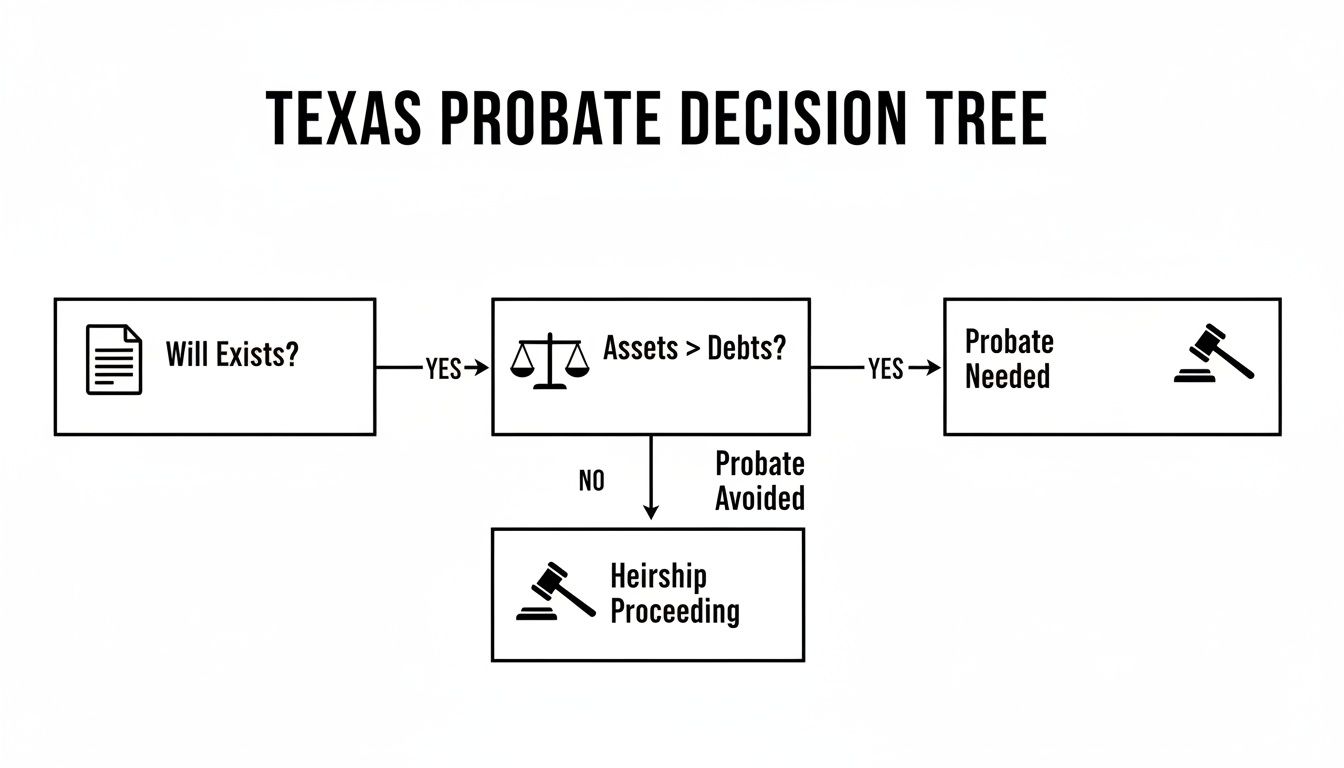
As you can see, when a valid will exists and there are assets to be transferred, a formal probate proceeding is usually necessary.
Posting and Waiting Period
Once Maria files the application, the county clerk will "post" a notice at the courthouse. This is a public announcement that a will has been submitted for probate. It's a Texas legal requirement that triggers a mandatory waiting period of about two weeks before any hearing can take place.
This waiting period serves a real purpose: it gives anyone who might want to contest the will—perhaps a relative who feels they were unfairly left out—a chance to step forward. For Maria and her family, it’s a quiet but necessary pause.
The Court Hearing
The court hearing often makes people the most nervous, but in most cases, it's surprisingly simple and quick. Maria will go before a probate judge, usually with her attorney. During this short hearing, she’ll be sworn in and asked a few basic questions to prove the will is legitimate.
The judge will likely ask her to confirm:
- That her father, Carlos, has passed away.
- That he lived in Harris County when he died.
- That the document presented is his last will.
- That the will was properly signed and witnessed.
As long as no one contests the will and everything is in order, the judge will sign an order admitting the will to probate. This is the court's official stamp of approval. The judge will also officially appoint Maria as the executor, just as her father wanted.
Taking the Oath and Posting Bond
After the judge’s approval, Maria has one more step before she can get to work. She must take an oath of office, a formal, sworn promise to carry out her duties as executor faithfully, following the law and the will's instructions.
In some cases, the court might also require her to post a bond. A bond is like an insurance policy that protects the estate’s beneficiaries and creditors from any major mistakes by the executor. Fortunately, many Texas wills, including Carlos's, have a clause that waives this requirement, which simplifies things.
Receiving Letters Testamentary
Once Maria takes her oath, the court clerk issues a critical one-page document called Letters Testamentary. This paper is the golden ticket—it's the official proof that Maria has the legal authority to act on behalf of her father's estate.
Key Insight: Letters Testamentary are incredibly powerful. This single document allows an executor to access bank accounts, sell property, talk to financial institutions, and handle all other estate business. Without it, you have no authority.
Maria will need certified copies of these letters for banks, mortgage companies, and anyone else holding estate assets. Her attorney will likely advise getting several copies right away.
Notifying Creditors and Marshalling Assets
With her Letters Testamentary, Maria’s real work begins. One of her first legal duties is to notify creditors. Texas law requires her to publish a general notice in a local newspaper to alert any unknown creditors.
She must also send specific notices via certified mail to any known secured creditors, like a mortgage or car loan company. Creditors then have a set time to submit a claim for payment from the estate.
At the same time, Maria starts marshalling the assets—a legal term for tracking down, gathering, and securing all of her father's property. This job includes:
- Contacting banks to find and consolidate accounts.
- Searching for life insurance policies or retirement accounts.
- Getting appraisals for his house or valuable personal items.
- Creating a detailed list called an Inventory, Appraisement, and List of Claims to file with the court.
This part of the process requires diligence and organization. It lays the groundwork for paying off the estate’s debts and distributing what remains to the beneficiaries, allowing your family to move forward.
What Being an Executor in Texas Really Means
When a loved one names you the executor of their will, it’s a profound act of trust. It’s more than a title; it’s a promise to see their final wishes through with care. While it's an honor, the role comes with serious legal duties that can feel overwhelming, especially when you're also grieving.
You're stepping into a fiduciary duty—the highest standard of care recognized by law. This means you are legally required to put the interests of the estate and its beneficiaries first, a responsibility that demands honesty and precision.

Core Duties of a Texas Executor
Once the court officially appoints you and grants you Letters Testamentary, your work begins. Your main job is to marshal and protect the decedent's assets, settle legitimate debts, and distribute what’s left to the people named in the will.
These duties generally break down into a few key areas:
- Asset Management: Your first task is to find, gather, and secure everything the person owned. This can mean anything from changing the locks on a vacant house to taking control of bank accounts.
- Financial Administration: You become the estate's bookkeeper. This involves setting up a dedicated bank account, paying final bills, handling tax returns, and keeping meticulous records of every dollar.
- Beneficiary Communication: Keeping everyone in the loop is critical. Clear, consistent communication with beneficiaries can prevent misunderstandings and family friction.
Under Title 3, Subtitle G of the Texas Estates Code, an executor has a fiduciary duty to preserve the estate. Any failure to do so can lead to personal liability. In plain English, you could be financially responsible for losses caused by poor management.
Navigating the Practical Challenges
The legal checklist is one thing; the human element is another. The toughest challenges often come from managing complex family dynamics. You might find yourself caught between grieving relatives, trying to manage expectations while remaining impartial.
Here’s a common scenario: An executor is handling her mother's estate, which is to be split equally among three siblings. One brother is in a tough spot financially and is pushing for his share now. However, the executor must first pay all the estate’s debts and file the final tax returns—a process that takes months. If she distributes money early, she could be held personally liable if the estate ends up short on cash to cover its obligations.
Tips for a Successful Executorship
Staying organized and being proactive will make all the difference. How you manage this role isn't just about honoring your loved one; it's also about protecting yourself from legal headaches.
Here are a few practical tips:
- Create a Detailed Inventory: Immediately start making a list of all assets and their values. This "Inventory, Appraisement, and List of Claims" is a formal document you'll file with the Texas court.
- Open a Separate Estate Bank Account: Never mix estate funds with your own. Open a dedicated checking account for the estate to ensure clean record-keeping.
- Communicate Proactively: Don’t make beneficiaries chase you for information. Send out simple, periodic updates on your progress.
- Get Professional Help: You aren't expected to be a legal or financial expert. An experienced probate attorney can be your most valuable asset, ensuring you meet deadlines and avoid common pitfalls. For a deeper look, understanding an executor of a will's responsibilities is a great place to start.
Serving as an executor is a final act of service. By approaching the role with diligence and getting the right support, you can confidently fulfill this important duty and bring their affairs to a peaceful close.
When a loved one passes, the last thing most families want is a drawn-out, expensive court process. The good news is, in Texas, a full formal probate isn't always the only way forward. Our legal system offers simpler, more direct paths to settle an estate, which can save families precious time, money, and emotional energy.
Using a Muniment of Title to Transfer Property
One of the most useful alternatives to a full probate is the Muniment of Title. This unique Texas process lets a will function as a deed. The court legally recognizes the will as the document that transfers ownership of property, creating a clear link in the chain of title.
The biggest advantage is that it completely skips the administration phase. You don't appoint an executor, send notices to creditors, or file a detailed inventory of assets with the court.
Muniment of Title only works if a few key conditions are met:
- The deceased must have left a valid will.
- The estate cannot have any unsecured debts. The only exception is for debts secured by real estate, like a home mortgage.
This process is a perfect fit when the main asset is the family home and there aren't lingering credit card or medical bills.
Practical Insight: Think of Muniment of Title as asking the court to rubber-stamp the will as the new deed. It's a quick, efficient way to get real estate into a beneficiary's name without the burdens of a full probate administration.
When a Small Estate Affidavit Is the Right Choice
What if there's no will? For smaller estates, the Small Estate Affidavit (SEA) can be an incredibly valuable tool. This is a sworn statement filed with the court that allows heirs to collect and distribute assets without needing a formal administration.
The eligibility rules are strict:
- The estate's assets (not including the homestead and other exempt property) cannot be worth more than $75,000.
- The value of the assets must be greater than the estate's known debts (not counting any mortgages).
- The affidavit must be signed and sworn to by all heirs and two disinterested witnesses (people who aren't inheriting anything).
An SEA is great for transferring title to a bank account or a car. A key limitation is that it cannot be used to transfer title to real estate, other than the decedent's homestead. Getting the paperwork right is critical. For a closer look, you can review the details of the Small Estate Affidavit Texas form.
Formal Probate vs. Simpler Alternatives in Texas
Choosing the right path boils down to your specific situation. This table breaks down the key differences to help you see which route might make the most sense for your family.
| Feature | Formal Probate | Muniment of Title | Small Estate Affidavit |
|---|---|---|---|
| Will Required? | Preferred, but can proceed without one (intestate) | Yes, a valid will is mandatory. | No, this is only for estates without a will. |
| Asset Limit | None. | None. | Assets (excluding homestead) must be $75,000 or less. |
| Debt Situation | Can handle complex debts and creditor claims. | No unsecured debts allowed. | Assets must exceed known liabilities. |
| Executor Needed? | Yes, an executor or administrator is appointed. | No executor is appointed. | No executor is appointed. |
| Court Involvement | High. Multiple hearings and ongoing supervision. | Minimal. One hearing to validate the will. | Low. Affidavit is filed, but no formal hearing. |
| Best For | Large or complex estates with debts or disputes. | Simple estates with a will, real estate, and no debt. | Small, straightforward estates with no will. |
By exploring these alternatives, many Texans can honor their loved one's legacy without the stress and cost of a prolonged court proceeding.
Navigating Common Probate Hurdles
Even the most straightforward probate cases can encounter challenges. When you're already grieving, a surprise claim from a creditor or a family dispute is the last thing you want to deal with. Knowing what might come up can help you face these issues with a clear strategy.
As an executor, your job is to be the estate's shield, protecting its assets by navigating tricky claims and delicate family situations with a steady hand.
Managing Claims from Creditors
One of your first duties as an executor is to put creditors on notice. This is a formal process required by the Texas Estates Code that starts a countdown for them to submit claims against the estate.
You'll need to publish a general notice in a local newspaper for all potential creditors. For any known secured creditors—like a mortgage company—you must send a notice by certified mail. Once claims start arriving, it's your job to vet them.
- Valid Claims: If the debt is valid, you'll pay it from the estate's funds before any money or property goes to the beneficiaries.
- Questionable Claims: If a claim seems incorrect or is past the statute of limitations, you have a duty to formally reject it. This has a strict deadline, and if the creditor pushes back, it could end up in court.
Getting this process right is critical. Failing to notify creditors properly or paying a bogus claim could result in you being held personally liable.
Dealing with the Stress of a Will Contest
A will contest is one of the most draining challenges in probate. This is a lawsuit filed by an "interested party"—often a disgruntled heir—claiming the current will is invalid.
In Texas, they must prove one of four specific legal arguments:
- Lack of Testamentary Capacity: The argument that the person who made the will wasn't mentally competent when they signed it.
- Undue Influence: The claim that someone manipulated or pressured the person into creating or changing the will to benefit them.
- Improper Execution: A technical argument that the will wasn't signed and witnessed exactly as Texas law demands.
- Fraud or Forgery: A claim that the will is a fake or that the person was tricked into signing it.
Here's the bottom line: The person challenging the will has the full burden of proof. They must present solid evidence to convince a judge to throw out a will that is otherwise presumed to be valid.
When a contest is filed, everything halts. As the executor, your job is to defend the will. This is a scenario where you absolutely need a skilled attorney in your corner to protect the final wishes of the person who passed.
Resolving Disputes Among Beneficiaries
Sometimes the conflict isn't with the will itself, but with how things are being handled. Beneficiaries might argue over selling the family home or who gets sentimental items. In these moments, clear and consistent communication is your best tool.
Remember, probate is a public process. Most documents filed are available for public inspection at the county clerk’s office. You can learn more about how Texas makes vital records accessible. Proactively sending updates, explaining your decisions, and treating every beneficiary fairly can stop small disagreements from escalating into painful legal fights.
Facing these challenges takes patience and a level head. If you find yourself dealing with creditor issues, a will contest, or family infighting, don't try to weather the storm alone. The Law Office of Bryan Fagan can help you protect the estate and find a clear path to resolution.
Why a Probate Attorney Is Your Most Valuable Ally
Trying to navigate the Texas probate system on your own can feel like wading through a swamp in the dark. The sheer volume of forms, deadlines, and legal duties is overwhelming, and one wrong move can have serious financial and personal consequences.
While it's understandable to want to save money, attempting to probate a will without professional guidance is a significant risk. An experienced probate attorney is more than a paper-pusher—they are your guide, your shield against liability, and your objective voice of reason when emotions are running high.
Beyond Paperwork: Protection from Personal Liability
When you agree to be an executor, you take on a fiduciary duty. This is the highest standard of care under Texas law, meaning you must act in the absolute best interests of the beneficiaries and creditors.
If you make a mistake—like distributing inheritances before a surprise creditor claim comes in, or missing a critical tax deadline—you could be held personally liable for the financial fallout. Your own assets could be at risk.
An attorney ensures every step you take complies with the Texas Estates Code. They handle the creditor notification process, verify claims, and ensure all debts and taxes are paid before any assets are distributed. This oversight protects the estate and, just as importantly, protects you.
A Crucial Takeaway: Hiring a probate attorney isn't just an expense for the estate; it's an insurance policy for the executor. Their guidance helps ensure your loved one's wishes are carried out correctly while shielding you from expensive legal blunders.
An Investment in Peace of Mind and Efficiency
Many families focus on the cost of legal fees, but that overlooks the hidden costs of not having an attorney. A lawyer who knows the local probate courts—whether in Dallas County or Bexar County—can prevent simple mistakes that might otherwise freeze assets for months longer than necessary.
Consider a common scenario: siblings can't agree on whether to sell the family home. An attorney can step in as a neutral third party, explain the legal requirements, and mediate the disagreement before it explodes into a court battle. That kind of fight not only drains the estate's resources but can permanently damage family relationships.
Ultimately, a good attorney provides clarity and peace of mind. Instead of spending your nights trying to decipher dense legal statutes, you can focus on being there for your family. They translate legal jargon into plain English, so you feel confident you're doing the right thing.
During this challenging chapter, you don't have to carry the legal burden alone. The compassionate attorneys at The Law Office of Bryan Fagan, PLLC are here to provide the clarity and support your family deserves. We will guide you through every step of probating a will in Texas, protecting you from liability and ensuring your loved one's legacy is honored. Schedule a free, no-obligation consultation today to discuss your family's needs and learn how we can help.