Skip to content
Losing a family member is one of life's most challenging experiences. Discovering they passed away without a will can add a layer of legal confusion to an already painful time. This is where a Texas intestacy chart becomes an essential tool. It's a legal roadmap that shows how the state decides who gets what, providing families with a clear, visual guide to Texas's default inheritance laws and helping you understand the process with clarity and care.
Navigating Inheritance Without a Will in Texas
When a person in Texas dies without a valid will, they have died "intestate." In these situations, the Texas Estates Code (Title 2, Subtitle E, Chapter 201) lays out a rigid, default plan for how their assets are divided. This legal formula determines the heirs based on their relationship to the deceased, regardless of what the person's unwritten wishes might have been. For many families facing this, the state’s plan can be a jarring and confusing reality.
This happens more often than you might think. A staggering number of Americans, including many right here in Texas, pass away without an estate plan. People often underestimate how critical formal planning is. Even Texas billionaire Howard Hughes, with his immense fortune, left his estate to be sorted out by state intestacy laws, sparking a massive legal battle among potential heirs.
To cut through the complexity of these rules, an intestacy chart or flowchart is an invaluable tool. It simplifies the line of succession by walking you through a series of questions about the deceased’s surviving family members.
This decision tree shows the exact questions a court, such as a Harris County Probate Court, will ask to identify the legal heirs, starting with the most fundamental one: did the person leave behind a spouse or children?
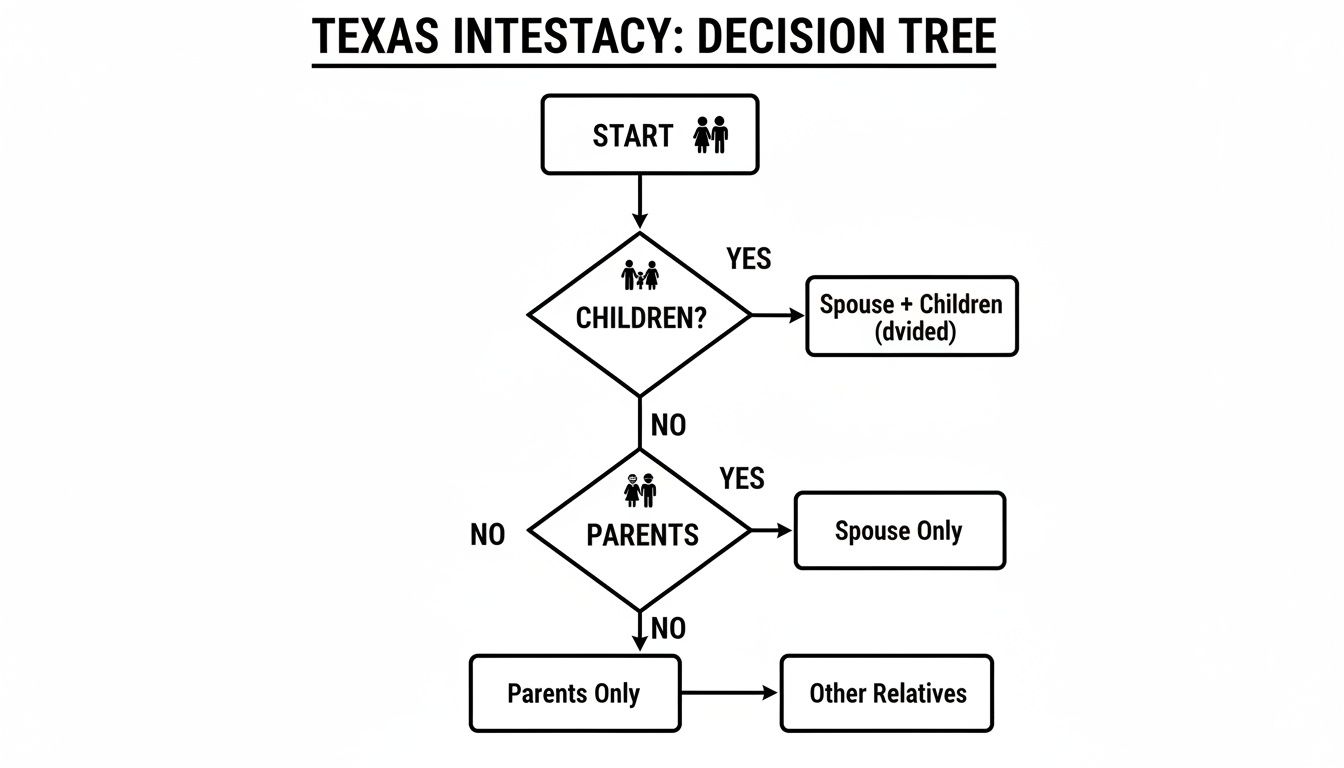
As you can see from the chart, the presence of a surviving spouse and children completely changes how property is divided, especially when you factor in the critical difference between community and separate property.
Once the heirs are identified using this process, you will likely need legal tools to officially transfer the assets. For instance, you can learn more about how an heirship affidavit is used in Texas to establish rightful ownership. We’ll walk through each of these common scenarios in detail below, providing practical steps and empathetic guidance.
Texas Intestacy Scenarios at a Glance
To make this even clearer, we've put together a table summarizing the most common inheritance situations in Texas. It breaks down who inherits based on whether the assets are classified as community or separate property.
| If the Deceased Is Survived By… | Who Inherits Community Property | Who Inherits Separate Property |
|---|---|---|
| Spouse, No Children | Spouse inherits all community property. | Spouse inherits all separate personal property and a one-half interest in separate real property. The other half of the real property goes to the deceased’s parents. If no parents survive, then to the deceased's siblings. |
| Spouse and Children (all from that spouse) | Spouse inherits all community property. | Spouse inherits one-third of the separate personal property. The children inherit the remaining two-thirds. For separate real property, the spouse receives a life estate in one-third, with the remainder interest going to the children. |
| Spouse and Children (from another relationship) | Spouse keeps their one-half share. The deceased's one-half share goes to their children. | Spouse inherits one-third of the separate personal property. The children inherit the remaining two-thirds. For separate real property, the spouse receives a life estate in one-third, with the remainder interest going to the children. |
| Children, No Spouse | All property is considered separate property. | Children inherit the entire estate, divided equally among them. |
| Parents, No Spouse, No Children | All property is considered separate property. | Parents inherit the entire estate, divided equally. |
| Siblings, No Spouse, No Children, No Parents | All property is considered separate property. | Siblings inherit the entire estate, divided equally. |
This table provides a quick reference, but remember, the specifics of your family’s situation can introduce nuances. The following sections will dive deeper into what these terms mean and how the rules are applied in practice, empowering you with the knowledge to navigate this process.
Understanding Community vs. Separate Property
Before you can use a Texas intestacy chart, you must understand how the state classifies marital assets. Texas is a community property state, which creates a fundamental divide between two types of assets: community property and separate property. This distinction is the single most important factor in determining how an estate is divided when there’s no will. We recognize that dealing with financial matters after a loss is challenging, and our goal is to explain this as simply as possible.
So, what is community property? It's generally everything a couple acquires during their marriage while living in Texas. It doesn’t matter whose paycheck bought it or whose name is on the title. If it was acquired after the wedding, Texas law presumes it belongs to both spouses as a marital "community."
Separate property, on the other hand, is completely different. This is property that belongs to one spouse alone, entirely outside the marital estate.
Defining Separate Property
The Texas Estates Code § 3.001 clearly defines what qualifies as separate property. It includes:
- Assets owned by one spouse before the marriage.
- Property acquired by one spouse during the marriage as a gift. For example, if a parent gifts their daughter a car for her birthday, that car is her separate property.
- An inheritance received by one spouse during the marriage. If a husband inherits his family's ranch, it remains his separate property.
- Compensation from a personal injury settlement, though any portion of the settlement meant to cover lost earning capacity during the marriage is considered community property.
Getting this classification right is absolutely critical, because community and separate property are distributed very differently under intestacy laws. A single mistake in identifying an asset can alter the entire inheritance calculation.
A Note on Commingling: Be aware of a common pitfall called "commingling." This happens when separate property gets so mixed with community assets that it's impossible to tell them apart. For instance, if you deposit inherited money into a joint checking account used for daily bills, that inheritance can gradually lose its separate character and become community property.
Hypothetical Scenario: Property Classification
Let’s use a hypothetical scenario to make this clear. Imagine Maria and Juan, married for 15 years and living in Houston.
- Family Home: They bought their house in Harris County five years into their marriage using money from Juan's salary. This house is community property.
- Classic Car: Maria inherited a vintage Mustang from her grandfather before she met Juan. That car is her separate property.
- Savings Account: They share a joint savings account where they both deposit their paychecks. This account is community property.
- Inherited Stocks: Last year, Juan's aunt left him $50,000 in stocks. As long as he keeps them in a brokerage account under his name only, these stocks remain his separate property.
Understanding these foundational rules is the first practical step you can take to navigate the probate process and apply the Texas intestacy chart to your family's situation. If you are dealing with complex assets, it is always a wise decision to seek professional legal guidance.
How a Surviving Spouse Inherits in Texas
When you lose a spouse, the last thing you want is a confusing legal process. Understanding how Texas intestacy law handles your inheritance is a critical first step toward finding your footing. The rules can seem complex, but they follow a clear—though sometimes surprising—formula based on who else survives your partner.
The way assets get divided depends on two key factors: the type of property (community or separate) and whether your deceased spouse had children from another relationship. This framework determines exactly what you inherit and what, if anything, goes to other relatives.

Spouse and Shared Children
This is the most straightforward scenario. If you and your deceased spouse have children together (and there are no children from other relationships), the law is designed for simplicity: the surviving spouse inherits 100% of the community property.
When it comes to separate property, the surviving spouse gets one-third of the personal property, with the children inheriting the other two-thirds. For separate real estate, you receive a "life estate" in one-third of the property. This means you have the right to use that portion of the property for the rest of your life, but it ultimately passes to the children upon your death.
Spouse and Children from a Prior Relationship
Things become more complicated when your deceased spouse has children from a different relationship. In this case, the surviving spouse keeps their own one-half share of the community property, but the deceased's one-half share goes directly to their children. This rule often catches families by surprise and can create significant emotional and financial challenges, as many assume the surviving spouse is entitled to all assets acquired during the marriage.
The division of separate property remains the same. You would receive one-third of the personal property and a one-third life estate in any real property, while the children inherit the rest.
Example: Maria and David’s Story
Maria and David were married for ten years in Dallas. David had a son from a previous marriage. They owned a home together (community property). When David died without a will, Maria was shocked to learn she did not inherit the entire house. Instead, she kept her 50% ownership, and David’s son inherited his 50% share, making them co-owners. This unexpected outcome highlights the importance of proactive planning, especially for blended families.
Spouse and No Children
If the deceased spouse had no children but is survived by you and their living parents, the rules shift again. The surviving spouse inherits all community property and all separate personal property.
However, the deceased’s separate real property is divided. The surviving spouse receives a one-half interest in it. The other half goes to the deceased's parents. If only one parent is alive, they receive one-quarter, and the deceased's siblings inherit the other quarter. If no parents are alive, the siblings inherit that entire half share.
This complex web of rules shows why relying on the state’s default plan can lead to unexpected and often undesirable outcomes. If you're facing this situation, understanding your rights through a free consultation can bring much-needed clarity during a difficult time.
Children's Inheritance Rights Without a Will
When a parent passes away without a will in Texas, it can leave children navigating a confusing and emotional legal landscape. The state provides specific rules under the Texas Estates Code to determine how assets are divided. These laws create a clear line of succession, with the goal of ensuring a parent's children are recognized as the primary heirs.
But as any modern family knows, "family" can be complex. Understanding how Texas law views different relationships—like those with adopted children, stepchildren, and grandchildren—is critical, especially for blended families. These details matter and can significantly change who inherits.

Adopted Children vs. Stepchildren
When it comes to inheritance, Texas law draws a very clear and important line between adopted children and stepchildren.
Adopted Children: Under Texas Estates Code § 201.054, a legally adopted child has the exact same legal standing as a biological child. Once an adoption is finalized, the law treats them as a natural-born child for all inheritance purposes, granting them the exact same rights.
Stepchildren: This is where many blended families face a painful surprise. A stepchild has no automatic inheritance rights from a stepparent. Unless the stepparent has gone through the formal process of legally adopting them, they are not considered a legal heir under the state's intestacy laws.
This distinction is crucial. It highlights why, if a stepparent wants their stepchild to inherit, they must either legally adopt them or specify their wishes clearly in a will. Without one of these actions, the law will not recognize that relationship for inheritance purposes.
What About Grandchildren?
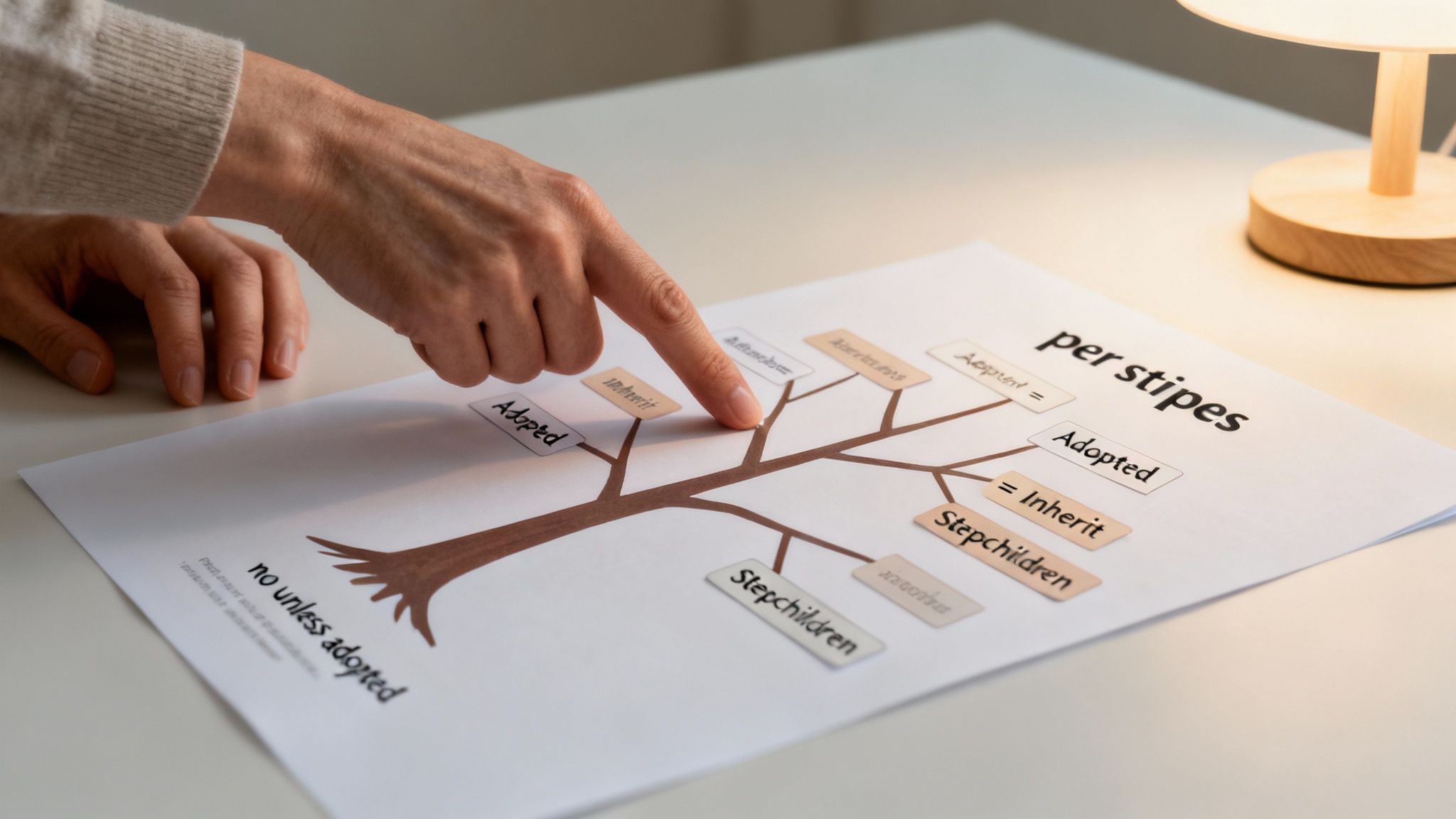
Grandchildren generally inherit only if their own parent (the deceased person's child) has already passed away. This legal principle is known as per stirpes distribution, which literally means "by the roots."
Here is a hypothetical scenario to explain: a grandmother has two children, a son and a daughter. Her estate is set to be split into two main shares.
If her daughter passes away before she does but left behind two children of her own (the grandchildren), the daughter's share does not simply disappear. Instead, the estate is still divided in two. The living son receives his one-half share, and the deceased daughter's one-half share "passes down" to be split equally between her two children.
This system ensures that each branch of the family tree receives its intended portion of the estate, preventing a deceased child's entire line from being cut off from the inheritance.
For families in Harris County, Travis County, or anywhere in Texas trying to sort through these complex questions of heirship, the probate court will follow these rules precisely. The only way to guarantee your specific wishes are followed is through careful and proactive Estate Planning. If you're already facing this situation without a will, our team can offer the clarity and compassionate guidance you need. We invite you to schedule a free consultation to discuss your family's unique circumstances.
When Parents and Siblings Inherit an Estate
When someone passes away without a spouse or any children, the Texas intestacy chart shifts focus to the next tier of relatives: parents and siblings. Working through this kind of loss is always difficult, especially when a young person dies unexpectedly. The law provides a clear, though sometimes complex, hierarchy for how the estate is divided in these specific family situations.
Under Texas Estates Code § 201.001, the rules are designed to keep the estate within the immediate family. The distribution hinges entirely on which of these relatives—parents or siblings—survive the person who passed away. Each scenario creates a distinct legal outcome, which courts in Harris County, Dallas County, and across the state will follow precisely.
Distribution Scenarios for Parents and Siblings
The law anticipates several common family structures, ensuring there is a default plan for each one. Here’s how it typically works:
- Both Parents Survive: If both parents are living, the entire estate is split equally between them. Each parent inherits a one-half share of the property.
- One Parent and Siblings Survive: If only one parent is alive, they do not inherit the whole estate. Instead, the surviving parent takes one-half, and the other half is divided equally among the deceased's siblings.
- Only Siblings Survive: When neither parent is alive, the entire estate is distributed equally among the surviving siblings.
Texas intestacy laws have evolved over many years, often alongside the state's ability to track family lineage. State death registration began in 1903, creating the kind of vital records that are now crucial for proving who the heirs are. For instance, when there are no children but both parents are alive, the estate is split half and half under §201.001(c)—a rule that depends on clear proof of parentage. You can find more insights on this topic by exploring the history of Texas vital records at TSL.Texas.gov.
Example: The Estate of a Young Professional
Let's walk through a hypothetical situation to see this in action. Alex, a 28-year-old software developer in Austin, dies in a car accident without a will. Alex was unmarried and had no children but is survived by a mother, a father, and one sister.
- Asset Distribution: According to the Texas intestacy chart, Alex's estate is divided equally between the two surviving parents. The mother receives 50%, and the father receives 50%. Alex’s sister does not inherit anything in this scenario.
Now, let’s change one fact. Imagine Alex’s father had passed away a few years earlier.
- Revised Distribution: In this case, Alex's mother would inherit 50% of the estate. The remaining 50% would go directly to Alex's sister.
These rigid formulas highlight why relying on state law can lead to outcomes that might not match what someone would have wanted. Proactive Estate Planning is the only way to ensure your assets are divided according to your own wishes. For families already facing these situations, we offer compassionate guidance. Schedule a free consultation to understand your next steps.
Navigating the Texas Intestate Probate Process
Knowing who inherits is just the first piece of the puzzle. The next, and often more complicated, question is how they inherit. When someone in Texas dies without a will, their estate usually has to go through a formal court process called probate.
This legal proceeding is designed to ensure the deceased’s property is correctly identified, their debts are paid, and the remaining assets are distributed to the right heirs according to the Texas intestacy chart. This is not an automatic process; it requires a formal court filing to begin, which can feel overwhelming for families already coping with loss. The goal of probate is to bring legal and financial closure under a judge's supervision.
Key Steps in the Intestate Probate Process
While every situation is unique, settling an intestate estate in a Texas probate court, like the Harris County Probate Court, generally involves a few critical steps. An interested party, usually a close family member, must initiate the process.
The main legal tool for this is an Application for Determination of Heirship. This court proceeding legally identifies the deceased's heirs based on the evidence presented. It is the formal way for the court to confirm who is legally entitled to inherit.
Often, the family will also file an Application for Letters of Administration at the same time. If the court grants this, it appoints someone as the estate administrator—the person with the legal authority to manage the estate’s affairs.
An estate administrator has a fiduciary duty, which is the highest legal standard of care. This means they are required to act solely in the best interests of the estate and its heirs, managing assets responsibly and with complete transparency.
The Role and Duties of an Estate Administrator
Once the court appoints an administrator, they take on significant responsibilities. Their job is to methodically wind down the deceased’s financial life under the court's supervision. Many of these duties are similar to those of an executor when there is a will, and you can learn more in our detailed guide on probating wills in Texas.
Here are some of the key duties:
- Inventorying Assets: The administrator must find, identify, and create a detailed list of all property belonging to the estate.
- Notifying Creditors: They are legally required to give formal notice to potential creditors, giving them an opportunity to file claims against the estate.
- Paying Debts: All legitimate debts, taxes, and final expenses must be paid using the estate's funds before any assets are distributed.
- Distributing Property: After all debts and expenses are settled, the administrator distributes the remaining assets to the legally determined heirs, exactly as ordered by the court.
Navigating this process without legal help can be risky, leading to costly mistakes and even family disputes. We understand the emotional and financial strain this places on families. For personalized guidance, please schedule a free consultation to discuss your situation with our compassionate team.
Why Proactive Estate Planning Is Essential
Relying on the rigid formulas of a Texas intestacy chart means you are giving up control over your legacy. The state’s default plan is impersonal and cannot account for your family's unique dynamics, your specific wishes, or the needs of your loved ones. Proactive estate planning is the only way to replace the state's one-size-fits-all approach with your own thoughtful, personalized instructions.
Taking the time to create a will or trust empowers you to make critical decisions that intestacy laws completely ignore. A well-crafted plan provides clarity, prevents conflict, and protects your family from uncertainty during an already painful time.
Taking Control of Your Family’s Future
With a formal estate plan, you gain the power to direct your assets precisely where you want them to go. This ensures your legacy is handled with the care and intention it deserves.
Here are just a few key benefits of planning ahead:
- Appointing Guardians for Children: You can nominate a guardian to care for your minor children—a deeply personal decision the court would otherwise make without your input.
- Protecting Vulnerable Loved Ones: A trust can be established to manage assets for a child with special needs or a relative who struggles with financial management, ensuring their long-term security.
- Minimizing Conflict: By clearly stating your intentions, you can prevent the disagreements and legal battles that often erupt when family members are left to interpret vague intestacy laws.
- Maximizing Your Legacy: Strategic planning can help minimize potential estate taxes and administrative costs, preserving more of your assets for your heirs.
Beyond the legal documents, comprehensive estate planning often includes practical considerations for aging family members. Ensuring their home is safe and they can maintain independence is a crucial part of a holistic plan, as discussed in this helpful Aging in Place Checklist.
Ultimately, the difference between intestacy and estate planning is the difference between letting the state make decisions for you and making them yourself. By creating a plan, you provide your family with a clear roadmap, sparing them the stress and expense of a prolonged court process.
You can learn more about how to get started by exploring our guide on estate planning in Texas. Don't leave your family’s future to chance. Schedule a free consultation with our compassionate legal team today to take control of your legacy.
Frequently Asked Questions About Texas Intestacy
Losing a loved one without a will often brings up a storm of practical, pressing questions. In this final section, we’ll tackle some of the most common concerns families have when they first encounter Texas intestacy laws, providing clear, straightforward answers.
What Happens to Debt When Someone Dies Without a Will in Texas?
When a person passes away, their debts do not simply vanish. The responsibility for paying off any outstanding liabilities—like credit card bills, a mortgage, or medical expenses—falls to the deceased person's estate.
Before any property can be distributed to heirs, the estate administrator has a legal duty to use the estate's assets to pay all legitimate creditor claims. If the debts are greater than the assets, the estate is considered insolvent. In that scenario, heirs typically will not receive an inheritance. It's important to know that family members are generally not personally responsible for a relative's debt unless they co-signed a loan.
How Long Does the Intestate Probate Process Take?
The timeline for settling an intestate estate in Texas can vary widely. A very simple case, with easy-to-identify heirs and minimal assets, might be completed in as little as six months.
However, several common issues can significantly extend this timeline:
- Heirship Disputes: The process can become much longer and more expensive if family members cannot agree on who the legal heirs are.
- Complex Assets: Valuing and distributing complicated assets, like a family business or multiple real estate holdings, naturally takes more time.
- Creditor Claims: If there are numerous creditors or contested claims against the estate, resolving them can add months to the process.
For these more complex situations, it’s not unusual for the probate process to take well over a year to complete.
Can We Avoid Probate If My Loved One Died Without a Will?
Yes, but only in very specific, limited circumstances. Texas law provides a couple of alternatives to a full, formal probate for smaller or less complicated estates.
One of the most common tools is the Small Estate Affidavit. This option is only available if the estate's value is $75,000 or less (not counting the homestead and other exempt property) and its assets are worth more than its debts. Another alternative, a Muniment of Title, is only available when there is a valid will.
For intestate estates, the usual routes are either a formal Determination of Heirship proceeding or a Small Estate Affidavit. The reality is that most situations, especially those involving real estate beyond the primary homestead, will require a court-supervised process to legally transfer ownership to the heirs.
Ultimately, relying on state law and the probate court system to handle an estate can be a slow, public, and emotionally draining process. It underscores why taking control of your legacy is so important.
How Can I Prevent My Family From Dealing With Intestacy?
The single most effective way to shield your family from the costs and confusion of intestacy is through proactive estate planning. To ensure your wishes are followed—and to avoid the rigid, one-size-fits-all outcomes of the Texas intestacy chart—it is vital to prepare essential estate planning documents.
By creating a legally sound will or trust, you get to name exactly who inherits your property, appoint an executor you trust to manage your affairs, and even designate guardians for minor children. This gives your loved ones a clear roadmap, which goes a long way in minimizing stress and potential family conflict.
The complexities of intestacy law can feel overwhelming, but you don't have to face them alone. The compassionate team at The Law Office of Bryan Fagan is here to provide the clarity and guidance your family needs. Schedule a free, no-obligation consultation with us today to discuss your specific situation and learn how we can help.