Skip to content
Deciding between per stirpes vs per capita is a critical moment in Texas estate planning that can have a lasting impact on your family's future. The core difference boils down to this: per stirpes divides your assets by family branch, ensuring a deceased child’s share passes to their children. In contrast, per capita splits assets equally only among living heirs of the same generation, which can unintentionally disinherit your grandchildren. Navigating this choice with care is essential to protecting your loved ones and honoring your legacy.

Understanding Your Estate Distribution Options in Texas
When you sit down to create a will or trust in Texas, you’re not just filling out forms; you're making deeply personal choices about your legacy. The legal terms you choose will dictate exactly how your assets are handed down to your loved ones, and a simple misunderstanding can lead to results you never intended. For Texas families, especially those whose wills might pass through a Harris County or Travis County probate court, making the right choice is key to preventing family disputes during an already emotional time.
This decision isn't just about finances. It's about honoring family lines and what you believe is fair for future generations. We understand the emotional weight of these decisions and are here to provide clarity and compassionate guidance.
- Protecting Generational Lines: Do you want to guarantee that each branch of your family receives an equal share, regardless of who outlives you?
- Ensuring Fairness Among Heirs: Or do you prefer to treat all living descendants at a certain level—like your children—equally, even if that means some family branches ultimately receive more than others?
Before you can make the right call, it's vital to have a firm grip on the basics. For instance, fully understanding beneficiary roles in estate planning is a fundamental step toward ensuring your assets are distributed correctly.
Per Stirpes vs Per Capita At a Glance
Here’s a quick table to break down the fundamental differences between these two distribution methods. Think of it as the first step in creating a clear, effective estate plan that truly reflects your intentions. You can see how these clauses fit into the larger document by reviewing a Texas last will and testament sample.
| Distribution Method | Per Stirpes (By Branch) | Per Capita (By Head) |
|---|---|---|
| Core Principle | Assets are divided equally by each branch of the family, starting with your children. | Assets are divided equally among all living members of a specific generation (e.g., children). |
| If a Child Predeceases You | The deceased child's share passes down to their children (your grandchildren). | The deceased child's share is redistributed among the other surviving children. |
| Impact on Grandchildren | Grandchildren are guaranteed to inherit their parent's intended share. | Grandchildren from a deceased parent's line may receive nothing from your estate. |
As you can see, the path you choose dramatically alters who gets what, especially when unforeseen tragedies happen. We’ll dig into specific examples next to show you exactly how this plays out in the real world.
How Per Stirpes Protects Each Family Branch
The Latin term per stirpes literally translates to "by branch" or "by roots," a phrase that perfectly captures its purpose in Texas estate planning. This method is all about honoring the distinct lines of your family. It ensures your legacy flows downward through each branch just as you intended, even if tragedy strikes. Think of it as a crucial safeguard for your grandchildren.

With a per stirpes distribution, if one of your children passes away before you, their designated share of your estate doesn't just vanish or get reabsorbed by the surviving siblings. Instead, that exact portion passes directly to their own children—your grandchildren. This principle actually mirrors the default inheritance rules in Texas for anyone who dies without a will, as laid out in the Texas Estates Code.
A Practical Example of Per Stirpes in Action
Let's walk through a common scenario we see in courts from Harris County to Dallas County to show you how this works in the real world. We understand these situations can be emotionally challenging, and clear planning is the best way to protect your family.
Imagine Maria, a retired teacher in Austin, has a $1.2 million estate. She has three adult children: David, Sarah, and Michael. Her will clearly states that her estate should be divided among her children, per stirpes.
- Initially, each child's "branch" of the family is entitled to a one-third share, which works out to $400,000.
Tragically, Sarah dies in a car accident a few years before Maria. Sarah leaves behind two children of her own, Emily and James (Maria’s grandchildren). When Maria eventually passes away, how does this affect the distribution of her estate?
Because Maria chose per stirpes, the outcome is fair to each family branch:
- David, as a surviving child, receives his full one-third share: $400,000.
- Michael, the other surviving child, also receives his full one-third share: $400,000.
- Sarah's Share is preserved for her kids. Her original $400,000 is split equally between Emily and James.
- Emily and James (the grandchildren) each receive $200,000.
This result ensures Sarah’s branch of the family isn't financially penalized due to her untimely death. Crucially, Emily and James are not unintentionally disinherited.
A key benefit of the per stirpes method is its predictability and fairness across generations. It treats each of your children's family lines as a separate and equal entity, providing a clear path for your assets and reducing the potential for family disputes during the already difficult probate process.
The Legal and Emotional Security of Per Stirpes
Opting for a per stirpes distribution provides both legal clarity and emotional peace of mind. It mirrors how most people naturally think about their legacy—that what was meant for a child should then benefit that child's children if they are no longer there. This approach is especially important for families navigating complex emotional situations, like those requiring a guardianship for minor grandchildren.
Consider a Houston business owner with $3 million in assets who used per stirpes in his will. After one of his children died tragically, that child's kids—the grandchildren—received their parent's full share. This simple clause prevented the kind of bitter disputes that complicate a huge percentage of Texas probate cases. You can explore how these designations secure family legacies in different estate planning situations.
The emotional weight of these decisions cannot be overstated. By specifying a per stirpes distribution in your will or trust, you create a clear, legally enforceable plan that protects your grandchildren and honors the family structure you've built over a lifetime.
Navigating the nuances of estate distribution requires compassionate and experienced guidance. If you are considering how to best structure your will to protect every member of your family, our team can help. Schedule a free consultation with The Law Office of Bryan Fagan today to discuss your unique family circumstances and create an estate plan that brings you peace of mind.
Understanding Per Capita: An Equal But Risky Distribution
While per stirpes is all about preserving family branches, the per capita method takes a completely different road. Translating to "by head," this approach divides your estate equally among all living beneficiaries of the same generation.
On the surface, it might sound like the simplest and fairest way to handle things. But this method carries significant risks that every Texas family needs to understand before including it in a will.
With a per capita distribution, the core function is to divide assets only among those who are alive when you pass away. If one of your named beneficiaries, like one of your children, predeceases you, their potential share doesn't flow down to their own kids. Instead, that share gets absorbed back into the pot and is split equally among the other surviving beneficiaries in that group.
This isn't just legal jargon. It has profound, real-world consequences that can unintentionally disinherit your grandchildren and spark lasting family conflict.
How Per Capita Works: A Direct Comparison
To really see the stark difference between per capita vs. per stirpes, let’s go back to our example with Maria's $1.2 million estate and her three children: David, Sarah, and Michael. This time, let's say Maria’s will directs her estate to be divided among her children, per capita.
Just like before, Sarah tragically dies before Maria, leaving behind her two children, Emily and James. When Maria eventually passes, the distribution of her estate looks dramatically different under the per capita rule:
- Sarah's Share Vanishes: Because Sarah is no longer living, her potential one-third share of the estate doesn't go to her children, Emily and James. Under a "by head" count, she simply isn't included.
- The Estate is Re-Divided: Maria's $1.2 million estate is now split equally only among her surviving children.
- David gets half of the estate: $600,000.
- Michael gets the other half: $600,000.
- Emily and James—Maria's grandchildren—get nothing.
This outcome is a world away from the per stirpes method. David and Michael walk away with a much larger inheritance, but Sarah's entire branch of the family is completely cut off from Maria’s legacy. This is rarely what a person actually wants and can cause deep, understandable pain for the grandchildren who are left out.
The biggest risk of a per capita designation is unintended disinheritance. While it seems to promote equality among your living children, it can inadvertently punish the family line of a child who has passed away—a consequence most people would never consciously choose.
When Might Per Capita Make Sense?
Despite these major pitfalls, there are a few very specific situations where someone might still consider a per capita distribution. For instance, a person with no grandchildren or someone who intentionally wants to reward only their surviving children might find this method aligns with their goals.
It might also come up in cases where a person has already provided for their grandchildren through other financial vehicles, like a trust or life insurance policy.
However, even in these less complicated family structures, the choice demands careful thought. Life is unpredictable. Family situations can change in an instant. A decision that seems logical today could lead to painful and unfair consequences down the road. The legal and emotional complexities of guardianship and estate planning are significant, and a poorly worded clause can have devastating effects.
The compassionate attorneys at The Law Office of Bryan Fagan understand the emotional weight of these decisions. We are dedicated to helping Texas families navigate the probate process with clarity and care, ensuring your final wishes are honored. Schedule a free consultation to discuss your family's unique needs and create a plan that provides true peace of mind.
Visualizing The Financial Impact Of Your Choice
Legal terms can feel distant and abstract, but their real-world consequences are anything but. To fully understand the per stirpes vs. per capita debate, it helps to see the numbers. Let's walk through a hypothetical Texas estate to turn these concepts into concrete, dollars-and-cents outcomes for a family just like yours.
This diagram shows how a per capita distribution flows from a grantor to their children and grandchildren, highlighting what happens when one child is no longer living.
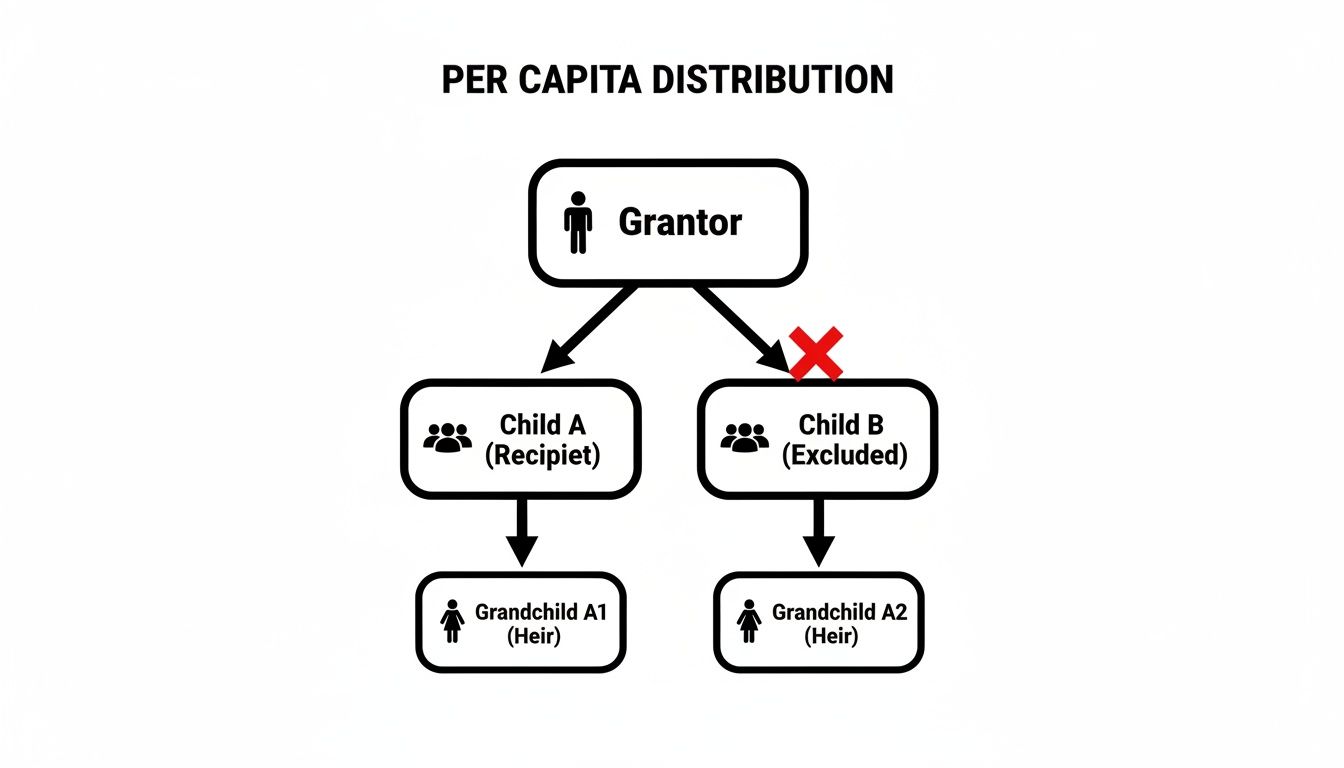
As you can see, the per capita method only considers the living heirs at the same generational level. This can, often unintentionally, disinherit grandchildren whose parent has passed away.
A Side-by-Side Financial Breakdown
Let's return to our example of Maria, a San Antonio resident with a $1,200,000 estate. She has three children: David, Sarah, and Michael. Tragically, Sarah has passed away, leaving behind her two children, Emily and James.
We'll now put the two distribution methods side-by-side to show the exact dollar amounts each family member would receive. The difference is stark and immediate.
Seeing the numbers makes the decision personal. It’s no longer about legal definitions; it’s about the legacy you leave for each branch of your family and the financial stability you provide for your grandchildren.
Distribution Scenario for a $1,200,000 Estate
This table clearly lays out how Maria's estate is divided among her children and grandchildren under both methods. Pay close attention to how Sarah's children, Emily and James, are treated completely differently depending on Maria's choice.
| Heir | Relationship to Grantor | Inheritance Under Per Stirpes | Inheritance Under Per Capita |
|---|---|---|---|
| David | Surviving Child | $400,000 | $600,000 |
| Michael | Surviving Child | $400,000 | $600,000 |
| Emily | Grandchild (from deceased child Sarah) | $200,000 | $0 |
| James | Grandchild (from deceased child Sarah) | $200,000 | $0 |
| Total Distributed | $1,200,000 | $1,200,000 |
This comparison gets right to the heart of the matter: per stirpes protects the generational line, ensuring a deceased child's share passes to their kids. In contrast, per capita rewards only the living children, completely cutting out the children of the deceased child.
Many Texas families are surprised to learn that assets like retirement accounts and life insurance policies—often thought of as non-probate assets—can also be affected by these beneficiary designations.
Impact on Larger Estates and Family Businesses
With more complex assets, like a family business, the financial stakes get even higher. Picture a Dallas family business where three adult children—Sam, John, and Laura—are set to inherit 1,500 shares of stock worth $15 million.
If the estate plan uses per stirpes, each child's branch gets 500 shares. If Sam has predeceased the parents, his share would pass down to his children. But if a per capita distribution is used and Sam has passed, his share is simply divided between the surviving siblings, John and Laura, potentially diluting the control and ownership intended for Sam's branch of the family.
This is why your choice between per stirpes vs. per capita is far more than a minor detail in your will; it's a foundational decision that will shape your family's financial future for generations. It’s a choice that demands careful thought and compassionate legal guidance. The emotional and financial weight of these decisions is significant, and you don’t have to carry it alone.
How Texas Law Interprets Your Will
When you're putting together an estate plan, the words you choose have immense power. If your will is unclear or doesn't specify a distribution method like per stirpes vs per capita, a Texas probate court must step in and interpret your intentions. Unfortunately, this is often the moment when family disputes ignite, leading to costly and emotionally draining litigation.
To make sure your wishes are truly honored, it’s essential to understand the legal backdrop here in Texas. The state has default rules for what happens when someone dies without a will—a status known as being intestate. These rules show a clear preference in Texas law.
The Default Rule: Texas Intestacy Laws
If you pass away without a will, Texas law doesn’t leave your asset distribution to chance. The Texas Estates Code, Title 3, Subtitle G, sets up a clear hierarchy for inheritance, creating a system that functions very much like a per stirpes distribution.
This default system is designed to keep shares within family branches. It ensures that if one of your children passes away before you, their portion of the estate goes directly to their own children (your grandchildren). That share isn't just absorbed and redistributed among your other surviving children.
This legal preference highlights just how important precision is in your own estate planning documents. If your goal is to protect each branch of your family, mirroring this established principle in your will adds a strong layer of legal reinforcement. It makes your wishes far less likely to be challenged in a Harris County or Bexar County probate court. You can learn more about the specifics by reviewing the Texas Estates Code.
Ambiguity Can Lead to Unintended Consequences
Ambiguous language in a will or trust is one of the biggest drivers of family conflict during probate. Without a clear designation, surviving family members can easily have different ideas about what you intended. This confusion can quickly escalate into legal battles that fracture relationships and drain the very assets you wanted to pass on.
For Texas families, the stakes are high. Unclear beneficiary designations can cause significant assets to be redirected in unintended ways. An estate plan that aligns with Texas intestacy law, such as by using a per stirpes designation, provides a crucial safeguard against these outcomes.
The goal of a well-drafted will is to remove all doubt. Precise legal language acts as your voice in the probate court, clearly directing the distribution of your assets and preventing judges or grieving family members from having to guess your wishes.
Working with an experienced estate planning attorney is the most effective way to prevent these painful outcomes. A legal professional can help you draft a will or trust with clear, legally sound language that stands up to scrutiny in any Texas court, ensuring your legacy is protected exactly as you envision.
The decisions surrounding your legacy are deeply personal and can feel overwhelming. You do not have to navigate this complex process alone. Schedule a free consultation with The Law Office of Bryan Fagan to receive personalized guidance and create an estate plan that provides clarity and peace of mind for you and your loved ones.
Deciding Between Per Stirpes and Per Capita for Your Family
Choosing between per stirpes vs. per capita isn't just a legal technicality; it’s a deeply personal decision that shapes your legacy. There's no one-size-fits-all answer. The right choice aligns your estate plan with your family's unique structure and your personal values, ensuring your final wishes are carried out exactly as you intended.
For many Texas families, especially those spanning multiple generations, per stirpes offers a straightforward sense of fairness and continuity. It's designed to honor each branch of your family tree, which is a powerful way to prevent the unintentional disinheritance of your grandchildren if one of your children passes away before you. This approach is particularly important in blended families or any situation where securing a financial future for specific family lines is a priority.
Recommendations for Common Family Situations
Thinking through your family’s specific dynamics is the key to getting this right. Here are a few common scenarios that might help guide your decision:
- You Have Grandchildren: If making sure your grandchildren receive the share their parent would have inherited is your top priority, per stirpes is almost always the best path forward.
- You Have a Blended Family: Precision is everything for blended families. Using a per stirpes distribution helps you clearly direct assets to your children and their own descendants, which can head off a lot of confusion and potential conflict during probate.
- A Beneficiary Has Special Needs: If a grandchild or another descendant requires long-term care, a per stirpes distribution can be directed into a special needs trust. This is a crucial strategy for providing lifelong financial support without jeopardizing their eligibility for government benefits.
Your estate plan is more than just a legal document—it's your final message to the people you love. Choosing the right distribution method ensures that message is one of fairness, care, and thoughtful planning, preventing conflict long after you are gone.
These decisions can feel heavy, and you don’t have to make them alone. The legal and emotional complexities of estate planning and the probate process are best navigated with compassionate, professional guidance. An experienced attorney can walk you through these choices, making sure your will is not only legally sound but also a perfect reflection of your wishes.
Our firm is committed to helping Texas families protect their legacies with clarity and confidence. To build a personalized estate plan that brings you and your loved ones lasting peace of mind, schedule a free consultation with The Law Office of Bryan Fagan today.
Frequently Asked Questions About Estate Distribution
Navigating the details of an estate plan naturally brings up many questions. The choices you make between per stirpes vs per capita can echo for generations, so it’s completely normal to want clarity before making a final decision.
Here are straightforward answers to questions we often hear from Texas families. Consider this a starting point for a deeper conversation with your family and your attorney, as every situation has unique aspects.
What Happens If My Will Doesn't Specify Per Stirpes Or Per Capita?
This is an excellent and important question. If your will is silent or ambiguous on how assets should be divided, Texas law provides a default. Under the Texas Estates Code, Title 3, Subtitle G, the state’s intestacy rules (the laws for when someone dies without a will) apply, and they operate very much like a per stirpes distribution.
This means a deceased child's share would automatically flow down to their children (your grandchildren). However, relying on a legal default is risky. It can open the door to family disputes and court interpretations, which is the last thing you want. Always state your preference explicitly to avoid potential legal challenges.
Can I Use Different Methods For Different Assets?
Yes, you can, and this can be a very strategic move. A well-crafted estate plan allows for this kind of detailed customization.
For instance, you might want your family home and certain heirlooms to be distributed per stirpes to ensure they stay within direct family lines. At the same time, you could decide that a brokerage account should be distributed per capita among only your surviving children. This flexibility lets you match your goals to specific assets, but it demands extremely precise language in your will or trust to be effective.
Does Per Stirpes Vs Per Capita Affect Beneficiary Designations On Life Insurance?
Absolutely, and this is a critical point that many people overlook. These designations matter immensely for non-probate assets like life insurance policies, IRAs, and 401(k)s. When you fill out those beneficiary forms, you’ll often see a checkbox or an option to select either per stirpes or per capita.
Say you name your children as primary beneficiaries and one of them passes away before you. Your choice right here on this form dictates what happens to their share. A per stirpes designation ensures their portion goes to their kids. A per capita choice, however, would redirect that money to your surviving children, which could unintentionally disinherit your grandchildren from that asset. Reviewing these forms is a crucial part of any comprehensive Estate Planning.
Making these decisions can feel heavy, but you don't have to figure it all out on your own. The right legal guidance can bring clarity and peace of mind, ensuring your family is protected exactly the way you intend.
At The Law Office of Bryan Fagan, we know the emotional and legal weight Texas families carry when planning for the future. We are here to offer compassionate, clear guidance through every step of the Probate and estate planning process. Schedule a free, no-obligation consultation today to discuss your family’s unique needs and create a plan that secures your legacy. Visit us at https://texasguardianshiplawyer.net to get started.