Skip to content
When you're caring for a loved one, especially in a temporary situation, a guardianship sample letter can feel like a quick, common-sense fix. Many Texas families use these letters to give a grandparent or other trusted adult the authority to enroll a child in school or approve medical care when parents are unavailable. We understand the emotional and practical challenges you're facing. While these letters can be useful for short-term needs, it's critical to understand their legal limitations here in Texas to ensure your loved one is fully protected.
Understanding Guardianship Letters in Texas
Navigating the logistics of family caregiving is tough enough without legal confusion. You might find yourself needing to make critical decisions for a child who isn't yours or an adult family member who can no longer handle their own affairs. This is where the idea of a "guardianship letter" usually comes up, but it's vital to know the difference between an informal letter you write yourself and a formal, court-ordered guardianship. They are not the same thing.
An informal guardianship letter is a document signed by a parent or legal guardian that temporarily gives another adult specific decision-making powers. Think of a grandparent in Harris County needing to take their grandchild to the doctor while the parents are deployed. This kind of letter can often bridge that gap for temporary situations.
The Power and Limits of an Informal Letter
An informal letter is essentially a permission slip. It outlines the care arrangement and typically includes a few key elements to make sure institutions like schools or doctor's offices will accept it:
- Who’s Involved: Full names and contact information for the parents, the child, and the temporary caregiver.
- What They Can Do: A clear list of specific powers, like the authority to make educational or routine medical decisions.
- How Long It Lasts: A specific start and end date for the arrangement.
While these letters are practical for short-term needs, they are not a substitute for the real legal authority granted by a Texas probate court under the Texas Estates Code, Title 3, Subtitle G. An informal letter is just a request for cooperation; it doesn’t grant the caregiver the full legal rights of a guardian. For instance, you can't use it to manage a child’s inheritance or make major, long-term financial choices.
When a Court Order is Necessary
True legal guardianship is established only through a formal court process. This process appoints an individual (the guardian) with the legal authority to care for another person (the "ward"). This is often necessary for long-term care, especially in cases of adult incapacity or when a minor needs permanent placement outside the parental home.
The official court document that establishes this relationship is what's actually called the "Letters of Guardianship." These are recognized statewide and provide undeniable proof of your authority to act on the ward's behalf.
Key Takeaway: A simple, notarized letter can solve many short-term problems. But for long-term care, significant financial decisions, or situations involving incapacity, a formal court-ordered guardianship is the only way to get full legal protection for both you and your loved one.
To help clarify the differences, here’s a straightforward comparison of what an informal letter can do versus a formal court order.
Guardianship Letters vs Court Orders in Texas
| Feature | Guardianship Letter (Informal) | Court-Ordered Guardianship (Formal) |
|---|---|---|
| Legal Authority | A notarized request; not legally binding on all parties. | A legally binding court order recognized statewide. |
| Scope | Limited to specific, temporary powers (e.g., school enrollment, routine medical care). | Broad authority over personal, medical, and/or financial decisions as defined by the court. |
| Duration | Temporary, with a defined start and end date. | Long-term or permanent, subject to court review. |
| Creation Process | Simple to draft and notarize; no court involvement needed. | Requires a formal court process, including filing petitions, hearings, and legal representation. |
| Best For | Short-term situations like parental travel, deployment, or temporary medical issues. | Long-term care for minors or incapacitated adults, managing significant assets, and complex medical decisions. |
| Financial Decisions | Not suitable for managing finances, property, or inheritance. | Grants full authority to manage the ward's estate, pay bills, and handle investments. |
Understanding these distinctions is the first step in protecting your family and making sure you have the right legal tools for the job. Recognizing when a simple letter is enough—and when you need the full power of the court behind you—can save you from significant headaches down the road.
If you're unsure which path is right for your situation, we are here to help. Schedule a free consultation with The Law Office of Bryan Fagan to discuss your family's needs with clarity and compassion.
Crafting an Effective Texas Guardianship Letter

Writing a guardianship letter can feel overwhelming, especially when you're already worried about a loved one's well-being. Your goal is to create a document that's crystal clear and leaves zero room for confusion. Think of it less as a formal legal document and more as a detailed instruction manual for the temporary caregiver and any institution—like a school or hospital—that will need to rely on it.
The tone should be compassionate but professional. You are placing an immense amount of trust in someone, and the letter needs to reflect the seriousness of that responsibility. Ultimately, this document has to be practical and precise to do its job.
To make this happen, you need to use direct, unambiguous language. Vague wording can lead to misinterpretations, delays, and a mountain of frustration right when you can least afford it. While you don't need a law degree to draft a simple letter, understanding the basics of clear legal writing ensures your intentions are perfectly understood by everyone who reads it.
Essential Components of Your Letter
Every solid guardianship letter, whether for a child with special needs or an elderly parent in Bexar County, is built on the same foundation. Getting these core components right is the key to creating a document that institutions will recognize and respect.
- Identifying Information: Start with the basics. List the full legal names, current addresses, and contact numbers for everyone involved: the parents or legal guardians, the child or incapacitated person (the "ward"), and the person you're appointing as the temporary guardian.
- A Clear Statement of Intent: Get straight to the point. The very first sentence should state the letter's purpose directly. For example: "We, [Parent's Name] and [Parent's Name], hereby grant temporary guardianship of our child, [Child's Name], to [Guardian's Name]."
- Specific Powers Granted: This is the most crucial part of the letter. Avoid general phrases. Instead of saying something broad like "to take care of my mother," you need to list the exact powers you are authorizing.
Think in concrete terms. You might specify the power to "consent to routine and emergency medical treatment," "enroll the child in school and sign educational forms," or "access medical records." The more detailed you are here, the better.
A well-drafted letter acts as a shield, protecting both the caregiver and your loved one. Specificity prevents others from overstepping their authority and ensures the caregiver has the clear power to act when needed.
Duration and Notarization: Your Keys to Validity
Two final elements transform your letter from a simple note into a more formal and authoritative document: the duration and the signature. Don't skip these.
Defining the Timeframe
Your letter absolutely must include a precise duration for the guardianship. An open-ended letter is a major red flag for most institutions and is likely to be rejected. Always state a specific start date and a clear end date.
For instance: "This temporary guardianship will begin on October 1, 2024, and will end on March 31, 2025." This clarity protects everyone and sets firm expectations right from the start.
The Importance of a Notary Public
Finally, the letter must be signed by the parents or legal guardians in the presence of a Notary Public. Notarization is the official process that verifies your identity and confirms you signed the document willingly.
A notarized letter carries significant weight. It tells a school administrator in Dallas or a doctor in Travis County that the document is authentic and can be trusted. Without that notary's seal, your letter is far more likely to be questioned or flat-out rejected, which could cause a crisis just when you need the caregiver to be able to act.
As you consider these details, you might find it helpful to understand the broader context. You can learn more about how to prepare for a guardianship hearing in Texas in our detailed guide.
Guardianship Sample Letter Templates for Texas Families

To help you move from theory to practice, we've put together a few sample guardianship letters. These templates are based on the real-world situations we see Texas families navigate every day, giving you a solid, reliable place to start. We've added notes to explain why certain phrases and details are so critical.
Think of these as your foundation. No two families are exactly alike, so you'll need to tailor the details to fit your specific circumstances. The whole point is to create a document that's crystal clear to the caregiver and immediately accepted by schools, hospitals, or government offices.
Letter for Temporary Guardianship of a Minor
This is probably the most common need we come across. A temporary guardianship letter for a child is an incredibly practical tool for parents who need to be away—whether for work, military deployment, or other short-term reasons.
Real-World Scenario: Mark and Sarah have a three-week international work assignment. They're leaving their 10-year-old son, Leo, with his grandmother, Susan. They need to make sure Susan can handle everything from a parent-teacher meeting to a sudden medical issue without any roadblocks.
Sample Letter: Temporary Authorization for Care of a Minor
[Date]
To Whom It May Concern,
We, Mark Thompson and Sarah Thompson, residing at [Your Full Address], are the legal parents of Leo Thompson (Date of Birth: [Child's DOB]).
We hereby grant temporary guardianship authority to his grandmother, Susan Gable, residing at [Grandmother's Full Address], from [Start Date] to [End Date].
During this period, Susan Gable is authorized to:
- Make all educational decisions for Leo, including signing school forms and communicating with administrators at [School Name] in [City, Texas].
- Consent to any routine and emergency medical or dental care, treatment, and hospitalization for Leo.
- Access Leo's medical and educational records as needed.
A copy of our driver's licenses and Leo's birth certificate are attached. We can be reached at [Your International Contact Number].
Sincerely,
Mark Thompson
Sarah Thompson
Notary Public Section:
State of Texas
County of [County Name]
Sworn to and subscribed before me on this ____ day of ______, 20.
Notary Public
Legal Insight: The key here is specificity. You'll notice we listed "educational decisions" and "medical or dental care" explicitly. This leaves no room for misinterpretation. Attaching ID copies and getting the letter notarized makes it much harder for an institution to reject it.
Letter to a School District
Schools often have rigid rules about who can enroll a child or even look at their report card. A straightforward, notarized letter can cut through the red tape and prevent frustrating headaches for the caregiver.
Real-World Scenario: A single mom in Dallas ISD landed a new job that requires her to travel constantly for the next six months. Her brother, David, is stepping in as the main caregiver for her 8-year-old daughter, Emily. He needs the authority to attend parent-teacher conferences and sign field trip permission slips.
Sample Letter: Authorization for Educational Decisions
[Date]
To the Administration of [School Name],
Dallas Independent School District
This letter is to inform you that I, [Parent's Full Name], residing at [Your Address], am the legal guardian of Emily [Last Name] (DOB: [Child's DOB]), a student at your school.
From [Start Date] to [End Date], I authorize my brother, David [Last Name], residing at [Brother's Address], to make all necessary educational decisions on Emily's behalf. This authority includes, but is not limited to:
- Attending parent-teacher conferences.
- Signing permission slips for school activities.
- Receiving and responding to all school communications.
- Accessing Emily's academic and attendance records.
Please add David [Last Name] as an authorized contact for Emily. He can be reached at [Brother's Phone Number].
Thank you for your cooperation.
Sincerely,
[Parent's Full Name]
Notary Public Section:
State of Texas
County of Dallas
Sworn to and subscribed before me on this ____ day of ______, 20.
Notary Public
Letter for Medical Consent for an Adult
When you're caring for an adult who can't speak for themselves, having clear authority to talk to doctors is absolutely critical. This kind of letter can act as a temporary fix until a formal Guardianship or a Medical Power of Attorney is officially in place.
Real-World Scenario: An elderly father in Harris County suffers a stroke and is temporarily unable to communicate. His son lives just a few miles away and needs to discuss his dad's condition and treatment plan with the hospital staff right away.
Sample Letter: Authorization for Medical Consent and Information
[Date]
To the Medical Staff at [Hospital/Clinic Name],
I, [Patient's Full Name], residing at [Patient's Address], hereby authorize my son, [Son's Full Name], to act on my behalf in all matters related to my medical care.
This authorization grants him the power to:
- Access all my medical records and health information (HIPAA release).
- Discuss my diagnosis, prognosis, and treatment options with all physicians and medical staff.
- Provide consent for medical procedures and treatments recommended by my attending physician.
This authorization is effective immediately and will remain in effect until I revoke it in writing.
[Patient's Signature, if able]
[Witness Signature]
Important Note: In situations involving incapacity, a letter like this is often just a stopgap measure. The most legally sound solution is a formal Medical Power of Attorney, which should be part of a well-thought-out Estate Planning strategy. For those who want to understand how binding legal documents are structured, reviewing a legal retainer agreement template can offer some helpful perspective.
Letter of Intent for a Formal Court Application
When a simple authorization letter won't cut it, you have to petition the court. While it isn't a mandatory step, drafting a letter of intent can be a great way to organize your thoughts and present a clear, concise case to your attorney and, eventually, the judge.
Real-World Scenario: A family has come to the difficult realization that their mother's dementia has advanced to a point where she can no longer manage her finances or personal care safely. They've decided to seek formal guardianship through the Tarrant County Probate Court.
Sample Letter: Declaration of Intent to File for Guardianship
[Date]
To the Honorable Judge of the Probate Court of Tarrant County, Texas,
I, [Your Full Name], am writing to declare my intent to file an Application for Appointment of Permanent Guardian for my mother, [Mother's Full Name], the Proposed Ward.
My mother suffers from advanced dementia and is no longer able to manage her financial affairs or make sound decisions regarding her personal care and medical needs, as required under the Texas Estates Code, Title 3. A physician's certificate confirming her incapacity will be submitted with the formal application.
It is my sincere belief that appointing a guardian is in her best interest to protect her from exploitation and ensure her needs are met. I am prepared to fulfill all fiduciary duties required of a guardian.
Respectfully,
[Your Full Name]
These templates are meant to provide a solid framework, but your family's situation deserves personal attention. To make sure your documents are legally sound and perfectly tailored to your needs, contact The Law Office of Bryan Fagan for a free consultation.
Common Mistakes to Avoid With Guardianship Letters
When you're stepping up to protect a loved one, the last thing you want is a simple paperwork mistake creating a major roadblock. A guardianship letter can feel straightforward, but we've seen a few common errors render them completely ineffective, causing stress right when a smooth process is needed most.
At The Law Office of Bryan Fagan, we've helped countless Texas families navigate these documents. Understanding these potential pitfalls ahead of time is the best way to make sure your letter actually works.
The Dangers of Using Vague Language
The single biggest mistake we see? Using fuzzy, imprecise language. Families write these letters with the best intentions, using phrases like "to take care of my child" or "to handle my mother's affairs." While the sentiment makes perfect sense to you, those statements are legally vague and wide open to interpretation.
A school administrator in Travis County or a doctor at a Houston hospital needs explicit, undeniable authority to act. Vague terms create liability concerns for them, which makes them hesitate—or just refuse—to honor your letter.
Here’s how to get it right:
- Instead of: "Authorize medical care."
- Use: "Authorize any routine and emergency medical, dental, and psychological treatment."
- Instead of: "Handle school matters."
- Use: "Enroll the child in school, sign permission slips, access academic records, and attend parent-teacher conferences."
Specificity is your best friend here. A well-worded guardianship sample letter leaves zero doubt about the powers you are granting.
Forgetting to Notarize Your Signature
A signature on a piece of paper is just that—a signature. But a signature witnessed and sealed by a Notary Public becomes a verified legal act. Failing to notarize your guardianship letter is a critical error that severely weakens its authority.
Notarization is the official proof that you are who you say you are and that you signed the document of your own free will. For institutions that have to follow strict rules, a notary's seal is non-negotiable. It gives them the confidence they need to rely on your letter without fearing legal repercussions.
Consider this real-world scenario: A family drafted a perfect letter giving a grandparent authority to care for their child during a military deployment. But they never got it notarized. When the child had an unexpected allergic reaction, the emergency room initially hesitated to treat him because they couldn't verify the letter's authenticity. That preventable delay caused immense stress during an already terrifying crisis.
Misunderstanding the Letter's Legal Power
It is absolutely vital to remember that an informal guardianship letter is not a court order. It's a formal request—a powerful permission slip—but it doesn't carry the same legal weight as official "Letters of Guardianship" issued by a Texas probate court.
This misunderstanding can lead to serious problems. An informal letter simply cannot be used to:
- Manage a loved one's inheritance or large financial accounts.
- Sell real estate or other significant property on their behalf.
- Make long-term decisions if the person is legally incapacitated.
- Resolve disputes between family members over care.
These actions fall squarely under the authority granted by a court in a formal guardianship proceeding, as laid out in the Texas Estates Code, Title 3. Believing a simple letter can do the job of a court order can put your loved one's assets and overall well-being at serious risk.
Avoiding these common pitfalls can make all the difference. By being specific, getting your letter notarized, and understanding its limitations, you empower your designated caregiver to act confidently and effectively when it matters most.
If your situation involves complex medical needs, financial assets, or the possibility of a long-term arrangement, it’s time to seek professional guidance. Schedule a free consultation with The Law Office of Bryan Fagan to ensure your loved one has the full legal protection they deserve.
When a Letter Is Not Enough in Texas
While a well-drafted guardianship letter is a fantastic tool for temporary situations, it has hard legal limits. Knowing when to move from an informal letter to a formal, court-ordered guardianship is one of the most critical decisions you can make to protect your loved one. We know this step can feel overwhelming, but it's essential when the need for help becomes long-term or legally complex.
A formal guardianship becomes necessary when a simple letter can't provide the legal authority needed to fully protect a person's well-being or financial interests. These are the moments you need the full weight and authority of a Texas probate court to provide complete protection.
Red Flags That Signal the Need for a Formal Guardianship
If you find yourself in any of the following situations, it's a strong sign that a letter won't cut it anymore. These scenarios demand the solid legal framework laid out in the Texas Estates Code, Title 3, Subtitle G, to make sure every decision is legally sound and enforceable.
- Managing an Inheritance or Significant Assets: A letter gives you zero authority to manage a minor's inheritance or an incapacitated adult's finances. If your loved one needs help with banking, selling property, or handling investments, only a court-appointed guardian of the estate has that power.
- Long-Term Incapacity: When an adult's cognitive decline from something like dementia or a severe injury becomes a long-term reality, temporary fixes are not enough. A formal guardianship provides the durable, ongoing authority needed for medical and personal care decisions.
- Resolving Family Disputes: If family members can't agree on who should be the caregiver or what medical treatments are best, a guardianship dispute may arise. A judge will need to get involved to appoint a guardian who will act in the proposed ward's best interest, putting an end to the conflict with a legally binding decision.
- Need for Emergency or Temporary Guardianship: In a crisis, such as a sudden medical event where an adult is left incapacitated with no power of attorney, you may need a court to quickly grant temporary guardianship. This provides immediate legal authority to make critical decisions while a permanent solution is determined.
Taking the First Steps in the Formal Process
Acknowledging that you need the court's help is a big emotional step. The legal process is designed to be thorough to protect the person in need, and it all starts with a few key actions.
First, you must file an Application for Appointment of Guardian with the correct probate court, which is usually in the county where the proposed ward lives, such as the Harris County Probate Court. This application lays out exactly why a guardianship is necessary.
Next, you’ll need a physician's certificate. This is a critical piece of evidence. It's a formal assessment from a doctor confirming the person's physical and mental condition, stating why they are incapacitated and need a guardian.
Making the decision to pursue a formal guardianship is an act of profound care. It’s about ensuring your loved one receives stable, legally recognized protection for the long haul, safeguarding their dignity and well-being.
Navigating this transition—from a temporary letter to a permanent legal solution—is where professional guidance becomes essential. The process involves precise legal standards and court procedures that are tough to manage on your own. Our guide on how to apply for legal guardianship provides more detail on what to expect.
If you believe your situation requires more than just a letter, you are not alone. The Law Office of Bryan Fagan is here to provide the compassionate and experienced legal support your family deserves. Schedule a free, confidential consultation with us today to discuss your next steps.
Answering Your Guardianship Letter Questions
Even after you've drafted a guardianship letter, it's natural to have lingering questions. We get it—these are big decisions with a lot of emotional weight behind them. Our goal is to give you the clear, direct answers you need to feel confident moving forward. Here are some of the most common questions Texas families ask us.
Does a Notarized Guardianship Letter Expire in Texas?
Yes, absolutely. A critical part of any effective guardianship sample letter is a clearly defined timeline. You must include a specific start date and, just as importantly, an end date.
Any letter that's open-ended is a huge red flag for schools or doctors, and they will almost certainly reject it. The letter's authority officially expires on the end date you write into the document.
Can This Letter Be Used for Government Benefits?
Generally, the answer is no. Government agencies like the Social Security Administration or Veterans Affairs have incredibly strict rules for who can manage someone else's benefits. An informal, notarized letter simply doesn't grant the kind of legal authority they require to name a representative payee. Handling government benefits almost always requires a formal, court-ordered appointment.
This decision tree helps visualize when a simple letter just won't cut it, and you'll need to involve the court.
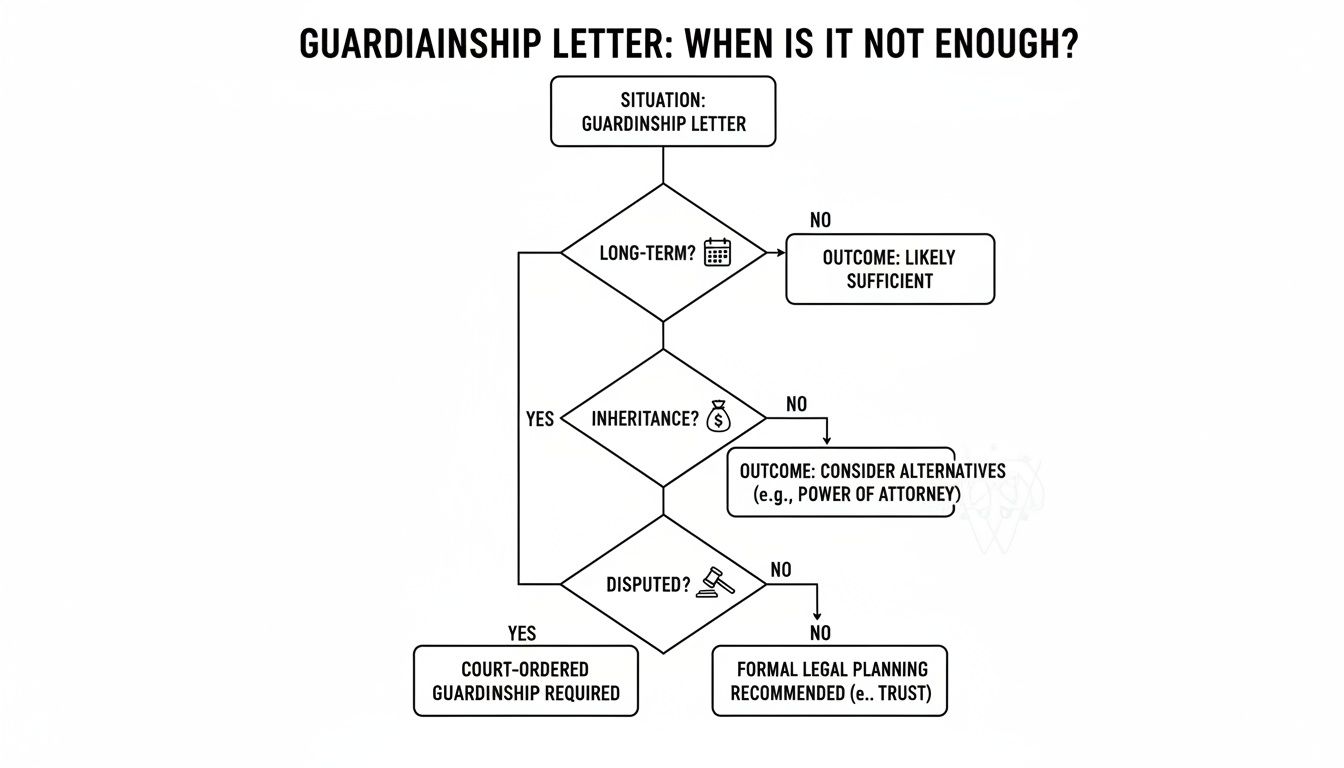
As you can see, the moment you're dealing with long-term care, financial assets like an inheritance, or disagreements among family members, you've crossed the line into territory that demands a more robust legal solution than an informal letter can provide.
What Should I Do if a School Refuses My Letter?
If a school, doctor's office, or another institution pushes back on your letter, the first step is to stay calm. Politely ask them to explain exactly why they are refusing it.
- Is it missing a notary seal?
- Is some of the language too vague for their policies?
- Do they require you to fill out their own specific form instead?
Often, it's an issue you can fix by simply correcting the document. But if they dig in their heels and refuse to cooperate, take it as a sign. This situation likely requires the undeniable authority that only a court-ordered Guardianship can provide.
How Is a Guardianship Letter Different From a Power of Attorney?
This is a really important distinction to understand. A Power of Attorney (POA) is a legal document that a competent adult—the "principal"—creates to give another person—the "agent"—the authority to act for them. The key here is that the principal must have the mental capacity to understand and sign the document. A POA is a key tool in planning for potential future incapacity and is a powerful alternative to guardianship.
A guardianship, on the other hand, is a process imposed by a court for someone who has already been determined by a judge to be incapacitated and unable to make their own decisions. A simple letter is just an informal request. A POA and a formal guardianship are legally binding instruments created under entirely different circumstances. Getting this right is a central piece of proper Estate Planning.
We know that every family's situation is unique, and these general answers may not fully address your specific concerns. The path of caring for a loved one is complex, but you don't have to walk it alone.
The legal system can be tough to navigate on your own. For personalized guidance tailored to your family’s specific needs, contact The Law Office of Bryan Fagan, PLLC to schedule a free, compassionate consultation. Let us help you find the clarity and protection your loved one deserves. You can learn more at https://texasguardianshiplawyer.net.