Skip to content
A ward in guardianship is a person, either a minor or an incapacitated adult, who a Texas court has appointed a guardian to protect. That legal status matters because it changes who can make certain decisions, but it does not erase the person's dignity, voice, or daily needs.
A family usually reaches this question at a hard moment. Maybe a parent is forgetting bills and medication, or a child has received money and needs someone to manage it safely. Maybe everyone in the family sees the problem, but nobody agrees on what to do next. Texas guardianship law gives you a formal path forward, and it starts with understanding what ward means in real life.
When You See a Loved One Needs Help
A daughter starts noticing her father leaving the stove on and missing doctor appointments. Her brother says Dad is just stressed. Her mother says he needs help with money, but she worries that guardianship sounds too harsh. That tension is common, and it's exactly where the term ward begins to matter.
In Texas, a loved one does not become a ward just because the family is worried. The title attaches only after a court appoints a guardian, which is why the legal status is so important. The court is not merely labeling someone vulnerable. It is creating a protected relationship with real duties and oversight.
That can feel unsettling at first. Many families hear the word “ward” and think it means total loss of control. It doesn't have to mean that. In many cases, it means the court is stepping in so the person can get help with the parts of life they can no longer manage safely.
A good guardianship case starts with one question, what does the person still do well, and where do they need support?
For Texas families, that question is often the first step toward a calmer plan. A court can look at a parent's medical care, housing, finances, or daily safety and decide what level of protection makes sense. If you're trying to understand what is a ward in guardianship, the short answer is this, it is the person the court has placed under a guardian's legal protection.
That protection can be broad or narrow. It depends on the person's needs, the evidence, and the court order. For help understanding how Texas guardianship works in practice, many families also review what a court-appointed guardian does and the Texas guardianship lawyer page for representation in guardianship of the person and estate under the Estates Code, Texas Guardianship Lawyer.
Understanding the Role of a Ward in Texas Law
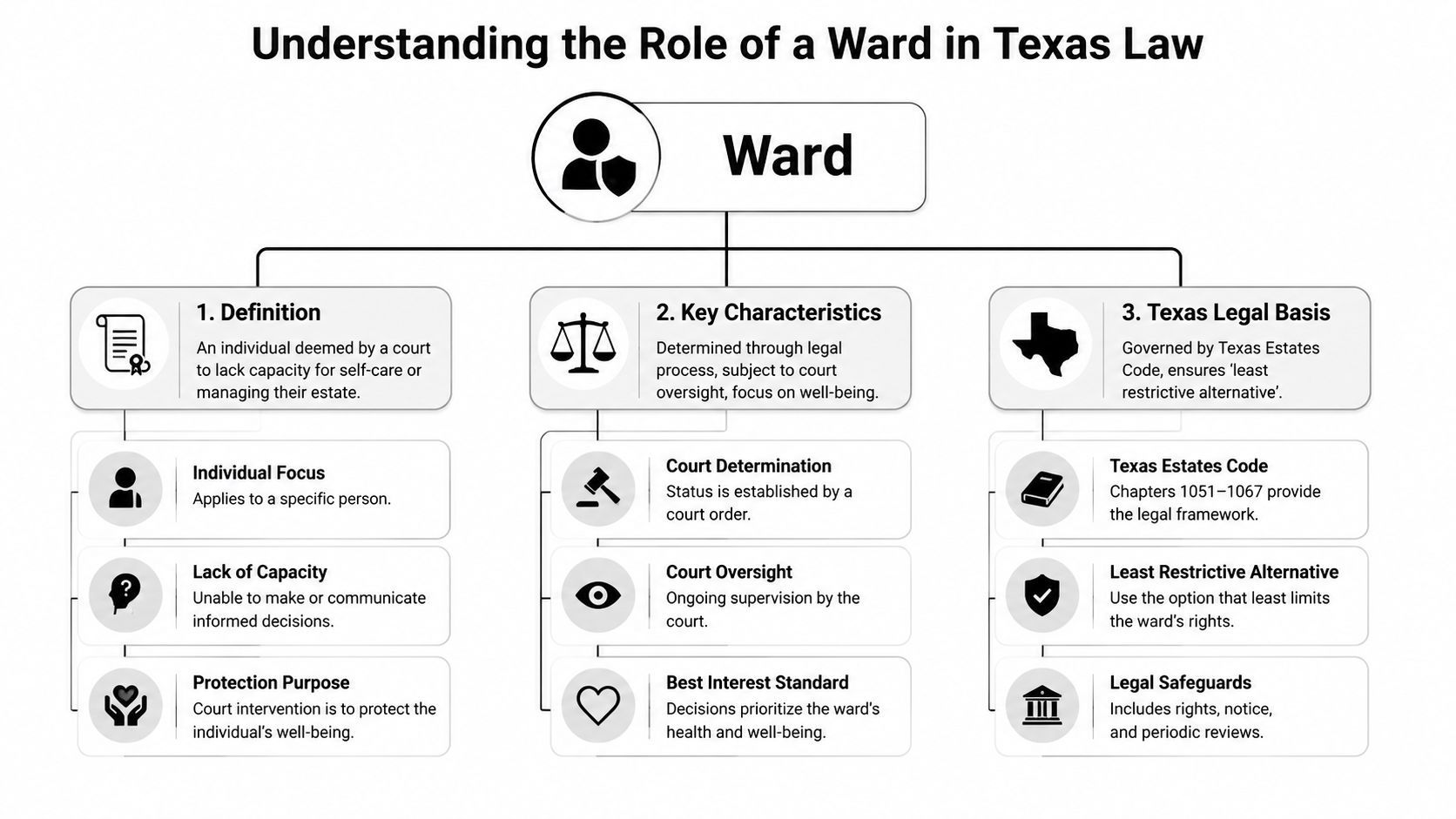
In Texas, a ward is “a person for whom a guardian has been appointed,” so the label comes from a court order, not from age, diagnosis, or family concern alone. That distinction matters because a person may need help without yet being under guardianship, while a ward is someone the court has already placed within a legal protection structure. The court creates that status, and the status brings both authority and oversight. Texas Estates Code definition of ward
Who can be a ward
A ward is often a minor or an incapacitated adult. A child may need a guardian if parents cannot care for the child, and an adult may need a guardian if a court finds the person cannot safely handle health care, finances, or daily living decisions. In both settings, the court's goal is protection, not punishment.
That role can arise in different family situations. A child with a settlement may need someone to manage property, while an older adult living with dementia may need help with medical care and money matters. The facts are different, but the legal result is the same, the court has decided a guardian is needed.
Why the term matters
The word ward identifies the person the guardian must answer for. It also shows that the court remains involved. Texas guardianship law requires the guardian to report to the court and follow its orders, so this is not just an informal family arrangement.
A simple way to separate the roles is this, the ward is the person under the court's protection, and the guardian is the person given court-approved authority to act. Those roles are separate, and families often blur them because the word “ward” gets used casually. In the legal setting, the term has a narrower meaning.
The broader guardianship framework in Texas follows the same idea, and courts in other states describe the role in a similar way. For a practical explanation of how courts view the ward's remaining decision-making ability, see this overview of guardianship basics and what a court-appointed guardian does.
Two Key Types of Guardianship for a Ward
A ward does not always lose every decision-making right at once. Modern guardianship can separate authority by subject matter, so one person may help with medical and housing choices while another manages money and property. That is why families need to understand the difference between the person and the estate.
| Area of Responsibility | Guardianship of the Person | Guardianship of the Estate |
|---|---|---|
| Daily care | Helps with living arrangements and personal support | Usually does not control daily care |
| Medical decisions | Often involved in treatment and care choices | Usually does not handle medical decisions |
| Finances | Usually does not manage money | Manages bills, property, and assets |
| Court focus | Personal safety and well-being | Financial protection and asset management |
Mary's example
Take Mary, an older adult who has trouble remembering medications and falls behind on rent payments. Her guardian of the person might help choose a safe living arrangement and talk with doctors. Her guardian of the estate might pay bills, protect her bank account, and manage property.
That division matters because Mary may still be able to choose some things for herself. She might still pick her clothes, express where she wants to live, or tell the court what matters to her. Guardianship should fit the person's actual needs, not just a label.
Why the split helps families
A family sometimes thinks guardianship has to be all or nothing. It doesn't. The court can tailor authority to the scope of incapacity and the order it enters. That makes the ward's legal status decision-specific rather than automatic across every part of life.
Practical rule: if your loved one can still make some choices, ask whether the court can limit the guardian's authority instead of taking every right away.
That idea also helps reduce conflict. A limited order can preserve more independence while still protecting the person from harm. Families trying to compare the two roles often benefit from reading about guardian of the person vs. guardian of the estate.
The Protected Rights and Legal Limits of a Ward

A ward is still a person with a life, routines, relationships, and preferences. Texas guardianship is meant to protect that person while preserving as much independence as the court can safely allow. The idea behind the least restrictive alternative is straightforward, the court should choose the level of protection that addresses the problem without taking away more freedom than necessary.
That means a ward may still keep important everyday rights, depending on the order the judge enters. The person may still express preferences, take part in decisions, and have the guardian consider what matters to them. Even when a guardian has legal authority, that authority is not a blank check. The guardian must act in the ward's best interest and remain under court supervision.
What families should keep in mind
The legal limit is about control, but it is also about accountability. A guardian cannot step in and ignore the ward's needs or wishes. The court stays involved so the guardian's authority remains tied to the order and to the ward's actual condition.
Families often ask a practical question, what can a ward still decide for themselves? The answer depends on the court order. Some orders are narrow, and some are broader, but the goal stays the same, protect the person without taking more authority than the law allows. New York court guidance on guardianship basics explains that basic split in a simple way.
The ward's preferences still matter, especially when the guardian is deciding about care, housing, or medical choices.
That balance helps preserve identity. A parent with limited capacity may still enjoy routines, family contact, favorite food choices, or social decisions. Those small choices can matter a great deal in daily life, even when some legal rights have shifted to a guardian.
For Texas families, that balance is one reason guardianship hearings are taken seriously in Harris County Probate Court and other probate courts across the state. The court's role is to protect the person, while avoiding a broader loss of rights than the situation requires. How to file for guardianship in Texas can help families understand the filing side of the process.
The Path to Guardianship in Texas Courts
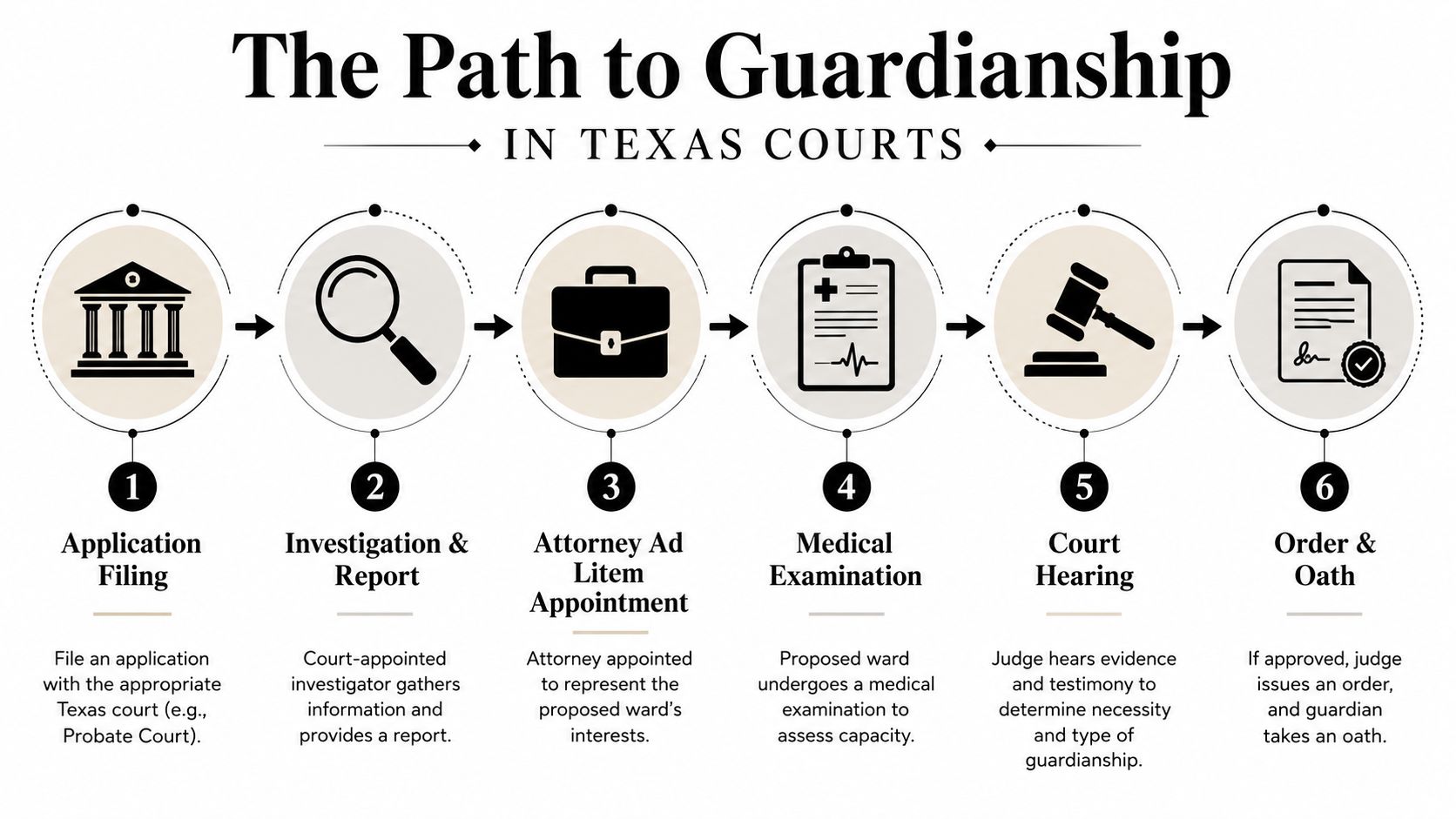
A Texas guardianship case starts with paperwork, but it doesn't end there. The court has to protect the proposed ward before it can appoint a guardian, and that means checking the facts carefully. Families often feel frustrated by the process, but those steps are there to prevent abuse and mistakes. How to file for guardianship in Texas is a useful place to understand the filing stage.
What the court looks for
Under Texas Estates Code Chapter 1101, the judge must find by clear and convincing evidence that the proposed ward is incapacitated, that guardianship is in the person's best interest, that the person's rights or property will be protected, and that alternatives to guardianship and available supports and services were considered and found not feasible. The court also makes additional findings by a preponderance of the evidence on venue, the guardian's eligibility, and whether the ward is totally or partially without capacity. Texas Estates Code Chapter 1101 findings
That means the judge is not guessing. The court wants proof, and it wants to know whether a narrower option would work.
What families can do before the hearing
A family can help by gathering medical records, writing down examples of unsafe behavior, and keeping a clear timeline of what changed. If the case involves a minor, school records and custody information may matter too. If the case involves an adult, a physician's evaluation often becomes a key part of the evidence.
Bring facts, not just fear. The court needs examples of what is happening now, and what risk exists if nothing changes.
Notice also matters. Texas law requires notice in guardianship proceedings to people entitled to receive it, so families should expect that relatives and other interested parties may be involved. That is one reason these cases can feel slow and emotional, especially when siblings disagree. Texas notice requirements in guardianship proceedings
Exploring Alternatives Before Seeking Guardianship
A guardianship case should not be the first answer every time. Texas families often have other tools that can protect a loved one while leaving more independence in place. That is especially important when the person can still make some choices with help.
A Durable Power of Attorney can let a trusted person handle financial matters. A Medical Power of Attorney can authorize someone to make health care decisions if the person cannot. A Supported Decision-Making Agreement can help a person stay involved in decisions while getting practical support. For a broader look at less restrictive options, is guardianship too extreme is a helpful resource.
Families sometimes use out-of-state forms as a reference point, especially when comparing what a medical form does. A plain example is this resource on Medical Power of Attorney Form Maryland, which can help readers understand the concept even if Texas law will control the actual arrangement here.
If the person can still understand choices with support, a less restrictive tool may preserve more dignity than a full guardianship.
That doesn't mean guardianship is never necessary. It means the court should only be asked to remove decision-making rights when the other tools won't work. Texas law reflects that approach, and families usually feel better when they know they explored the lighter option first.
The Law Office of Bryan Fagan, PLLC helps families compare those choices and decide whether guardianship, powers of attorney, or another plan fits the situation. That kind of planning can spare a family from starting with the most extreme option.
Answers to Common Questions from Texas Families
Can a ward still sign documents or make choices? Sometimes, yes, depending on the court order and the type of guardianship. A ward may keep some rights even after the court appoints a guardian, especially if the order is limited. The issue is not the label alone, but rather what the judge took away and what the person still keeps.
What happens if family members disagree about who should serve? Texas law allows a parent to use a will or written declaration to name a preferred guardian for an incapacitated adult child, and the court must give that person preference unless the designee is disqualified. That can reduce conflict, but it doesn't end every dispute. If family members still disagree, the judge will look at the evidence and the person's best interest. Texas designation of guardian by parent
How does the court watch the guardian after appointment? The guardian remains accountable to the court, and the law can require reports, inventories, and continued oversight depending on the type of guardianship. That supervision is one reason guardianship is not a private arrangement. The court stays involved to protect the ward.
What if the person improves? Guardianship can end when the legal basis for it ends, such as when a minor reaches adulthood, the ward dies, or the court terminates the guardianship. In other words, the status is not always permanent. It can change when the facts change.
If you're trying to protect a parent, child, or adult loved one and still preserve as much independence as possible, schedule a free consultation with Law Office of Bryan Fagan, PLLC. We can help you understand whether guardianship, a less restrictive alternative, or a dispute strategy makes sense for your family.