Skip to content
Two sisters sit in a hospital family room in Houston. One believes their mother can still live at home with help. The other wants immediate placement in a memory care facility and plans to file for guardianship in Harris County Probate Court. Both say they're protecting Mom. Both are angry. Both are scared.
That situation is common in Texas guardianship cases. By the time families call a lawyer, the disagreement usually isn't just about paperwork. It's about old resentments, caregiving burdens, money worries, and fear of making the wrong choice for someone vulnerable.
Texas courts don't decide these cases by asking who loves the person more or who argues louder. The judge has to decide whether guardianship is necessary, what kind of authority is needed, and who is qualified to carry that responsibility under Texas Estates Code Title 3, Subtitle G. In adult cases, the court also appoints an Attorney Ad Litem, serves notice, reviews medical evidence, and holds a hearing before signing an order, as outlined in this Texas guardianship process overview.
Families often expect the court to “pick the closest relative.” That's not how contested guardianship works. The court looks at evidence. It studies caregiving history, financial judgment, stability, credibility, and whether a less restrictive option could protect the person without taking away more rights than necessary.
Navigating the Heartbreak of a Guardianship Dispute
A contested guardianship case often starts in the middle of a family emergency. An adult child finds overdue bills, missed medications, or a hospital discharge plan that no one can safely manage. Another relative disagrees about how serious the problem is. Within days, the family is no longer just arguing about care. They are preparing affidavits, gathering records, and asking a probate court to decide who will make decisions for someone they all say they want to protect.
That shift is painful. It also changes what matters.
In court, the judge is not deciding which family member sounds more devoted or who has carried the most resentment for the longest time. The judge is deciding whether legal incapacity has been shown, whether a guardianship is needed, and who can present the most credible, workable plan for the proposed ward's care and property.
What families usually get wrong
The first mistake is treating the case like a referendum on family history. Judges hear that history, but it rarely decides the outcome by itself. What tends to matter more is whether the applicant can prove current need with medical evidence, explain the least restrictive plan, and show that day-to-day decisions will be handled responsibly.
The second mistake is waiting too long to get organized.
In a close case, timing matters. The person who can quickly produce physician information, medication lists, bank records, caregiving schedules, discharge instructions, and names of reliable witnesses usually starts from a stronger position than the person who arrives with broad accusations and no documents to back them up.
Practical rule: A judge can work with a specific care plan. A judge cannot do much with “my sibling can't be trusted” unless the claim is tied to records, testimony, or conduct the court can verify.
What actually drives the case early
Many families expect the final hearing to be the only important date. It usually is not. Early filings and temporary requests can shape the whole dispute.
If there is an immediate risk, one side may ask for temporary relief to protect the proposed ward, secure access to records, stop financial transfers, or stabilize living arrangements until the court can hold a fuller hearing. That early stage often tells the judge a great deal about each applicant's judgment. A request specifically addressing safety and continuity is usually received better than a sweeping demand for total control.
The court is also watching conduct outside the courtroom. Has someone kept other relatives informed. Has anyone isolated the proposed ward, changed accounts, removed property, blocked medical access, or ignored existing powers of attorney without good reason. Those facts often carry more weight than emotional testimony because they show how each person exercises power when conflict rises.
What the court is trying to protect
Guardianship can take away important legal rights, so Texas courts treat it as a serious remedy. The judge's job is to protect the person at the center of the case while preserving as much independence as the evidence allows.
That is why these cases turn on proof, not family status alone. A strong applicant shows the court three things. The person needs help that cannot be handled through a less restrictive option. The proposed guardian is qualified and dependable. The proposed plan for care, placement, finances, and reporting is realistic enough for the court to trust.
Sometimes that leads to one relative being appointed over another. Sometimes it leads to a limited guardianship or a temporary order while the evidence develops. Sometimes the evidence shows the family needs support services, not a full guardianship at all.
Understanding the Best Interest of the Ward Standard
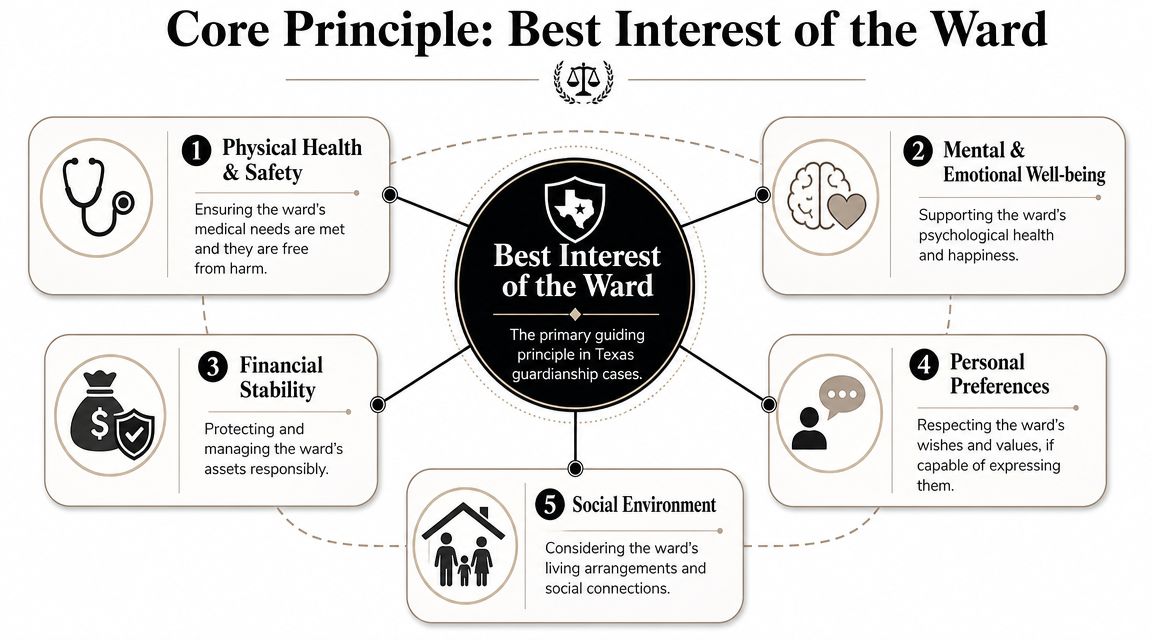
The controlling idea in a contested case is the best interest of the proposed ward. In plain English, that means the court asks what outcome will best protect the person's health, safety, dignity, property, and remaining independence.
Texas courts don't automatically choose the nearest relative. They weigh statutory priority against the ward's best interests. Judges review the ward's physical and mental condition, living arrangements, care needs, relationship history with each applicant, and whether the proposed guardian will preserve remaining autonomy. In contested matters, courts can hear testimony from multiple witnesses and review records, which means a person with statutory preference can still lose if the evidence shows someone else is the better fit, as explained in this discussion of how Texas courts decide who becomes a guardian.
What a judge looks at
A best-interest analysis usually includes several practical questions:
- Health and safety needs. Does the person need help with medication, mobility, placement, or treatment decisions?
- Mental and emotional condition. Can the person understand choices, communicate preferences, and recognize risk?
- Living situation. Is the current arrangement stable, safe, and realistic?
- Relationship history. Who has been involved, reliable, and appropriate over time?
- Preservation of independence. Which option protects the person without removing more rights than needed?
A court may also look at conflict of interest. For example, if one applicant lives in the ward's home rent-free or has access to the ward's accounts, the judge may look closely at whether that arrangement creates pressure or divided loyalty.
Best interest is not the same as family preference
A common misunderstanding is that “best interest” means the judge picks whoever seems nicest or most familiar. It's more disciplined than that. The court is trying to match authority to actual need.
Here's a simple comparison:
| Issue | Weak position | Stronger position |
|---|---|---|
| Medical needs | “She needs help” | Current records, physician evaluation, treatment plan |
| Placement | “She should live with me” | Specific housing plan, transportation, supervision details |
| Finances | “I'll handle it” | Clear budget, account structure, records, willingness to report |
| Autonomy | “She can't decide anything” | Explanation of what she can still do and what support is enough |
The best presentation is usually the one that respects both protection and dignity.
That point matters in contested cases. If one applicant seeks broad power over every aspect of life and another proposes a narrower, evidence-based solution, the narrower request may carry more weight.
Who Has Priority to Be Appointed Guardian in Texas
A common flashpoint in these cases sounds simple at first: the spouse says, “I come first,” and an adult child says, “I have been doing the work for months.” In Texas, both may be partly right. The Estates Code gives the court an order of preference, but in a contested case, priority only gets an applicant serious consideration. It does not guarantee the appointment.
Under Texas Estates Code Title 3, Subtitle G, the court generally looks first for a valid designation by the proposed ward, then considers close relatives in the statutory order, including a spouse, adult children, parents, and other qualified persons. That order matters. Judges know it, attorneys argue it, and families often focus on it. But once someone objects, the case turns from family rank to proof of suitability.
Priority helps, but suitability decides contested cases
In practice, judges ask a harder question than “Who is next in line?” They ask, “Who can serve lawfully, consistently, and with the least risk to this person and this estate?”
That changes how these hearings are won.
A spouse with priority can be passed over if the evidence shows poor judgment, unmanaged conflict, financial commingling, or an unwillingness to follow reporting rules. An adult child with lower priority may prevail if she has been coordinating care, keeping records, communicating with doctors, and proposing a workable plan the court can trust.
Those details matter because guardianship gives real power over medical care, living arrangements, and, in some cases, money. Judges tend to focus on the applicant who can show stable follow-through, respect for limits, and a clear understanding of fiduciary duties. If you want a closer look at the kind of proof that tends to sway the court, see what evidence matters in Texas guardianship contests.
How priority disputes play out in court
Here is a pattern I see often. An out-of-state son argues he should serve because he has higher statutory priority. A daughter who lives nearby responds with calendars, medication lists, appointment history, and testimony from caregivers showing she has been handling daily needs for a year. The son may still have the better place in the statutory order. The daughter may still be the better candidate in the judge's eyes.
The same is true when a spouse has priority but there are warning signs. If bank records show unexplained transfers, bills have gone unpaid, or other witnesses describe isolation from family and medical providers, the court may look for a safer option. Sometimes that is another relative. Sometimes it is a neutral third party.
What can override statutory preference
Courts do not remove a preferred applicant lightly, but several issues regularly change the outcome:
- Conflict of interest, especially involving the ward's home, bank accounts, or expected inheritance
- Poor recordkeeping or inability to explain how money has been handled
- Lack of involvement in the proposed ward's recent care and daily needs
- Instability, such as untreated substance abuse, erratic behavior, or unreliable housing
- Resistance to oversight, including hostility to inventories, accountings, court approval requirements, or bond obligations
At this stage, families often misjudge the case. They prepare to argue fairness, history, or birth order. The court is preparing to decide who can be trusted with a legal duty under supervision.
Temporary orders can shape the final result
Priority disputes also develop before the final hearing. If there is an immediate risk to the proposed ward, one side may ask for temporary guardianship or other emergency relief. The person who steps in early is not guaranteed the final appointment, but temporary orders can affect the evidence the judge sees later.
For example, if a temporary guardian stabilizes medical care, secures the residence, stops financial loss, and complies with reporting requirements, that performance may strengthen the case for a permanent appointment. The opposite is also true. If a temporary appointee overreaches, alienates caregivers, ignores court limits, or creates more conflict, the court notices.
For that reason, families should treat the first hearing as more than a placeholder. It often sets the tone for the case and creates a record the judge will remember.
What judges want from any applicant
Whatever a person's place in the statutory order, the strongest applicant usually shows the court four things:
- A realistic care plan
- Clean financial boundaries
- A history of reliable involvement
- A willingness to follow court supervision
Priority matters in Texas. Proof matters more once the appointment is contested.
Building Your Case Evidence in a Contested Guardianship Hearing
A contested guardianship hearing often turns on a simple courtroom problem. Two family members both say they are protecting the same person, but only one of them has records, witnesses, and a plan the judge can rely on.
That is the practical difference between concern and proof.
A Texas probate judge is not picking the relative who sounds the most sincere. The judge is building a legal record that can support an order restricting another person's rights. In a contested case, the winning side usually presents evidence that is specific, organized, and tied to the exact powers requested.
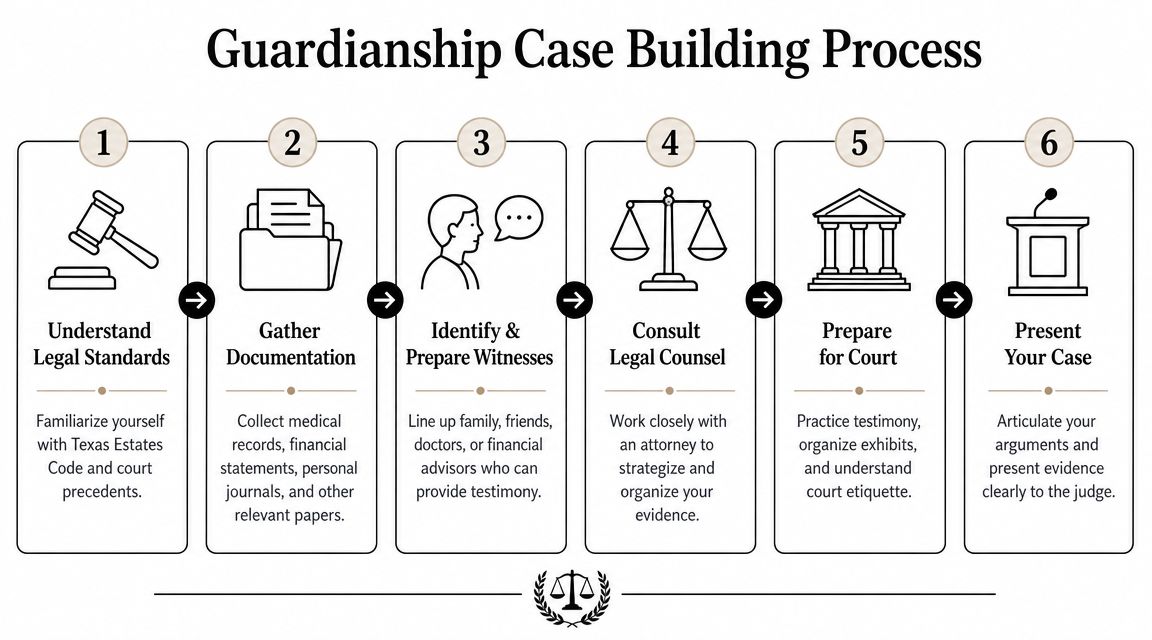
Build your proof around the questions the judge must answer
In most hearings, the judge is working through three issues. Is a guardianship needed at all. If it is, what powers should be granted. Who can carry out those duties responsibly under court supervision.
Evidence should be sorted the same way. Families lose focus when they bring in every old grievance, every sibling dispute, and every suspicion about motive. Judges tend to focus on what can be proven with documents, testimony, and a realistic care proposal.
Medical evidence needs detail, not labels
A diagnosis alone rarely decides the case. The court wants to know how the condition affects daily functioning, judgment, safety, financial decision-making, medication compliance, and the ability to understand consequences.
Strong medical proof usually includes current physician evaluations, office notes, discharge records, neuropsychological findings when available, and testimony that explains functional limits in plain language. Weak medical proof is vague, stale, or inconsistent with what other witnesses describe.
If one side claims the proposed ward cannot manage basic needs, but the records show the person still handles some decisions well, the court may limit the guardianship rather than grant broad authority.
Caregiving evidence should show a pattern
Judges tend to trust specifics. Bring calendars, appointment records, medication logs, text messages confirming care coordination, incident reports, and facility notes if placement is disputed. A short timeline can help the court see what happened, when it happened, and who responded.
I often tell families to prove care the way they would prove a business expense. Dates matter. Names matter. Records matter.
Useful examples include:
- doctor visit records showing who scheduled and attended appointments
- pharmacy records showing missed refills or confusion about medications
- written notes about falls, wandering, missed meals, or unsafe driving
- discharge paperwork showing recommendations for supervision or placement
- photographs of living conditions, if safety or neglect is part of the dispute
Financial evidence carries unusual weight
Money issues change the tone of a guardianship case very quickly. If the dispute involves control over accounts, benefits, property, or unpaid bills, the court will look closely at financial habits and boundaries.
The stronger applicant usually brings bank statements, benefit letters, recurring expense summaries, property information, and a clear plan for keeping the ward's funds separate. The court also notices who has already been handling money, whether records were kept, and whether withdrawals or transfers need explanation.
Saying “I've always handled Mom's finances” is not persuasive by itself. A ledger, account statements, and clean documentation are.
Neutral witnesses often matter more than relatives expect
Family members usually spend a lot of time attacking each other's motives. That rarely helps as much as they think it will. The more persuasive voices are often the people with less emotional stake in the outcome.
That group may include:
- the Attorney Ad Litem
- treating physicians
- nurses or facility staff
- social workers and case managers
- paid caregivers
- neighbors, friends, or clergy who have regular firsthand contact
The Attorney Ad Litem deserves special attention. In many cases, that lawyer's view shapes how the court sees the dispute, especially on the ward's wishes, the need for a limited guardianship, and whether a proposed guardian seems trustworthy and realistic.
Temporary orders can influence the final hearing
Contested cases do not begin and end at the final trial. If someone seeks temporary guardianship or other emergency relief, the court may get an early look at who can stabilize care, protect assets, and follow instructions.
That early period matters. A temporary appointee who keeps good records, follows the court's limits, communicates with providers, and avoids unnecessary conflict may strengthen a later bid for permanent appointment. A temporary appointee who overreaches, cuts off family access without justification, or treats the role like ownership can damage the case.
Families should prepare for the first hearing with the same seriousness they would bring to trial. Temporary orders often create the first body of evidence the judge sees.
What usually persuades the court
The strongest case is often the narrowest credible one. Judges respond well to applicants who acknowledge the proposed ward's remaining abilities, address less restrictive alternatives openly, and ask only for the authority the facts support.
Overstatement is a common mistake. So is turning the hearing into a referendum on which sibling was more devoted over the last ten years. The court is deciding who can serve now, under present conditions, with court supervision and legal duties attached.
Families dealing with these hearings can review what evidence matters in Texas guardianship contests for a closer look at the proof judges tend to weigh most heavily. For case preparation, many families also work with a probate or guardianship attorney to organize filings, witness testimony, medical support, and hearing strategy. One option is Law Office of Bryan Fagan, PLLC, which handles Texas guardianship establishment and contested proceedings.
Common Guardianship Disputes and How to Approach Them
A contested guardianship usually breaks along predictable lines. One child wants Mom to stay at home with help. Another says the home plan is unsafe. A relative who has handled day-to-day care feels pushed aside. A family member who lives farther away suspects money problems or isolation. Judges see these disputes often, and they do not decide them based on who sounds more offended or who has the longest list of family grievances.
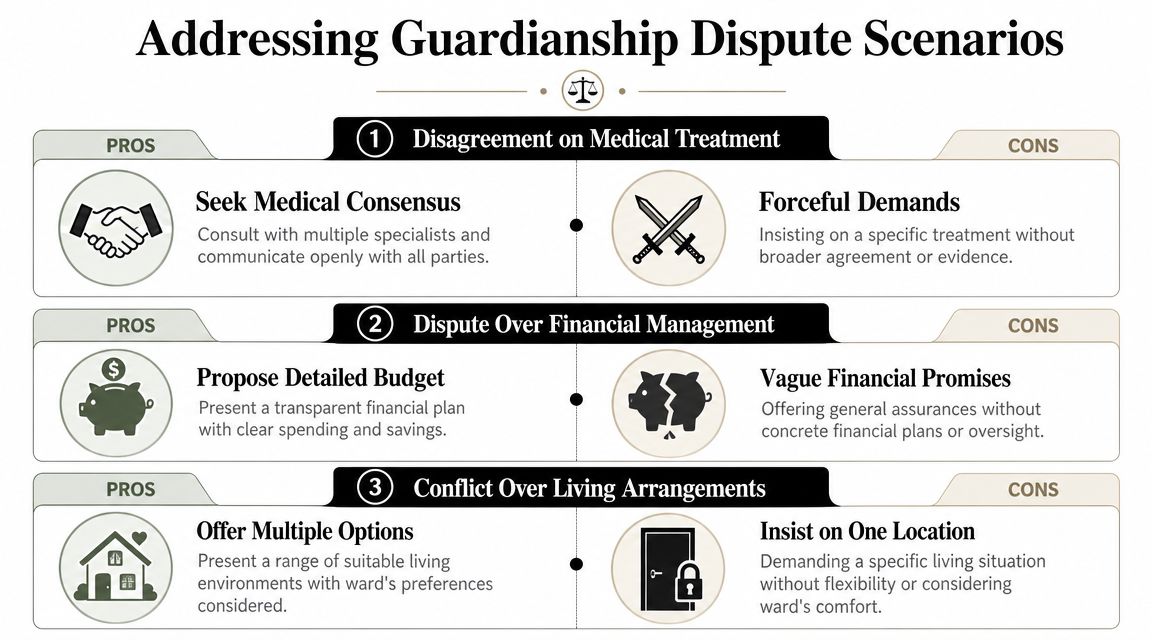
The dispute that gets traction in court is the one tied to proof and a workable plan.
Sibling versus sibling
Sibling cases often turn into a replay of old family roles. That history may explain the conflict, but it rarely decides the case. The judge is looking for current evidence about safety, capacity, finances, and who can follow court rules.
If one sister argues for home care, she should bring more than a general promise to "check on Dad." A credible home plan usually includes names of caregivers, a schedule, medication management, transportation, how overnight supervision will work, and how the plan will be paid for. If the brother argues for placement in a facility, he needs more than fear. Discharge records, fall history, wandering incidents, missed medications, adult protective services reports, or testimony from treating providers will carry more weight than accusations that someone is selfish or uninvolved.
The same rule applies to financial concerns. If a sibling claims another has mishandled funds, the court will want bank records, unusual withdrawals, unpaid bills, changes in beneficiaries, or documentation showing commingling. Vague suspicion does not go far.
Families dealing with this pattern often benefit from reviewing how Texas courts handle sibling disputes over guardianship, especially where each side has some legitimate concerns and some weak points.
Local caregiver versus out-of-state child
This is one of the most emotional matchups because both sides usually have a point. The local caregiver may know the doctors, medications, and daily routine better than anyone else. The out-of-state child may be the first person willing to question missing money, blocked access, or a care setup that is no longer safe.
Texas courts do not automatically favor the person who lives closest. They also do not reward a late-arriving relative merely for raising alarms. Judges tend to focus on two practical questions. Who has been managing the ward's needs responsibly, and who can continue doing so under court supervision?
A local caregiver helps the case by showing calendars, appointment records, pharmacy logs, caregiver invoices, and a history of keeping other family members informed. An out-of-state child helps the case by bringing records, not theories. Flight receipts and concern alone are not enough. Emails requesting updates, evidence of denied contact, unexplained transfers, or provider testimony about care failures are far more persuasive.
Sometimes the best answer is narrower than either side wants. A judge may divide responsibilities, limit authority, require bonding, restrict access to accounts, or impose reporting conditions that reduce the chance of misuse.
Full guardianship versus limited authority
Some fights are really about scope, not the person serving. One family member asks for full control over medical and financial decisions. Another argues that the proposed ward still makes some choices with support and does not need that much authority taken away.
That argument matters. Texas courts are expected to consider whether a less restrictive option will address the problem, including limited guardianship, supported decision-making, powers of attorney that are still valid, or other arrangements that protect the person without stripping more rights than necessary.
In practice, the stronger position is usually the one that matches the evidence closely. If the proposed ward can express consistent preferences, handle small personal spending, or participate meaningfully in some medical discussions, asking for every possible power can make an applicant look overstated. A narrower request often sounds more credible because it shows the court the applicant understands the ward's remaining abilities and is asking only for authority the facts support.
That is also where evidence presentation matters. Medical records should identify specific deficits. Witnesses should describe what the ward can still do and where help is needed. Proposed orders should be adapted to those limits. In a close case, that kind of restraint can make the difference between appointment with limited powers and denial of an overbroad request.
What Happens in an Emergency Temporary Guardianship Explained
A contested guardianship can take time. That delay creates a serious problem when no one currently has legal authority to consent to treatment, authorize placement, or protect property. In practice, hospitals, rehabilitation facilities, and banks often need a legally authorized decision-maker before they can move forward.
Texas addresses that gap through temporary guardianship. The delay between filing a petition and receiving a final court order can leave a period where no one has legal authority, and temporary guardianship allows a judge to appoint someone to make urgent medical or placement decisions while the permanent dispute is being resolved, as discussed in this explanation of how guardianship works in Texas.
When temporary relief makes sense
Temporary guardianship is usually considered when there is immediate risk. Examples might include:
- A vulnerable adult is about to be discharged and no one can legally admit them to a safe facility.
- Bills, benefits, or accounts are exposed to misuse and action can't wait.
- Medical consent is needed quickly and family members disagree.
The court won't grant temporary power just because the family is fighting. The request should connect the emergency to a concrete risk and explain why waiting for a final hearing would create harm.
What families should do right away
If you think the situation is urgent:
- Gather recent medical records and discharge information.
- Document the immediate safety or financial problem.
- Identify exactly what authority is needed now.
- Avoid asking for broader powers than the emergency requires.
That last point matters. A sharply focused request often looks more credible than a sweeping one.
Temporary guardianship is not a shortcut to winning the permanent case. It's a tool for immediate protection.
If your family is facing a crisis and needs to understand the emergency filing process, this step-by-step guide to getting emergency guardianship fast in Texas is a useful starting point.
How to Prepare for a Texas Guardianship Dispute
A contested guardianship hearing often starts the same way. One family member arrives with strong opinions and stories about what has gone wrong. Another arrives with records, a workable care plan, and witnesses who can explain specific facts. Judges listen to both, but organized proof usually carries far more weight than family frustration.
One short overview can help you think through the process:
Preparation in these cases is practical. The court wants to see whether you understand the proposed ward's current condition, what authority is necessary, and whether you can carry out the court's reporting and fiduciary duties under Texas Estates Code Title 3, Subtitle G. In a close case, credibility often turns on details. Can you explain medication needs, living arrangements, unpaid bills, who has access to accounts, and what less restrictive options were considered?
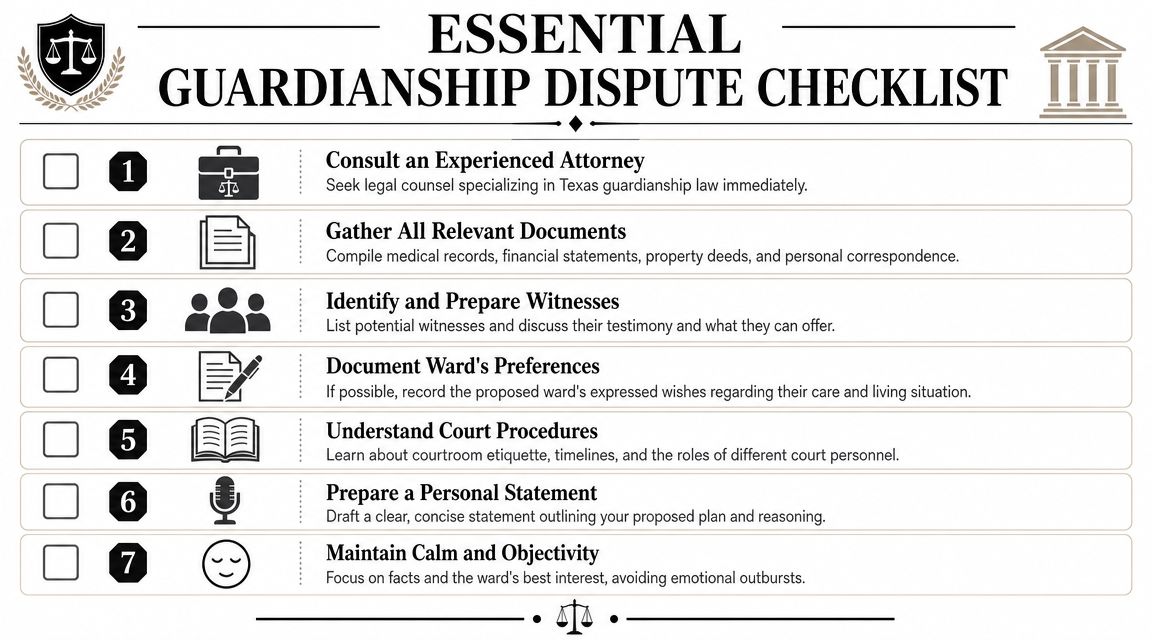
A practical checklist
Before the hearing, gather and organize the evidence a judge is likely to rely on:
- Current medical proof. Obtain physician evaluations, treatment records, medication lists, hospital records, and discharge paperwork that show present limitations, not just past concerns.
- A timeline of concrete events. Write out falls, wandering, missed medications, financial mistakes, exploitation concerns, hospitalizations, or unsafe incidents with dates and supporting documents.
- A realistic care plan. Explain where the proposed ward will live, who will provide hands-on care, how transportation will be handled, and how medical appointments will be managed.
- Financial records. Identify income, recurring expenses, available assets, debts, and any unusual withdrawals or account access issues.
- Witnesses with first-hand knowledge. Treating providers, facility staff, social workers, caregivers, and other neutral witnesses can be more persuasive than relatives repeating family grievances.
- The ward's preference, stated accurately. If your loved one can express a preference, present it fairly. Do not overstate capacity or put words in their mouth.
- A narrow request. Ask only for the powers the facts support. Overreaching can damage credibility.
- A compliance plan. Be ready to explain how you will handle inventories, annual reports, accountings, and court oversight after appointment.
That last point matters more than many families expect.
Courts do not just decide who should serve. Courts also consider whether the proposed guardian is likely to follow through on the obligations that come after the order is signed. A person who arrives prepared to keep records, meet deadlines, and separate the ward's finances from their own often appears more reliable than someone focused only on winning the dispute.
What good preparation looks like in practice
Strong preparation is not a stack of unsorted papers handed to the court on the morning of the hearing. It is evidence arranged around the legal questions the judge must answer.
For example, if you are asking to be guardian of the person, show how you will meet daily care needs and why your plan is safer and more stable. If you are asking to manage property, show bank records, benefit information, recurring expenses, and a clean explanation of how funds will be protected. If another applicant has a history of conflict, missed care, or poor financial judgment, prove it with records, messages, witnesses, or prior court filings. General accusations rarely help.
Temporary orders can shape the permanent case too. If the court has already entered a temporary guardianship or other interim relief, review exactly what happened during that period. Judges pay attention to whether the temporary arrangement stabilized care, protected assets, and reduced immediate risk, or whether it created new problems. In many contested cases, the conduct of the parties during the temporary phase becomes part of the larger credibility picture.
The right goal
The strongest position is usually the one that gives the court a specific, lawful plan for protecting the proposed ward with the least restriction necessary.
That means preparing for hard questions. Why is guardianship needed now? Why are lesser alternatives not enough? What powers are necessary? Who will help with care and reporting after appointment? Families who answer those questions directly are usually in a better position than those who treat the hearing as a referendum on which sibling the judge likes more.
If you are involved in a contested guardianship in Harris County Probate Court or another Texas court, start organizing records, witnesses, and your care plan early. Timing affects strategy. The attorneys at Law Office of Bryan Fagan, PLLC help Texas families evaluate guardianship options, prepare evidence, address emergency concerns, and guide through hearings with a clear plan grounded in Texas law. Schedule a free consultation to discuss your loved one's situation, your concerns, and the practical next steps.