Skip to content
A family member can contest your guardianship case in Texas, but they cannot veto it on their own. The judge makes the final decision based on legal qualifications, evidence of incapacity, whether guardianship is necessary, and whether you are a suitable person to serve.
If you're reading this, you're probably already in a hard spot. Maybe your mother is missing medications, your brother says she's "fine," and bills are piling up. Maybe your adult child needs protection, but another relative thinks you're overreacting. In real life, guardianship fights usually don't start with bad people. They start with fear, grief, old family conflict, and very different ideas about what help looks like.
That emotional reality matters, but Texas probate courts don't decide guardianship cases based on who argues louder at the kitchen table. They decide them under the Texas Estates Code, mainly in Title 3, Subtitle G, using evidence. That's the part many families don't hear soon enough. A sibling's objection may delay the case, increase expense, and force a hearing. It does not automatically end your case.
Navigating Family Disagreements in Texas Guardianship
An aging parent in Houston starts missing medications, giving money to strangers, and leaving the stove on. You step in because someone has to. Your sister says you are overreacting, your brother says you want control, and a problem that began at home is now headed to probate court.
That is how many Texas guardianship fights begin. The actual dispute is usually not whether the family gets along. It is whether anyone can prove, with admissible evidence, that a guardianship is necessary and that the person asking to serve is the right choice.
Family conflict matters because objections change the case. A relative can force closer scrutiny of your application, challenge your credibility, argue for a less restrictive alternative, or offer another proposed guardian. That can slow the process, raise costs, and expose weak spots in your evidence. It does not give that relative the power to decide the outcome.
The practical problem is that many families treat a guardianship dispute like a moral argument. Probate courts treat it like an evidence problem. If you are asking for appointment, expect the court to look past labels such as "greedy," "controlling," or "absent for years" unless those claims are backed by records, testimony, and facts that relate to the ward's safety, capacity, finances, or your fitness to serve.
What family opposition can and can't do
A relative's objection can derail an unprepared case. It can lead to contested hearings, requests for records, disputes over who should serve, and sharper attention to whether a power of attorney, supported decision-making, or another less restrictive arrangement would protect the proposed ward.
Judges do not resolve these cases by counting relatives.
They look for proof. Medical evidence, financial records, care history, text messages, witness testimony, and evidence of past involvement usually carry more weight than family opinions offered in broad terms. In contested cases, I often see the same mistake from otherwise well-meaning applicants. They know the loved one needs help, but they have not organized the evidence needed to show why guardianship is legally justified and why they are the safer choice.
A strong objection usually falls into one of two categories. The objecting family member argues that no guardianship is needed, or argues that you should not be the one appointed. Those are very different fights, and they require different responses. If your family is already splitting into camps, this discussion of a family dispute over guardianship in Texas can help you see how fast caregiving concerns turn into litigation and what issues tend to decide the case.
The Court's Role in Texas Guardianship Decisions
A guardianship case is not a private family process. It is a formal court proceeding under the Texas Estates Code. In most adult cases, that means probate court. Depending on the county, that may be a statutory probate court, a county court at law with probate jurisdiction, or another court handling guardianship matters.
The judge is deciding legal questions
When a court reviews a guardianship application, it is not asking, "Which child does Mom love more?" It is asking legal questions such as:
- Capacity: Does the proposed ward lack capacity in the areas at issue?
- Necessity: Is a guardianship needed?
- Scope: Should any guardianship be limited instead of broad?
- Suitability: Is the applicant legally qualified and practically appropriate?
- Alternatives: Would a less restrictive option protect the person without a guardianship?
Those questions come from the structure of Texas Estates Code Title 3, Subtitle G, which governs many guardianship proceedings, duties, and protections. In plain English, the court's job is to protect the proposed ward, not to settle family scorekeeping.
Who gets to speak in the case
Not every person with an opinion has the same role. Close relatives often receive notice and may participate, especially if they claim the applicant is unsuitable or that another plan would be better. The proposed ward also has rights in the case, and the court commonly appoints an attorney ad litem to represent that person's interests.
That changes the tone of the case. Once filed, the case belongs to the court process. Medical records, testimony, financial concerns, and daily care evidence become more important than family status alone.
The strongest presentation in a guardianship case is usually the one tied to current records, specific safety concerns, and a realistic plan for care.
Best interests do not mean family preference
Families often assume the court will choose whichever relative has the strongest family tie. Texas courts do give preference to family members in many situations, but that preference isn't automatic. If the evidence shows conflict, abuse, incapacity, poor judgment, or another serious concern, the court may deny that applicant and appoint someone else.
A helpful way to think about it is this:
| Family belief | What the court asks instead |
|---|---|
| "I'm the oldest child." | Are you suitable and qualified? |
| "My sister objects." | What evidence supports her objection? |
| "Dad would hate court." | Is guardianship necessary, or would another tool work? |
| "Our family can work it out." | Is the proposed ward safe right now? |
That shift in focus is often what helps families stop reacting emotionally and start preparing effectively.
Statutory Grounds for Disqualifying a Guardian in Texas
If you want the clearest answer to "Can a Family Member Block You from Becoming a Guardian in Texas?" this is it. A relative usually succeeds only when the objection is tied to a real legal disqualifier or persuasive evidence that you are not the right person to serve.
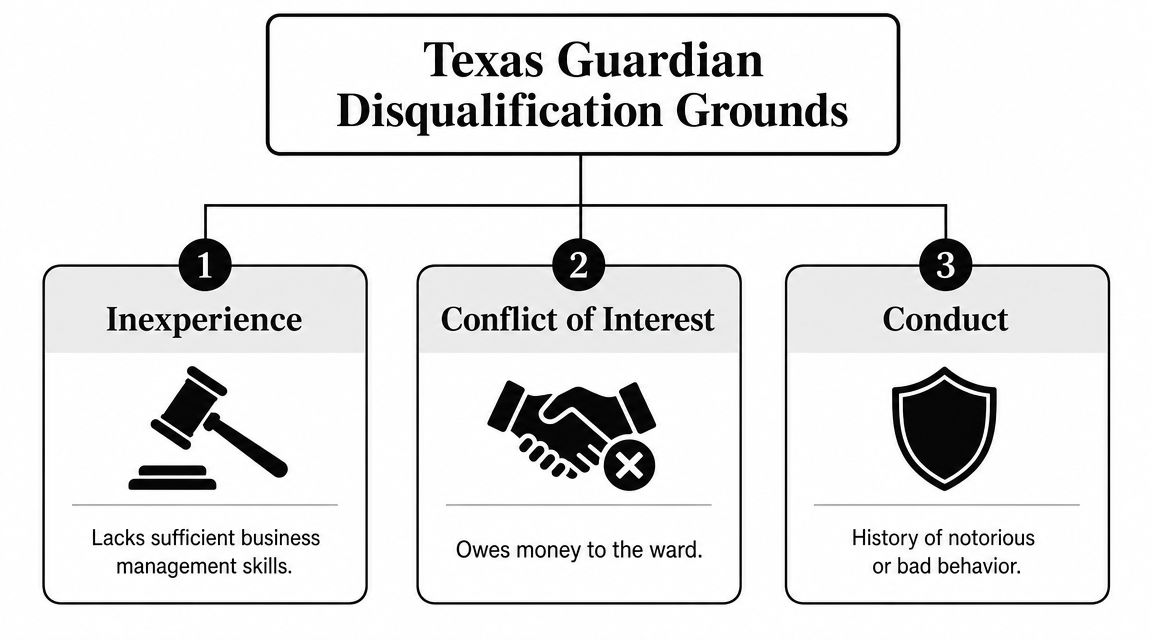
Under Texas Estates Code Chapter 1104, a proposed guardian must be at least 18 years old, and the court may reject a person with disqualifying conflicts such as being indebted to the ward or asserting an adverse claim against the ward's property, as discussed in this explanation of who should not be a guardian under Texas law.
Conflict of interest is a major red flag
Some objections fail because they amount to "I don't like my sibling." Others land because they point to a direct legal conflict.
Examples include:
- Debt owed to the ward: If you owe the proposed ward money, the court may see that as a conflict.
- Adverse property claims: If you're already fighting over the ward's property, your interests may be too adverse.
- Financial self-interest: If your plan appears to benefit you more than the ward, expect close scrutiny.
A court wants a guardian whose loyalty is clear. If your sibling can show that your personal financial interests are entangled with the ward's property, that objection becomes much more serious.
Criminal history and conduct can disqualify you
Texas guardianship guidance also notes that certain convictions are disqualifying, including serious violent or sexual offenses. The court is not required to ignore conduct that raises trust and safety concerns.
That doesn't mean every old mistake bars service. It does mean that conduct affecting honesty, safety, exploitation, or abuse can become central in a contested case.
A successful objection usually connects the law to facts the judge can verify. Records, filings, account statements, and witness testimony carry more weight than family labels.
Suitability includes practical ability
Suitability isn't just about criminal history or direct conflict. It also includes whether you can perform the work of a guardian.
That may involve questions such as:
- Can you manage medical decisions responsibly?
- Can you handle records, deadlines, and court compliance?
- Are you living close enough to monitor the ward's needs?
- Are you already in such intense conflict with other relatives that service would harm the ward?
Texas courts can appoint a neutral third party if relatives are unsuitable or the conflict is too severe. That's one reason families shouldn't assume the fight is between two siblings. If the court concludes neither side is a safe choice, neither side may win.
What to Expect in a Contested Guardianship Hearing
A contested guardianship hearing often starts with a family believing the judge will quickly see who is "right." That is rarely how it goes. In court, the question is not who sounds more upset, more involved, or more offended. The question is who can prove, with admissible evidence, what the proposed ward needs and why a particular appointment serves that person's best interests.

A common dispute looks like this. One sister files for guardianship of their mother. The other objects and says guardianship is unnecessary, claims money has been mishandled, or argues that existing planning documents should control. At that point, the case becomes an evidence problem. The family member with the better proof, the cleaner record, and the more workable plan usually has the advantage.
How the dispute usually unfolds
Most contested cases move through a series of predictable steps, even if the timing varies by county and by the judge's docket:
The application is filed
A family member asks the court to appoint a guardian and states why the proposed ward cannot manage personal or financial affairs without court protection.An objection is filed
Another relative challenges the request. The objection may focus on whether guardianship is needed, whether the applicant is suitable, or whether a less restrictive option can address the problem.Records and witness information start to matter
Medical evaluations, care notes, financial records, text messages, facility reports, and testimony from people with firsthand knowledge can shape the case long before the hearing date.The proposed ward receives representation
The court often appoints an attorney ad litem, and in some cases other court-appointed professionals may investigate and report to the court.The judge hears the evidence
Witnesses testify under oath. Documents are offered into evidence. The judge decides whether guardianship is warranted, what powers are needed, and who, if anyone, should serve.
Families usually make better decisions once they understand the mechanics of an evidentiary hearing in a Texas guardianship case before they walk into court.
What kind of proof matters
Judges see family conflict every day. Conflict alone does not decide these cases.
What carries weight is specific, documented proof tied to the legal issues before the court. If you are seeking guardianship, that usually means current medical evidence of incapacity, concrete examples showing the loved one cannot manage important decisions, and a practical plan for care. If you are opposing an objection, it means answering the accusation with records, witnesses, and a credible explanation, not indignation.
These points usually help a case:
- Current medical evidence showing impaired capacity and the effect on daily decision-making
- Specific safety concerns such as missed medications, wandering, self-neglect, abuse, or exploitation
- Financial documentation showing unpaid bills, unusual transfers, confusion about assets, or failure to protect income
- Evidence about alternatives showing they have failed, are unavailable, or are not enough to keep the person safe
These points usually do very little by themselves:
- "My brother has always been controlling."
- "She is only doing this for the house."
- "Our mother would never want this," without a reliable basis and supporting facts
- "The family disagrees"
A short overview can help make the courtroom setting feel less unknown:
Who has to prove what
The applicant has the first burden. That person must prove the legal need for guardianship and show that the requested appointment and powers are appropriate. If another family member wants to block the appointment, that person should be prepared to present evidence supporting the objection, whether the argument is lack of necessity, a less restrictive alternative, or the applicant's unsuitability.
Strategy matters in this situation. A relative can slow a case down with allegations. Stopping the appointment is harder. To do that, the objector usually needs evidence the judge can rely on, such as bank records, prior court filings, testimony from care providers, medical evidence, or proof that an existing decision-making arrangement is still functioning.
The practical trade-off is straightforward. Waiting to gather proof until the week of the hearing puts even a strong case at risk. Early preparation gives the court something solid to work with and puts your loved one's needs, not family friction, at the center of the decision.
How to Prepare for and Potentially Avoid a Guardianship Fight
The best guardianship dispute is often the one you never have to file. Texas law treats guardianship as a last-resort, rights-restricting remedy because an adult guardianship can remove major civil rights, so courts must consider less restrictive alternatives before appointing a guardian, as explained in this discussion of what to do if a sibling is blocking a guardianship case in Texas.

Planning tools that often reduce conflict
When a loved one still has enough capacity to plan, these tools can reduce the odds of a later courtroom battle:
- Durable Power of Attorney: Lets the person appoint someone to handle financial matters.
- Medical Power of Attorney: Lets the person name who can make health care decisions if needed.
- Declaration of Guardian: Lets the person state who they want, or do not want, appointed later.
- Supported decision-making tools: In some situations, these preserve autonomy while adding structure and help.
Not every document prevents litigation. A declaration of guardian, for example, is not itself immediate authority. It is evidence the court may weigh later. But it can still be powerful because it tells the judge what the person chose while able to express that choice.
What works and what doesn't
Some families wait until a crisis and then scramble. That usually creates more conflict, not less.
What tends to help:
- Early documentation: Keep medical notes, discharge paperwork, medication lists, and records of unsafe incidents.
- Clear role assignments: Know who is helping with finances, appointments, housing, and communication.
- Consistent communication: Family meetings, written updates, and shared records can reduce suspicion.
- Legal review before filing: A lawyer can help you assess whether guardianship is necessary or whether another tool is better.
What often makes things worse:
- Using guardianship as an advantage in a family property dispute
- Filing without current medical support
- Hiding information from relatives who will receive notice anyway
- Assuming family priority alone is enough
"The question isn't only whether you can file. It's whether you can show the court that filing is necessary and that your plan protects the ward better than the alternatives."
For families who need help evaluating those options, Law Office of Bryan Fagan, PLLC handles Texas guardianship applications, disputes, and related planning matters, including review of medical evidence, filings, and less restrictive alternatives.
Using Temporary Guardianship When a Loved One Is in Danger
Some situations can't wait for a long family fight to play out. If a vulnerable adult faces immediate danger, Texas law allows the court to appoint a temporary guardian in urgent cases under Texas Estates Code Chapter 1251, as discussed in this article on ex parte guardianship in Texas.

That matters when delay itself is dangerous. A sibling may still object, but the court has a tool for emergencies rather than waiting for family agreement that may never come.
When temporary guardianship may fit
Temporary guardianship is often considered when there is a pressing threat to the person's physical health or financial estate. Examples may include:
- Immediate medical risk: The person can't consent to urgent care and no workable authority exists.
- Active financial danger: Someone is exploiting accounts, draining assets, or pressuring the person to sign documents.
- Unsafe living conditions: The person is exposed to neglect, abandonment, or severe self-neglect.
Evidence still matters in an emergency
Emergency cases move faster, but they are not casual. Judges still want real evidence. In practice, that may include recent medical proof, records of exploitation, testimony from caregivers, or documentation showing that waiting would put the person at serious risk.
Texas guardianship materials also note that courts commonly require recent physician or psychologist documentation before a permanent guardianship application is heard, and they may consider less restrictive alternatives before any appointment. In urgent cases, temporary relief can stabilize the situation while the larger dispute continues.
If your loved one is in danger, speed matters. So does accuracy. Filing the wrong case, or filing without enough support, can cost valuable time.
Your Next Steps Taking Control of the Guardianship Process
When a relative objects, it can feel like everything has stopped. Usually, it hasn't. What has changed is the type of case you now have. You're no longer dealing with an uncontested guardianship. You're dealing with an evidence-driven court proceeding.
A practical checklist
Start with the basics and get organized:
- Gather current medical support: Capacity evidence is often central to whether the court will act.
- Document specific risks: Write down missed medications, unsafe conditions, financial problems, or exploitation concerns.
- Collect legal paperwork: Powers of attorney, prior court orders, declarations of guardian, and care records all matter.
- Review your own suitability: Be honest about conflict issues, finances, prior conduct, and your ability to serve.
- Prepare for alternatives: If a less restrictive option could work, the court will want to hear about it.
Think beyond the hearing
Guardianship is not just about appointment. It carries ongoing duties. A guardian may need to make decisions carefully, report to the court, comply with deadlines, and stay within the authority granted by the order. In some cases, families later need help with modification, restoration of rights, compliance problems, or termination.
That broader view matters because judges often look for applicants who understand the work ahead, not just the immediate conflict.
The strongest guardianship cases are usually built before the hearing. Families who come in with organized records, realistic care plans, and a clear understanding of the ward's needs are easier for the court to trust.
If you're facing a dispute over who should serve, or whether a guardianship should be filed at all, legal guidance can save time, conflict, and avoidable mistakes. You can also learn more about related Texas matters through these resources on Guardianship, Probate, and Estate Planning.
If your family is struggling over a loved one's care, you don't have to sort it out alone. The Law Office of Bryan Fagan, PLLC helps Texas families with contested guardianship cases, temporary guardianship requests, capacity issues, and planning options that may avoid court altogether. Schedule a free consultation to get guidance specific to your county, your evidence, and your loved one's immediate needs.