Skip to content
A guardianship notice can feel like a punch to the chest. One child believes Mom needs protection. Another believes she's being pushed out of her own decisions. Sometimes the fight is about safety. Sometimes it's about money. Sometimes it's about who gets control.
In Texas, a guardianship contest is more than a family disagreement. It's a court case, usually in probate court, where a judge has to decide whether someone is incapacitated, whether a guardian is necessary, who should serve, and whether a less restrictive option would protect the person just as well. In places like Harris County Probate Court, Fort Bend County, Dallas County, and Bexar County, judges hear these disputes regularly. What persuades them isn't outrage. It's evidence that answers the legal question in front of the court.
That's why Guardianship Contests in Texas: What Evidence Matters is really a practical question. Families often arrive with strong feelings and stacks of papers, but not all papers matter equally. The difference between a weak case and a strong one is usually whether the proof is current, organized, and tied to the exact issue the judge must decide under Texas Estates Code Title 3, Subtitle G.
Understanding Why Guardianships Are Contested
Most contests begin with a basic conflict. One side says, “Dad can't safely manage his health or money anymore.” The other says, “He's forgetful, but he's still making his own decisions.” A different contest starts after a guardian is already appointed, when family members believe the guardian isn't acting in the ward's best interest.
The law treats both situations seriously because guardianship can remove major rights. A court may give someone else authority over where a person lives, how money is handled, or what medical decisions get made. That's why a contest isn't just about hurt feelings. It's about whether the evidence supports taking away or limiting another adult's legal autonomy.
The disputes judges see most often
Some cases focus on capacity. Is the person legally incapacitated, or are family members overstating normal aging, disability, or a temporary setback?
Others focus on suitability. Even if a guardian is needed, is the proposed guardian the right person? Prior conflict, poor financial habits, isolation of the ward, or self-interest can become central issues.
A third group of cases focuses on necessity. The person may need help, but not a full guardianship. That's where powers of attorney, supported decision-making, trusts, and reliable family support can matter a great deal.
Families often assume the loudest concern wins. In court, the better documented concern usually wins.
Texas has a long history of contested guardianship issues involving capacity, oversight, and whether full guardianship is necessary. Family conflicts between siblings are especially common, and the court's focus is rarely on who feels more devoted. It's on who can prove the legal point with reliable evidence. That's why families dealing with sibling disputes over guardianship in Texas and who wins and why need to think early about records, witnesses, and alternatives.
Where procedure starts to matter
Under the Texas Estates Code, guardianship cases involve formal pleadings, notice, medical evidence, and court review. If the application seeks a guardian of the person, the court looks at personal care and decision-making. If it seeks a guardian of the estate, the court examines property, finances, and risk of loss. Some cases involve both.
Emergency disputes can move faster. A temporary guardianship request may be filed when someone claims immediate danger to the person or estate. Those hearings can happen quickly, so delayed evidence gathering can hurt your position. If you think a contest is coming, start preserving documents right away.
The Legal Standards That Shape a Guardianship Contest
Texas guardianship hearings are driven by a small number of legal questions. If your evidence doesn't answer those questions, it usually won't help much.
What the court must decide
Under Texas Estates Code Title 3, Subtitle G, the court generally looks at:
- Whether the proposed ward is incapacitated
- Whether a guardian is necessary
- Whether a less restrictive alternative would work
- Who is qualified and suitable to serve
- What scope of guardianship, if any, is appropriate
That last point gets missed all the time. Guardianship isn't always all-or-nothing. Courts can tailor powers to the actual need. A narrowly limited guardianship may be more appropriate than a full one.
Why records carry so much weight
Texas courts rely heavily on filings and supporting proof. In fiscal year 2025, Texas court compliance specialists reviewed 7,590 guardianship cases and found about 34% were out of compliance with statutory reporting rules, according to the Texas Judicial Branch annual guardianship compliance reporting. That matters in a contest because incomplete, stale, or inconsistent records can damage a party's credibility fast.
A judge wants a clear documentary trail. If one side says the person can't manage medication, but pharmacy records and caregiver notes show consistent management, the court notices. If a guardian claims careful financial stewardship, but the accountings don't line up with bank statements, the court notices that too.
Practical rule: Bring proof that can be dated, compared, and verified. Judges trust timelines more than accusations.
Relevance decides what gets in
Evidence must connect to a real issue in the case. Texas Rule of Evidence 402 bars irrelevant evidence. In plain English, that means a judge doesn't need to hear every old family complaint. The court needs proof that makes incapacity, necessity, suitability, harm, or an effective alternative more or less likely.
A short example helps. If a son wants to oppose guardianship for his mother, testimony that his sister “has always been controlling” may not carry much weight by itself. But emails showing the sister blocked doctor access, redirected bank mail, and refused to share care information may become relevant if they help prove unsuitability or manipulation.
Families often benefit from understanding the burden of proof in a Texas guardianship case. The applicant doesn't win because they filed first. They still have to prove what the law requires.
Medical Evidence The Cornerstone of Capacity Disputes
When the central fight is about incapacity, medical evidence usually starts the case and often shapes the outcome. But not all medical evidence is equal. Judges tend to give the most weight to recent, specific evaluations that connect diagnosis to actual decision-making ability.

Why the physician certificate matters so much
In many Texas cases, the key medical document is the physician's examination supporting the guardianship request. Families often call it the Certificate of Medical Examination, or CME. Whatever label gets used in practice, the court wants a medical opinion that speaks to legal capacity, not just a diagnosis.
A diagnosis of dementia, stroke history, intellectual disability, autism, or mental illness does not automatically answer the guardianship question. The court needs to know how the condition affects the person's ability to make decisions about residence, health care, finances, nutrition, safety, and daily functioning.
That's why a vague letter can fall flat. “Patient is declining and needs help” is usually weak. A much stronger medical opinion explains what the person can and cannot do, whether the condition is expected to improve, and what decision areas are affected.
Texas has seen substantial growth in guardianship activity. A 2017 Senate report noted a 37% increase in active guardianships over five years, with many cases handled in counties lacking specialized probate courts, according to the Texas Senate Aging Committee report. For families, that means concise, credible medical proof matters even more. Judges managing heavy dockets often respond best to clear records that answer the statutory question directly.
What makes medical evidence persuasive
The strongest medical evidence usually has these traits:
- Recent timing. An old evaluation may not reflect current functioning.
- Specific findings. The report should connect symptoms to real limitations.
- Functional detail. It should address money, medications, appointments, safety, and communication.
- Consistency with other records. If the medical opinion clashes with daily-life records, the conflict needs to be explained.
A simple comparison shows the difference:
| Medical proof | Usually weak | Usually stronger |
|---|---|---|
| Doctor letter | General conclusion | Detailed findings tied to decision-making |
| Diagnosis | Name of condition only | Effect of condition on specific tasks |
| Evaluation date | Stale or undated | Current and clearly timed |
| Support | No records attached | Backed by treatment notes or testing |
If you're dealing with this issue, it helps to review the requirements around a physician certificate for guardianship in Texas.
The video below gives broader context on how families approach these disputes.
A common hearing problem
One of the biggest problems in contested hearings is when family testimony outruns the medical record. A daughter may sincerely believe her father is unsafe because he repeated a story at dinner. But if his physician's records show stable cognition, and his other records show he still pays bills and attends appointments, the daughter's concern may not carry the day.
Good medical evidence doesn't just say someone has a condition. It shows how that condition affects legal decision-making.
On the other hand, if the records show worsening confusion, missed medications, inability to understand assets, and repeated unsafe choices, the court is far more likely to find incapacity.
Financial and Lifestyle Evidence Painting the Full Picture
A medical file rarely decides a contested case by itself. Judges want to know how the person functions day-to-day. That's where financial records, care records, and witness observations become powerful.
When daily life supports capacity
If you are contesting a guardianship because you believe your loved one can still function, collect proof of ordinary competence. Judges respond well to evidence that shows routine, follow-through, and stability.
Useful examples include:
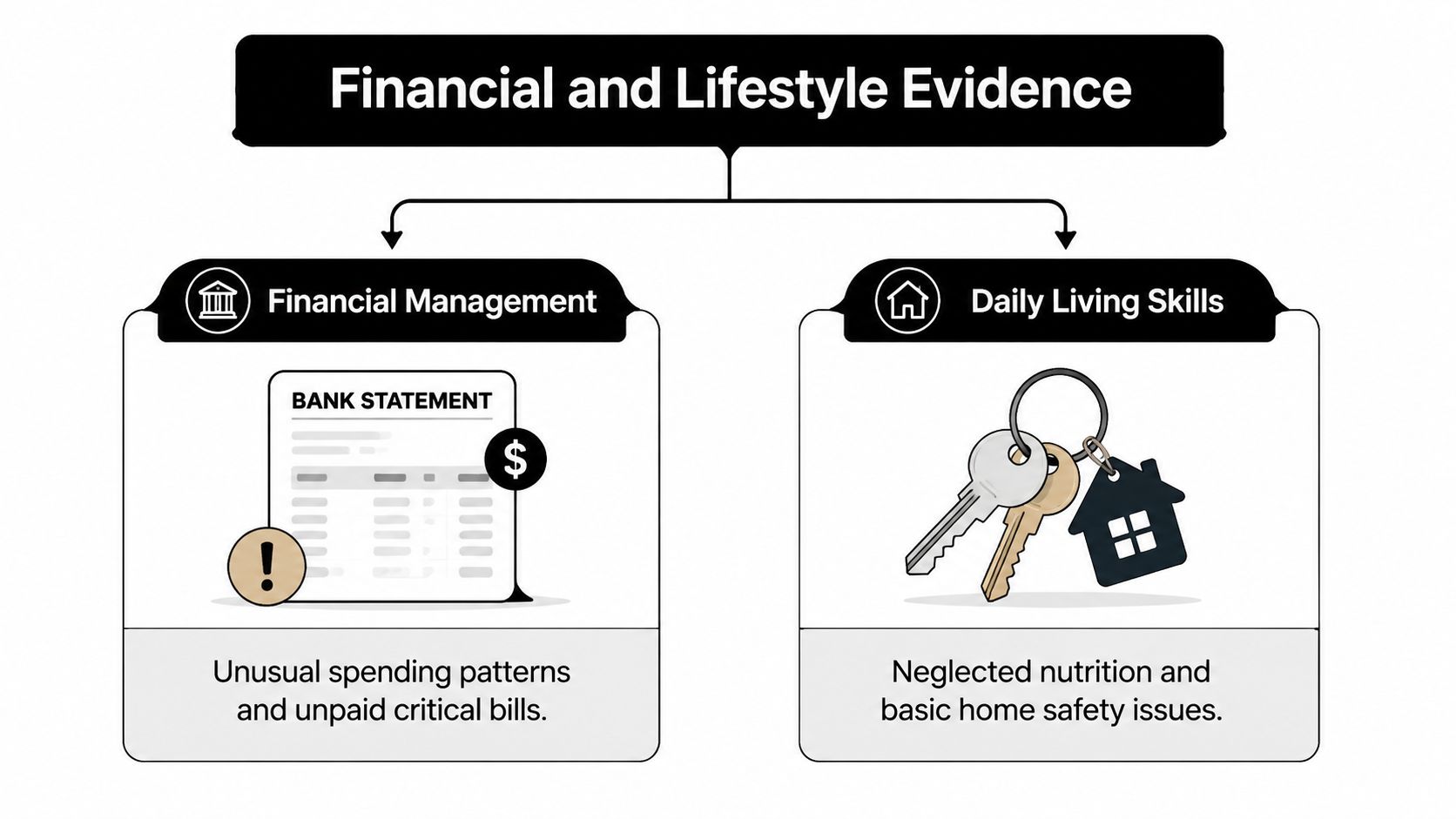
- Bank records showing regular bill payment and no pattern of chaos
- Calendar logs showing kept appointments
- Prescription records showing medications are refilled and taken consistently
- Texts or emails that show coherent decision-making
- Home records showing groceries, utilities, and basic upkeep are being managed
The best version of this evidence is organized on a timeline. A doctor's opinion from one date, bank activity from the same period, and witness observations from that same period can support each other. That kind of alignment is often more persuasive than broad claims that someone is “doing fine.”
When the evidence points the other way
Sometimes families need to prove that a current or proposed guardian is causing harm. In those cases, the records should reconstruct what happened.
Courts want documented proof of harm. Evidence like unexplained bank withdrawals, missed bill payments, or unusual asset transfers can be decisive because they show a possible breach of fiduciary duty, as discussed in this explanation of the process to challenge a guardianship decision in Houston.
A few examples often matter:
- Unexplained transfers from the ward's account to the guardian or the guardian's relatives
- Property transactions that don't appear to benefit the ward
- Tax or utility problems that should not exist if the estate is being managed properly
- Care logs showing visits weren't happening despite claims of regular supervision
Witnesses who help and witnesses who hurt
Witness testimony matters most when it is concrete. A neighbor who says, “She still walks to get her mail, remembers our conversations, and asks me to confirm appointment times,” can help. So can a caregiver who says, “I saw unopened medications, spoiled food, and unpaid notices on the counter.”
Weak witness testimony sounds like this:
- “He's always been stubborn.”
- “She just isn't herself.”
- “I don't trust my brother.”
Stronger testimony answers four questions: what happened, when it happened, who saw it, and why it matters.
Emotional testimony may explain the conflict. Documentary testimony usually decides it.
This is also where rights and duties matter after appointment. Guardians of the person and estate have ongoing obligations under the Estates Code, including reporting and accountings. If those duties aren't met, modification or removal may become appropriate. Families often also need to think beyond litigation and consider related planning tools through Estate Planning and Probate if a dispute touches trusts, beneficiary issues, or property transfers.
Proving a Less Restrictive Alternative Is Sufficient
Some of the strongest guardianship contests don't try to prove the person is perfect. They prove that full guardianship is too much.
That argument can be very effective when the evidence shows the person can function safely with support. Texas courts are supposed to consider less restrictive alternatives and the ward's best interests. A contest built around supported independence often has more credibility than one built around denial.
What the court needs to see
Saying “we can help her” isn't enough. The court usually needs proof that the support system already works or can be put in place immediately and reliably.
That proof may include:
- A valid Durable Power of Attorney
- A Medical Power of Attorney
- A supported decision-making agreement
- A trust structure or direct bill-pay arrangement
- Care plans, transportation schedules, or medication support systems
- Testimony from the people providing the support
The strongest evidence forms a tight chain proving functional ability. By linking a doctor's findings with proof of intact bill-paying and medication management, a family can rebut an incapacity theory by showing the condition does not prevent self-management, especially with support, under the principles reflected in the Texas Rules of Evidence on relevance and admissibility.
A practical example
Take an older adult with mild cognitive decline. She sometimes forgets names and needs reminders for appointments. Her son files for full guardianship of the person and estate. Her daughter contests.
The daughter's better argument may not be “Mom has no problems.” A more credible argument is this:
- Mom has a valid medical power of attorney.
- Bills are on autopay, with monthly review by her accountant.
- A caregiver visits on weekdays to assist with medications.
- Her physician's notes show she can still state preferences and understand basic choices.
- Her bank records and pharmacy records line up with that picture.
That is the kind of record that shows a judge a full guardianship may be unnecessary.
Why this angle is often overlooked
Most online discussion focuses on proving incapacity. But in real hearings, families often do better when they present a workable alternative. A judge may worry about risk, but still reject a full guardianship if the evidence shows the risk is already being managed through narrower tools.
A short checklist of what usually helps:
- Signed documents that are current and properly executed
- Real-world proof that the plan has been working
- Specific helpers who can testify, not vague promises
- A narrow request that respects autonomy while addressing actual risk
This is often where Guardianship and estate planning overlap. If existing documents are outdated, unclear, or incomplete, the family may need to revise the plan quickly and present that revision to the court.
A Practical Checklist for Gathering Your Evidence
Families often lose time by collecting every paper they can find instead of collecting the right papers first. Start with the issue you need to prove. Then build a file around that issue.
Medical file
If the fight is about capacity, gather the records that show current condition and current functioning.
- Physician examination records that address decision-making ability
- Hospital or clinic notes from the relevant period
- Medication lists and refill history
- Therapy, neurology, or psychological evaluations if they exist
- Discharge instructions after falls, strokes, or other major events
Check dates carefully. A current record with useful detail usually carries more weight than an older, dramatic record that no longer reflects the person's condition.
Financial file
If the fight involves need for a guardian of the estate, suitability of a guardian, or possible misconduct, financial proof becomes central.
Gather items like:
- Bank statements
- Credit card statements
- Tax returns
- Property deeds and closing papers
- Insurance notices
- Utility statements
- Any court-filed inventories or accountings
Make a simple timeline. Mark unexplained withdrawals, missed payments, account changes, or evidence of steady self-management. Don't hand a judge an unsorted stack.
Organizing evidence by month is often more useful than organizing by document type.
Personal and support evidence
This category is where many good cases improve. Families contesting guardianship often need to prove a less restrictive option works. Evidence showing the effectiveness of existing supports, such as a power of attorney or supported decision-making agreement, is essential because Texas law requires courts to choose the least restrictive option that serves the ward's best interests, as discussed in this guide on contesting guardianship in Texas.
That file may include:
- Powers of attorney
- Supported decision-making agreements
- Caregiver schedules
- Appointment logs
- Transportation arrangements
- Texts, emails, or notes showing consistent choices
- Statements from neighbors, social workers, clergy, or caregivers
Before the hearing and after the hearing
Before the hearing, make sure your documents are complete, legible, and grouped by issue. Bring copies for your lawyer and keep a witness list with phone numbers.
During the hearing, listen closely to the legal theory being pushed by the other side. If they claim financial risk, your answer should come from records. If they claim unsafe living, your answer should come from care logs, photos, inspection records, or witness testimony.
After the hearing, keep preserving evidence. If a guardian is appointed, reporting duties continue under the Estates Code. That means annual reports, accountings, and compliance can later become important in a modification, removal, or termination proceeding.
When to Hire an Attorney for Your Guardianship Contest
A guardianship contest can look simple from the outside. Bring the doctor. Bring the bank statements. Tell the judge what happened. In practice, that approach often falls apart because evidence still has to be authenticated, admitted, and tied to the right legal standard.
An attorney helps decide what proof matters and what proof is noise. That includes preparing witnesses, subpoenaing records, cross-examining a proposed guardian, challenging weak medical opinions, and making sure the court hears a coherent story instead of a pile of disconnected concerns. This matters in Harris County Probate Court and in counties without specialized probate benches.
Some cases also need outside experts. For example, if a dispute involves neurodevelopmental conditions, nuanced capacity questions, or the need for specialized evaluation, families may benefit from reviewing resources on medico-legal support for autism and ADHD to better understand how expert assessment can frame functional ability in legal settings.
If you're facing an emergency application, allegations of financial misuse, or a fight over whether a less restrictive alternative is enough, get legal advice early. The Law Office of Bryan Fagan, PLLC handles guardianship establishment, temporary guardianship, contested hearings, compliance issues, and related probate matters, which allows families to address both the immediate hearing and the longer reporting duties that may follow.
A guardianship case affects dignity, safety, money, and family relationships all at once. That's too much to leave to guesswork.
If your family is dealing with a contested guardianship, a temporary emergency filing, or a dispute over whether a guardian is still necessary, schedule a free consultation with Law Office of Bryan Fagan, PLLC. We help Texas families gather the right evidence, understand the Texas Estates Code, and present a clear case that protects both safety and dignity.