Skip to content
An ada accommodations request form is more than just paperwork; it’s the formal key to starting a conversation with an employer about getting the support you need at work due to a disability. This applies whether you are managing your own health condition or fulfilling your duties as a legal guardian. It’s not about asking for special treatment, but about exercising a legally protected right under the Americans with Disabilities Act (ADA). This guide will walk you through the process with clarity and care, helping you understand your rights in Texas.
Understanding Your Right to Reasonable Accommodations
The Americans with Disabilities Act (ADA) can seem complex, but it’s founded on a powerful, straightforward principle: you have a right to reasonable support in the workplace to ensure equal opportunity. For countless families across Texas, especially those navigating the responsibilities of guardianship, this right is a crucial lifeline.
A "reasonable accommodation" is any change to the work environment or the way things are usually done that allows someone with a disability to have the same employment opportunities as everyone else. The key is that the change must be reasonable and not create an “undue hardship”—a significant difficulty or expense—for the employer.
What Is a Reasonable Accommodation?
The concept is flexible and depends on the individual's needs and their job. It could be a physical object, a change in process, or an adjustment to a policy.
- A physical change: An employee with a chronic back issue might request an ergonomic chair to manage pain and remain productive.
- A schedule modification: A caregiver who has Guardianship over a parent with dementia might need a flexible schedule to handle essential medical appointments.
- A policy adjustment: An employee with social anxiety could ask to submit reports over email instead of presenting them in large meetings.
These are not special favors; they are necessary adjustments that empower a capable person to perform their job effectively. For a closer look at the types of support available for specific conditions, this practical guide to Autism Spectrum Disorder accommodations is an excellent resource.
The goal of the ADA is to remove barriers. Whether you're managing your own disability or your duties as a legal guardian, the law gives you a protected way to talk about what you need to succeed.
This is especially critical for caregivers. Imagine you are the legal guardian for your adult child with special needs, a role confirmed by a Harris County probate court. If your child's daily care conflicts with a rigid 9-to-5 workday, requesting a modified schedule is a reasonable accommodation directly tied to your responsibilities under Texas Estates Code, Title 3, Subtitle G. It’s a key piece of the support puzzle, much like putting together a thoughtful special needs plan.
Knowing this right exists is the first step. It shifts your mindset from feeling like you’re making a difficult ask to confidently starting a conversation that federal law protects. The ADA accommodations request form is simply the tool that gets that important dialogue started.
How to Nail Your ADA Accommodation Request Form
Think of your ADA accommodations request form as the official start of a critical conversation with your employer. Getting this document right from the beginning sets the stage for a successful outcome, making it easy for them to understand exactly what you need and why.
The whole process can feel intimidating, but we can break it down into a few manageable parts. It’s about understanding your rights, identifying your specific need, and then clearly communicating it on the form.
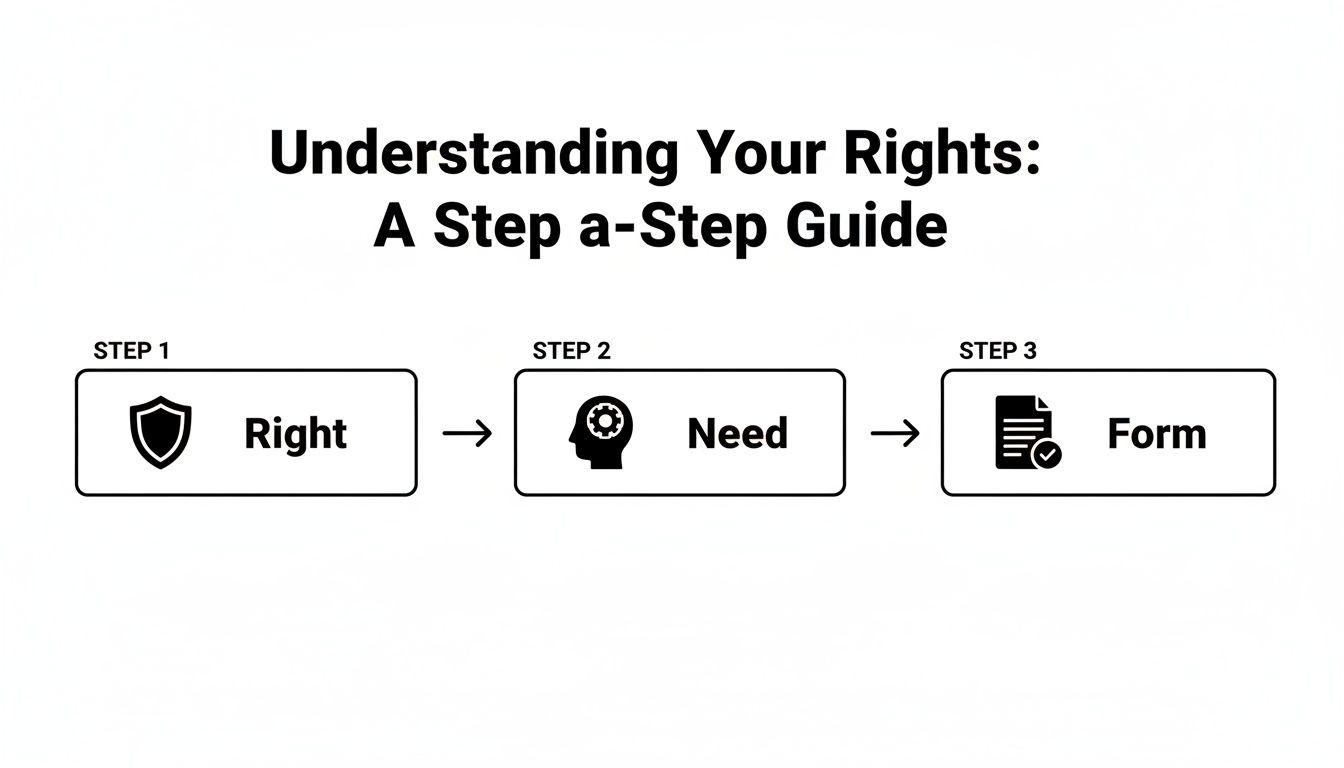
This simple framework helps cut through the legal jargon and gives you a clear path forward.
Be Clear Without Sharing Your Whole Life Story
A common worry we hear from families is about privacy. How much do you really need to tell an employer? The good news is, you are not required to disclose your entire medical history or every detail about your disability or a loved one's condition.
The magic words are limitation and solution. Your focus should stay firmly on how the disability-related responsibilities create a specific barrier to performing your job and what accommodation would remove that barrier.
For example, if you have Guardianship of your father who has Alzheimer's, your request doesn't need to detail his daily challenges. Instead, it should explain how your duties as his guardian create a limitation for you at work.
Key Takeaway: You must connect the disability-related limitation to a specific work-related barrier. The request is about enabling you to perform your job, not about sharing every private detail.
A Practical Example: Juggling Caregiving and Work
Let's walk through a real-world scenario. Imagine you're the court-appointed guardian for your mother in Harris County, a responsibility outlined in the Texas Estates Code. She has frequent, mid-day medical appointments that are essential for her care. Your rigid 9-to-5 schedule makes it impossible to attend them without using all of your sick time, which you need for your own health.
Here’s how you’d frame your request:
- State the Limitation: "My responsibilities as the legal guardian for a family member with a disability require me to attend necessary medical appointments that often occur during standard business hours."
- Propose a Solution: "I am requesting a modified work schedule on the days of these appointments. I propose working from 7:00 AM to 3:30 PM on those days. This adjustment would allow me to fulfill all my job responsibilities while also meeting my legal caregiving obligations."
This approach works. It's professional, proactive, and draws a straight line between your need and a workable solution for your employer.
Breaking Down the Form
To make sure your request is as clear as possible, it helps to structure it logically. Think of it like filling out any other important document where clarity is key.
Below is a table breaking down the key sections you should include in your written request.
Key Sections of an ADA Request Form
A breakdown of the essential components to include in your written accommodation request for maximum clarity and effectiveness.
| Form Section | What to Include | Example Wording |
|---|---|---|
| Personal Information | Your name, position, and contact details. | Standard contact information. |
| Statement of Need | Briefly state that you are requesting an accommodation under the ADA. | "I am writing to request a reasonable accommodation due to my legal responsibilities as a guardian for a person with a disability." |
| Describe the Limitation | Clearly explain the work-related barrier your caregiving duty creates. | "My current work schedule prevents me from attending recurring and necessary medical appointments for a family member under my legal guardianship, as required by my duties." |
| Proposed Accommodation | Suggest a specific, reasonable solution. | "I request a modified schedule, working 7:00 AM to 3:30 PM, on days with pre-scheduled appointments." |
| Connect to Job Functions | Explain how the accommodation will help you perform your essential job duties. | "This schedule change will allow me to maintain my full-time hours and complete all essential job functions without disruption." |
Structuring your request this way leaves no room for confusion and shows that you've thought through a practical solution.
Common Mistakes That Can Derail Your Request
A carefully written request can head off problems before they start. We have seen too many valid requests get denied or delayed because of a few simple, avoidable mistakes.
Watch out for these common pitfalls:
- Being too vague: Saying "I need more flexibility" is easy to dismiss. Get specific about what you need and why.
- Making demands: Your request should feel like a proposal for a partnership, not an ultimatum.
- Failing to connect the dots: Always explain how the accommodation will help you do your job. That’s the entire point of the ADA in the workplace.
- Submitting an incomplete form: Make sure every section is filled out. Much like well-designed patient registration forms that guide users to provide all necessary information, your goal is to give HR everything they need in one go.
If you're staring at a blank form and feeling unsure about the right words to use, or if you're worried about how your employer might respond, you don't have to go it alone. The team at The Law Office of Bryan Fagan is here to help. Schedule a free consultation, and let's talk through your situation with confidence.
Securing the Right Medical Documentation
Your ada accommodations request form is strong, but the right medical documentation is what gives it legal weight. This step isn't about handing over your entire medical history. It's about strategically providing just enough credible information to back up your request and make it legally sound.
It’s absolutely critical to understand what your employer can and cannot ask for. Under the law, they have a right to request documentation that accomplishes two specific things:
- It confirms that the person has a medical condition that legally qualifies as a disability under the ADA.
- It explains why the accommodation you’re asking for is necessary because of that disability.

They are not entitled to the person's entire medical file or even a specific diagnosis unless you choose to share it. The entire conversation must stay focused on the functional limitations and how the accommodation helps you do your job.
What to Ask Your Doctor to Include
When you go to the doctor, you need to be direct and specific about what the letter needs to say. A vague, one-sentence note won't cut it. Your goal is to walk out with a letter that draws a clear, professional line between the medical reality and the workplace solution you need. This documentation can come from a range of healthcare providers, including a primary physician, a specialist, or a licensed therapist.
Here’s a quick checklist to help guide your conversation with your provider:
- A clear statement confirming a physical or mental impairment.
- An explanation of how this impairment “substantially limits” one or more major life activities (which includes major bodily functions and activities like working).
- A description of the specific, work-related challenges or limitations caused by the condition.
- A professional recommendation for the exact accommodation you’re requesting, explaining how it will enable you to perform the essential duties of your job.
Remember, the letter should center on professional medical opinion. For example, a doctor might write, “The patient’s condition causes significant pain and difficulty with prolonged sitting. An ergonomic chair is medically necessary to allow them to perform their core job functions without exacerbating their condition.”
Guardianship and Caregiver Accommodations
For many Texas families navigating Guardianship, the need for accommodation often falls on the caregiver, not the person under guardianship (the "ward"). If you are the legal guardian for a parent with dementia or an adult child with special needs, your ability to work can be significantly impacted.
In these cases, documentation is still the cornerstone of your request. While your own medical history isn't the point, documents from your ward's care team are. For example, if you have guardianship over a loved one, a letter from their doctor explaining a demanding care schedule can powerfully support your request for a modified work schedule or remote work.
Don't forget the power of official paperwork. Court documents from a Harris County or Travis County probate court that officially establish you as a guardian are solid proof of your legal responsibilities under the Texas Estates Code. Combining these formal records with medical notes about your ward’s needs creates a compelling case for why you require accommodation. Some of these needs might be met through state programs; our guide on Medicaid waiver programs in Texas offers more details on these support systems.
We understand that sharing any health-related information can feel incredibly sensitive. That's why the ADA has strict confidentiality rules requiring employers to keep your medical documents in a separate, secure file. This information should only be shared with managers who have a legitimate, need-to-know reason.
If your employer is pushing for more information than they're entitled to or denies a request that you've backed with solid documentation, it might be time to get legal advice. Our team at The Law Office of Bryan Fagan is here to help Texas families protect their rights every day.
Navigating the Interactive Process With Your Employer
Submitting your ADA accommodations request form isn't the final step—it’s the beginning of a critical, legally required conversation with your employer. This dialogue is officially known as the "interactive process." Your employer has a legal obligation to engage in this good-faith discussion with you to find an effective and reasonable solution.
This isn't a negotiation where you're expected to fight for your rights. Think of it more as a collaborative, problem-solving session. The law requires your employer to come to the table, listen to your needs, and seriously explore potential accommodations that will work.

This part of the process can feel intimidating, but being prepared will empower you to guide the conversation productively and with compassion.
What a Good-Faith Discussion Looks Like
A productive interactive process is a two-way street. Both you and your employer have a role to play in landing on a solution that works. A positive and lawful discussion generally includes:
- Prompt Communication: Your employer should acknowledge your request and schedule a time to discuss it without unreasonable delays.
- Exploring Options: They should discuss the solution you proposed. If they have concerns about it, they need to explore alternative accommodations with you.
- Focusing on Solutions: The conversation should stay focused on one thing: how to remove the workplace barrier so you can perform your essential job functions.
For example, we've seen cases where a guardian in Dallas County requested a predictable work-from-home day to manage care for a loved one. The employer might counter by offering a different day or a flexible start/end time instead. This back-and-forth is a normal part of the process, as long as the alternative they suggest is also effective for your situation.
The core of the interactive process is mutual engagement. An employer cannot simply say "no" without a valid reason and without first discussing other possibilities. Their responsibility is to work with you.
Documenting Every Step
From the moment you submit that form, documentation is your best friend. Keeping a clear, written record of all communications provides a timeline and holds both parties accountable. It creates a professional paper trail that can be invaluable if a dispute arises.
Practical Steps for Documentation:
- The date and time you submitted your ADA accommodations request form.
- The names and titles of every person you speak with.
- Summaries of every conversation—whether it was in-person, on the phone, or via video call.
- Copies of all emails and any other written correspondence.
After any verbal conversation, it’s a smart practice to send a brief follow-up email. Something as simple as, “Thank you for meeting with me today. To confirm, we discussed A, B, and C, and the next step is for you to look into X,” creates a powerful, time-stamped record of your discussion.
Warning Signs of Unlawful Resistance
While most employers in Texas understand their obligations, some may unlawfully resist or fail to engage in the interactive process. Knowing these red flags can help you identify when you might need to seek legal support.
Watch for these signs:
- Ignoring Your Request: The employer doesn't respond to or acknowledge your form for weeks.
- Outright Refusal: They deny your request flat out, without any discussion or explanation.
- Requesting Excessive Medical Information: They demand the ward's entire medical file instead of just the documentation related to your specific limitation.
- Retaliation: Suddenly, your hours are cut, you’re given undesirable assignments, or you face other negative actions right after making the request.
If you run into these roadblocks, especially after you've provided clear documentation, it’s a signal that your rights may be at risk. At this point, professional guidance is no longer just helpful—it's essential.
Navigating a difficult interactive process alone can be overwhelming. If you feel your employer isn't acting in good faith, The Law Office of Bryan Fagan can help. Schedule a free consultation to ensure your rights as an employee and caregiver are fully protected.
What to Do When Your Accommodation Request Is Denied
Receiving a denial for your ADA accommodations request form can feel like hitting a brick wall. It’s discouraging, but it is rarely the end of the road. Whether you're an employee with a disability or a caregiver handling responsibilities under a Guardianship, you have a clear path forward. The first step is to understand why they said no.
It’s important to know that not every denial is illegal. An employer can legally turn down a request if it causes an "undue hardship"—a significant difficulty or expense for the business. They can also say no if the accommodation isn't medically required for you to perform the essential parts of your job.
But a denial crosses into unlawful territory if it’s given without a legitimate reason, if your employer refuses to discuss it with you (failing the "interactive process"), or if it feels like punishment for asking in the first place.
Understanding the Reason for Denial
Your employer should tell you in writing why they denied your request. That explanation is critical. For instance, let's say you're a guardian and you asked to work 100% remotely, but your job requires hands-on tasks at the office. Your employer might deny that specific request as unreasonable.
Even so, they are still required by law to discuss other options. Perhaps a hybrid schedule would work. Or maybe flexible hours could solve the problem.
If the reason they give is vague or doesn’t seem right, it's time to open a dialogue. A professional, written follow-up asking for more clarification is a surprisingly powerful next move.
Appealing the Decision Internally
Before taking the issue outside the company, it’s usually best to use the internal appeal process. This might mean talking to a higher-level manager or a different person in HR.
- Review Your Original Request: Did your form and doctor’s note clearly show the link between the disability-related need and the specific help you asked for? Make sure the connection is obvious.
- Provide More Evidence: If the denial mentioned a lack of information, go back to your doctor. A more detailed letter can make all the difference. For caregivers, this might mean getting more documentation about your ward’s specific needs and your role.
- Suggest Alternatives: Show them you’re willing to work together. If your first idea was denied because of "undue hardship," come to the appeal with one or two backup solutions. This is a practical step you can take during a dispute.
A denial is not a "no" to all accommodations; it is a "no" to that specific request. Your employer's duty to engage in the interactive process doesn't end. You should use the appeal to reopen that conversation.
Escalating to an External Agency
If your internal appeal goes nowhere, or if your employer simply refuses to cooperate, you can take your case to an outside agency. In Texas, you have two main options for filing a formal complaint:
- The Texas Workforce Commission (TWC) Civil Rights Division: This is the state agency that investigates claims of employment discrimination, including ADA violations.
- The U.S. Equal Employment Opportunity Commission (EEOC): This is the federal agency that enforces the ADA across the country.
Filing a complaint is a major legal step. Once you do, the agency will launch an investigation, which could lead to mediation or even a lawsuit. At this stage, having an experienced attorney on your side is essential. For caregivers, figuring out your rights can feel as complicated as securing benefits for your loved one. For more on that, you can check out our guide on Social Security benefits for disabled adults.
When your duties as a guardian in a Tarrant County or Bexar County case are the reason you need an accommodation, you need a lawyer who understands both employment law and guardianship law. The team at The Law Office of Bryan Fagan is here to protect your rights and walk you through this process. Schedule a free consultation to get the help you deserve.
Frequently Asked Questions About ADA Requests in Texas
Navigating the ADA process for the first time brings up many questions. It can feel confusing, and you want to make sure you get it right from the start. Let's walk through some of the most common concerns we hear from Texas families and employees as they prepare an ada accommodations request form.
Can My Employer Ask for My Entire Medical History?
Absolutely not. While it might feel like your employer has a lot of power, their right to private medical information is strictly limited.
They are only allowed to ask for documentation that does two things: confirms there is a disability as defined by the ADA and explains why the specific accommodation you’re asking for is medically necessary. They cannot go on a fishing expedition for complete medical records or demand a specific diagnosis.
Does the ADA Protect My Role as a Caregiver?
This is a fantastic question, and the answer is yes, in a specific way. While the ADA’s primary focus is on protecting individuals with their own disabilities, it includes a critical "association" provision. This rule prevents an employer from discriminating against you simply because you have a relationship with someone who has a disability.
For caregivers, this provision can be a powerful tool. It is often used to support requests for things like a modified work schedule needed to provide care for a loved one. This is especially true if you have been appointed as their legal guardian in a Texas court under the Texas Estates Code.
This protection is a key part of Guardianship, where your legal duties often demand a certain level of flexibility from your workplace.
What if My Employer Offers a Different Accommodation?
An employer doesn't have to provide the exact accommodation you requested, which can be frustrating. However, the alternative they offer must still be effective. It needs to successfully remove the barrier that's preventing you from performing your job.
This is where the "interactive process" becomes so important. You should engage in a good-faith conversation with your employer to discuss why their suggestion may or may not work as well as your original request.
How Long Does My Employer Have to Respond?
The ADA doesn't give a hard-and-fast deadline, like 30 or 60 days. Instead, the law states that employers must respond and engage in the interactive process "promptly."
What does "promptly" mean? It's subjective, but unreasonable or unexplained delays can be seen as a violation of the law. This is precisely why it’s so critical to document every phone call, email, and meeting, including the date of each interaction. That paper trail is your best evidence of the steps you've taken.
Navigating an ADA request, especially when it’s tied to your duties as a guardian, requires a blend of legal knowledge and compassion. The attorneys at The Law Office of Bryan Fagan, PLLC have helped countless Texas families protect their rights in these exact situations. For personalized guidance on your case, schedule a free, no-obligation consultation with our team by visiting us at https://texasguardianshiplawyer.net.