Skip to content
Navigating social security benefits for a disabled adult can feel overwhelming, like trying to solve a puzzle with half the pieces missing. We understand that when you're caring for a loved one, the last thing you need is more confusion. These federal programs, however, are absolutely crucial financial lifelines. The two main programs are Social Security Disability Insurance (SSDI), which is tied to a person's work history, and Supplemental Security Income (SSI), which is based on financial need.
Figuring out which program fits your loved one's situation is the first, and most important, step toward securing their financial future. Our mission is to guide Texas families through these complexities with clarity and care.
Your Guide to Social Security Benefits in Texas
For families here in Texas, understanding social security benefits for disabled adults is a vital part of planning for long-term care. Whether you're in Harris County, Fort Bend County, or anywhere else in our great state, these federal programs can provide a steady monthly income and, just as importantly, access to healthcare.
We recognize the emotional and financial challenges families face. The path forward might seem complicated, but with the right information and compassionate guidance, you can tackle it with confidence.

SSDI and SSI: The Two Main Lifelines
The Social Security Administration (SSA) offers two very different types of disability benefits. It helps to think of them as two separate roads to financial support, each with its own map and rules.
- Social Security Disability Insurance (SSDI): This program works like an insurance policy. It’s for adults who have worked and paid Social Security (FICA) taxes long enough to build up what the SSA calls "work credits."
- Supplemental Security Income (SSI): This is a needs-based program. SSI is designed for disabled adults (and children) who have very limited income and few financial assets, regardless of their work history.
We understand the sheer emotional and financial weight that comes with caring for a disabled family member. These programs were created to help lift some of that burden. Their impact is huge—in the United States, roughly 12.5 million working-age Americans receive disability benefits through SSDI and SSI. You can explore more about the national scope of these disability benefits and see the latest data.
Quick Comparison: SSDI vs. SSI for Texas Families
Sometimes, seeing the key differences side-by-side makes everything click. Here’s a quick breakdown to help you distinguish between the two programs.
| Feature | Social Security Disability Insurance (SSDI) | Supplemental Security Income (SSI) |
|---|---|---|
| Eligibility Basis | Based on your work history and FICA tax contributions | Based on limited income and financial resources |
| Work History | Required. You must have enough "work credits." | Not required. |
| Income/Asset Limit | No strict limits on assets, but work income is capped | Strict limits on both income and resources |
| Benefit Amount | Varies based on your lifetime earnings record | A fixed federal monthly amount (may be reduced) |
| Healthcare | Qualifies you for Medicare after a 24-month wait | Often qualifies you for Medicaid immediately |
| Family Benefits | Certain family members may also receive benefits | Benefits are only for the individual |
This table is just a starting point. The specific rules for each program have many nuances, but this should give you a clear initial picture of which path might be the right one for your loved one.
Why This Matters for Texas Families
The process of applying for and managing these benefits often intersects directly with Texas law, especially when a loved one is unable to manage their own finances. This is where concepts like Guardianship become critically important. A guardian, appointed by a Texas court like the Harris County Probate Court, may be necessary to handle a disabled adult's benefits, ensuring the funds are used properly for their care.
Trying to follow the SSA's rules while also keeping up with the requirements of the Texas Estates Code (Title 3, Subtitle G) can be a real challenge. Our goal is to demystify this process and provide you with clear, practical steps. For personalized guidance on how these benefits interact with guardianship, probate, or your family's Estate Planning, we are here to help. Schedule a free consultation to discuss your unique situation.
Understanding SSDI vs. SSI Eligibility
When you first start looking into Social Security benefits for a disabled adult, it's easy to feel like you're drowning in an alphabet soup of government programs. The two you absolutely need to know are SSDI and SSI. While they both offer a financial lifeline, they operate in completely different ways.
Think of it like this: SSDI is like an insurance policy you've paid into through years of hard work. SSI, on the other hand, is a safety net program based purely on financial need. Grasping this core difference can save your family a world of frustration and point you down the right path.
SSDI: The Insurance You Earned
Social Security Disability Insurance (SSDI) is directly tied to a person's work history. To qualify, an adult needs to have worked long enough—and recently enough—to have paid a certain amount in Social Security (FICA) taxes. The system tracks this through what the Social Security Administration (SSA) calls "work credits."
You earn these credits simply by working and paying your taxes. The exact number of credits needed depends on the person's age when they became disabled. It's a straightforward concept: a program for those who contributed to the system and then, through no fault of their own, found themselves unable to keep working.
For a deeper dive, a guide to understanding Social Security Disability requirements can be a huge help. It breaks down technical rules, like the work credit system, into plain English.
Hypothetical Scenario: Maria in Houston
Maria was a dedicated teacher in Harris County for over 20 years. When a degenerative medical condition forced her into early retirement, she had a substantial work history. Because she consistently paid FICA taxes, she had more than enough work credits to qualify for SSDI. Her monthly benefit amount is calculated based on her average lifetime earnings. This provides her with a stable income that she earned through her years of service.
SSI: The Needs-Based Safety Net
Supplemental Security Income (SSI) is a completely different program. It has nothing to do with a work history. SSI is a program based strictly on financial need, designed to help aged, blind, and disabled people who have very little income and few resources.
This program serves as a critical lifeline for adults who may have never been able to hold a job or who didn't work long enough to be eligible for SSDI. Be aware, though, that the financial eligibility rules for SSI are incredibly strict. The SSA will scrutinize an individual's income, bank accounts, property, and any other assets to make sure they fall below a very low threshold.
This distinction is crucial for families planning for the future.
Hypothetical Scenario: David in Dallas
David is a young adult in Dallas who has lived with a significant disability since birth, which prevented him from ever holding a job. His family has provided for him, but he has no personal work history and almost no financial assets to his name. David's path to benefits would be through SSI. His eligibility is based entirely on his disability and his financial need, not on past employment. The monthly SSI payment helps his family cover his basic needs for food and shelter.
Figuring out if your loved one's situation is more like Maria's or David's is the first, most important step. If you're feeling stuck on which program to apply for or how a guardianship under the Texas Estates Code might play a role, you are not alone. These are complex issues with serious consequences for your family's future.
Navigating the Application and Appeals Process
Starting the application for Social Security benefits can feel like standing at the entrance to a massive maze. The paperwork seems endless, and the process adds another layer of stress when you're already focused on your loved one's health. We want to break this journey down into clear, manageable steps so you can find your way through with confidence.
First things first: preparation is your most powerful tool. Before you even start the online application, taking the time to gather every necessary document can save you from major delays. Think of it like packing for a long trip—having everything you need from the start makes the entire journey smoother.
Your Essential Application Checklist: A Practical First Step
The Social Security Administration (SSA) needs a detailed, crystal-clear picture of your loved one's medical condition and work history. Being thorough here isn't just a good idea; it's critical.
- Medical Records: Collect comprehensive records from every single doctor, therapist, hospital, and clinic involved in their care. This means diagnoses, treatment histories, lab results, and detailed physician notes.
- Work History: Put together a list of every job they've held in the last 15 years. Include job titles, a description of the duties performed, and the dates of employment. This is absolutely vital for an SSDI claim.
- Personal Information: Have the basics ready to go. This includes their birth certificate, Social Security number, and proof of U.S. citizenship or legal resident status.
Once you have everything organized, you can start the application online, by phone, or in person at a local Texas office. Accuracy and detail are everything. Double-check every single entry, because that initial effort can dramatically increase the odds of a first-time approval.
Understanding the Reality of Denials
It’s a tough but necessary truth: many initial applications for social security benefits for disabled adults are denied. Seeing that denial letter can feel devastating, but it is crucial to remember this is often not the end of the road. For many people, it’s a standard part of the process.
A denial is not a final judgment on your loved one’s disability. It's an invitation to provide more evidence and make a stronger case. Don't let it discourage you.
The key is to act quickly. You generally have only 60 days from the date you receive the denial notice to file an appeal. If you miss that deadline, you’ll most likely have to start the entire application over from scratch, which means an even longer wait for the support your family needs.
The Four Levels of the Appeals Process
If your initial claim is denied, the SSA has a structured appeals system. Each level gives you another chance to have your case reviewed.
- Reconsideration: Your first step. Someone new at the SSA—who wasn't involved in the first decision—will review your entire file, along with any new evidence you submit.
- Hearing by an Administrative Law Judge (ALJ): If the reconsideration is also denied, you can request a hearing. This is a huge step, as it's your opportunity to present your case in person before a judge. You can bring in witnesses, like medical experts, to testify about your loved one’s condition.
- Appeals Council Review: If the ALJ’s decision is unfavorable, you can ask the Social Security Appeals Council to review it. The Council looks for legal or procedural errors the judge might have made, but be aware, they can choose whether or not to even hear the case.
- Federal Court Review: The final option is to file a lawsuit in a U.S. District Court. This is a major legal action and absolutely requires the guidance of an experienced attorney.
Navigating an appeal, especially a hearing before a judge in a place like the Harris County court system, can be incredibly intimidating. This is often the point where professional legal help becomes invaluable. An attorney who understands both SSA regulations and the specific complexities of Texas guardianship law can help build the strongest possible case for your loved one.
If you're facing a denial or just feel overwhelmed by the application process, remember that support is available. Schedule a free consultation with us to talk through your situation and get clear, compassionate direction on what to do next.
How Guardianship and a Representative Payee Work
When a loved one receives social security benefits for a disabled adult but cannot manage their own money, a critical question arises: who handles the funds? This is where the Social Security Administration (SSA) and Texas law work together to protect the individual. The SSA will appoint someone called a Representative Payee to manage the benefits.
This is a role built on serious trust. The payee is responsible for using the funds for the disabled adult’s essential needs—like housing, food, and medical bills. They must also keep detailed records of how every penny is spent and report back to the SSA. It’s a crucial duty designed to prevent financial abuse and ensure benefits are used as intended.
The Guardian and Payee Distinction
Here in Texas, many families go through the legal process of establishing a Guardianship to protect a disabled adult. It's a common point of confusion, but it’s absolutely vital to understand that a court-appointed guardian and an SSA-appointed Representative Payee are two completely separate roles.
A guardian is appointed by a Texas court, like the Harris County Probate Court, following the rules in the Texas Estates Code (Title 3, Subtitle G). This role can grant legal authority over the person's healthcare, living situation, and overall finances. A Representative Payee, on the other hand, is appointed only by the SSA and has authority only over the Social Security benefits.
The journey to getting these benefits in the first place can feel like a marathon, as this graphic shows.
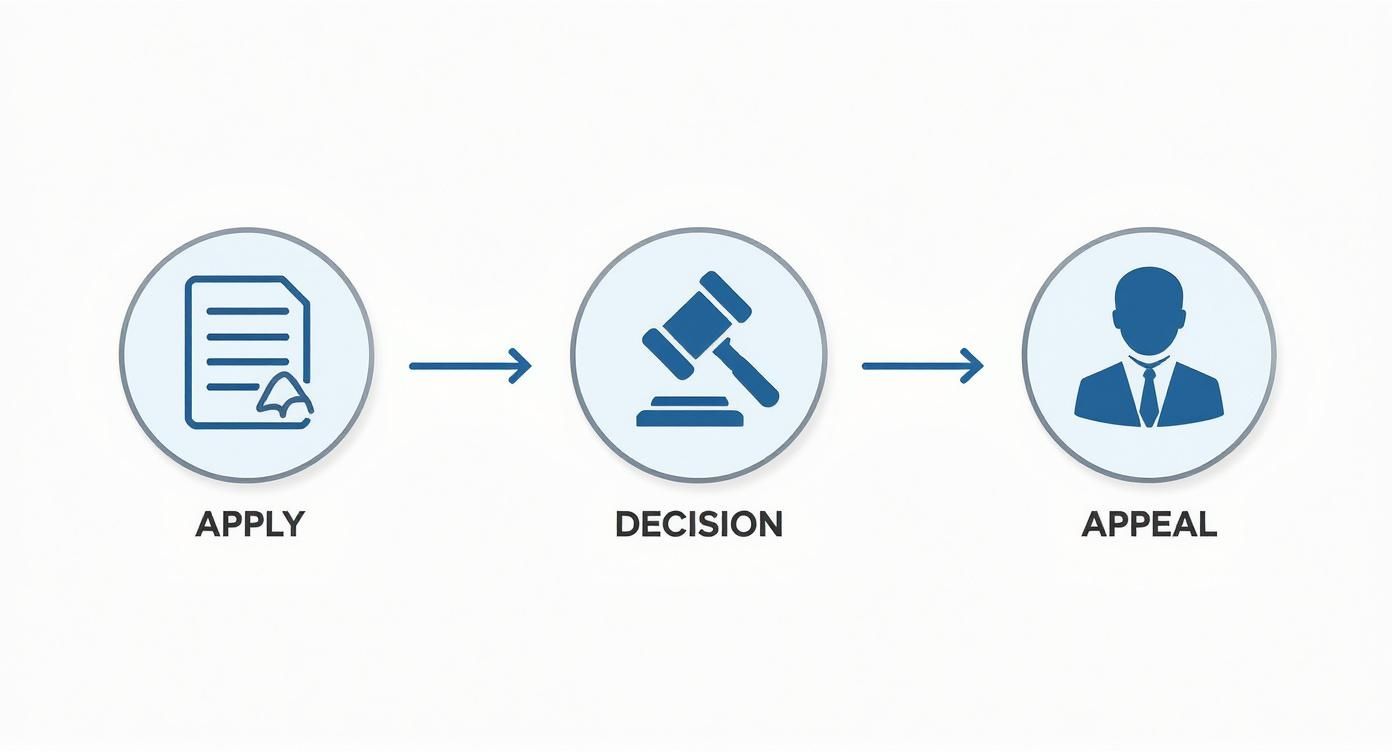
As you can see, the path often has multiple stages. Knowing your role as a potential payee or guardian right from the start makes the whole process much smoother.
A Practical Example in Montgomery County
Let's walk through a common scenario to make this crystal clear.
Imagine a parent in Montgomery County who has just been appointed the legal guardian of their adult son, who has a significant intellectual disability. Because the son cannot manage his finances, the parent also needs to apply to the SSA to become his Representative Payee to handle his SSI checks.
While the SSA almost certainly approves a court-appointed guardian for the payee role, it’s not automatic. The parent must complete the SSA’s separate application process. Once approved, they will have two different sets of legal duties: one to the Texas court as a guardian, and another to the federal government as a payee. Our firm has extensive experience explaining how Social Security and guardianship in Texas intersect, and we can help you fulfill both roles correctly.
Fulfilling Your Duties Correctly
Understanding what’s required of you is key to protecting your loved one and staying on the right side of the law. Both roles demand careful attention to detail and a total commitment to acting in the disabled person's best interests.
As a Guardian, your duties to the court may include:
- Filing an annual accounting of all the person's finances.
- Making decisions about their medical care and living arrangements.
- Protecting their personal property and assets.
As a Representative Payee, your duties to the SSA include:
- Using benefits for current needs like housing, food, and clothing.
- Saving any leftover funds in a dedicated, protected bank account.
- Keeping detailed records of all income and expenses.
- Submitting an annual report to the SSA showing how the money was used.
The need for these protective roles is massive. An estimated 1.3 billion people worldwide live with a significant disability, which really underscores why systems like these are so important.
Juggling these responsibilities can feel overwhelming, especially when you’re already focused on day-to-day care. If you're considering guardianship or have been asked to be a Representative Payee, you don’t have to figure it all out alone. Schedule a free consultation with our team for compassionate, clear guidance tailored to your family’s unique situation.
How Income and Resources Affect Eligibility
The financial rules for Social Security benefits, especially for Supplemental Security Income (SSI), can be a huge source of stress for families. It often feels like walking a tightrope. One small misstep—like a well-meaning gift from a grandparent or an unexpected inheritance—could suddenly jeopardize the monthly support your loved one absolutely depends on.
Understanding exactly what the Social Security Administration (SSA) considers "income" and "resources" is the key to navigating this landscape with confidence. This is where a little bit of planning goes a very long way.

Defining Income and Resources
The SSA has very specific definitions for what they look at when deciding if someone qualifies for SSI. Getting these straight is the first step to protecting those benefits.
- Income: This isn't just a paycheck. It includes money earned from a job, but also funds from other places like pensions or even direct help from family. The SSA can even count things like free food or shelter as a form of income.
- Resources: Think of these as assets you own. This covers cash, money in bank accounts, stocks, and property (but not the home you live in).
The limits are notoriously strict. For an individual to stay eligible for SSI, their total countable resources can't be more than $2,000. That incredibly low number is precisely why proactive financial planning isn't just a good idea—it's essential.
Protecting Eligibility with Smart Financial Tools
The great news is that families in Texas have access to powerful legal tools designed for this exact situation. These tools allow you to provide for your loved one's future without risking the essential social security benefits for disabled adults they need today. The two most common are ABLE accounts and Special Needs Trusts.
These aren't just about managing money; they're about creating peace of mind. They ensure your loved one can enjoy a better quality of life without being penalized by rigid government rules.
Think of these tools as creating a protective shield around your loved one's assets. They build a legal barrier that prevents funds meant for their care and well-being from being counted against them by the SSA.
ABLE Accounts and Special Needs Trusts
While they serve a similar purpose, these two options work a bit differently. Knowing the basics can help you start the conversation about what makes sense for your family.
- ABLE (Achieving a Better Life Experience) Accounts: These are tax-advantaged savings accounts specifically for individuals with disabilities. The money can be used for qualified disability-related expenses—like housing, education, and transportation—without affecting SSI or Medicaid eligibility.
- Special Needs Trusts (SNTs): An SNT is a more flexible legal arrangement where a trustee manages funds for the benefit of the disabled person. These are ideal for holding larger sums of money, like an inheritance or a legal settlement, without disrupting benefits. You can get a deeper understanding of how a Special Needs Trust in Texas can provide true long-term financial security.
Setting these tools up correctly is critical. It requires careful legal work to make sure they comply with both federal SSA regulations and the Texas Estates Code. A simple mistake in drafting a trust document could have devastating consequences for your loved one's benefits.
Navigating the intersection of benefit eligibility and long-term financial planning is complex. If you want to secure your loved one's future while protecting their current benefits, personalized legal guidance is crucial. Schedule a free consultation to discuss how our estate planning and guardianship experience can help your family build a secure future.
Coordinating Social Security with Health Insurance
For Texas families with a disabled loved one, ensuring they have consistent, reliable healthcare is often the biggest worry. It can be confusing to figure out how Social Security benefits connect to health insurance, but once you understand the basics, you're in a much better position to build a stable long-term care plan.
The type of Social Security benefit your loved one receives directly determines which health insurance program they can get. These two paths—Medicare and Medicaid—are completely different, and getting this distinction right from the start is absolutely essential to avoid any gaps in medical coverage.
The SSDI Path to Medicare
If your loved one qualifies for Social Security Disability Insurance (SSDI) because of their work history, they will eventually get Medicare. The key word here is eventually. It's critical to know that this coverage isn't immediate.
There is a mandatory 24-month waiting period that starts after the first month they are entitled to receive their SSDI cash benefits. This gap can leave a person uninsured for two full years, which makes careful planning a necessity. A practical guide on how to compare health insurance plans can be an invaluable resource during this time, helping you explore private or marketplace options to bridge that gap.
The SSI Path to Medicaid
For those who qualify for the needs-based Supplemental Security Income (SSI) program, the connection to healthcare is much more direct. In Texas, when a person is approved for SSI, they are typically automatically eligible for Medicaid.
This immediate access is a crucial lifeline. It provides comprehensive coverage for doctor visits, hospital stays, and prescription medications without that long, stressful waiting period. For families who need immediate and ongoing medical support for their loved one, this automatic eligibility removes a massive layer of worry.
Understanding the link between SSI and Medicaid is vital for families. This connection forms the bedrock of a stable healthcare plan, allowing you to focus on care rather than coverage.
This is especially true when you start thinking about long-term care solutions. Many Texas families find it helpful to learn more about the different options available. Our firm offers a detailed overview of Medicaid waiver programs in Texas, which can provide significant additional support.
Coordinating these benefits and healthcare systems requires real attention to detail. If you are a guardian or caregiver in communities like Harris or Montgomery County and feel uncertain about how to piece all this together, you are not alone. These are complex systems, but with the right guidance, you can build a secure health plan for your loved one.
Common Questions from Texas Families
When you're trying to line up Social Security benefits and a potential guardianship, it’s natural for a lot of practical questions to come up. Below, we've tackled some of the most common concerns we hear from families across Texas, offering clear, straightforward answers to help you find your footing.
Can my adult child get benefits based on my work record?
Yes, in many cases, this is possible through a program for an “Adult Child with a Disability.” If you’re receiving retirement or disability benefits yourself (or if you’ve passed away), your adult child might be able to draw benefits from your work record instead of their own.
The key requirement is that their disability must have started before they turned 22 years old. This is a critical lifeline for individuals who have dealt with lifelong conditions and never had the chance to build a substantial work history of their own.
What happens to benefits if my loved one is hospitalized?
How a hospital stay affects benefits depends on which type of benefit they receive and how long they are admitted.
- SSDI: For the most part, Social Security Disability Insurance benefits aren't affected by hospital stays. Since these are earned benefits, they continue as usual.
- SSI: Supplemental Security Income is more complex. Because it's a needs-based program, if Medicaid covers more than half the cost of their hospital care, SSI payments can be reduced or even stopped after a certain amount of time. It's vital to report any hospitalization to the Social Security Administration (SSA) right away to prevent any overpayments that you'd have to pay back later.
Staying on top of these rules can save you from unexpected financial stress. Always keep the Social Security Administration in the loop about changes in living situations to make sure benefits are calculated correctly.
Can we appeal an unfavorable decision from a judge?
Absolutely. If you’ve gone through a hearing and disagree with the decision made by the Administrative Law Judge (ALJ), you have the right to appeal. The next step is to ask the Social Security Appeals Council to review the case.
The Council's job is not to rehear the case, but to look for specific legal or procedural mistakes the judge may have made. If the Council turns down your request or you don't agree with their finding, your last resort is to file a lawsuit in a U.S. District Court. At this stage, having a skilled attorney is non-negotiable, as navigating the federal court system is incredibly complex.
Successfully weaving together the requirements of Texas guardianship law, found in the Texas Estates Code, with the intricate rules of federal Social Security regulations demands a sharp eye for detail.
Trying to secure your loved one's future can feel like a maze, but you don't have to find your way through it alone. For personalized help with establishing a guardianship or coordinating benefits, get in touch with The Law Office of Bryan Fagan, PLLC to schedule a free, no-obligation consultation. We are here to provide the compassionate, professional guidance your family deserves.
We've compiled a quick-reference table to answer some of the most pressing questions families have when navigating Social Security benefits for a disabled adult.
| Question | Answer |
|---|---|
| Can an adult with a disability get benefits from a parent's record? | Yes, if their disability began before age 22. This is part of the "Adult Child with a Disability" program and is a crucial option for those unable to build their own work history. |
| Do SSDI benefits stop during a hospital stay? | Generally, no. Social Security Disability Insurance (SSDI) is an earned benefit and is not typically affected by hospitalization. |
| Do SSI benefits stop during a hospital stay? | They might. If Medicaid is paying for more than half of the care, Supplemental Security Income (SSI) payments can be reduced or stopped. It's essential to report the hospitalization to the SSA immediately. |
| What happens if an Administrative Law Judge denies a claim? | You can appeal the decision. The first step is to request a review from the Social Security Appeals Council. If that fails, the final option is to file a lawsuit in U.S. District Court, which requires experienced legal representation. |
Hopefully, this summary provides some quick clarity. Remember, every situation is unique, and getting advice tailored to your specific circumstances is always the best path forward.