Skip to content
A daughter in Houston notices her father is up late sending money through payment apps to people he's never met. A husband in Harris County learns his wife can no longer manage her email or online bank logins after a medical crisis, but the companies won't talk to him. A grandparent caring for a teen worries about harmful messages, fake accounts, and strangers reaching out through social media.
Those problems don't feel like “digital asset” issues when you're living through them. They feel personal, urgent, and frightening.
Texas families now deal with incapacity as finances, photos, messages, subscriptions, and even identity all live online. That changes what protection looks like. It's no longer only about a house, a checking account, or a car title. Sometimes the danger is sitting in an inbox, a direct message, or a social media account that keeps feeding scams and manipulation.
A Digital World and a Vulnerable Loved One
When families ask whether a guardian can control social media or digital accounts, the question usually comes from a crisis. Someone has already been targeted, confused, isolated, or overwhelmed. A loved one may be clicking fraudulent links, talking to online strangers, or losing access to records that now exist only in the cloud.

For older adults and adults with diminished capacity, online contact can become a doorway to exploitation. For minors, the concern may be harmful messages, bullying, impersonation, or pressure from strangers. Families often need practical safety help before they ever step into a courtroom. For example, if online relationships are part of the risk, resources on how to stay safe on dating apps can help caregivers recognize warning signs and talk about boundaries.
Why this issue feels so urgent
A social media account isn't just entertainment anymore. It may hold private conversations, financial clues, business contacts, family photos, two-factor authentication tools, and account recovery links for other services.
That's why modern guardianship questions are broader than “Can I get the password?” Families are really asking things like:
- Can I stop scam messages: If my mother keeps responding to fake prize offers, can I step in?
- Can I preserve evidence: If someone is manipulating my brother online, can I save messages for court?
- Can I prevent more harm: If my child or dependent adult is being contacted through a platform, can I shut it down?
- Can I recover records: If bills, statements, and medical notifications arrive by email, can I reach them lawfully?
Families usually don't need digital access because they're curious. They need it because something has gone wrong, or they're trying to stop it before it gets worse.
Texas law does offer tools, but it doesn't hand families a universal master key. The legal answer depends on the type of guardianship, the court's order, the person's capacity, and the rules of the platform involved. If you're dealing with privacy concerns for an older adult who is still active online, this discussion on guardianship for tech-savvy seniors and digital privacy in Texas is a useful starting point.
The Guardian's Legal Authority Over Digital Assets in Texas
Texas guardianship law starts with the Texas Estates Code, especially Title 3, Subtitle G, which governs guardianship proceedings, duties, court oversight, and the rights of the proposed ward. A guardian only has the authority the court gives. That point matters more in digital cases than families expect.
In plain terms, there are two common guardianship tracks:
- Guardianship of the Person deals with personal care, residence, medical decisions, and daily well-being.
- Guardianship of the Estate deals with property, money, account management, and financial protection.
Digital accounts often touch both. An email account may contain medical notices and financial records. A social media account may present a safety risk, but it may also contain evidence of exploitation or information tied to account recovery for financial platforms.
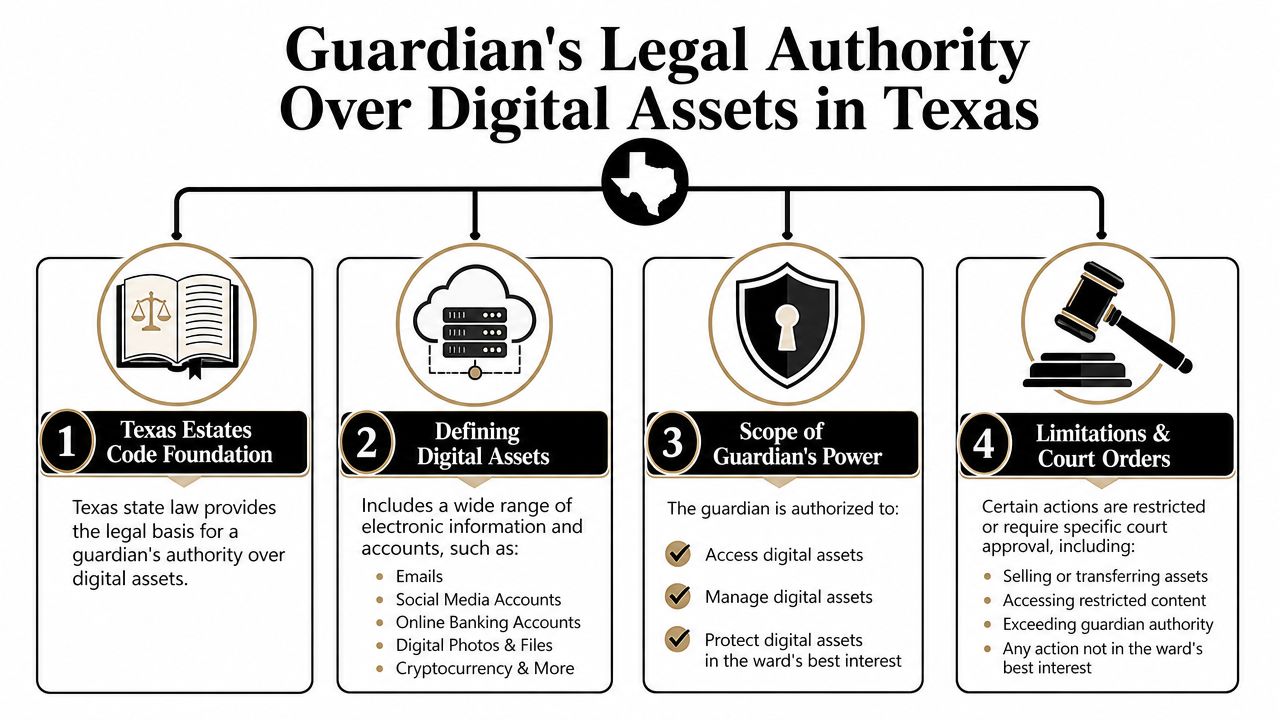
What counts as a digital asset
Families often think only of Facebook, Instagram, or email. In practice, digital assets can include:
- Communication accounts: email, text-linked accounts, messaging apps
- Financial access points: online banking portals, payment apps, investment dashboards
- Storage and records: cloud drives, photo libraries, scanned documents
- Platform accounts: social media, shopping accounts, subscription services
The Texas rule that changed the conversation
A major turning point came when Texas adopted the Revised Uniform Fiduciary Access to Digital Assets Act in 2017. Under that framework, digital accounts and content can be treated as assets with fiduciary access rules, but a guardian's access is not automatic. The court must authorize it, or the ward must have already granted authority in another valid legal instrument, and even then platform terms can still limit what happens in practice, as explained in this discussion of Texas digital guardianship law and RUFADAA.
That means a court may let a guardian seek access, manage certain online property, or request records, but the appointment itself doesn't instantly transfer control of every account.
Practical rule: If digital access matters, ask for it specifically. A vague guardianship order can leave families stuck when they contact a platform.
Where the Estates Code fits in real life
Texas courts focus on necessity, scope, and the least restrictive option. Judges want to know why the requested authority is needed and whether a narrower solution would protect the ward while preserving dignity and autonomy. That approach runs throughout Subtitle G.
A family in Dallas or a case in Harris County Probate Court may involve requests for authority to manage online statements, disable harmful account activity, or preserve communications tied to exploitation. The stronger applications explain the problem with detail. They don't just say “digital assets.” They identify the risk and the purpose.
How to Get Court-Ordered Control of Digital Accounts
The strongest guardianship cases don't ask for digital authority as an afterthought. They build it into the case from the beginning.
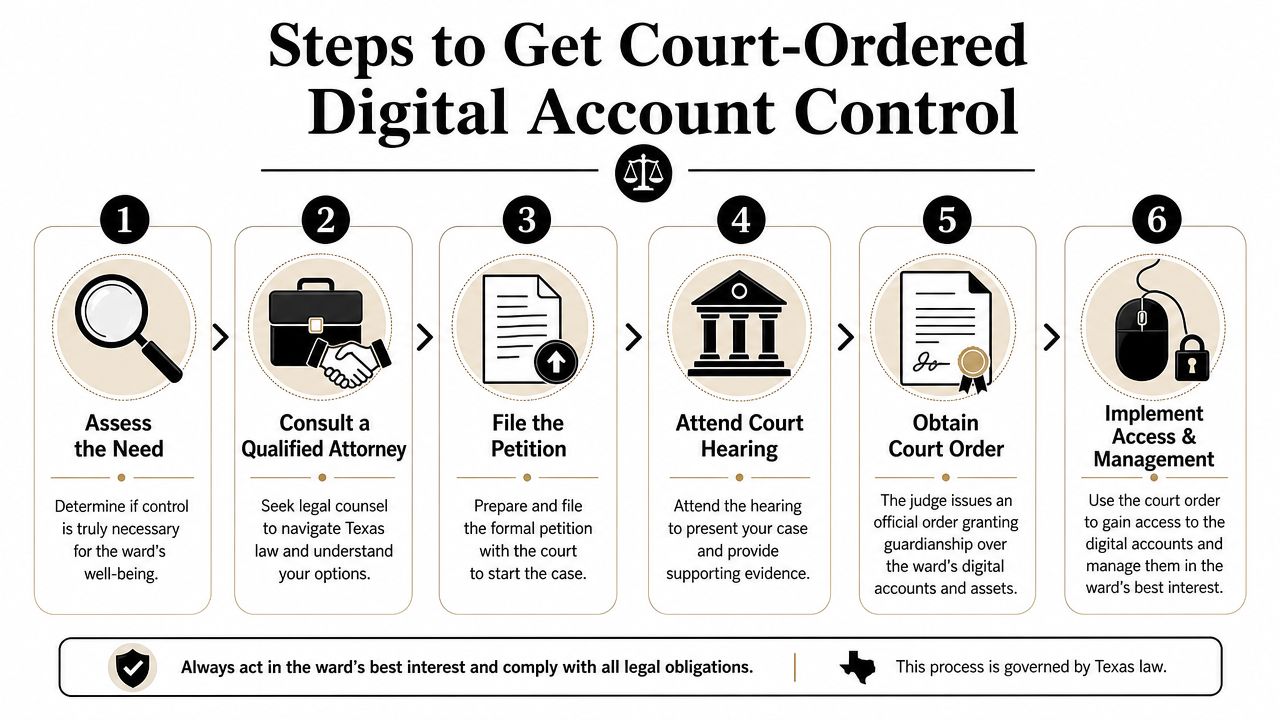
If you're trying to protect a loved one from online exploitation or get lawful access to critical accounts, the process usually looks like this.
Build the request into the guardianship application
Your filing should identify the digital problems with enough detail for the court to understand why relief is necessary. General language often isn't enough.
A useful application may describe:
- The person's incapacity and how it affects online judgment or account management.
- The immediate risks, such as scam contact, suspicious transfers, or inability to receive notices.
- The requested authority, such as managing email access, preserving online records, or communicating with service providers.
- Why narrower alternatives won't work, especially if the person can't sign new permissions or no valid power of attorney exists.
Families who are new to the process often benefit from reviewing the broader steps for getting guardianship in Texas, then adding a digital access strategy to the petition and proposed order.
Bring proof, not suspicion
Judges in Texas probate courts need evidence. If the concern is digital exploitation, bring screenshots, transaction records, preserved messages, notices from providers, and any pattern showing danger or incapacity.
That evidence may include:
- Medical support: a physician's evaluation or capacity evidence tied to the person's inability to manage online affairs
- Financial warning signs: suspicious transfers, repeated online purchases, or unusual payment app activity
- Platform evidence: threatening messages, fake account activity, or impersonation attempts
- Missed obligations: unpaid bills or lost access to essential records because everything is online
Courts respond better to concrete examples than to broad fear. “He sent money after receiving online messages” is stronger than “I'm worried about the internet.”
Ask for an order the platform can understand
The order should be specific enough that a company's legal team can process it. If the court grants authority, the wording matters. Platforms often want to see exactly what the guardian can do, what records can be requested, and whether the order covers account management, disclosure requests, or preservation of content.
In temporary or emergency situations, families may also need to consider whether a temporary guardianship is appropriate under the Estates Code when immediate harm is likely. That can matter if active scams, identity misuse, or rapid financial loss are happening online.
A short video can help ground the process before you file or prepare for hearing.
What happens after the hearing
If the judge signs the order, the work isn't over. The guardian may need to contact multiple companies, provide certified copies, complete platform-specific forms, and wait while legal or trust-and-safety departments review the request.
That's one reason families should prepare early. Court approval is essential, but implementation often takes time.
Real-World Reasons a Guardian Needs Digital Access
The legal framework makes more sense when you look at the problems families are trying to solve.

Stopping fraud and manipulation
A son may discover that his mother with dementia is answering messages from strangers who promise romance, prizes, or investment opportunities. A sister may find that her brother keeps sending gift cards after repeated contact through social media. In these cases, digital access isn't about curiosity. It's part of protection.
The concern is well-founded. The FTC reported that consumers lost more than $10 billion to fraud in 2023, which shows how often digital channels are used in exploitation and why families seek faster intervention tools through guardianship, as noted in this discussion of social media and guardianship concerns.
A guardian may need access to:
- Identify active scams: review recent contacts, suspicious requests, or account-linked alerts
- Reduce exposure: change settings, report impersonation, or ask a platform to restrict harmful access
- Preserve evidence: save messages and account records for use in court or law enforcement reports
Recovering essential records
Sometimes the problem isn't fraud. It's paralysis. A spouse becomes incapacitated, and every notice comes through email. Tax forms live in a cloud drive. Utility accounts are paperless. Insurance updates arrive only through app notifications.
In that setting, a guardian may need digital authority to protect the estate and keep life functioning. The account itself may not be valuable, but what it contains may be indispensable.
A common example looks like this:
| Situation | Why digital access matters |
|---|---|
| Bills and statements are paperless | The guardian may need to locate balances, due dates, and service providers |
| Family photos are stored online | The guardian may need to preserve content before an account is closed or compromised |
| Online records show suspicious activity | The guardian may need to document exploitation or identity misuse |
A digital account can be the doorway to the real asset. The value may be in the records, not the login itself.
Protecting minors and dependent users
Guardianship can also intersect with youth safety. A guardian for a minor may need to monitor online activity, respond to cyberbullying, or address harmful contact. But practical control often depends on the tools built into the platform rather than direct takeover.
Families dealing with hijacked or misused short-form video accounts sometimes also look for technical recovery help, such as services for TikTok recovery, while they sort out legal authority. That kind of help doesn't replace a court order, but it can be part of a broader response when an account is compromised.
What works and what doesn't
What usually works:
- Specific court authority
- Clear documentation of risk
- Fast preservation of evidence
- Narrow requests tied to protection
What often fails:
- Assuming family status is enough
- Trying to log in without authority
- Sending platforms vague court papers
- Treating all digital accounts the same
When a Court Order Is Not Enough Platform Limitations
Many families think the hard part is getting appointed. Sometimes the harder part starts after the judge signs the order.
A Texas court can authorize a guardian to seek access or management authority, but the platform still applies its own internal rules. In practice, control over a living person's account is often partial and platform-limited, not absolute. A fiduciary may be able to manage some digital assets, while the service provider restricts disclosure, and the user's own prior instructions can override broader access, as discussed in this overview of digital guardianship and online account limits in Texas.
The common point of frustration
Families often ask for three things:
- The login itself
- Private message content
- Authority to delete or change the account immediately
The provider may not grant all three. Some companies will respond to court papers by offering a narrower remedy, such as memorialization, limited account management, or a request for additional legal documentation. Others may divide “content” from “catalogue information,” which can affect what they disclose.
Why the answer is often limited
Online accounts usually operate under license terms and privacy rules. That means the user doesn't own the account in the same way they own a car or a bank balance. A guardian's legal authority matters, but it doesn't erase the platform's procedures.
This creates real trade-offs:
| Request | What may happen |
|---|---|
| Full takeover of a social media account | The platform may resist or require added review |
| Access to account records | The platform may ask for a specific order and identity documents |
| Deletion or closure | The platform may offer a process, but not full content disclosure |
A court order opens the door. It doesn't guarantee the company will hand over everything behind it.
The practical response
Families usually do best when they act in a disciplined way:
- Read the platform's fiduciary or deceased/incapacitated user policy
- Send certified orders and letters of guardianship
- Keep requests narrow and tied to safety or management
- Document every submission and response
That approach reduces delays and avoids the mistake of asking for more than the company is likely to produce.
Proactive Alternatives to Guardianship for Digital Assets
Not every family should wait for a crisis. In many cases, the better solution is planning ahead so a court-supervised guardianship may never be necessary.
A well-drafted Durable Power of Attorney can give an agent authority to handle financial and digital matters during incapacity, if the document is specific enough and properly executed. Estate planning documents can also include digital instructions, and some platforms offer built-in tools that let users name contacts or set inactivity preferences.
Comparing Digital Asset Management Tools
| Method | Court Involvement | Level of Control | When It's Used |
|---|---|---|---|
| Guardianship | Court supervision required | Can be significant, but limited by the order and platform rules | When incapacity exists and no lesser alternative works |
| Durable Power of Attorney | No guardianship court case if valid and accepted | Often useful for financial and digital management if authority is clearly written | When the person plans ahead while they have capacity |
| Platform-native tools | No court needed to set up | Usually narrow and account-specific | When a user wants to direct what happens inside a specific platform |
Why planning often works better
Guardianship is powerful, but it's also public, formal, and supervised. It can require hearings, medical evidence, reporting, and ongoing compliance with Texas court rules. In contrast, advance planning may allow a trusted agent to step in more smoothly.
That doesn't mean planning solves everything. Companies may still scrutinize documents, and some account content remains difficult to access. But planning usually gives families a better starting position than trying to untangle authority after a crisis begins.
For minor accounts, direct control may be even more limited than parents expect. On major platforms, supervision often runs through account-linked tools. Meta's Family Centre, for example, centralizes supervision and uses an invitation-and-acceptance process, which means a parent can't unilaterally seize control in supported age groups, as described in this article on Meta's supervision tools for teens.
A practical planning checklist
- Update core documents: Ask your estate planning attorney to address digital assets expressly.
- List key accounts: Keep a secure inventory of major platforms, subscriptions, and cloud storage.
- Use platform tools: Set legacy or emergency contacts where available.
- Review forms carefully: If you're looking at examples from outside Texas, such as 2026 WA Power of Attorney forms, treat them as formatting references only. Texas documents should be prepared under Texas law.
For families comparing options, this is often where probate, estate planning, and guardianship intersect. Each tool has a place. The right one depends on timing, capacity, and urgency.
Take the Next Step to Protect Your Loved One
Digital life has changed guardianship. Families now need answers about inboxes, payment apps, cloud records, social media, and online exploitation, not just bank accounts and real estate. The law can help, but only when the authority is requested clearly and used carefully.
The legal pressure is real. The growth of social-media data has made account control a major issue, and once a person becomes incapacitated, families often aren't legally allowed to access account content without proper authorization, which is why court-supervised control now comes up so often, as explained in EPIC's discussion of social media privacy and access concerns.
If you're weighing options, keep these points in mind:
- Guardianship can help, but the court should be asked for specific digital authority.
- Emergency situations need fast action, especially when scams or impersonation are active.
- Less restrictive alternatives matter, including powers of attorney and platform tools.
- Ongoing compliance matters too, because Texas guardians must follow reporting and fiduciary duties under the Estates Code.
Some families need a full guardianship case. Others need temporary relief, a contested hearing, or a review of whether an existing order is broad enough. Some need to explore alternatives before filing anything at all.
The Law Office of Bryan Fagan, PLLC handles guardianship, probate, and estate planning matters that overlap with these digital issues. If your loved one is at risk online, getting legal guidance early can prevent costly mistakes and protect important evidence.
If you're trying to protect a parent, spouse, child, or dependent adult from online scams, harmful messages, or loss of access to critical digital records, schedule a free consultation with Law Office of Bryan Fagan, PLLC. A Texas guardianship attorney can review your situation, explain the options under the Texas Estates Code, and help you pursue a plan that protects your loved one while respecting their rights and dignity.