Skip to content
Texas charges $223 for a new guardianship filing and $75 for later filings in the same case type. But the person who files doesn't automatically pay everything, because Texas law usually looks first to the ward's estate before shifting court costs elsewhere.
A lot of families hit this question at the courthouse door. Maybe you're in Harris County or Dallas County, holding paperwork for a parent, a child, or another loved one, and you're trying to figure out whether moving forward means taking on a bill you can't afford. The answer depends on the kind of case, the assets involved, and whether the court grants a waiver or finds another source of payment.
Understanding the Guardianship Cost Landscape in Texas
A daughter in Harris County Probate Court can walk in ready to protect her mother, then stop cold at the filing desk when she realizes the case has real costs attached. A son in Dallas can have the same reaction, especially if the family is already stretched thin from medical care, missed work, and travel. Guardianship is not just a legal filing, it's a court process with fees, service costs, and sometimes professional appointments that add up quickly.
Texas treats guardianship as a specialized docket, not an ordinary civil lawsuit. That matters because the fee structure is different, and the law recognizes that these cases often involve vulnerable people, limited assets, or urgent decisions about care and finances. The state's fee schedule reflects that difference by setting guardianship-related filings apart from standard civil filings in the courts covered by the schedule. Texas Courts' 2025 civil filing-fee schedule shows that distinction clearly.
Why the cost question matters early
Families often focus on whether guardianship is legally necessary, then only later ask who pays. That order is understandable, but it can create surprises. The better approach is to think about cost at the same time you think about capacity, medical evidence, notice, and the hearing.
Practical rule: if the ward has assets, the estate may be the first place the court looks for payment.
That's why the financial side of guardianship is tied to the legal side. The filing itself, the hearing process, and the court's later oversight can all affect who ultimately bears the cost. For a plain-English overview of the court process, families often find it helpful to review How to Get Guardianship in Texas: The Process, because the steps and the costs move together.
If you're comparing guardianship with other family-law-adjacent matters, it also helps to keep broader estate administration in mind. Guardianship can overlap with probate, asset management, and long-term planning, which is why the court's fee rules don't stand alone. They fit into a larger Texas Estates Code framework that decides what gets paid, from where, and in what order.
Texas Guardianship Filing Fees and What They Cover
A family can do the paperwork, get ready for the hearing, and still be surprised by the courthouse bill. Texas treats guardianship filings differently from ordinary civil cases, and the filing charge depends on the type of case and the kind of court handling it. The court fee schedule for 2025 shows a $223 county-level filing fee for a new probate, guardianship, or mental health case in county, statutory county, or statutory probate court, and a $75 fee for a later filing or action in those same case types. Ordinary civil cases carry lower filing charges, which is one reason guardianship costs tend to feel heavier from the start. The current schedule is set out in the Texas Court's 2025 civil filing-fee schedule.
That fee is only the opening line item. A guardianship case can start with the application, then continue through amended pleadings, notices, and other follow-up court activity. Each later filing may trigger the $75 subsequent-filing fee in the covered court types, so the cost often grows in the same way a stack of documents grows, one page at a time, not all at once.
Families often expect the filing fee to be the whole story. It rarely is. Court-generated charges, service-related expenses, and professional appointments can appear at different stages, depending on what the judge orders and how the case develops. A careful budget should account for those pieces before the hearing, because the courthouse bill is only one part of the total.
What the fee schedule tells families
The fee schedule does more than list prices. It shows that Texas places guardianship with probate and mental health matters, not ordinary civil disputes, because the court is dealing with a person's welfare or property under closer supervision. That difference matters. It explains why the filing charge is higher and why later actions in the case can also carry their own fee.
For families trying to organize receipts, account balances, and estate records, Texas accountants on HireAccountants can be a useful place to start when the financial paper trail gets complicated. That kind of help does not replace legal advice, but it can make the bookkeeping side easier to follow.
| Texas Guardianship and Probate Court Fees | New-Case Fee | Subsequent Filing Fee |
|---|---|---|
| Probate, guardianship, and mental health cases | $223 | $75 |
| Ordinary civil cases | $213 | $35 |
The fee structure also fits with the broader court-process picture described in the Texas guardianship cost guide, which helps families see how filing charges fit beside the rest of a guardianship case.
Plain-English takeaway: the first payment matters, but it is not the only cost a guardianship case may create.
How Texas Law Decides Who Pays Court Costs
Texas Estates Code Section 1155.151 uses a priority system for guardianship court costs. It does not say, “the person who files always pays.” Instead, it asks where the money is available and whether a waiver or exemption applies. That order matters, because even a small amount of ward property can change who bears the cost.
The payment order in plain language
First, the court looks to the guardianship estate. If the ward has assets, those assets are generally the first source for court costs. If a management trust exists and the court finds that using it serves the ward's best interest, the trust can be used next. Only when those sources can't cover the expense does responsibility move to the filing party, unless a valid Rule 145 affidavit of inability to pay changes the result. Under the statute, the county treasury becomes responsible only if the estate or trust can't cover the costs and the affidavit has been filed. The statute also gives fee protection to an attorney ad litem, a guardian ad litem, a filer who submits an affidavit of inability to pay under Rule 145, a nonprofit guardianship program, and certain governmental entities and agencies.
The legal logic is simple. Texas tries to tie payment to the source that benefits from the proceeding. If the ward has property, the ward's assets are usually the first place to look. If not, the law has fallback rules that can keep the burden from landing entirely on a family member who stepped forward to help.
| Statutory Priority Order for Paying Guardianship Court Costs | Source of Payment | Conditions |
|---|---|---|
| 1 | Guardianship estate | Used first when estate assets are available |
| 2 | Management trust | Used if the court finds it serves the ward's best interest |
| 3 | Filing party | Applies if the estate and trust can't cover costs and no valid waiver changes the result |
| 4 | County treasury | Applies if the estate and trust are unavailable or insufficient and a valid Rule 145 affidavit is filed |
This structure is especially important in contested cases, where cost questions can overlap with capacity disputes, service issues, and medical proof. For readers dealing with the examination side of a case, the court's medical-proof rules can affect timing and expense, and medical examination requirement guidance for guardianship in Texas is part of that bigger picture.
If you're trying to manage a guardianship with no clear family consensus, the cost issue can get tense fast. The law's priority order gives judges a framework, but it also gives families a way to plan before the hearing instead of arguing about money afterward.
When the Ward Has Assets and When They Do Not
When the ward has enough money, the court's cost question gets much easier. The Texas Health and Human Services adult guardianship guide says that legal fees may be reimbursed and court costs may be paid from the ward's estate when the ward has sufficient funds, which puts the financial burden where the assets are. That is usually the cleanest outcome for a family, because the guardian isn't left fronting every expense personally.
When the ward doesn't have enough money, the picture changes. The guardian may need to pay first, ask for low-cost or free help, or request payment from the court under the conditions allowed by law. That can feel unfair to families who are already stepping in out of necessity, but Texas law does not assume every petitioner has the ability to absorb the costs up front.
What families should gather before filing
A few records can make a big difference:
- Bank statements and account balances: These show whether there are liquid assets that might cover filing and court costs.
- Insurance and benefit information: This helps the court and counsel understand what money is available.
- Property records and title documents: Real estate may affect whether funds exist, even if cash is tight.
- Bills and care expenses: These help show why the family is asking for guardianship and whether the ward's money is already committed.
If the ward has assets, the legal question is often not whether costs will be paid, but when and from which account.
That is why families should gather financial records early, ask the court about reimbursement options, and talk with counsel before the hearing. A family working through managing ward assets in Texas should be especially careful to keep records clean, because reimbursement usually depends on documentation.

For families without a clear asset picture, the safest move is to treat the first hearing as a financial checkpoint, not just a legal one. The court may be deciding more than guardianship authority. It may also be deciding how the case gets paid.
Reducing Costs Through Fee Waivers and Exemptions
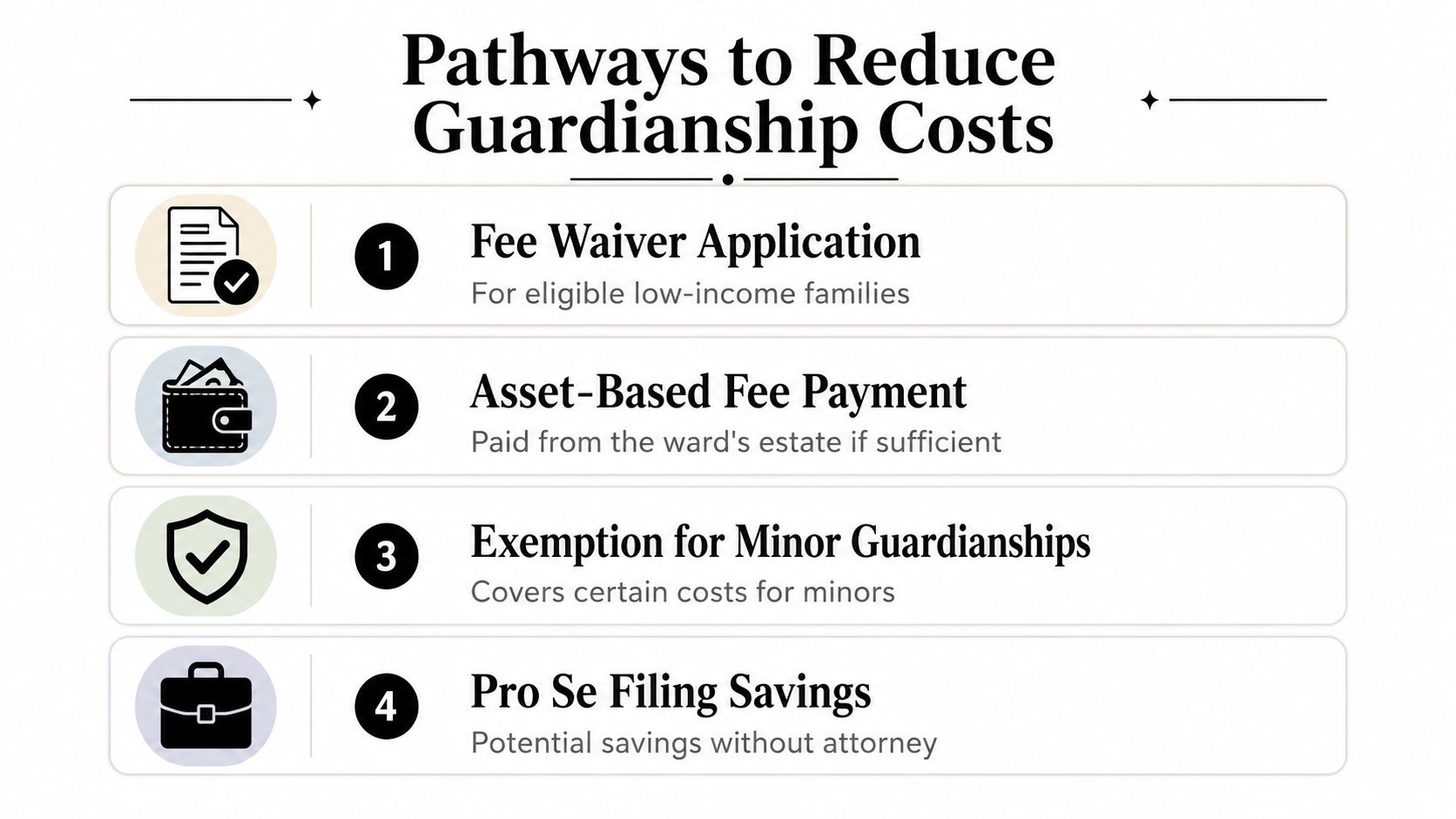
Texas law gives families a real path to lower guardianship costs when money is tight. If the court waives costs, that waiver can cover more than the initial filing fee. It can also cover fees for issuance and service of process and fees for a court-appointed professional, according to Texas Law Help's explanation of court fees and fee waivers. That matters because guardianship expenses often arrive in layers, not in one lump sum.
The main tool is the Rule 145 affidavit of inability to pay. A filer who qualifies can ask the court to waive certain costs instead of paying them up front. The affidavit is especially important when the ward has no liquid assets and the family is trying to keep the case moving without adding financial strain.
A practical path to ask for relief
- Review the ward's finances first. If there's money in the estate, the estate may still be the first source of payment.
- Ask whether waiver paperwork is needed. Rule 145 can change who pays if the family cannot afford the costs.
- List every charge you expect. Filing fees are only part of the picture, because service and professional fees can come into play.
- Bring records to the hearing. Clear paperwork makes it easier for the court to see why relief is needed.
The statute also protects certain participants from paying court costs at filing or during the proceeding, including attorneys ad litem, guardians ad litem, nonprofit guardianship programs, and certain governmental entities. Those exemptions can reduce friction in cases where the ward has little or no money.
For families that are comparing different ways to organize legal tasks and records, practical process tools can help reduce administrative waste. Articles like expert tips on healthcare efficiency may not be about guardianship itself, but they can give caregivers ideas about keeping paperwork and approvals organized.
When a waiver is available, it can keep a case from stalling because of one fee at the clerk's window. That can be a lifeline for relatives who are doing their best to protect someone else and can't afford to front every courthouse charge.
Real Scenarios Showing How Fees and Costs Play Out
A Tarrant County grandmother has been managing her adult son's daily needs after a stroke. She files the guardianship application and pays the $223 new-case fee because the court requires it to open the case. Later, when the case needs another filing, the $75 subsequent-filing fee applies again, because the matter is still active in the same court type.
The son has a small bank account, so the family keeps careful records and shows the court that the guardianship estate can cover the case costs. That means the filing fee and later court costs can be handled through the estate instead of coming out of the grandmother's pocket. If the son had no assets at all, the family might have needed to rely on a valid waiver request under Rule 145 or ask the court to consider another cost allocation allowed by law.
What changes from county to county
The state sets the base filing fees, but local courts can still vary in how they handle scheduling, payment methods, and waiver processing. A family in Harris County Probate Court may be asked for different paperwork timing than a family in a Dallas County court, even though the statutory fee structure stays the same. That's why two families can face the same law but have different practical experiences at the counter.
Local reality: the fee number may be statewide, but the courthouse process still runs on local rules and local staff procedures.
The same family may also see cost questions come up again if the case is contested. A dispute over capacity, the proposed guardian, or the medical evidence can lead to more filings and more court time. That is where planning matters, because each later filing can bring another cost decision.
A family with a coordinated team can reduce confusion by keeping payment records, asset records, and hearing documents in one place. If the court later approves reimbursement from the ward's estate, those records help show what was paid and why. That sort of organization is one reason guardianship cases often go more smoothly when the family prepares early.
Taking the Next Step with Confidence
Texas guardianship costs are easier to handle when you know the structure. The first filing in a covered guardianship case starts at $223, later filings are $75, and Texas law usually looks to the ward's estate first before making the filer personally responsible. Fee waivers, exemptions, and reimbursement rules can soften the financial hit when the ward has limited assets or the family qualifies for relief.
That's why the emotional side and the money side go together. Families are often making these decisions during a stressful time, while also trying to protect dignity, safety, and stability. A calm review of the finances can prevent a rushed filing from turning into a surprise bill.
If you're preparing for guardianship, it can also help to review related planning resources and background checks for volunteers or caregivers who may be involved in the ward's daily support. For families coordinating broader support networks, volunteer background checks can be part of a larger safety plan, especially when several adults are helping with care.
The Law Office of Bryan Fagan, PLLC works with Texas families on guardianship, probate, and estate planning questions like these, including the cost side of a filing, reimbursement from the ward's estate, and waiver issues that come up in court. If you're unsure how the fees, costs, and payment order apply to your situation, we can help you sort through it with clarity and care.
If you need guidance on Texas guardianship filing fees, court costs, and who pays them, the Law Office of Bryan Fagan, PLLC can help you understand your options and prepare for the courthouse with more confidence. Visit Law Office of Bryan Fagan, PLLC to schedule a free consultation and get personalized guidance for your county, your family, and your case.